
A lighter wheel isn’t automatically a better investment. Calculating the ROI of lightweight forged wheels for EVs means weighing potential energy savings against the purchase cost, while also considering changes in acceleration, steering response, and ride control. The upgrade makes sense when these practical benefits justify the cost for your driving needs.
It’s natural to focus on range, but wheel weight is only one part of the equation. Tire choice, wheel design, speed, and driving conditions also affect efficiency, so a lighter setup won’t necessarily deliver a specific range improvement.
This article explains how wheel weight influences an EV’s handling and energy use, and how to assess the trade-offs without treating range gains as the whole return. It also covers why fitment, load capacity, brake clearance, and the wheel-and-tire combination matter when choosing an upgrade. The goal is a clearer decision: understand what you may gain, what can limit those gains, and whether lightweight forged wheels align with your priorities.
Key Takeaways
- Assess wheel weight by its effects on both suspension response and rotational effort, not by the scale alone.
- Estimate potential efficiency benefits with the full wheel-and-tire setup in mind, including aerodynamics and driving conditions.
- Judge financial payback by comparing the upgrade’s upfront cost with the present value of energy savings over time.
- Prioritize vehicle-specific fitment, load capacity, and brake clearance so a lighter setup remains suitable for your EV.
Unsprung mass and rotational inertia
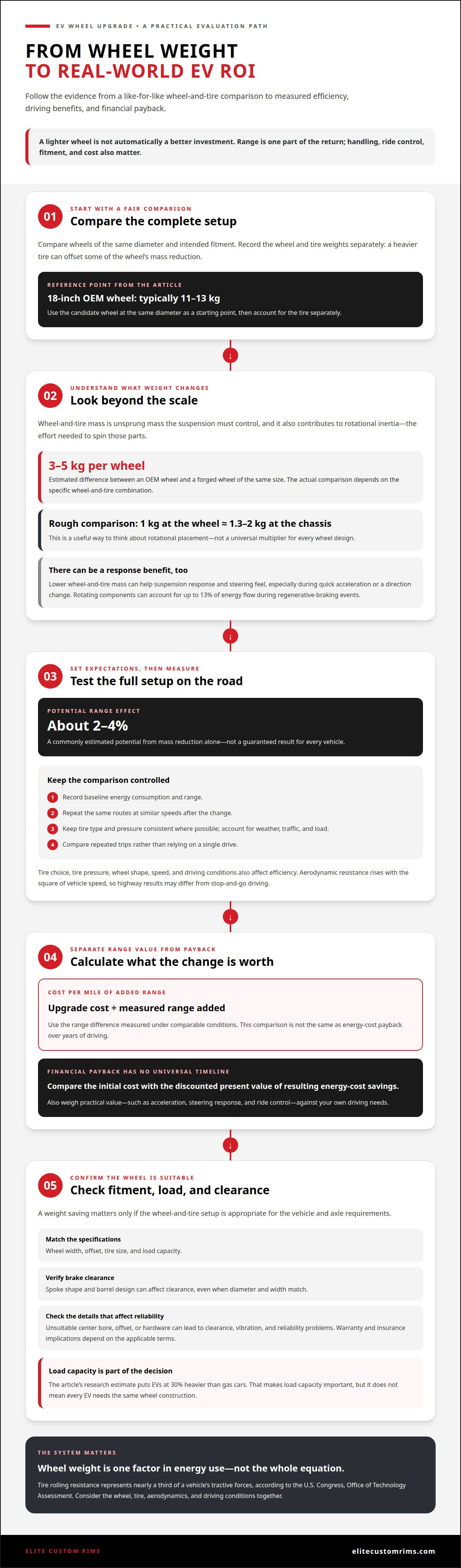
Wheel weight affects an EV through unsprung mass and rotational inertia. Unsprung mass is the weight the suspension must control, including the wheels and tires. Rotational inertia is the effort needed to spin those parts. A heavier wheel can demand more energy during acceleration and more suspension effort over road imperfections.
For wheels of the same size, the estimated difference between an OEM wheel and a forged wheel is 3 to 5 kilograms per wheel. The actual comparison depends on the specific wheel and tire combination. Forged wheels are made by compressing aluminum under high pressure, creating a dense material structure. Cast and flow-formed wheels use different manufacturing processes; the method alone does not establish their weight or strength. Compare the actual specifications for the same diameter and intended fitment.
Wheel placement makes mass especially relevant: the wheel rotates at the vehicle’s outer edge, while mass closer to the hub has less rotational effect. A rough estimate treats each kilogram added at the wheel as equivalent to 1.3 to 2 kilograms added to the chassis. This is a useful comparison, not a universal multiplier for every wheel design.
Reducing wheel-and-tire mass can help suspension response and steering feel. The change may be noticeable during quick acceleration or a direction change, because an EV’s torque reaches the wheels immediately. During regenerative braking, rotating inertia also matters: the motor slows the wheels while recovering energy, and rotating components can account for up to 13 percent of energy flow during regenerative braking events.
For fitment and load rating, match wheel width, offset, tire size, and load capacity to the vehicle and axle requirements. Check brake clearance, too: spoke shape and barrel design can affect it even when diameter and width match. Unsuitable center bore, offset, or hardware can lead to clearance, vibration, and reliability problems. Warranty and insurance implications depend on the applicable terms.
Payback has no universal timeline. According to the National Highway Traffic Safety Administration, assess it by comparing initial cost with the discounted present value of resulting energy-cost savings.
Potential effects on range and efficiency
Lower wheel weight can help efficiency, but it works alongside tire choice, wheel shape, speed, and driving conditions. Isolate the weight effect from other changes to estimate the range value more clearly.
Range Gains from Lower Wheel Weight
Reducing wheel weight means less mass to accelerate and control, which can support EV range. A commonly estimated potential is about 2 to 4 percent from mass reduction alone. That’s a useful starting point, not a promise for every vehicle. Tire weight, pressure, diameter, and driving conditions matter, too. Open-spoke aftermarket designs can also affect airflow, so lighter wheels don’t automatically improve highway efficiency.
Calculating Efficiency and Range Changes
Estimate an efficiency change by comparing energy use before and after the wheel-and-tire change under similar driving conditions. Record baseline energy consumption and range, then compare them with readings from the same routes and at similar speeds. Keep tire pressure and tire type consistent where possible. This helps distinguish wheel-weight effects from changes caused by weather, traffic, or a different tire design.
Regenerative braking recovers energy as the vehicle slows, but it doesn’t make rotational mass irrelevant. For a practical estimate, compare repeated trips rather than a single drive. Aerodynamic resistance rises with the square of vehicle speed, so highway results may differ from stop-and-go results. The U.S. Department of Energy notes that tire choice can measurably change vehicle efficiency, making the complete setup important.
Cost per Mile of Added Range
Cost per mile of added range is the wheel upgrade’s cost divided by the range added under comparable conditions. First, measure the range difference between the original and new setups. Then divide the upgrade cost by that measured gain. This gives a direct comparison, but it isn’t the same as energy-cost payback over years of driving.
For calculating the ROI of lightweight forged wheels for EVs, also compare energy use over your typical routes and charging pattern. A correct estimate separates measured range improvement from styling, handling, or braking value. Explore EV wheel options with the full tire-and-wheel setup in mind.
Research on vehicle mass and energy use
Mass matters, but an electric vehicle’s battery and body already contribute to its overall weight. The research estimate here puts EVs at 30% heavier than gas cars. That difference makes load capacity important when selecting wheels, but it doesn’t mean every EV needs the same wheel construction. Vehicle model, axle load, wheel size, and intended use shape the right comparison.
Tires also affect the energy needed to move a vehicle. According to the U.S. Congress, Office of Technology Assessment, tire rolling resistance represents nearly a third of a vehicle’s tractive forces and is directly proportional to the weight supported by the tire. That relationship explains why reducing wheel-and-tire mass can matter, while also showing why a wheel-only comparison misses part of the system.
Use a same-size comparison as a starting point. An 18-inch OEM wheel is described as typically weighing between 11 and 13 kilograms. Compare that with the candidate wheel at the same diameter, then account for the tire separately. A heavier tire can offset some of the wheel’s mass reduction. Keep tire type and size consistent when comparing setups.
For a useful energy-use comparison, record the vehicle’s baseline consumption and route conditions before changing wheels. Repeat the same route afterward, keeping speed, tire pressure, and load as similar as practical. These controls help separate wheel effects from weather, traffic, or added cargo. A battery’s energy use over a trip reflects the whole vehicle, not wheel mass alone.
Material density gives context, not a complete performance verdict. Typical 6061 aluminum density is about 2.70 g/cm³, while AZ80-class magnesium is about 1.8 g/cm³. A lower density may allow a lighter structure, but wheel design and required load capacity still matter. Include the complete wheel-and-tire weight, vehicle fitment, and offset in any comparison. That gives a more useful basis for judging energy use than material labels alone.
US cost of lightweight forged wheels for EVs?
There isn’t one useful price for every EV wheel setup. The total depends on the vehicle, wheel size, design, and fitment, so compare costs using the actual price for the intended configuration. A price for a different diameter or vehicle won’t provide a sound basis for your return calculation.
Start with the complete purchase amount, then separate the wheel expense from any other items shown in the transaction. Exclude the original wheels’ value unless you’re actually selling them. This gives you the upgrade’s true upfront cost, rather than a guessed market average or a figure based on a different package.
Next, estimate annual energy savings from your own driving. Multiply annual miles by the measured change in energy use per mile, then by your electricity rate. Compare the result with the upfront cost. If the new setup uses less energy on your regular routes, the difference contributes to payback. If energy use stays similar, the financial return comes mainly from the non-energy benefits you value.
For a fuller ROI estimate, compare the present value of expected energy savings with the initial outlay. The National Highway Traffic Safety Administration identifies this discounted-savings approach for evaluating efficiency upgrades. Use consistent units, such as dollars per year, and document your baseline consumption, route, and charging rate. A spreadsheet can keep the assumptions visible and make it easy to update the result when electricity rates or driving habits change.
Keep the calculation separate from the decision’s other benefits. More responsive handling or a different appearance may matter to you, but don’t count either as energy savings. When calculating the ROI of lightweight forged wheels for EVs, show the upfront amount, measured efficiency change, annual savings, and payback period as distinct figures.
Explore EV wheel options and compare the configuration with your vehicle and priorities.
Elite Custom Rims
Elite Custom Rims offers wheel options for drivers weighing fitment, design, and vehicle needs alongside potential efficiency gains. Its selections include Audi, Chevy, Mercedes, and Porsche wheels, as well as options across other makes. Use factors such as your vehicle model, wheel size, and intended use to narrow your search to relevant options.
Lower wheel weight is only one part of the value calculation. Compare the complete setup with your priorities, whether those are handling feel, appearance, or energy use. If you’re considering wheels for an EV, focus on vehicle-specific fitment and the practical trade-offs discussed above rather than assuming weight alone determines range or payback.
For help exploring wheel options for your vehicle, contact Elite Custom Rims.
Make the Next Wheel Choice Count
Turn your estimate into a decision that reflects how you actually use your EV. Decide which outcomes matter most, then keep financial return separate from priorities such as steering feel, appearance, or a more engaging drive. That distinction makes it easier to judge the upgrade on your terms, rather than expecting one wheel change to deliver every benefit.
As you narrow your options, treat vehicle compatibility as part of the value equation. A setup that suits your EV and driving needs is a stronger basis for comparison than a choice made on appearance or weight alone. Elite Custom Rims offers Audi Wheels, Chevy/GMC Wheels, and Mercedes Wheels among its selections.
Use your priorities to guide the next step, and refine your comparison around the vehicle you drive. For help exploring suitable wheel options, contact Elite Custom Rims today. A clear, vehicle-focused choice puts you in a better position to decide whether the benefits are worth pursuing.
Frequently Asked Questions
Are Forged Wheels a Good Choice for Electric Vehicles?
Yes, forged wheels can suit an electric vehicle when their fitment and load capacity match its requirements. Consider them if reducing wheel weight or changing the vehicle’s appearance matters to you. Before choosing, compare the wheel’s specifications with your vehicle’s model and intended use. A lightweight option isn’t a good match if its load rating or clearance doesn’t suit the vehicle.
Do Aftermarket Wheels Affect Gas Mileage or EV Range?
Yes, aftermarket wheels can affect fuel economy or EV range, but the result depends on the complete setup. Wheel shape influences airflow, while tire size and rolling resistance affect energy use. For example, a lighter wheel paired with a heavier or less efficient tire may not improve the overall result. Compare the full wheel-and-tire package, not just the wheel alone.
How do you keep efficiency when you upgrade wheels?
Keep the replacement setup close to the vehicle’s original diameter and choose tires designed for low rolling resistance. Maintain the tire pressure specified for the vehicle, since underinflation can increase energy use. To evaluate a change, compare energy consumption across similar routes and conditions. Avoid changing wheel size, tire type, and driving habits all at once, so the comparison remains useful.
How much does wheel weight change fuel economy?
For a typical car, reducing wheel weight generally improves fuel economy by a low-single-digit percentage, with the greatest benefit in stop-and-go driving. The actual effect depends on the vehicle and the replacement wheel-and-tire combination. For a fair comparison, use the same tire size and driving route where practical, and track fuel use across repeated trips instead of relying on one journey.