
Are you paying for the logo on the center cap or the structural integrity that keeps your vehicle on the road? It's a common dilemma for luxury owners facing the significant price gap in the forged vs cast wheels debate. You want your Porsche, Mercedes, or Tesla to look its best, but you don't want to overpay for a name. More importantly, you shouldn't have to worry about a cracked rim after hitting a standard city pothole.
We know that technical terms like "unsprung weight" can feel like unnecessary jargon designed to confuse you. You're looking for a balance of elite aesthetics and practical reliability without the guesswork. This guide masters the technical and practical differences between forged and cast manufacturing processes. We'll compare everything from the 10,000 tons of pressure used in forging to the cost-effective simplicity of casting. By the end, you'll know exactly which wheel type fits your driving style and how to make a high-end investment with total confidence.
Key Takeaways
- Understand the fundamental manufacturing divide between molten aluminum molds and high-pressure solid billets.
- Discover how reducing unsprung weight directly improves your vehicle's acceleration, braking response, and handling precision.
- Master the forged vs cast wheels debate by learning why forged options offer superior pothole resistance and structural integrity.
- Evaluate the upfront cost of premium wheels against their long-term resale value and performance efficiency.
- Identify the specific driving scenarios where each wheel type excels, from daily luxury commuting to high-performance track days.
Forged vs. Cast Wheels: Understanding the Manufacturing Divide
Your wheels are the only point of contact between your luxury vehicle and the asphalt. Choosing between forged vs cast wheels isn't just a matter of style; it's a decision about the structural foundation of your car. While both options might look identical from ten feet away, their DNA is fundamentally different. One is born from liquid metal poured into a mold. The other is hammered into existence under thousands of tons of pressure. This manufacturing divide dictates how your car handles every corner and survives every pothole.
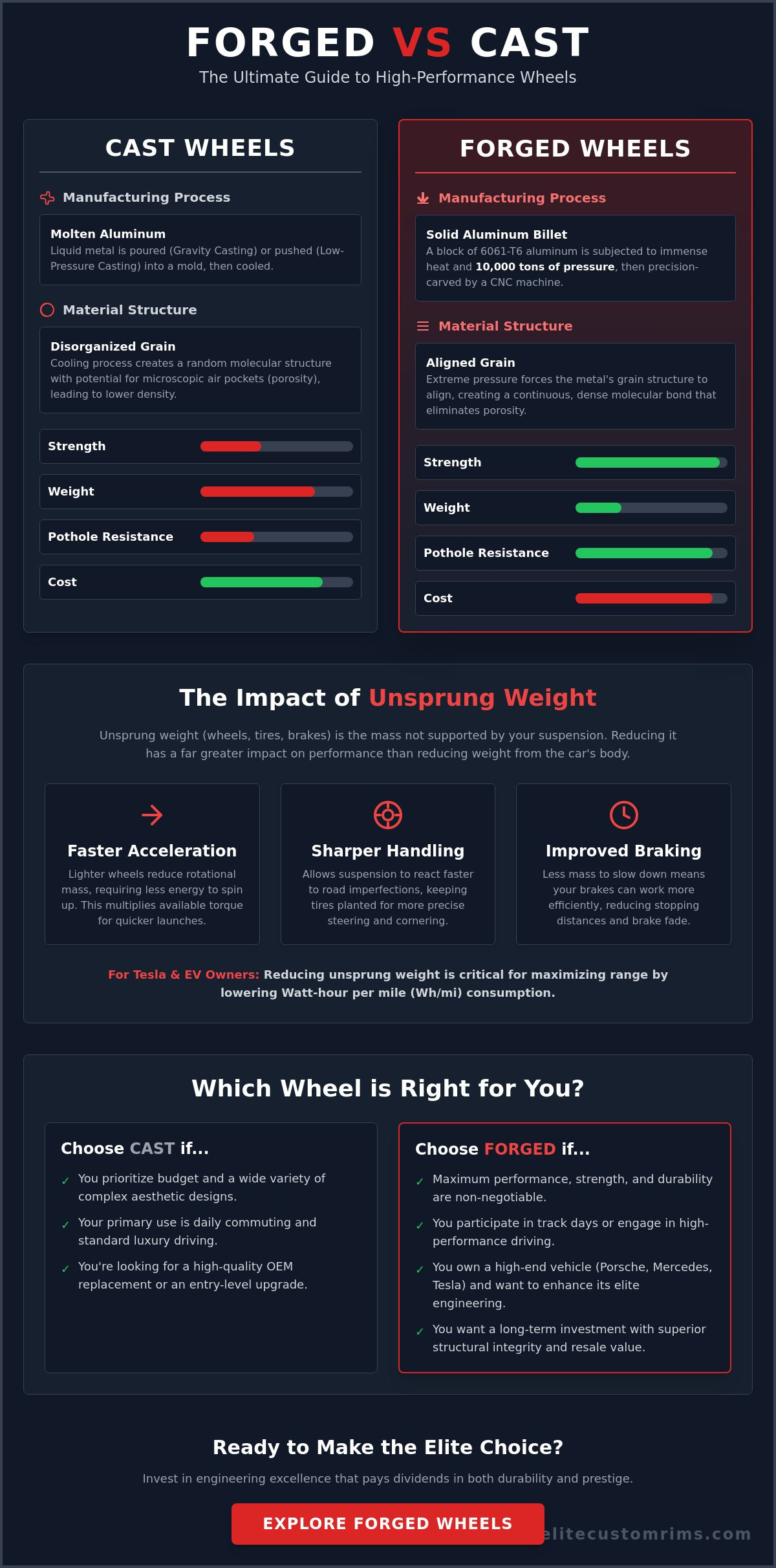
The core difference lies in the grain structure of the aluminum. In a cast wheel, the molecules are disorganized and random. This creates tiny, microscopic air pockets called porosity. Forging changes the game. By taking a solid billet of 6061-T6 aluminum and subjecting it to immense heat and pressure, engineers force the metal's grain to align. This creates a continuous, stronger molecular bond. It's the difference between a block of ice and a compressed sheet of steel. This structural integrity is why your choice of wheel is the ultimate baseline for performance and safety.
How Cast Wheels Are Made
Cast wheels are the industry standard for mass production because they're efficient and cost-effective. Manufacturers use two primary methods: gravity casting and low-pressure casting. Gravity casting is the most basic, where molten aluminum is simply poured into a mold. Low-pressure casting is a step up, using air pressure to push the metal into the mold more quickly. This reduces bubbles and increases density, though it's still not as dense as a forged product.
There are clear advantages to this process. Casting allows for incredibly intricate and complex spoke designs that would be difficult or expensive to machine from a solid block. It's the go-to choice for standard OEM wheels and entry-level aftermarket upgrades. If you're looking for a fresh look on a budget-conscious build, high-quality cast wheels provide the aesthetic variety you need without the premium price tag.
The Precision of the Forging Process
Forging is an elite manufacturing discipline. It starts with a 10,000-ton press that crushes the aluminum billet into a rough shape. This extreme pressure eliminates porosity entirely. There are no air pockets. No weak spots. Just pure, high-density metal. Once the "blank" is created, it moves to a CNC machine. Here, high-precision lathes carve the final design with surgical accuracy.
This process allows for much thinner spokes and lighter barrels without sacrificing any strength. It's why forged wheels are the undisputed choice for high-performance brands like Porsche and Mercedes. You get a wheel that's significantly lighter than its cast counterpart but capable of handling much higher load ratings. It's a premium investment in engineering excellence that pays dividends in both durability and prestige.
Performance Dynamics: Unsprung Weight and Handling
Performance isn't just about what's under the hood. It's about what's under the wheel well. When comparing forged vs cast wheels, the most immediate difference you'll feel is in the steering wheel. This is due to a concept called unsprung weight. In simple terms, unsprung weight includes components not supported by your vehicle's springs, such as your wheels, tires, and brake assemblies. Reducing this weight is far more effective than stripping weight from the interior because it allows your suspension to track the road with surgical precision.
Heavy wheels act like a pendulum. They resist changes in motion. When you hit a bump, a heavy cast wheel forces the shock absorber to work harder to control the bounce. This creates a harsher ride and slower recovery. Over time, this extra stress accelerates wear on your bushings and shocks. By switching to a lighter alternative, you're not just improving the ride; you're protecting your vehicle's long-term mechanical health and maintaining its factory-spec handling.
Acceleration and Braking Efficiency
Reducing rotational mass through lighter wheels effectively multiplies your available torque by decreasing the energy required to get the drivetrain spinning. Because forged wheels are significantly lighter than cast versions, they also require less effort to stop. This allows your braking system to dissipate heat more effectively during spirited driving. You'll notice a snappier, more immediate steering response that makes your vehicle feel smaller and more agile than it did on factory cast rims.
The Tesla Efficiency Connection
For electric vehicle owners, weight is the ultimate enemy of range. Every extra pound of rotational mass increases your Watt-hour per mile (Wh/mi) consumption. If you're looking at premium Tesla wheels, the choice becomes a matter of pure physics. A 22-inch cast wheel can be drastically heavier than a 22-inch forged counterpart. This weight penalty can shave miles off your total range on every single charge, effectively making your car less efficient.
Forged wheels help maintain the high-performance profile of the Model S and Model Y without the efficiency trade-off. They provide the structural strength needed to support heavy battery packs while remaining light enough to maximize battery life. Choosing forged isn't just an aesthetic upgrade for an EV; it's a strategic move to preserve the range you paid for. It ensures your Tesla remains as quick and efficient as the day it left the showroom.
Structural Integrity: Addressing the Durability Objection
Durability is where your investment truly pays for itself. When you analyze the forged vs cast wheels debate, the most critical distinction is how the metal reacts to failure. Cast aluminum is fundamentally brittle. Because the molecules are disorganized, the metal lacks the ability to absorb a sudden, violent impact. When you hit a deep pothole at highway speeds, a cast wheel often snaps. This results in a cracked rim that is impossible to repair safely. It becomes immediate scrap metal.
Forged wheels are malleable. The high-pressure manufacturing process aligns the grain structure, making the metal ductile and resilient. If you encounter that same pothole, a forged wheel is far more likely to bend than shatter. A bent lip can often be straightened by a professional technician, saving you from the cost of a full replacement. More importantly, a bend typically holds air long enough for you to pull over safely. A crack leads to an instant, dangerous blowout.
Consider the structural demands of heavy luxury vehicles. Owners of a Cadillac Escalade or GMC Sierra manage massive curb weights that put immense pressure on every square inch of the wheel. Standard cast options often struggle to meet the high load ratings required for these platforms. Forged construction provides the structural headroom needed for heavy-duty use. It ensures your wheels can handle the vertical load of a full-sized SUV and the lateral stress of towing without developing hairline fractures over time.
Fatigue Resistance Over Time
Every mile subjects your wheels to thousands of stress cycles. Cast metal is more susceptible to metal fatigue, meaning its structural integrity degrades faster than forged aluminum. This is a major concern for trucks used for towing or high-mileage luxury commuters. Don't let "OE-Style" marketing fool you. A wheel that mimics the look of factory equipment but uses inferior casting won't provide the same long-term security. Demand a wheel that maintains its strength for the life of the vehicle.
Safety in Extreme Conditions
Heat management is a hidden performance advantage. High-performance braking generates intense thermal energy that can soften inferior metals. Forged wheels dissipate this heat more efficiently, maintaining their shape during aggressive driving. Cheap cast wheels also suffer from porosity, creating microscopic holes that lead to frustrating, slow air leaks. This is exactly why high-performance brands like Audi rely on the superior strength of forged alloys for their RS models. They require a wheel that stays round, stays sealed, and stays safe under extreme pressure.
Economic Realities: Upfront Cost vs. Long-Term Value
Sticker shock is the most common hurdle in the forged vs cast wheels debate. In 2026, a standard set of cast wheels typically costs between $450 and $1,200. Premium forged wheels represent a different financial tier, with sets starting around $1,600 and reaching well over $10,000 for elite designs. This price gap exists because forging is a resource-intensive process. It requires massive industrial presses, expensive 6061-T6 aluminum billets, and hours of precision CNC machining. You aren't just paying for a brand name. You're paying for a manufacturing cycle that is three to five times more expensive to execute than traditional casting.
Smart investors look beyond the initial invoice. Forged wheels offer a tangible return on investment through durability and efficiency. Because they're less likely to crack during a pothole impact, you avoid the recurring cost of replacing "disposable" cast rims. Additionally, the weight savings we discussed earlier translate into reduced wear on your tires and suspension components. Over the life of a vehicle, these hidden savings can offset a significant portion of the upfront premium. You're choosing to invest in quality once rather than paying for mediocrity repeatedly.
Is the Investment Justified?
Analyze your cost per mile. For a daily driver, the reliability of a forged wheel provides peace of mind that cast alternatives can't match. Forged wheels are also a primary "value-add" modification. When it's time to sell your vehicle, a set of high-end monoblocks acts as an asset rather than a sunk cost. They signal to the next buyer that the car was maintained to a professional standard. This psychological benefit is backed by the confidence of knowing your vehicle's most critical contact point is structurally over-engineered for safety.
Resale and Brand Prestige
Equity matters in the luxury market. Premium forged wheels enhance the curb appeal and market price of high-end marques like Porsche or Rolls Royce. While cast wheels lose most of their value the moment they're mounted, forged sets from reputable manufacturers hold their equity remarkably well on the secondary market. It's the "buy once, cry once" philosophy. You make the right choice today so you don't have to fix the wrong choice tomorrow. If you're ready to upgrade your vehicle's stance and performance, explore our curated selection of elite wheels to find the perfect match for your build.
Making the Elite Choice for Your Performance Vehicle
Deciding between forged vs cast wheels ultimately depends on your vehicle's mission and your long-term performance goals. There is no one-size-fits-all answer. A show car that rarely leaves the garage has different requirements than a daily-driven Tesla or a heavy-duty GMC Sierra used for towing. By understanding your specific driving profile, you can avoid overspending on features you don't need or, conversely, compromising the safety of a high-performance machine with inferior equipment.
Cast wheels are a practical choice for budget-conscious builds or dedicated winter setups where salt and road grime are a constant threat. They offer a massive variety of aesthetic styles at a lower entry price. However, if your priority is high-performance driving, heavy-duty utility, or maximizing electric vehicle range, forged construction is the undisputed standard. For those seeking a middle ground, flow-formed wheels offer a hybrid manufacturing process. This technique uses hydraulic rollers to stretch the barrel of a cast wheel, increasing its strength and reducing weight for a price point typically between $1,000 and $2,000 per set.
Before you finalize your purchase, run through this final checklist:
- Weight: Does this wheel reduce unsprung mass to improve my car's agility?
- Strength: Is the load rating sufficient for my vehicle's curb weight and cargo?
- Style: Does the design complement the lines of my Porsche, Mercedes, or Audi?
- Budget: Am I accounting for the total cost of ownership, including resale value?
Brand-Specific Recommendations
For Tesla Model 3 and Model Y owners, we recommend prioritizing lightweight forged options to preserve every mile of battery range. Mercedes and BMW drivers should look for forged monoblocks that match the sophisticated suspension engineering of these German platforms. If you're outfitting GMC or Chevy trucks, focus on high load ratings. Heavy SUVs like the Cadillac Escalade require the structural headroom that only high-pressure forging can provide for long-term reliability.
The Elite Custom Rims Advantage
We take the guesswork out of the equation by curating a selection that meets strict technical standards for fitment and finish. Our team acts as an authoritative specialist, ensuring that every wheel we offer is a smart investment for your specific luxury brand. We're dedicated to helping you find a setup that balances trendy aesthetics with no-nonsense results. Don't settle for a generic fitment when you can have a tailored solution. Browse our curated collection of forged and cast wheels today and transform your vehicle with total confidence.
Command the Road With Confidence
The choice between forged vs cast wheels is the most impactful modification you can make for your vehicle's performance and longevity. You now understand the structural advantages of aligned grain structures and the performance boost that comes from shedding unsprung weight. Whether you prioritize the budget-friendly versatility of cast designs or the elite strength of a forged monoblock, your decision should align with your driving goals. Every corner you take and every mile you drive will reflect the quality of the engineering beneath you.
We're here to help you execute that vision perfectly. We offer precision fitment guaranteed for Tesla, Mercedes, and Porsche, supported by expert technical advice to eliminate the guesswork from your purchase. Plus, we provide national shipping on all new premium wheel sets to get you on the road faster. Upgrade Your Ride: Shop Elite Forged and Cast Wheels Now. It's time to give your vehicle the elite stance it deserves.
Expert Answers to Common Wheel Questions
Are forged wheels really worth the investment for a daily driver?
Yes, because they offer a superior safety margin and long-term durability for everyday road hazards. While the initial cost is higher, you'll save money by avoiding the frequent replacements required for cracked cast rims. Forged wheels also hold their resale value much better than cast alternatives. It's a strategic investment in your vehicle's safety and financial equity.
Can you tell the difference between forged and cast wheels by looking at them?
You can often identify forged wheels by their incredibly sharp, crisp edges and thinner spoke profiles. Casting requires thicker structures to maintain strength, while forging allows for delicate, lightweight designs. Look for precision CNC machining marks on the inner barrel. These details provide an elite, high-end aesthetic that mass-produced cast wheels simply can't replicate.
Do forged wheels improve fuel economy or EV range?
Yes, reducing rotational mass directly lowers the energy required to move your vehicle. This is a critical factor in the forged vs cast wheels debate for Tesla and hybrid owners. Lighter wheels improve your Watt-hour per mile efficiency, effectively extending your range on every charge. It's one of the few modifications that pays you back at the charging station.
What happens if I hit a pothole with cast wheels vs. forged wheels?
A cast wheel will likely crack or shatter upon heavy impact because of its brittle molecular structure. This leads to an immediate loss of air pressure and an unrepairable wheel. A forged wheel is designed to bend rather than break. This often allows you to maintain enough tire pressure to reach safety. A professional can often repair a bend, saving you the cost of a full replacement.
Why do most car manufacturers use cast wheels from the factory?
Manufacturers prioritize cost efficiency and high-volume production for the general market. Casting is a fast, inexpensive process that meets basic safety standards for standard commuting. Forged wheels are typically reserved for flagship performance models or luxury trims where weight and strength are non-negotiable. Most owners upgrade to forged wheels to unlock the performance their factory setup left on the table.
Are flow-formed wheels the same as forged wheels?
No, flow-formed wheels are a hybrid that sits between the two categories. They start as a cast piece, and then the barrel is heated and stretched using high-pressure rollers. This makes the barrel stronger and lighter than a standard cast wheel. However, they don't offer the total molecular density of a fully forged billet. They're a great middle-ground for enthusiasts on a tighter budget.
How much weight can I save by switching to forged wheels?
You'll typically save between 5 and 10 pounds per wheel depending on your current setup. This sounds small, but it's a massive reduction in unsprung weight. Removing 30 pounds of rotational mass can feel like removing 100 pounds from the cabin. You'll notice faster acceleration, shorter braking distances, and a much more responsive steering feel immediately after the swap.
Do forged wheels require special maintenance or cleaning?
No, they require the same basic care as any premium automotive component. Stick to pH-neutral wheel cleaners and soft microfiber brushes to protect the finish. Avoid harsh acid-based chemicals that can strip the clear coat over time. Regular cleaning ensures your forged vs cast wheels maintain their showroom shine and structural integrity for the life of your vehicle.