
Your luxury SUV's performance is being held hostage by a manufacturing process designed for mass-market economy cars. It's a frustrating reality for many drivers. You've likely spent hours weighing the pros and cons of forged vs cast wheels, only to be met with confusing technical jargon about unsprung weight and grain structures. You want the high-end aesthetic, but you don't want the anxiety of a single pothole cracking your investment. We understand that concern. You deserve a wheel that matches the precision engineering of your Mercedes, Porsche, or Tesla.
This professional comparison cuts through the marketing noise to give you the facts. You'll master the technical differences between these manufacturing methods and discover which one actually fits your driving style. We'll explore why forged options offer a 25 to 30 percent weight advantage and how that translates to sharper handling on the road. This guide breaks down the structural integrity and real-world durability of each type to ensure your next purchase is a smart investment. Stop guessing and start driving with confidence.
Key Takeaways
- Master the technical distinction between molten casting and high-pressure forging to identify true structural quality.
- See how cutting unsprung weight transforms your vehicle’s handling, braking response, and overall suspension efficiency.
- Resolve the forged vs cast wheels debate by understanding which manufacturing style prevents catastrophic cracking during sudden impacts.
- Analyze the real-world cost of ownership, from the initial premium investment to the superior resale value of elite monoblock designs.
- Get a clear roadmap for choosing the right wheel type based on your specific vehicle and driving goals, whether you prioritize budget or peak performance.
Forged vs. Cast Wheels: Understanding the Manufacturing Divide
Choosing the right wheels for your Audi or Porsche isn't just about the finish. It's about how the metal itself was born. The debate over forged vs cast wheels begins with a fundamental choice: do you want a product poured into a shape or one forced into it? This decision dictates everything from your car's acceleration to its ability to survive a highway pothole. Understanding alloy wheel manufacturing methods is the first step toward a smarter investment in your vehicle's performance.
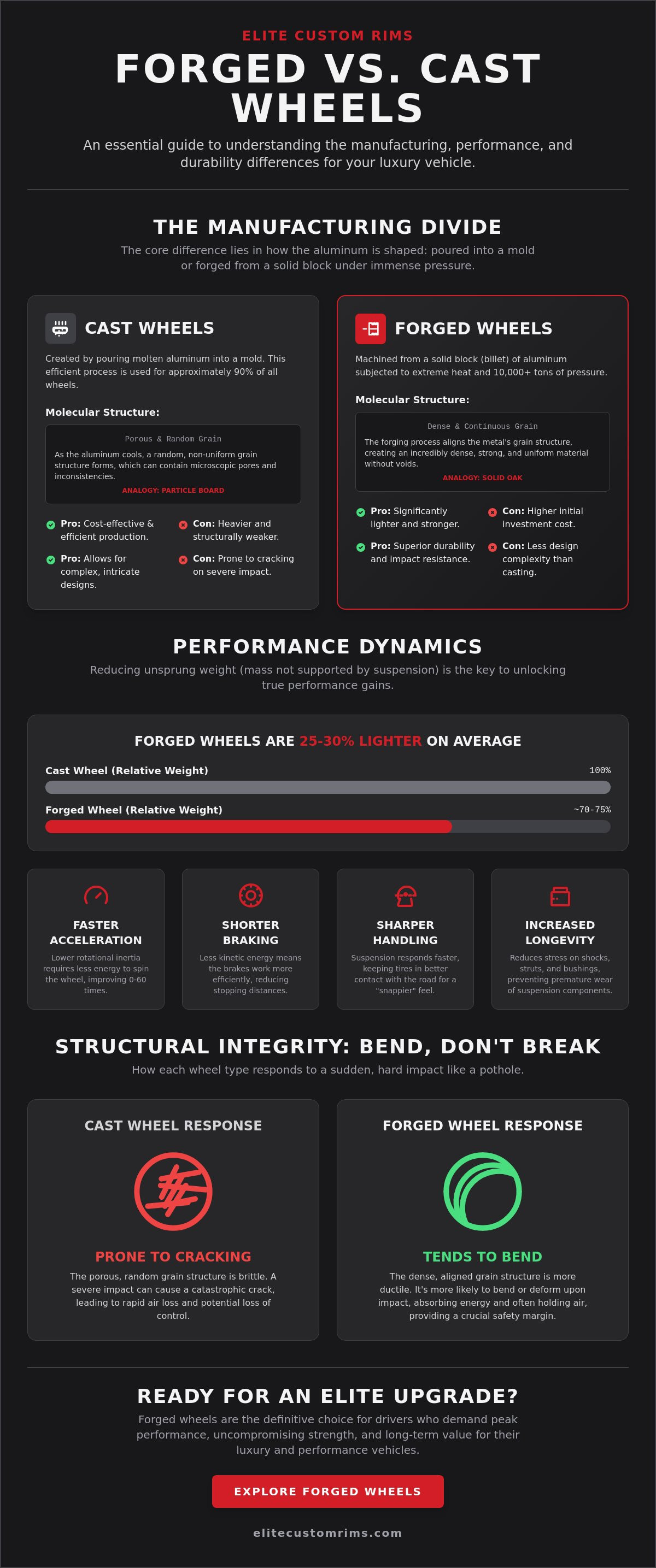
Cast wheels are created by pouring molten aluminum into a pre-made mold. It's an efficient, fast process that dominates about 90 percent of the original equipment market. Forged wheels, however, start as a solid block of high-grade aluminum. This solid billet is subjected to extreme heat and immense pressure to create the wheel's core shape. It's a labor-intensive process, but the results are unmistakable on the road.
The real magic happens at the molecular level. Forging creates a continuous grain structure that follows the contour of the wheel. This makes the metal significantly denser and stronger. In contrast, cast aluminum has a random, porous grain structure. Think of it as the difference between a solid piece of oak and a block of particle board. One is built for structural integrity; the other is built for ease of production. This molecular bond is the foundation of your safety at high speeds.
How Cast Wheels Are Made
Most entry-level aftermarket wheels use gravity casting. It's the simplest method, letting the molten metal fill the mold by weight alone. Low-pressure casting is a step up, using air pressure to push the metal in faster. This reduces air pockets and creates a denser wheel than gravity alone. Designers love casting because it allows for intricate, complex spoke patterns that are difficult to machine. It's the practical choice for winter setups or daily drivers where aesthetics and budget are the primary goals.
The Precision of the Forging Process
True performance wheels require more than just a mold. They require a 10,000-ton press. This massive force crushes any internal voids in the aluminum, ensuring the metal is perfectly uniform and incredibly strong. Once the rough blank is forged, it goes to a CNC machine. Here, high-precision tools carve out the final design with surgical accuracy. This process is why forged wheels are the elite choice for high-end brands like Mercedes, Rolls Royce, and Tesla. You get a wheel that's lighter, stronger, and perfectly balanced for high-speed stability.
Performance Dynamics: Unsprung Weight and Handling
Your vehicle's performance isn't just about horsepower. It's about how effectively that power reaches the pavement. When comparing forged vs cast wheels, the most significant performance metric is unsprung weight. This refers to any component not supported by the vehicle's springs, including the wheels, tires, and braking system. Reducing this weight is the single most effective way to sharpen your car's reflexes.
Heavy wheels create a massive amount of kinetic energy when they spin. This is known as rotational inertia. Think of it like trying to stop a spinning bowling ball versus a tennis ball. A lighter forged wheel requires less energy to start moving and less energy to stop. This translates directly to faster 0-60 times and significantly shorter braking distances. Because the suspension doesn't have to fight the momentum of a heavy cast rim, your tires stay in more consistent contact with the road. This improved contact patch results in the "snappier" steering response that performance drivers crave.
Beyond speed, there's the issue of longevity. Heavy cast wheels put immense stress on your shocks, struts, and bushings. Every time you hit a bump, that extra mass hammers into your suspension components. Over time, this leads to premature wear and a degraded ride quality. Transitioning to a lightweight setup is a proactive way to protect your investment in your vehicle's chassis. If you're ready to feel the difference on the road, you can explore performance-engineered wheels designed for your specific model.
Acceleration and Braking Efficiency
Rotational mass acts as a multiplier of weight; every pound saved at the wheel provides a disproportionate boost to your vehicle's agility and stopping power. By reducing the load on the braking system, lighter wheels allow for better heat dissipation. This prevents brake fade during spirited driving or heavy towing. You'll notice an immediate improvement in how the car "sets" itself into a corner, providing a level of professional assurance that heavy cast options simply can't match.
The Tesla Efficiency Connection
For EV owners, weight is the ultimate enemy of range. In the world of electric vehicles, efficiency is measured in Watt-hours per mile (Wh/mi). A set of 22-inch cast wheels can be significantly heavier than their forged counterparts, often by as much as 10 pounds per corner. This extra 40 pounds of rotational mass can noticeably decrease your total range on a single charge. By choosing forged wheels, Model S and Model Y owners can maintain their vehicle's sleek aesthetic without sacrificing the battery efficiency that makes a Tesla world-class. It's a smart financial move that pays off in both performance and range.
Structural Integrity: Addressing the Durability Objection
The metallurgical reality of forged vs cast wheels often reveals itself at the worst possible moment: a deep pothole at highway speeds. This is where the debate moves from performance metrics to pure safety. Cast aluminum is inherently brittle. When a cast wheel hit a sharp edge, the porous molecular structure can't absorb the energy. It cracks or shatters. Forged aluminum, however, is malleable. Because the metal was compressed under thousands of tons of pressure, it's far denser and more resilient. A forged wheel will typically bend rather than break, which can be the difference between a controlled stop and a catastrophic blowout.
For owners of heavy vehicles like the Cadillac Escalade or GMC Sierra, structural integrity isn't optional. These platforms carry immense weight, especially when loaded with passengers or towing a trailer. A standard cast wheel might look the part, but it often lacks the load rating required for long-term heavy duty use. High-strength forged options provide the professional assurance that your wheels won't fatigue under the constant pressure of a 6,000-pound SUV. Choosing the right manufacturing process ensures your vehicle remains a reliable tool for both luxury and utility.
Fatigue Resistance Over Time
Metal fatigue is a silent killer of wheel performance. Every rotation of your wheel creates a stress cycle. Over thousands of miles, these cycles cause microscopic fractures in cast metal to grow. Forged wheels offer superior fatigue resistance because their grain structure is continuous and uninterrupted. Don't be fooled by "OE-Style" aftermarket wheels that mimic the look of premium brands. Unless they match the forging quality of the original, they won't provide the same structural lifespan or safety margin.
Safety in Extreme Conditions
Heat management is a critical factor for performance enthusiasts. Under heavy braking, your rotors can reach temperatures that radiate directly into the wheel hub. Forged aluminum dissipates this heat more efficiently than cast alternatives, protecting your tires from heat-related pressure spikes. Cheap cast wheels also suffer from porosity, which are tiny air bubbles trapped in the metal. These can lead to frustrating slow air leaks that are impossible to patch. It's why high-end brands like Audi rely on the unyielding strength of forged materials for their RS and S-line models. You deserve the same level of protection for your daily drive.
Economic Realities: Upfront Cost vs. Long-Term Value
The sticker shock of premium wheels is a real hurdle for many enthusiasts. There is no way around it: the price gap in the forged vs cast wheels market is significant. You can expect to pay three to five times more for a forged setup. This isn't a "brand name" markup. It's a direct reflection of the intensive energy, massive machinery, and precision CNC labor required to produce a single monoblock. While cast wheels offer an accessible entry point, they often carry hidden costs that only appear after you've left the showroom.
Think about the replacement cycle. If you live in an area with neglected roads, a brittle cast wheel is a ticking financial clock. One sharp impact can crack the rim, rendering it useless junk. Because forged wheels are malleable, they can often be professionally straightened if they bend, saving you the cost of a full replacement. There's also a hidden ROI in your fuel and tire budget. Reducing rotational mass means your engine or battery doesn't work as hard. Over years of ownership, those small gains in efficiency and reduced suspension wear add up to real savings.
Is the Investment Justified?
Smart owners look at the "cost per mile" rather than just the checkout total. For a daily driver, the durability of a forged setup provides a level of professional assurance that pays for itself in peace of mind. You won't spend your commute scanning the asphalt for wheel-killing hazards. Beyond the drive, forged wheels are one of the few modifications that actually increase a vehicle's resale value. They aren't just parts; they're assets that signal to the next buyer that the car was maintained with no expense spared.
Resale and Brand Prestige
In the high-end market, wheels are a primary indicator of a vehicle's pedigree. Premium forged wheels significantly enhance the curb appeal and market price of a used Porsche or Rolls Royce. Buyers in these segments recognize quality. They'll pay a premium for a car already equipped with high-end monoblocks. It's the "buy once, cry once" philosophy in action. Investing in elite quality today prevents the frustration of settling for mediocrity tomorrow. If you're ready to make a smart investment in your car's future, you can upgrade your vehicle’s equity with our curated collection.
Making the Elite Choice for Your Performance Vehicle
Your vehicle deserves better than a guess. Deciding between forged vs cast wheels comes down to your specific driving environment and long-term goals. While the technical differences are clear, the right choice depends on how you use your machine. Cast wheels remain a practical solution for budget-conscious builds, winter setups where road salt is a concern, or low-mileage show cars where aesthetics outweigh weight savings. They provide a cost-effective way to refresh your look without the premium investment.
Forged wheels are the non-negotiable choice for those who demand peak performance. If you're tracking your car, towing heavy loads with a GMC Sierra, or trying to squeeze every possible mile out of your Tesla's battery, forging is the only way to go. You get the highest strength-to-weight ratio available in the industry. For those seeking a middle ground, flow-formed wheels offer a hybrid manufacturing process. By using hydraulic rollers to stretch the barrel of a cast wheel, manufacturers create a rim that is lighter and stronger than a standard cast but more affordable than a full monoblock.
Before you commit, use this final checklist to guide your purchase:
- Weight: Does your vehicle require reduced rotational mass for performance or range?
- Strength: Will you be driving on poorly maintained roads or carrying heavy loads?
- Style: Does your desired design require the intricate CNC precision of a forged blank?
- Budget: Are you looking for an immediate aesthetic upgrade or a long-term equity asset?
Brand-Specific Recommendations
Tesla Model 3 and Model Y owners should prioritize lightweight forged options. Every pound saved helps combat the range-killing effects of larger wheel diameters. For Mercedes and BMW owners, we recommend matching your vehicle's sophisticated suspension with forged monoblocks to maintain that factory-engineered ride quality. If you're driving a GMC or Chevy truck, focus on load ratings. Ensure your wheels are specifically rated for the gross vehicle weight of a modern heavy-duty pickup.
The Elite Custom Rims Advantage
We take the guesswork out of the equation. Our team curates a selection of wheels specifically for luxury brands to ensure perfect fitment and technical accuracy. We understand that your vehicle is an investment in both style and performance. We're here to provide the professional support you need to choose with confidence. Ready to transform your drive? Browse our curated collection of forged and cast wheels today and find the perfect match for your vehicle.
Take the Lead with Professional Performance
Your vehicle is a masterpiece of engineering; it deserves a wheel setup that enhances every mile. Throughout this guide, we've explored how the forged vs cast wheels debate impacts your car's safety, handling, and long-term resale value. You now understand that while casting offers accessibility, forging provides the structural integrity and weight savings required for peak performance. Whether you're looking to maximize your Tesla's range or ensure the load rating for your Cadillac Escalade, the right choice transforms your driving experience from ordinary to elite. If you are ready to see how these engineering marvels perform on the open road, you can discover Supercar Holidays for an exclusive luxury driving experience.
Don't let technical uncertainty hold you back. We provide expert support to eliminate the guesswork and ensure a precision fitment guaranteed for your Tesla, Mercedes, or Porsche. With national shipping on all new premium wheel sets, your upgrade is just a few clicks away. Our team is dedicated to helping you select the perfect finish and manufacturing style for your specific needs. Take the next step toward a more responsive and stylish ride today.
While upgrading your wheels is a major step in refining your vehicle's performance, you might also consider professional electronic enhancements from PFM Performance Auto Group to ensure your car's interior technology matches its new exterior capabilities.
Upgrade Your Ride: Shop Elite Forged and Cast Wheels Now
Invest in quality that lasts. Your vehicle's transformation starts with a single smart decision, and we're ready to help you make it.
Frequently Asked Questions
Are forged wheels really worth the extra money for a daily driver?
Forged wheels are a smart investment for daily drivers because they offer superior protection against unpredictable road hazards. While the initial cost is higher, the durability and resistance to cracking provide a level of professional assurance that cast options can't match. You're paying for a wheel that is more likely to survive a pothole and maintain its resale value over time. In the long run, the debate of forged vs cast wheels favors the driver who values reliability and long-term equity.
Can you tell the difference between forged and cast wheels just by looking at them?
You can often spot the difference by examining the sharpness of the design and the thickness of the spokes. Forged wheels utilize precision CNC machining to carve out thin, aggressive profiles that are physically impossible to create with a mold. Cast wheels generally feature thicker spokes and softer, rounded edges to compensate for the lower density of the metal. If the design looks surgical and incredibly lightweight, it's likely a forged monoblock.
Do forged wheels improve fuel economy or EV range?
Reducing rotational mass with forged wheels directly translates to better fuel economy and increased EV range. This is a critical factor for Tesla owners who want to maximize their battery efficiency without sacrificing a large-diameter aesthetic. Lighter wheels require less energy to start and stop, which reduces the load on your powertrain. It's a functional upgrade that pays dividends at the charging station or the fuel pump.
What happens if I hit a pothole with cast wheels vs. forged wheels?
A cast wheel is far more likely to suffer a catastrophic crack or shatter when hitting a deep pothole due to its brittle internal structure. Forged wheels are malleable and dense, meaning they'll typically bend rather than fracture under extreme impact. A bent forged wheel can often be professionally straightened and returned to service. A cracked cast wheel is junk and must be replaced immediately for your safety.
Why do most car manufacturers use cast wheels from the factory?
Mass production is the primary reason most manufacturers rely on casting for their standard fleet. It's a fast, cost-effective method that allows brands to produce millions of units with consistent aesthetics. While cast wheels are sufficient for average daily commutes, they lack the performance characteristics found in the forged options. High-end marques like Porsche and Mercedes only reserve forged wheels for their top-tier performance trims.
Are flow-formed wheels the same as forged wheels?
Flow-formed wheels are a hybrid middle ground but they are not the same as fully forged wheels. This process uses a cast face and then uses hydraulic rollers to stretch and compress the barrel. This results in a wheel that is stronger and lighter than a basic cast rim but lacks the total molecular density of a solid forged billet. It's an excellent value-oriented choice, but it doesn't offer the ultimate structural integrity of a monoblock.
How much weight can I actually save by switching to forged wheels?
You can expect to save approximately 25% to 30% of total wheel weight by making the switch. On a heavy vehicle like a Cadillac Escalade, this can remove up to 10 pounds of unsprung weight from each corner. That 40-pound total reduction has a massive impact on how your suspension reacts to bumps and how quickly your vehicle can come to a complete stop. It's the most effective way to improve your car's agility.
Do forged wheels require special maintenance or cleaning?
The manufacturing process doesn't change your cleaning routine; your maintenance depends entirely on the wheel's finish. Whether your wheels are forged or cast, you should use pH-neutral cleaners and soft microfiber tools to protect the surface. Avoid harsh acid-based cleaners that can damage powder coating or polished aluminum. Regular cleaning keeps your investment looking showroom-ready regardless of how the wheel was made.