
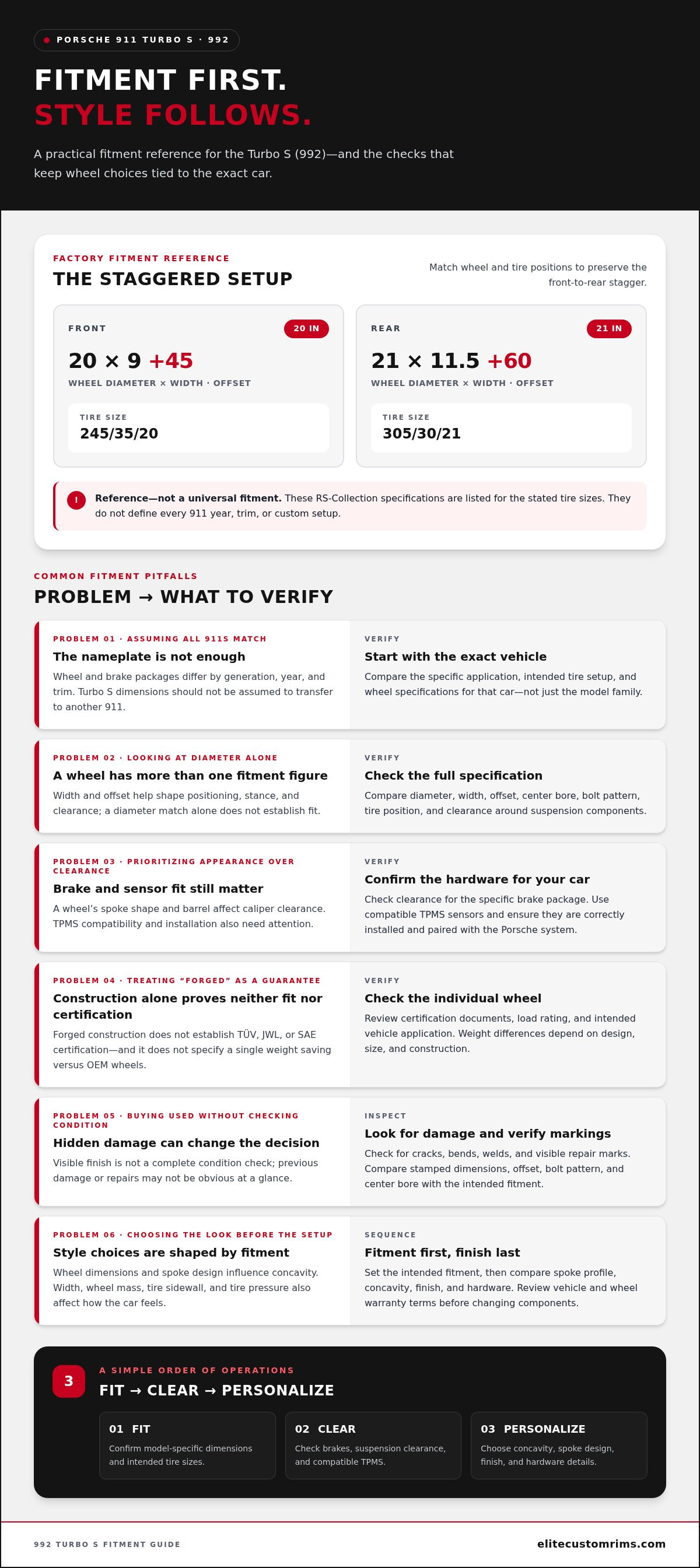
For the Porsche 911 Turbo S (992), the relevant OEM tire sizes are 245/35/20 and 305/30/21. Forged wheels for Porsche 911 models can be selected around these staggered sizes, while wheel width and offset help determine fitment.
Choosing wheels is about more than a bold design. Concavity, finish, and construction all shape the look and character of your 911, and the right balance starts with a setup suited to your model.
This guide explains how to compare wheel sizes and offsets, understand concavity and finish options, and weigh forged against flow-formed styles. You’ll also see the key fitment figures for the Turbo S (992), so you can narrow your choices with more confidence and less guesswork.
Key Takeaways
- Use the Turbo S (992) wheel dimensions, 20x9 +45 up front and 21x11.5 +60 at the rear, as a fitment reference.
- Compare wheel width and offset alongside diameter to understand how a setup affects fit and stance.
- Explore how forged and flow-formed construction differ, and what 6061-T6 forged aluminum brings to wheel options.
- Choose a finish and spoke design that suit your 911, from subtle detailing to a more pronounced concave look.
Porsche 911 Turbo S (992) wheel fitment
Fitment starts with the exact 992 model and its staggered tire setup. Wheel dimensions, brake clearance, and sensor compatibility matter alongside appearance.
Vehicle-Specific Fitment and Tire Recommendations
Tire sizes for the Turbo S (992) can vary by specific fitment. The RS-Collection wheel specifications are 20x9 +45 front and 21x11.5 +60 rear, listed for those tire sizes. Match wheel and tire positions to preserve the car’s staggered setup. For custom forged wheels, compare width and offset with the specific vehicle application, not just the 911 nameplate.
Fitment also includes the center bore, bolt pattern, and clearance around suspension components. The listed dimensions provide a concrete Turbo S reference, but they don’t define every 911 year or trim. For a Soul Performance IMS1 setup, use that car’s exact model and wheel specifications rather than assuming Turbo S dimensions transfer.
There’s no single weight saving for forged wheels versus OEM Porsche wheels. The difference depends on each wheel’s design, size, and construction.
Forged construction alone does not establish TÜV, JWL, or SAE certification. Check the specific wheel’s certification documents, load rating, and intended vehicle application.
Forged wheels can clear Porsche carbon-ceramic brakes when the spoke shape and barrel provide enough caliper clearance. Confirm clearance for your specific brake package.
Before buying used wheels, inspect for cracks, bends, welds, and visible repair marks. Compare their stamped dimensions, offsets, bolt pattern, and center bore with the intended 992 fitment.
Effects on Ride, Handling, Warranty, and TPMS
Wheel mass, width, and tire sidewall all affect ride and steering response. A lighter wheel can reduce unsprung mass, while tire size and pressure influence how the car feels on the road. Review your vehicle and wheel warranty terms before changing components. For TPMS, use compatible sensors and ensure they’re correctly installed and paired with the Porsche system.
Wheel size, concavity, and finish customization
Wheel diameter sets the visual foundation, while width and offset shape stance and clearance. Wheel dimensions can vary by Carrera configuration, so check the specific car’s fitment before choosing replacements. Listed forged wheels range from 15 to 30 inches in diameter, but that broad range isn’t a fitment recommendation for every 911. Start with the car’s existing configuration, then compare wheel dimensions and intended tire sizes.
Concavity describes how deeply the spokes sweep toward the hub. A deeper profile creates a more dramatic face, while spoke shape and wheel dimensions determine how much concavity the design allows. Treat the front and rear as separate decisions on a Carrera. A staggered setup, with narrower front wheels and wider rear wheels, illustrates why one profile or size may not suit both axles.
Finish changes a wheel’s character without changing its dimensions. A Satin Titanium Alloy look gives a restrained appearance; compare it with the body color, trim, and brake details. Hyper Silver uses a two-stage application of black and silver powders. For a different contrast, the featured Turbo S has black-filled rim grooves and text, adding detail without changing the wheel’s main finish.
Finish and hardware should work as one visual package. Compare the spoke color, center details, and fastener appearance before choosing a final combination. The listed wheels are powder-coated rather than painted, and that distinction describes the coating method, not a promise of a particular finish’s performance. For a custom selection, settle fitment first, then choose the spoke profile, concavity, finish, and hardware details. This sequence keeps styling choices connected to the wheel’s intended fit. Explore Porsche wheel selection as you narrow the look for your 911.
Forged and flow-formed wheel options for Porsche 911 models
Narrow the options by considering construction, wheel design, and fitment for your Porsche’s generation. Named examples include BBS LM and RS-Collection wheels.
Options Across Porsche 911 Generations
Each 911 generation has its own wheel and brake package, so a wheel that suits one model shouldn’t be assumed to fit another. Start with the exact generation and trim, then compare the wheel’s diameter, width, offset, and brake clearance with that vehicle’s requirements. RS-Collection wheels are made from 6061-T6 forged aluminum, offering one named forged option to consider.
Monoblock and Two-Piece Designs
A monoblock wheel uses one main piece, while a two-piece design combines a center with an outer rim. Those constructions affect appearance, design flexibility, and how the wheel is assembled. Forged and flow-formed describe manufacturing processes, not spoke patterns. Compare the construction and specifications of each wheel, then judge its fit for the intended Porsche 911 rather than relying on the design label alone.
Wheel Sizing Options
Size means more than diameter. Width and offset also shape positioning, clearance, and the tires a wheel can accommodate. BBS LM wheels are listed in 18-inch diameters, with widths of 8.5, 9, 9.5, 10, and 11 inches. Use those as specific size options, not as universal fitment guidance. Match front and rear dimensions to the exact model and intended tire setup.
BBS and Other Forged Wheel Brands
Named options in the available Porsche 911 examples include BBS LM and RS-Collection wheels. BBS LM is listed in several 18-inch widths, while RS-Collection wheels use 6061-T6 forged aluminum. The OEM Porsche Spyder RS wheel is described as cast, compared with the forged RS Spyder version. That distinction illustrates why similar names don’t necessarily indicate the same construction.
For a lightweight setup, compare the wheel’s construction, size, and fitment details together. A brand name alone doesn’t establish whether a specific wheel suits your 911 generation, trim, or brake package.
Forged wheel styles for the Porsche 911 992
The 992 Turbo S pairs striking performance with an assertive factory design. Its 3.8-liter twin-turbocharged flat-six produces 640 horsepower and 590 lb-ft of torque. A wheel style should complement that purpose without overpowering the car’s proportions. Choose the overall direction first: restrained and technical, or bold and aggressive.
The Turbo S reaches 0-60 mph in 2.6 seconds, so style decisions belong alongside practical fitment considerations. A multi-spoke face can create a detailed, motorsport-inspired look. Broader spokes can give the wheel a cleaner, more solid visual presence. These are design choices, not performance claims. Compare how each spoke pattern frames the brake hardware and sits within the wheel arch.
The 992 Turbo S’s carbon fiber body kit includes a front splitter, side skirts, and rear diffuser. Those components create distinct visual lines along the lower body. A dark finish can echo the carbon details, while a brighter finish can make the wheel design stand apart. Rim-groove or spoke accents add another layer, but repeating one existing body detail often creates a more cohesive result than mixing several contrasting treatments.
Use this simple selection sequence for a custom 992 setup:
- Set the style: Choose a sports-focused, understated, or aggressive spoke design.
- Match the finish: Compare wheel color with the body, carbon details, and brake hardware.
- Review the fit: Keep model-specific dimensions and clearance central to the decision.
- Check the full view: Consider front and rear wheels together, not as separate designs.
The strongest result balances the 992’s performance character with a consistent visual theme. Explore Porsche wheel styles and compare designs for your preferred look.
Elite Custom Rims: Audi Wheels
Elite Custom Rims is a natural next step for comparing Porsche Wheels after narrowing your 911’s fitment and style priorities. Use the model, generation, and wheel dimensions you’ve identified to focus your selection. Then compare spoke designs and finishes against the look you want for your car.
Once you’ve researched fitment, browse wheels designed for your Porsche. Elite Custom Rims also offers Audi Wheels, Chevy/GMC Wheels, and Mercedes Wheels, but choose by vehicle fitment rather than appearance alone. Compare the Porsche options with your preferred style and fitment requirements in mind.
Visit elitecustomrims.com to explore Porsche Wheels.
Make Your 911 Wheel Choice Personal
Your next step is to decide what you want the finished car to communicate. A clean, understated look and a bold, track-inspired presence call for different design choices. Choosing forged wheels for a Porsche 911 is about matching that vision with practical priorities, so keep your preferred style and driving needs in view as you compare options.
Elite Custom Rims offers Porsche Wheels, along with Audi Wheels, Chevy/GMC Wheels, and Mercedes Wheels. That range makes it easy to explore wheel options for different vehicles while keeping your Porsche project focused on its own fitment and design goals. Take the details you’ve considered and use them to guide your selection.
Ready to take the next step? Contact Elite Custom Rims to explore options for your Porsche. Give your 911 a look that feels distinctly yours.
Frequently Asked Questions
Which forged wheels fit each Porsche 911 generation and model?
Fitment depends on the exact 911 generation, model, and trim, so there isn’t one wheel specification for every car. For forged wheels for Porsche 911 models, compare wheel size, width, offset, bolt pattern, and brake clearance with the vehicle’s requirements. Elite Custom Rims listings show specifications and compatible models. Provide your year, make, model, and trim to a wheel specialist for fitment verification before ordering.
How much do forged Porsche 911 wheels cost in the United States?
There isn’t one fixed price for forged wheels across all Porsche 911 models. The selected wheel design, size, and listing determine the price, so use the specific product listing for its current amount. Listings generally show the price for a complete set of four wheels unless they state otherwise, such as a staggered setup or single-wheel listing.
How do forged wheels compare with flow-formed and cast wheels for a 911?
Forged, flow-formed, and cast describe different manufacturing methods, not guaranteed performance results. Forging shapes metal under pressure; casting forms a wheel from molten metal, while flow-forming applies pressure to shape the wheel barrel. Compare each wheel’s construction, dimensions, load rating, and intended application. A manufacturing label alone doesn’t establish how forged wheels for Porsche 911 applications will perform on your car.
What tire sizes work with forged wheels on a Porsche 911?
Tire size must match both the wheel dimensions and the 911’s model-specific setup. For the 992 Turbo S, the OEM tire-size pairing is 245/35/20 front and 305/30/21 rear. Other trims may use different combinations. Match the tire’s approved fitment to the wheel’s diameter and width, then preserve the vehicle’s intended front-to-rear arrangement.
How do wheel fitments differ for Carrera, GTS, Turbo, GT3, and GT3 RS models?
These model families can differ in wheel dimensions, brake packages, and available clearance, so don’t assume a Carrera setup fits a GT3 RS. Compare the exact year and trim, then account for front and rear wheel specifications and brake-caliper clearance. For an Elite Custom Rims order, provide your vehicle details to a wheel specialist for verification before purchase.