
A JWL mark is the manufacturer’s declaration that a wheel meets Japan’s minimum light-alloy wheel requirements; VIA indicates independent testing. For JWL impact testing, the specified air pressure is 200 kPa for all tires, while JWL-T testing uses the largest air pressure for each tire tested. Understanding JWL and VIA wheel testing standards means knowing what these marks show, and what they don’t.
A stamp can look reassuring, but JWL and VIA don’t mean the same thing. You’ll learn how to recognize each marking, what to look for when checking wheel certification, and how impact-test pressure differs between JWL and JWL-T. We’ll also explain how the impact test works and why a certification mark doesn’t tell you whether a wheel fits your vehicle. Clearer distinctions. Better-informed wheel choices.
Key Takeaways
- Read JWL as the manufacturer’s declaration against Japan’s wheel requirements, and VIA as an indication of independent testing.
- When assessing fatigue-test information, consider rotational speed alongside wheel resonance; the test cycle itself cannot be reduced.
- Know the pressure distinction: JWL impact testing uses 200 kPa for all tires, while JWL-T uses each tire’s largest air pressure.
- Look beyond the stamp when judging a wheel: certification addresses structural safety, while vehicle fitment and appearance are separate considerations.
How to recognize the markings on an alloy wheel?
JWL stands for Japan Light Alloy Wheel, a standard for wheel durability, fatigue, and impact testing. The JWL mark is the manufacturer’s declaration that a wheel meets Japan’s minimum requirements for light-alloy wheels. VIA, the Vehicle Inspection Association, indicates that a wheel has undergone independent testing. There is no single cost for JWL or VIA testing and certification: the amount depends on the required tests and the wheel specifications being assessed.
Look for the JWL and VIA marks on the wheel, then consider what each one tells you. A JWL marking represents the manufacturer’s declaration; a VIA marking indicates independent testing. Neither mark alone confirms that a wheel suits a particular vehicle. Match the wheel’s specifications to your vehicle and intended use.
These marks relate to different checks, not one single test. JWL testing covers radial fatigue, cornering fatigue, and impact. Radial fatigue applies a load as the wheel rotates against a drum; dynamic cornering fatigue applies a bending load at the hub face as the wheel turns. Impact testing checks how the wheel responds to a strike. Together, these tests assess durability under different stresses.
Rotational speed matters during a dynamic cornering fatigue test because wheel resonance can affect the test. A rotational speed of 5,500 rpm is stated as acceptable, but speed should be selected with resonance in mind. The rotational cycle cannot be reduced for this test. That distinction matters: changing rotational speed and reducing the required test cycle are not interchangeable adjustments.
Radial fatigue figures provide another way to understand the scope of testing. The listed radial stress test involves 500,000 rotations, while the JWL dynamic radial fatigue test for passenger-car wheels uses a test pressure of 460 kPa. An impact-test example uses a 13-degree angle and a 230 mm drop height. These figures describe test conditions, not a wheel’s vehicle fitment or its appearance after installation.
To understand a marking, read it alongside the wheel’s specifications and certification details. A certification mark and a vehicle inspection answer different questions: the mark relates to testing, while fitment depends on whether the wheel matches your vehicle. That’s the practical value of understanding JWL and VIA wheel testing standards.
Checking wheel certifications before purchase
JWL and VIA differ in who verifies the testing: JWL is manufacturer self-certification, while VIA involves independent testing. In the United States, certification marks also need context: a mark alone does not establish whether a wheel fits your vehicle.
Wheel Certification Types
A wheel certification identifies a testing or quality-assurance framework, and its value depends on what was assessed. JWL testing can be conducted in-house by the manufacturer without third-party oversight; VIA involves independent testing of a submitted wheel. TÜV Austria certification indicates that an alloy wheel passed durability, fatigue, and load tests and complies with European safety standards.
TCA is presented as a quality certification, but the label alone doesn’t explain its test scope. Check the issuing body and the criteria it represents. For TÜV manufacturer certification, the facility must pass an audit every 3 years. These distinctions help you tell apart wheel-level testing, manufacturing oversight, and a label whose assessment scope needs closer examination.
Comparing Wheel Standards
JWL and VIA focus on wheel testing, while U.S. federal rules address a different issue. FMVSS No. 110 governs tire-and-rim matching to a vehicle; it doesn’t require marking or pre-approval of passenger-car rims. The United States has no federal requirement that aftermarket passenger-car wheels be certified or approved before sale.
SAE, DOT, and TÜV aren’t interchangeable labels for JWL or VIA. The available comparison for SAE doesn’t establish a specific wheel-certification claim, so don’t treat an SAE reference as proof of JWL or VIA testing. TÜV approval relates to European safety standards, and TÜV/KBA approval is specific to a vehicle, wheel size, and offset. That specificity matters when assessing a wheel for your vehicle.
Before buying, compare the mark with the supporting certification details and the wheel’s intended application. For example, a JWL mark is a manufacturer’s declaration; it doesn’t establish independent VIA testing. Structural certification assesses integrity, not finish quality, concavity, or how a wheel looks on a vehicle. Keep these questions separate: testing evidence concerns structure, while fitment depends on the vehicle, size, and offset.
For an Audi fitment, explore Audi wheel options after you’ve identified the certification and application details that matter to your choice.
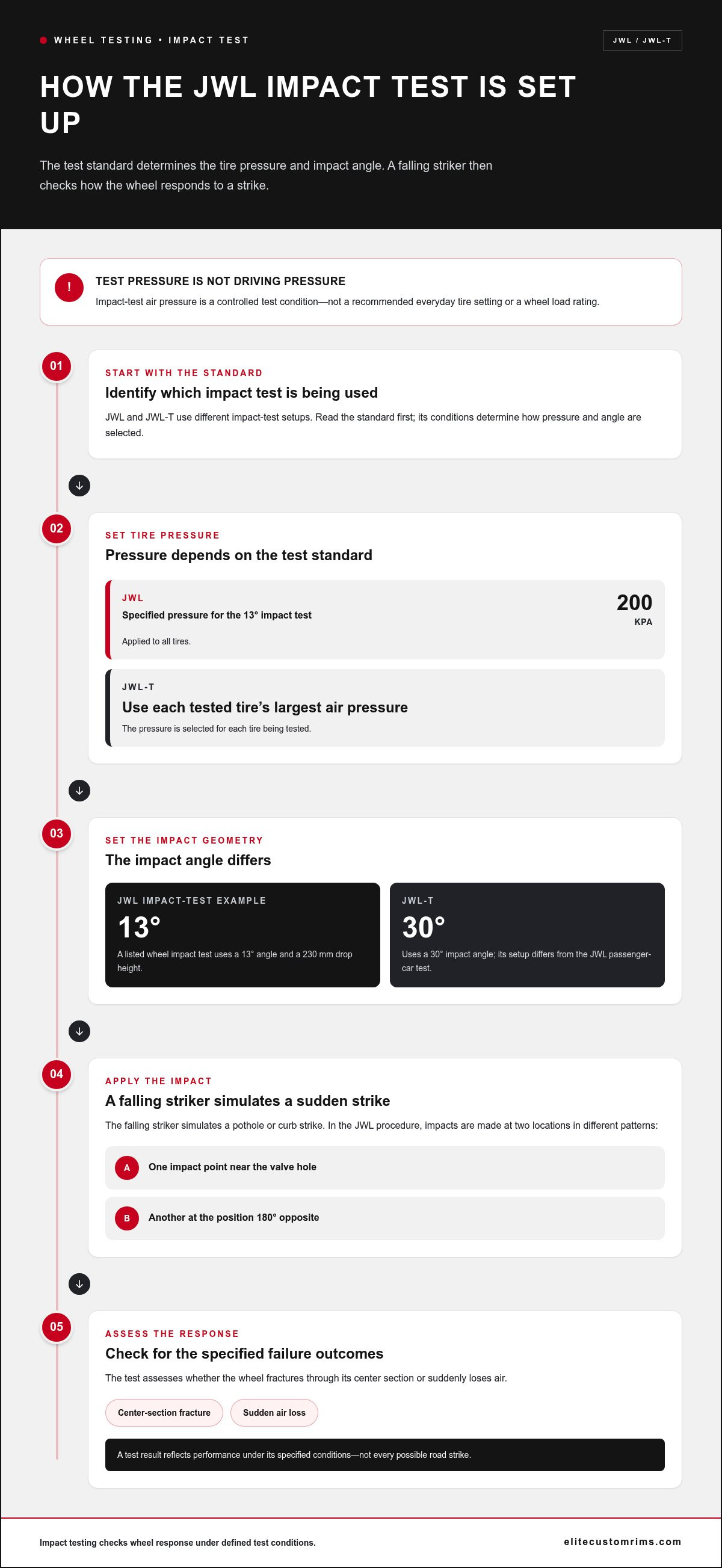
Impact-test air pressure for JWL and JWL-T
Impact-test pressure is a controlled test condition, not a recommended driving pressure. Under JWL, the specified pressure for the 13° impact test is 200 kPa for all tires. JWL-T uses the largest air pressure for each tire being tested. The distinction matters because the pressure is selected according to the test standard, not a wheel’s load rating or a vehicle’s everyday tire setting.
The impact test uses a falling striker to simulate a pothole or curb strike. It assesses whether the alloy wheel fractures through its center section or suddenly loses air. A listed wheel impact test uses a 13-degree angle and a 230 mm drop height. JWL-T uses a 30° impact angle, so its setup differs from the JWL passenger-car test.
Impact location is another defined part of the test. The JWL procedure uses two impact points in different patterns: one near the valve hole, and another near the position 180° opposite it. These locations expose different parts of the wheel to impact. The result reflects performance under specified test conditions, not every possible road strike.
Keep impact testing separate from radial fatigue testing. Impact testing applies a sudden strike; radial testing applies repeated load as the wheel rotates. Both help assess wheel durability, but they examine different stresses. Read a certification mark or approved specification in context, alongside the wheel’s intended vehicle application.
The Vehicle Inspection Association (VIA) is associated with independent wheel testing, while JWL identifies a manufacturer’s declaration against its standard. Neither mark turns impact-test pressure into a tire-pressure recommendation. For example, a wheel tested at 200 kPa under JWL doesn’t mean the vehicle should use 200 kPa on the road. Use the vehicle and tire specifications for operating pressure, and treat the test figures as laboratory conditions.
In short, compare the standard, tire, angle, and pressure together. JWL specifies 200 kPa for all tires during its 13° impact test; JWL-T uses each tested tire’s largest air pressure during its 30° test. Those conditions define how the wheel is evaluated, not how it should be used on a vehicle.
VIA independent testing and verification
VIA testing adds independent physical testing to the wheel’s certification picture. The Vehicle Inspection Association was founded in Japan in 1987, and VIA certification is based on the JWL standard. Unlike a JWL mark, which represents the manufacturer’s declaration, VIA indicates independent quality verification of a submitted wheel. That distinction helps explain what each marking can tell you.
Testing covers more than one specification in isolation. VIA testing includes wheels fitted with different tire sizes and used on different vehicles. It also includes deformation, durability, and tensile testing. Together, these checks examine how the tested wheel responds to different loads and configurations. A VIA mark therefore reflects an independent test process, not simply a manufacturer’s statement that minimum requirements are met.
Laboratory competence matters, too. EN ISO/IEC 17025 defines the competence of testing laboratories. It concerns the lab’s ability to carry out testing, rather than a separate strength rating for an alloy wheel. For readers, the distinction is useful: the wheel is tested against requirements, while laboratory competence concerns the organization conducting the assessment.
Manufacturers also need VIA approval of their testing equipment before conducting their own JWL tests. This requirement connects the two systems without making them identical. A JWL test may be conducted by the manufacturer, while VIA involves independent third-party testing of a submitted wheel. The evidence behind each mark therefore differs, even when both relate to wheel durability and fatigue.
Interpret the mark within its scope. VIA testing can provide independent verification, but it doesn’t establish fitment for every vehicle. Specifications such as tire size and intended application still matter. A strength or fatigue test also says nothing about finish quality or appearance. Understanding JWL and VIA wheel testing standards means separating test evidence from these other buying decisions.
Use certification as one part of your wheel assessment, then consider the vehicle application. Explore wheel options for your vehicle with testing and fitment considerations in mind.
Elite Custom Rims: Audi Wheels
Elite Custom Rims offers Audi Wheels for drivers ready to move from understanding certification marks to choosing wheels for their vehicle. Use what you’ve learned about JWL and VIA as context, then consider the wheel’s intended application and vehicle fitment. Certification addresses testing; fitment is a separate part of choosing a wheel.
Explore Audi Wheels alongside options for Chevy/GMC, Mercedes, and Porsche vehicles. Compare the available wheels with your vehicle’s requirements and the look you want. A certification mark can help explain testing, but it doesn’t replace choosing a wheel suited to your specific vehicle.
For your next step, browse the wheel options with certification and fitment in mind. Visit elitecustomrims.com to explore the selection or contact Elite Custom Rims.
Make Your Next Wheel Choice With Confidence
Understanding JWL and VIA wheel testing standards gives you a clearer basis for evaluating wheel information, but your choice should also reflect your vehicle and priorities. Consider the intended fitment, the specifications that matter for your application, and the look you want. Keep certification evidence in perspective: it explains testing, while compatibility remains a separate decision.
When you’re ready to explore options, Elite Custom Rims offers Audi Wheels, Chevy/GMC Wheels, and Mercedes Wheels. Compare those offerings with your vehicle’s needs, and use what you’ve learned to make an informed selection. Choose thoughtfully, not by a stamp alone.
Explore wheels at Elite Custom Rims and take the next step toward a choice that suits your vehicle.
Frequently Asked Questions
Are Your Wheels Really JWL?
A JWL stamp represents the manufacturer’s declaration that a wheel meets Japan’s minimum light-alloy wheel requirements. By itself, it does not show that an independent laboratory tested that specific wheel. VIA testing provides independent verification, so the two marks signal different kinds of evidence. For a useful check, compare the marking with the wheel’s specifications and the documentation identifying its testing basis.
Are Performance Tests Mandatory?
Requirements depend on where the wheel is used. In Japan, wheels used on the street must meet JWL standards. In the United States, there’s no federal requirement that aftermarket passenger-car wheels be certified or approved before sale. FMVSS No. 110 governs tire-and-rim matching to a vehicle, not pre-approval of passenger-car rims. A performance test mark and compliance with U.S. vehicle matching rules answer different questions.
Is a JWL Stamp Enough to Prove a Wheel Is Safe?
No. A JWL stamp indicates manufacturer self-certification, not independent confirmation that every wheel specification suits your vehicle. Consider the wheel’s load rating, size, offset, and intended application separately. Structural testing addresses integrity under defined test conditions; it doesn’t establish fitment or appearance. For example, a wheel’s JWL mark cannot tell you whether its offset is appropriate for your vehicle.
What Constitutes Pass or Fail?
A wheel passes when it meets the applicable acceptance criteria for the required tests. In JWL passenger-car impact testing, the wheel must hold air after testing; the test also checks against sudden air loss or fracture through the center section. Fatigue testing evaluates repeated loading, while impact testing examines a sudden strike. These results apply to defined test conditions, not every possible road event.
What Are the Japanese JWL Standards for Passenger-Car Wheels?
JWL is Japan’s minimum light-alloy wheel standard, covering structural tests for passenger-car wheels. Its assessment includes radial fatigue, cornering fatigue, and impact testing. Japan requires wheels used on the street to meet JWL standards. The mark reflects the manufacturer’s declaration of compliance, so distinguish it from VIA’s independent testing. These standards indicate testing requirements, not whether a wheel fits a particular vehicle.
What Tests and Load Ratings Does JWL Require for Wheels?
JWL testing includes radial fatigue, dynamic cornering fatigue, and impact tests. Load requirements depend on the wheel specification, rather than one rating applying to every wheel. For a specific example, the stated JWL requirement for an 18-inch wheel with a 5×130 bolt pattern is a 735 kg load rating. Compare a wheel’s actual rating with its intended vehicle application; the example isn’t universal.