
Could a wheel fit your vehicle perfectly and still leave the TPMS warning light on? Aftermarket wheel TPMS compatibility depends on more than wheel style. The sensor must meet the vehicle’s communication requirements and fit the wheel’s valve-stem opening. That can make a wheel upgrade feel less straightforward than it should.
It’s reasonable to wonder whether your current sensors can be transferred, whether removal could damage them, and what happens after the wheels are installed. Planning ahead helps you answer those questions before the work begins.
This guide explains the checks to make before choosing aftermarket wheels, including sensor type, frequency, protocol, and physical fit. You’ll learn when reusing sensors may make sense, when replacement or programming may be a better option, and why a sensor relearn may be needed after the swap. We’ll also cover the transfer sequence so you can coordinate wheel fitment and TPMS requirements with confidence.
Key Takeaways
- Aftermarket wheel TPMS compatibility involves more than wheel style. Sensor communication requirements and physical mounting both matter.
- Use your vehicle’s year, make, model, and trim to guide fitment checks, then compare sensor and valve-stem requirements with the wheel specifications.
- Choose whether to reuse, replace, or reprogram sensors based on their condition and compatibility with both the vehicle and wheels.
- Plan the transfer sequence carefully, protect the sensors during handling, and account for any relearn step needed for the vehicle to recognize sensor IDs.
- Coordinate vehicle-specific wheel fitment with TPMS requirements before ordering to reduce avoidable surprises during installation.
What aftermarket wheel TPMS compatibility actually depends on
Aftermarket wheel TPMS compatibility isn’t determined by appearance or basic wheel fitment alone. TPMS, or tire-pressure monitoring system, alerts the driver to low tire pressure. A wheel can match the vehicle’s bolt pattern and other fitment requirements while raising a separate question: can the vehicle’s TPMS sensors mount correctly and communicate with its monitoring system?
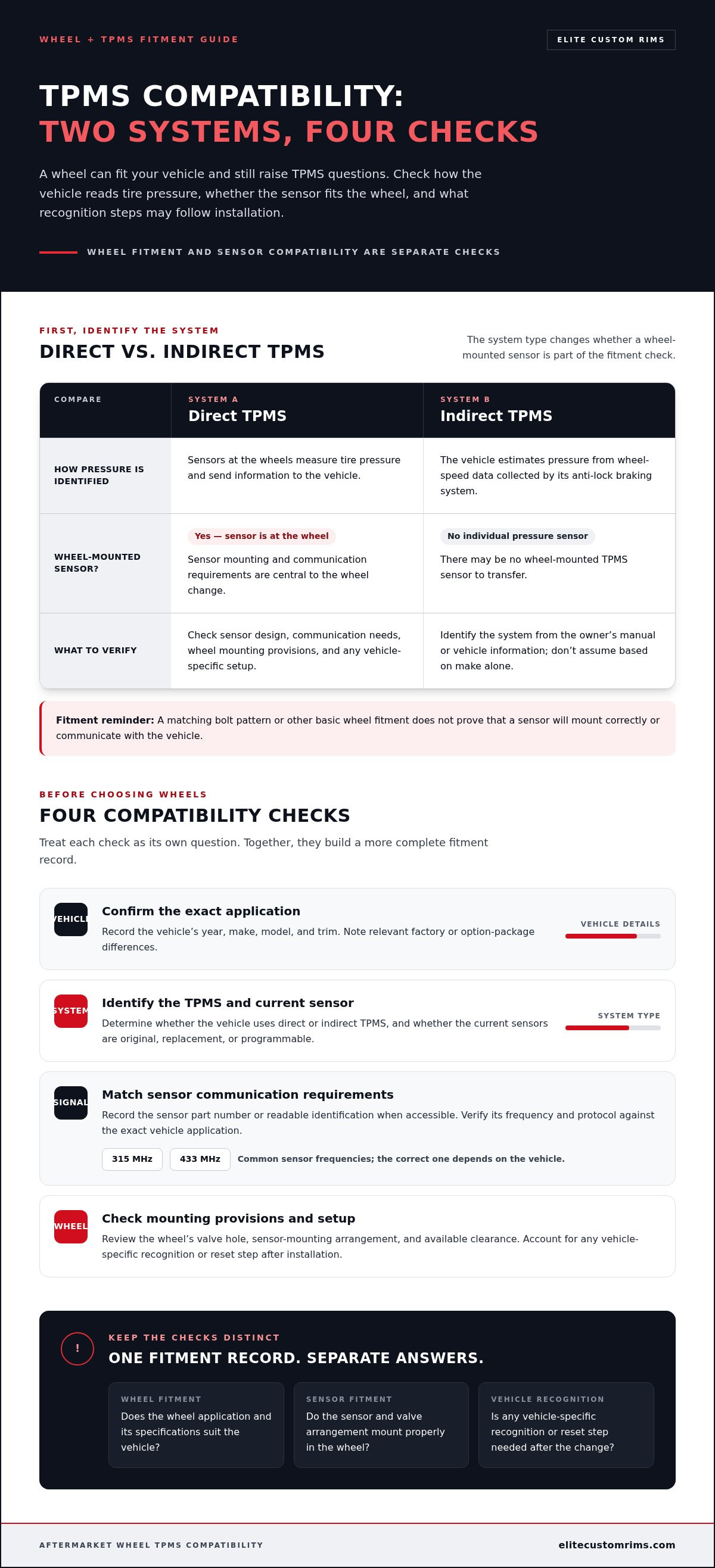
Think of these as two connected checks. Wheel fitment determines whether a wheel suits the vehicle. TPMS compatibility depends on the vehicle’s monitoring method, sensor design, wheel mounting provisions, and any setup needed after installation. Direct systems use sensors inside the wheels. Indirect systems don’t use individual pressure sensors, so there may be no wheel-mounted TPMS sensor to transfer.
Direct versus indirect TPMS: identify your vehicle system
Direct TPMS measures tire pressure with sensors at the wheels. These sensors send information to the vehicle. Indirect TPMS estimates pressure from wheel-speed data collected by the vehicle’s anti-lock braking system, rather than measuring pressure with a sensor in each wheel. The distinction matters because a wheel change primarily raises sensor-mounting and communication questions for direct TPMS.
In short, direct TPMS reads pressure at the wheel; indirect TPMS infers a pressure problem from wheel rotation. The Tire-pressure monitoring system (TPMS) overview explains both approaches. Check your owner’s manual or vehicle information to identify which system your specific vehicle uses. Don’t assume based on the make alone.
Why aftermarket wheel design matters to a TPMS sensor
Direct sensors attach at the valve stem or use another wheel-specific mounting arrangement. The sensor’s mounting style and valve-stem design must suit the wheel’s provisions. A mismatch can prevent proper installation or leave the sensor without suitable clearance. Wheel construction and the space around the mounting area can affect whether the sensor sits securely without interference.
A familiar brand, attractive finish, or matching diameter isn’t enough to establish sensor compatibility. Review the wheel’s mounting provisions alongside the vehicle-specific sensor requirements before ordering. Confirm the details that matter rather than treating “fits the vehicle” as proof that every sensor will fit too.
- Vehicle system: Identify whether the vehicle uses direct or indirect TPMS.
- Sensor requirements: Match the sensor design and communication needs to the vehicle. TPMS sensors commonly use 315 MHz or 433 MHz, and the correct frequency depends on the vehicle.
- Wheel provisions: Check that the valve-stem or sensor mounting arrangement and available clearance suit the sensor.
- Setup: Account for any vehicle-specific recognition or reset steps after a wheel change.
These checks work together, but none replaces the others. Vehicle-specific wheel selection helps narrow fitment uncertainty; matching the wheel’s sensor provisions to the vehicle’s TPMS requirements completes the picture.
Check sensor, wheel, and vehicle compatibility before ordering
Build a complete fitment record before choosing wheels. A vehicle’s year, make, model, and trim help identify the right application, but don’t automatically establish whether a particular TPMS sensor will mount correctly or communicate with the vehicle. Treat wheel fitment and sensor compatibility as related parts of one decision, not interchangeable checks.
Use this checklist to organize the details:
- Vehicle: Record the year, make, model, and trim. Note any relevant factory or option-package differences.
- TPMS: Identify the system type and whether the current sensors are original, replacement, or programmable.
- Sensor identification: Record the sensor part number or readable identification, if accessible. Keep any available service or installation records with it.
- Communication: Note the sensor frequency and protocol, then verify them against the specific vehicle. Don’t assume a specification from another model year or trim applies.
- Wheel: Review the wheel’s valve hole, sensor-mounting provisions, and clearance requirements alongside its vehicle-specific fitment details.
Which TPMS sensor details should you check?
Start with the sensor itself. Its part number or identification can help distinguish an original unit from a replacement or programmable sensor, but the number alone doesn’t prove fit. Compare the sensor’s documented frequency and communication protocol with the requirements for the exact vehicle. Verify any broad compatibility claim against the vehicle application before selecting or programming a replacement.
How to assess an aftermarket wheel’s sensor provisions
Review the wheel documentation for the valve hole, sensor mounting area, and required clearance. The sensor and valve configuration must suit both the wheel and the vehicle. A correct bolt pattern doesn’t establish that match. For a broader view of coordinated vehicle and wheel choices, use this custom wheel fitment reference.
Keep the checks separate. Each answers a different question:
| Check | What it confirms |
|---|---|
| Wheel fitment | Whether the wheel’s vehicle application and specifications suit the vehicle. |
| Sensor fitment | Whether the sensor and valve arrangement mount properly in the wheel and meet vehicle requirements. |
| Vehicle relearn | Whether the vehicle must be set up to recognize sensor IDs after a wheel or sensor change. |
Don’t let one successful check stand in for the others. A wheel may suit the vehicle while its sensor provisions still need review. A sensor may mount correctly but require vehicle-specific setup afterward. Before ordering, compare the vehicle information, sensor identification, and wheel documentation as a set. Explore vehicle-specific wheel options with those fitment details in mind.
Reuse, replace, or reprogram: compare your TPMS options
There isn’t one right choice for every wheel change. Your decision depends on whether the existing sensors work, suit the new wheel and vehicle, and meet the vehicle’s setup requirements. A sensor may physically attach to a wheel yet still fail to communicate with the vehicle. Confirm the specific vehicle requirements before deciding that a part is interchangeable.
Use these three options to frame the decision:
- Reuse existing sensors: This may work when each sensor is functional, undamaged, and compatible with both the new wheel’s mounting provisions and the vehicle. Removal and remounting require care to protect the sensor.
- Install compatible replacement sensors: Consider replacement if an existing unit is damaged, nonfunctional, or unsuitable for the wheel or vehicle. The replacement must match the vehicle’s verified requirements. A similar-looking sensor isn’t enough.
- Use programmable sensors: These sensors can be configured for certain vehicle applications. Coverage varies, so verify the specific sensor’s supported vehicle and communication requirements instead of assuming it works across all makes or models.
When reusing existing TPMS sensors makes sense
Reuse is worth considering if the sensors work and their mounting design suits the new wheels. Check their condition and available identification before the wheels are assembled. Careful handling during removal and transfer matters: impact or improper handling can damage a sensor, turning a planned reuse into a replacement decision.
A successful transfer doesn’t always mean the job is finished. The vehicle may need a relearn or another system setup step to recognize sensor IDs after the wheel change. Include that in the plan even if you keep the original sensors.
When replacement or programming may be needed
Consider replacement if inspection shows damage, a sensor isn’t functioning, or its design doesn’t meet the wheel’s mounting needs or the vehicle’s specifications. Programmable sensors offer another option when the particular sensor supports the vehicle. Their flexibility doesn’t guarantee universal compatibility, so verify frequency, protocol, and application details for the exact vehicle.
Programming and relearning are different steps. Programming configures a programmable sensor to communicate according to a supported vehicle application. Relearning teaches or registers the sensor ID with the vehicle after installation. Depending on the vehicle and sensor setup, one step may be needed, both may be needed, or a vehicle-specific procedure may apply. Follow the applicable specifications rather than relying on a generic reset assumption.
For a confident choice, weigh sensor condition, wheel mounting, vehicle communication, and required setup together. Coordinating those details with your vehicle-specific aftermarket wheel selection helps keep appearance and fitment decisions aligned.
How to plan a TPMS sensor transfer to new wheels
A sensor transfer involves more than moving a wheel from the vehicle to a work area. The tire must be separated from the wheel so the sensor can be accessed. Then the assembly must be put back together and the TPMS system checked. Plan the stages in advance, especially if you’re reusing sensors, so the new wheel’s mounting provisions and the vehicle’s requirements stay aligned.
“A TPMS sensor transfer is a tire-and-wheel operation, not a wheel-only swap.” Tire removal and sensor transfer require suitable tire-service equipment and careful handling. Don’t pry at a sensor, bend its components, or try to remove it through an inflated tire. Incorrect handling can damage the sensor or valve assembly.
Prepare the sensors and replacement wheels
Before disassembly, write down the vehicle’s year, make, model, and trim, along with each sensor’s identification if it’s accessible. Keep the information together so the sensors can be tracked through the transfer. Then compare the sensor design with the replacement wheel’s documented mounting requirements. This preparation helps catch a mismatch before work begins.
Complete the transfer and confirm the TPMS status
Use this sequence to keep the work organized. The actual procedure and equipment depend on the vehicle, sensor, and wheel.
- 1. Document and match: Record sensor identification and vehicle details. Assign each sensor to its intended wheel and verify the mounting configuration.
- 2. Dismount the tire: Separate the tire from the wheel with suitable tire-service equipment. Avoid putting force on the sensor or valve while accessing it.
- 3. Transfer and inspect: Move the sensor according to its design and the wheel’s requirements. Check the sensor and valve components for visible damage during handling. If a component looks damaged, don’t treat it as ready to reuse.
- 4. Remount and inflate: Reassemble the tire and wheel, then inflate to the vehicle’s specified pressure. Keep this stage distinct from sensor installation. A mounted sensor doesn’t by itself confirm the system is ready.
- 5. Install and verify: Fit the completed assemblies to the vehicle. Follow the owner’s manual for the prescribed relearn or drive procedure, if one is required, then check that the TPMS reports normal status.
Relearn instructions vary by vehicle. Some systems may recognize sensors after a specified drive; others may require a manual procedure or tool. Verify the exact steps in the vehicle manual instead of relying on a generic reset sequence. If a warning remains, don’t assume the sensor is faulty without checking the vehicle-specific setup and sensor communication requirements.
Planning aftermarket wheel TPMS compatibility alongside vehicle-specific wheel fitment can help prevent avoidable surprises during the transfer. Review vehicle-specific wheel options with the sensor requirements in mind.
Choose aftermarket wheels with TPMS fitment in mind
A strong wheel choice brings vehicle fitment and TPMS planning together. Before ordering, make sure the wheel application suits your exact vehicle and that the sensor mounting requirements and post-installation setup have been considered. Appearance matters, but it can’t confirm whether a wheel fits your vehicle or whether its sensor provisions match your TPMS system.
Use a fitment-first checklist before buying
Separate documented details from assumptions. A setup that worked on another vehicle, even one with a similar model name, doesn’t automatically apply to yours. Check the vehicle and wheel specifications together, then account for the sensor and any required relearn process.
- Vehicle application: Confirm year, make, model, and trim. Include relevant differences in factory equipment or options when identifying the vehicle.
- Wheel fitment: Match the wheel’s stated vehicle application and specifications to your vehicle, rather than relying on diameter or appearance alone.
- Sensor mounting: Compare the wheel’s valve and sensor provisions with the mounting requirements of your existing or selected sensor.
- TPMS requirements: Verify the sensor type and communication specifications for the exact vehicle. Don’t carry over frequency or protocol information from another vehicle without checking.
- System setup: Find out whether the vehicle’s instructions call for a sensor relearn, a specific drive sequence, or another setup step after the wheel change.
Mark each item as confirmed or as needing vehicle-specific verification. This makes it easier to spot a gap before purchase, such as having the right wheel application but no clear match for the sensor mounting arrangement. It also gives you a more useful basis for choosing whether to transfer existing sensors or plan around compatible replacements.
Vehicle-specific examples show why fitment details matter. A Chevy Silverado wheel fitment guide, for instance, focuses the wheel decision on a particular vehicle application. Use that specificity as a model for your own checks, not as proof that another year, trim, or vehicle shares the same requirements.
Resolve aftermarket wheel TPMS compatibility before ordering wheels and planning the transfer. Once the vehicle application, wheel specifications, sensor mounting, and relearn needs are aligned, you can make the upgrade decision with greater confidence. Choose wheels for confirmed fitment as well as the look you want.
Ready to narrow your choices? Explore vehicle-specific wheel options and keep your fitment details in view.
Make your next wheel upgrade a coordinated fit
Turn your compatibility notes into a purchase decision. Keep your vehicle details and TPMS requirements together as you compare wheels, so your choice reflects more than appearance. Planning ahead can make the upgrade more deliberate from selection through installation.
Use aftermarket wheel TPMS compatibility as part of the fitment decision, not a detail to leave until the wheels arrive. Elite Custom Rims offers vehicle-specific wheel fitment options for luxury, performance, and utility applications, including Audi, Mercedes, Porsche, Tesla, Chevy, GMC, and Toyota vehicles.
Choose a wheel application that suits your vehicle, then move forward with a clear plan for the sensors and system setup. Explore vehicle-specific aftermarket wheel options and find a fitment direction that brings your vehicle’s requirements and style goals together.
Frequently Asked Questions
Can a TPMS sensor battery be replaced?
Usually, the battery isn’t intended to be replaced separately because many direct TPMS sensors have sealed housings. If the battery fails, the typical remedy is replacing the sensor, then completing any required setup for the vehicle. Sensor designs vary, so check the service information for your exact vehicle and sensor before deciding. A TPMS tool can help identify a sensor that no longer responds, rather than relying on the dashboard light alone.
How can I tell whether a TPMS warning light is caused by the wheel change?
Start by checking each tire’s pressure with a reliable gauge, including the spare if your vehicle monitors it. If pressures are correct and the warning appeared immediately after the wheel change, the timing may point to a sensor that was damaged, isn’t communicating, or hasn’t been recognized by the vehicle. Review the vehicle’s relearn instructions and have the sensor system checked if the warning persists. A warning light alone doesn’t identify the cause.
Is it safe to drive with the TPMS warning light on after changing wheels?
Don’t use the warning light as a substitute for checking tire pressure. Pull over safely and inspect the tires; use a gauge to compare pressures with the vehicle’s recommended cold-pressure information. If a tire looks damaged, feels unstable, or is losing air, don’t continue driving on it. If pressures are correct and the vehicle handles normally, arrange prompt diagnosis and don’t treat the warning as resolved until the TPMS status is normal.
Can one TPMS sensor work on more than one vehicle?
Sometimes, but physical fit alone doesn’t establish that a sensor can communicate with both vehicles. Compatibility depends on the sensor’s design and each vehicle’s communication requirements. A programmable sensor may be configurable for supported applications, but its coverage isn’t universal. For aftermarket wheel TPMS compatibility, identify the exact vehicle applications and verify the sensor’s specifications for each one. If moving a sensor between vehicles, expect that setup or relearning may be needed.
Does a TPMS sensor monitor the spare tire?
It depends on the vehicle. Some systems monitor only the wheels in use, while certain vehicles may include a full-size spare in their monitoring setup. A compact spare may not have a sensor, or the vehicle may not display its pressure in the same way as the road tires. Check the owner’s manual for the spare-tire monitoring arrangement. Regardless, inspect the spare periodically and maintain its pressure according to the vehicle’s instructions.
Why does my TPMS light flash and then stay on?
A flashing light that becomes steady often signals a TPMS system fault rather than simply low tire pressure, but indicator patterns vary by vehicle. Possible causes include a sensor that isn’t communicating, a failed sensor, or a system that hasn’t recognized sensors after a wheel change. Check tire pressures first, then consult the owner’s manual for your vehicle’s warning-light meaning. If the light continues, have the system scanned to identify which sensor or component needs attention.