
The best aftermarket wheels for Mercedes S-Class cars start with correct fitment, not just a striking finish. Bolt pattern, offset, and wheel width all need to suit the vehicle to help avoid rubbing or affecting handling. For W222 and W223 models, the right build also depends on the look and ride feel you want.
A polished finish can bring out the S-Class’s elegant lines, while a darker or matte look creates a more understated presence. Finish is only one part of the decision: larger wheels can make the ride feel rougher, while smaller wheels can provide a smoother ride.
This guide explains how to compare wheel finishes, understand the fitment measurements that matter, and weigh forged and cast options for everyday use or a more performance-focused setup. You’ll also see featured Mercedes S-Class wheel builds and learn how to match their style and proportions to your W222 or W223. The goal is a confident choice that looks right and suits the way you drive.
Key Takeaways
- Choose a finish that suits your preferred look and cleaning routine, and weigh wheel size against ride comfort.
- Use bolt pattern, offset, and width together to assess fitment and help prevent rubbing or changes to handling.
- Compare wheel construction and design with how you use your S-Class, from everyday driving to a more performance-focused build.
- Look at W222 and W223 fitment separately; a wheel setup should suit the specific generation and vehicle configuration.
- Explore featured build choices to see how wheel proportions and finish can shape the overall look of your Mercedes-Benz.
1. Wheel finishes, including Polished Clear
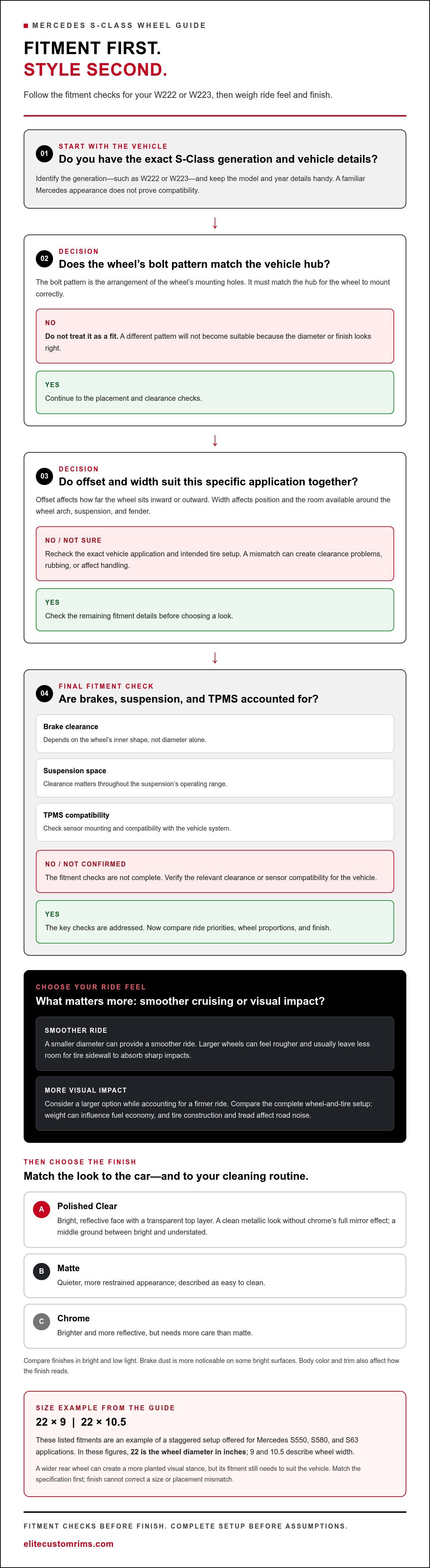
Finish changes how an S-Class wheel looks in daylight and shade. Polished Clear pairs a bright, reflective face with a transparent top layer for a clean metallic look without chrome’s full mirror effect. Matte finishes create a quieter appearance and are described as easy to clean. Chrome looks brighter and more reflective, but needs more care than matte. Choose a finish you’ll enjoy every day, not just one that looks good in a product photo.
Consider how each finish works with the S-Class’s body color and trim. A dark finish can make a light-colored car look more dramatic, while a polished face can echo bright exterior trim and maintain a formal appearance. Chrome draws more attention to the wheel; matte tends to keep the overall look restrained. Polished Clear offers a middle ground. Compare finishes in bright and low light, since reflections can change how they look. Factor in your cleaning routine, too: brake dust is more noticeable on some bright surfaces, while matte finishes are easier to clean.
Wheel diameter affects more than stance. Larger wheels can make the ride feel rougher, while smaller wheels can provide a smoother ride. A larger wheel usually leaves less room for tire sidewall, giving the tire less material to absorb sharp impacts. Wheel and tire weight can influence fuel economy because heavier rotating parts require more energy to accelerate. Tire construction and tread also affect road noise. For comfort, handling, fuel economy, and cabin quiet, compare the complete wheel-and-tire setup, not diameter alone.
Use the listed 22x9 and 22x10.5 fitments as a concrete example of a staggered setup offered for Mercedes S550, S580, and S63 applications. The figures describe wheel width, not diameter; the “22” identifies the wheel diameter in inches. That distinction matters when comparing finishes and proportions. A wide rear wheel can create a more planted visual stance, but its fitment must suit the vehicle. Finish cannot correct a mismatch in size or placement. Match the wheel specification first, then choose between Polished Clear, matte, or chrome.
Make the decision in this order: set your ride priorities, compare compatible diameters, then choose a finish. If smooth cruising matters most, a smaller diameter supports that preference. If visual impact matters more, consider a larger option while accounting for a firmer ride. For a refined S-Class appearance, Polished Clear adds a bright detail without making the finish the whole design.
2. Bolt pattern, offset, and width fitment
Three measurements shape S-Class wheel fitment: bolt pattern, offset, and width. Each affects how the wheel attaches and sits within the wheel arch. A mismatch can cause rubbing or affect handling. Start with the exact vehicle generation, such as W222 or W223. Then compare the wheel’s specifications with the requirements for that car. A familiar Mercedes appearance cannot prove compatibility. The measurements must work together, not just look close individually.
Bolt pattern describes the arrangement of a wheel’s mounting holes. It must match the vehicle’s hub for the wheel to mount correctly. Compare the wheel’s stated pattern with the exact S-Class application. Don’t rely on appearance or specifications from a similar Mercedes model. A different pattern won’t become suitable just because the diameter or finish is right. Keep the vehicle’s model and year details handy when reviewing fitment information.
Offset describes the wheel’s mounting position relative to its centerline, affecting how far it sits inward or outward. An unsuitable offset can bring the wheel closer to suspension components or push it toward the fender, creating clearance problems. For example, a wheel that sits flush on one S-Class configuration may sit differently on another. Compare offset with the specific vehicle application rather than treating it as a standalone number.
Width also affects wheel position and clearance. A wider wheel needs enough room inside the wheel arch and around nearby components. It can change the tire’s position relative to the suspension and fender, too. Review width alongside offset and the intended tire setup. A matching bolt pattern does not make every width suitable: correct fitment depends on all three measurements working together.
Will aftermarket wheels fit the S-Class brakes, air suspension, and TPMS? They can fit when their dimensions provide brake and suspension clearance and the TPMS sensors are compatible with the wheel and vehicle system. Brake clearance depends on the wheel’s inner shape, not diameter alone. Suspension movement also makes clearance important throughout the wheel’s operating range. TPMS fitment depends on sensor mounting and system compatibility.
Use a simple sequence: identify the S-Class generation, compare bolt pattern, then assess offset and width. Finish by considering brake clearance, suspension space, and TPMS fit. This approach helps narrow the best aftermarket wheels for Mercedes S-Class without treating one measurement as the whole answer. For a focused comparison, explore Mercedes wheel fitment options alongside the specifications for your vehicle.
3. Wheel brands and models featured on S-Class cars
A wheel name helps narrow a search, but the full specification matters more. The featured example here is the ALT RF PL35 for Mercedes S-Class fitments. Its listed sizes are 22x9 and 22x10.5. Those figures describe diameter and width, giving you a specific starting point for comparing proportions. Treat the model name as a lead, then study its dimensions and the vehicle application.
Compare each model by its design, construction, finish, and available dimensions. A multi-spoke pattern creates a different visual effect from a simpler spoke layout. A polished face draws attention to the wheel, while a darker finish creates a lower-contrast look. These are design choices, not proof of fitment. For the ALT RF PL35, begin with the listed S-Class application and sizes, then consider whether its appearance suits your car.
Read the full model designation carefully. Similar-looking names can refer to different wheel designs or specifications. Keep the maker’s name, model identifier, finish, and size together in your notes. For example, record “ALT RF PL35, 22x9 and 22x10.5” rather than searching only for “22-inch Mercedes wheels.” That makes comparisons clearer and helps prevent a style match from distracting you from the actual wheel dimensions.
Next, compare the model’s intended look with your S-Class build. A fine-spoke design can make the wheel face feel detailed. A broader-spoke design can look more solid and graphic. A bright finish emphasizes contrast; a subdued finish keeps attention on the body lines. Use these descriptions to sort visual preferences, not to assume a specific finish or construction for the ALT RF PL35. The listing’s actual model details should guide that decision.
Model availability and vehicle fitment are separate questions. A wheel may appear in an S-Class gallery or fitment listing, but the relevant generation and wheel specification still matter. Keep W222 and W223 searches distinct. Compare the listed application for your car, then review the bolt pattern, offset, and width together. This turns a broad brand search into a practical shortlist built around your exact S-Class and preferred design.
For a useful comparison, choose two or three candidate models and note their names, sizes, and finishes. Put the ALT RF PL35 beside other options only when their specifications are available for the same S-Class application. Then compare the visual effect and measurements side by side. This method keeps the decision focused: model identity narrows the choices, while complete fitment details determine whether a wheel belongs on your shortlist.
4. Wheels fitted to W222 and W223 S-Class models
W222 and W223 identify different S-Class generations. Treat them as separate fitment searches, not interchangeable labels. Start by identifying your car’s generation, model, and existing wheel setup. Then compare aftermarket listings against those details. For example, a listing that names an S-Class does not automatically cover every W222 or W223 configuration. Matching the generation first keeps the search specific and helps avoid relying on appearance alone.
Next, record the vehicle’s model designation, such as S550, S580, or S63. These names help distinguish applications within the S-Class range. Check that a wheel listing names the relevant model and generation, rather than only the Mercedes-Benz badge. If you’re comparing an S580 and an S63, don’t assume their wheel options match simply because both belong to the same generation. Read the stated application before comparing design or finish.
Use the current wheel setup as a reference point. Note its diameter, width, and position, then compare those measurements with the proposed wheel. A familiar diameter alone doesn’t establish a suitable match. Offset and width affect where the wheel sits, while its inner shape affects space around the brakes. For a W222, compare these details with its exact application. Repeat the same process for a W223 rather than carrying over assumptions.
Suspension and tire choices also shape the final fit. A W222 or W223 with a different tire setup may need a different wheel specification. Check that the proposed wheel leaves room for the brakes and suspension components. Consider the tire’s sidewall and overall diameter as part of the complete setup. A larger-looking wheel changes proportions, but it should not be selected by appearance alone. Keep comfort and intended driving use in view.
- Identify: Record W222 or W223 and the model name.
- Compare: Match the listed application and wheel measurements.
- Review: Account for brake, suspension, and tire clearance.
- Decide: Balance appearance with the ride feel you want.
For either generation, use the same careful sequence, but make each comparison vehicle-specific. A W222 listing and a W223 listing should be evaluated independently. For instance, an S550 fitment reference does not establish compatibility with an S580 or S63. The best aftermarket wheels for Mercedes S-Class cars are the ones whose stated fitment, dimensions, and intended use align with the exact vehicle. Keep those details together before settling on a design.
5. Aftermarket wheel builds for Mercedes-Benz S-Class vehicles
A strong S-Class build balances appearance, construction, and everyday use. Start with the vehicle generation and intended driving style. Then choose a wheel design and material that support those priorities. The ALT RF PL35 is one featured S-Class example, listed in 22x9 and 22x10.5 sizes. Treat those dimensions as a build reference, not a universal prescription.
What are the best forged versus flow-formed wheels for an S-Class? Wheel construction is one factor to consider when comparing aftermarket options. For flow-formed options, compare documented weight, load rating, and exact fitment before choosing. Match verified wheel specifications to your S-Class needs instead of relying on the construction label alone.
Start with a clear priority. A comfort-focused driver can favor a moderate diameter and preserve more tire sidewall. A performance-minded owner may prioritize reduced wheel weight and a responsive setup. Larger wheels can make the ride feel rougher, so visual impact comes with a trade-off. Align construction, tire choice, and fitment rather than treating the wheel as an isolated upgrade.
How much do aftermarket wheels for a Mercedes S-Class cost in the United States? The total depends on the wheel model, construction, size, finish, and whether the purchase includes a tire package. Compare complete configurations: wheel-only and wheel-and-tire builds are different purchases. Don’t judge a setup by the wheel’s appearance alone.
Which tires match aftermarket S-Class wheels without affecting speedometer accuracy or ride quality? Choose a tire size suited to the wheel width and keep the overall rolling diameter close to the vehicle’s original setup. A compatible sidewall and tire construction help preserve the intended ride feel. The complete wheel-and-tire combination matters for speedometer readings.
Do aftermarket wheels affect Mercedes warranty, insurance, or state inspection requirements? They can affect coverage or claim decisions if a wheel-related modification contributes to damage. Inspection requirements vary by state, so make sure the build specifications meet the rules where the car is registered.
Oversized wheels can reduce tire sidewall and increase rubbing risk. Incorrect fitment can affect handling, and replica wheels require careful review of their construction and specifications. Base your choice on the exact S-Class application, not a visual copy of another car’s setup.
Choose the vehicle, set your driving priorities, then compare complete wheel specifications. Explore Mercedes wheel options to move from a style idea toward an S-Class build.
Elite Custom Rims: Audi Wheels
Elite Custom Rims offers Mercedes Wheels for drivers choosing an aftermarket setup for a W222 or W223 S-Class. Use the fitment principles in this guide to narrow your preferences: compare wheel dimensions, finish, and construction with your vehicle and driving priorities. A specific model or finish can shape the look, but the complete wheel specification should guide your selection.
Explore the Mercedes Wheels offering as a next step when you’re ready to compare options for your S-Class. Elite Custom Rims also offers Audi Wheels, Chevy/GMC Wheels, and Porsche Wheels. Visit elitecustomrims.com to explore your options.
Shape the S-Class Build You Want
Your wheel choice can do more than reflect a finish preference. It can help define whether your S-Class feels understated, athletic, or distinctly personal. Use that design goal to guide your shortlist, while keeping the exact vehicle application central to your decision. The best aftermarket wheels for Mercedes S-Class models bring your preferred look and practical priorities together.
When you’re ready to explore wheel options, Elite Custom Rims offers Mercedes Wheels, as well as Audi Wheels and Chevy/GMC Wheels. Start with your preferred style and vehicle details to narrow your choices.
Contact Elite Custom Rims for help as you consider your S-Class wheel build. Choose a look that feels right for your car, and move forward with confidence.
Frequently Asked Questions
What aftermarket wheel sizes and offsets fit each Mercedes-Benz S-Class generation?
There isn’t one wheel size or offset that applies to every S-Class generation. Treat W222 and W223 as separate applications, then narrow further by model and trim. For example, an S580 and an S63 shouldn’t be assumed to share identical fitment just because they belong to the same generation. Compare the wheel’s application details with your specific car before selecting a size or offset.
Which aftermarket wheel brands make the best wheels for the Mercedes S-Class?
No single wheel brand is automatically best for every S-Class build. Compare each model’s design and complete specifications against your vehicle and priorities. One named example featured for S-Class fitments is the ALT RF PL35. Use its model name as a starting point, then assess the exact application and dimensions. A brand or design preference can narrow your shortlist, but fitment should decide which models remain under consideration.
What wheel bolt pattern, center bore, lug bolt seat, and load rating does my S-Class need?
Each specification must suit your exact S-Class and selected wheel. Don’t rely on a generic Mercedes specification or visual similarity. Compare the vehicle application with the wheel documentation for bolt pattern, center bore, lug bolt seat, and load rating. Check each detail separately: a matching bolt pattern alone doesn’t confirm that the other specifications are suitable. Your vehicle’s year, model, and trim help identify the right application.
What are popular 20-inch, 21-inch, and 22-inch S-Class wheel setups?
For a specific 22-inch example, the ALT RF PL35 is listed in 22x9 and 22x10.5 fitments for Mercedes S550, S580, and S63 applications. Those figures describe wheel diameter and width. For 20-inch or 21-inch options, compare the exact vehicle application and tire pairing rather than assuming one setup suits every S-Class. Your preferred ride feel and the available tire sidewall also help shape the choice.
How can I verify wheel fitment and avoid rubbing on a Mercedes S-Class?
Match the wheel’s vehicle application, dimensions, and clearance details to your exact car before ordering. Include the year, make, model, and trim when requesting fitment verification from a specialist. Brake-caliper clearance deserves specific attention, especially if the wheel design has a different inner profile. Contact Elite Custom Rims at 855-222-1223 for fitment or brake-clearance questions before ordering, and use the verified vehicle details to guide your final selection.
How much do aftermarket wheels for a Mercedes S-Class cost in the United States?
Pricing for the best aftermarket wheels for Mercedes S-Class models varies widely depending on the brand, construction method, and finish. Entry-level cast wheels generally start around $1,500 to $2,500 per set, while premium rotary-forged and fully forged custom multi-piece wheels can range from $3,000 to well over $7,000. Contact Elite Custom Rims at 855-222-1223 for accurate pricing on specific setups and finishes tailored to your budget.