
When comparing ANRKY wheels vs HRE manufacturing standards, start with a key connection: HRE engineers and manufactures all ANRKY wheels. ANRKY’s monoblock wheels use single-piece forged construction, while its three-piece designs have a modular build and are made to customer specifications.
Choosing a luxury wheel brand involves more than a name. Construction, fitment, finish, and the look you want all shape the decision. These details matter when comparing forged aluminum, modular, and carbon-fiber designs.
This article compares the brands’ manufacturing methods, wheel specifications, and custom finishes. It explains how ANRKY Carbon-Tech combines a carbon-fiber barrel with a forged center, and what to consider when matching a wheel design to your vehicle. The aim is to help you make a more informed choice based on how each option is built and configured.
Key Takeaways
- Compare wheel construction options, including single-piece forged, modular, and carbon-fiber designs, against your vehicle and desired look.
- Learn which quality-control details matter when assessing how a wheel is inspected before it reaches your vehicle.
- Understand how to interpret SAE, JWL, and VIA certification information when comparing wheel claims.
- Review warranty terms and structural coverage alongside design and fitment to make a more informed choice.
Forged aluminum material and manufacturing methods
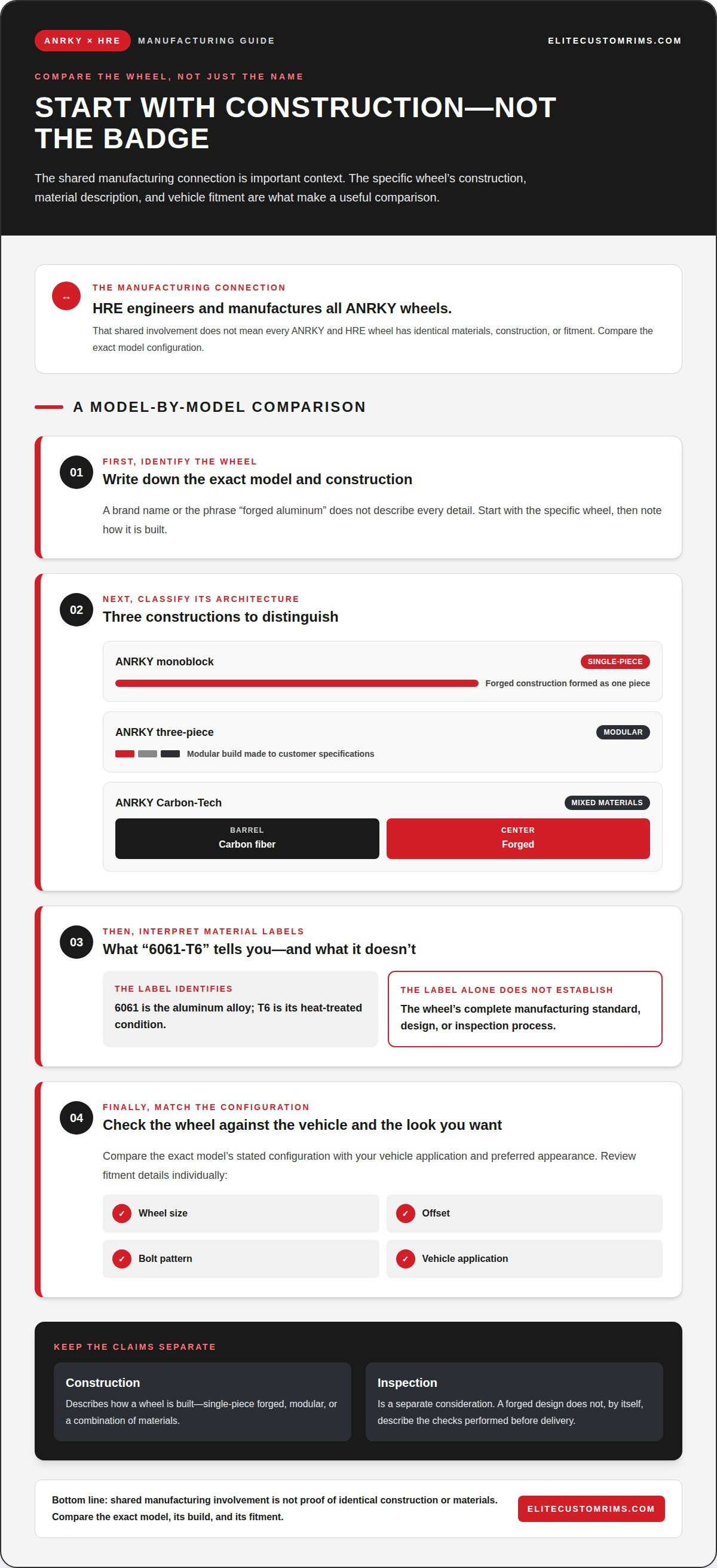
Construction is a useful place to start. ANRKY monoblock wheels use single-piece forged construction: each wheel is formed as one piece, rather than assembled from separate sections. ANRKY three-piece wheels have a modular design made to customer specifications. These methods affect how a wheel is built and configured, so they are not interchangeable descriptions.
HRE engineers and manufactures all ANRKY wheels, but that does not mean every ANRKY and HRE wheel is identical. The ANRKY wheels vs HRE manufacturing standards comparison depends on the specific model, construction, material description, and fitment. Focus on the stated configuration, not just the brand name. A one-piece forged wheel and a modular three-piece wheel have different constructions, even when associated with the same manufacturer.
6061-T6 is an aluminum alloy and temper designation buyers may encounter. The alloy number identifies the material, while T6 identifies its heat-treated condition. Don’t treat that label alone as proof of a wheel’s complete manufacturing standard. Compare the specific wheel’s stated construction and intended vehicle fitment. A material label cannot, by itself, describe the full design or inspection process.
ANRKY Carbon-Tech wheels combine a carbon-fiber barrel with a forged center, unlike an all-forged, single-piece design. This is why “forged” may describe only part of a wheel’s structure. Identify the barrel, center, and assembly method separately, then consider whether the configuration suits your vehicle and design priorities.
When comparing ANRKY wheels vs HRE manufacturing standards, don’t treat shared manufacturing involvement as proof of identical materials or construction. Compare each model’s stated configuration and fitment. Before choosing, distinguish a single-piece forged design from a modular or carbon-fiber assembly.
First, note the exact wheel model and construction. Then compare those details with your vehicle application and preferred appearance. The phrase “forged aluminum” doesn’t answer every question. ANRKY’s single-piece, three-piece, and Carbon-Tech designs show why it pays to review construction details closely.
What quality-control and inspection standards do ANRKY and HRE follow?
Brand names alone don’t tell you how a wheel is inspected. For ANRKY and HRE, compare the published quality-control details for the specific model and construction. Keep manufacturing claims separate from inspection claims: a forged design describes how a wheel is built, not the checks it undergoes before delivery. This keeps the comparison grounded in evidence rather than assumptions.
Start with fitment and dimensions. Check that the wheel’s stated size, offset, bolt pattern, and vehicle application match your intended setup. Assess each detail separately. Even a premium wheel may not suit your vehicle if its dimensions are incompatible. Review specifications for the exact model, not a general brand description.
Next, look for clear information about inspection stages. Useful details may explain how dimensional accuracy, assembly, and finish are assessed. These are categories to compare, not claims about procedures used by either brand. A finish review, for instance, addresses the visible surface, not structural test results. Keep each type of evidence distinct.
Use a simple comparison record for each wheel:
- Model: Write the exact ANRKY or HRE design.
- Fitment: Note the vehicle application and listed dimensions.
- Inspection: Record the quality-control steps described for that model.
- Evidence: Separate stated procedures from broad quality language.
This process helps you identify gaps in a claim without guessing. If HRE and ANRKY descriptions use different terms, compare what each term covers. A claim about finish consistency is not evidence of dimensional checks. Likewise, an inspection reference should not be assumed to cover every wheel configuration.
For a useful ANRKY-versus-HRE quality comparison, prioritize model-specific procedures, fitment details, and the scope of each inspection claim. Shared manufacturing involvement doesn’t prove that inspections are identical. Compare the same vehicle application and type of evidence for the specific wheel you’re considering.
Do ANRKY or HRE publish SAE, JWL, or VIA certifications?
A brand-wide statement doesn’t establish certification for every wheel. Treat SAE, JWL, and VIA references for ANRKY or HRE as model-specific evidence. The exact wheel and supporting documentation matter, so don’t assume a certification applies across a brand’s range. A monoblock, modular wheel, or different vehicle fitment may have separate documentation.
Keep three things distinct: a testing reference, a certification claim, and a published document. They are not interchangeable. A product description that mentions a standard, for example, doesn’t automatically prove the named wheel was certified under it. Look for the exact model designation and documentation linking that wheel to the stated reference. Then check that the document’s scope matches the wheel you’re considering.
Use this practical review for each ANRKY or HRE model:
- Identify the wheel: Record its exact name and construction.
- Find the reference: Note whether SAE, JWL, or VIA appears.
- Match the evidence: Check that the documentation names the same model.
- Read the scope: Separate a testing statement from a certification statement.
This approach prevents a broad brand statement from standing in for model-level proof and keeps different standards distinct. A reference to JWL, for example, should not be treated as a VIA or SAE certification. Compare like with like, rather than drawing conclusions from a logo or brief marketing phrase.
Do ANRKY or HRE publish these certifications? It depends on the specific wheel and the documentation available for it. A blanket yes or no for either brand overlooks model differences. For a sound comparison, note the standard named, the wheel it covers, and what the document actually claims. If those details don’t align, don’t treat the reference as evidence for another model. This review complements checking fitment and inspection claims, without confusing them with certification proof.
How do ANRKY and HRE wheel warranties and structural guarantees compare?
Compare the written warranty terms for the specific ANRKY or HRE wheel. A brand name alone doesn’t show what a warranty covers. Distinguish structural defects from finish issues, since one statement may not address both. Review the terms alongside the model and its intended vehicle application.
Read the warranty document for its scope, exclusions, and claim process. Note whether it covers materials, workmanship, finish, or structural failure. Check any named conditions that could affect coverage, such as installation or wheel use. Don’t assume the terms for one model apply to every ANRKY or HRE design.
A structural guarantee needs precise wording, too. Look for the component named, the type of failure covered, and the remedy offered. A statement about wheel structure, for example, shouldn’t be read as coverage for cosmetic damage unless the document says so. Likewise, finish coverage doesn’t establish protection against structural failure.
Use this comparison checklist for each brand and wheel:
- Model: Match the warranty to the exact ANRKY or HRE design.
- Coverage: Separate structural, workmanship, and finish terms.
- Limits: Record exclusions and stated conditions.
- Process: Note required documentation and claim steps.
This method makes the comparison useful without treating marketing language as a guarantee. Compare the details directly if one document describes a remedy and another sets out coverage boundaries. Keep the written terms with the wheel’s model information for reference if a warranty question arises.
For a fair ANRKY and HRE comparison, use equivalent documents and categories. Don’t rank either brand from a general assurance alone. Review the specific terms before deciding which wheel better fits your priorities. If you’re also matching a premium wheel to your vehicle, explore luxury wheel options by application and design.
Compare the warranty terms for the exact ANRKY and HRE models, distinguishing structural protection from finish coverage. Review each document’s exclusions, conditions, claim process, and stated remedy instead of treating a general assurance as a guarantee.
Elite Custom Rims: Audi Wheels
Elite Custom Rims helps drivers explore wheel options for Audi and find a style that suits their build. Its Audi Wheels are a practical next step when you’re ready to move from comparing manufacturing claims to choosing wheels for your vehicle. Match your selection to your Audi model and preferred look, or explore other categories, including Chevy/GMC Wheels, Mercedes Wheels, and Porsche Wheels.
For a focused next step, narrow your choice by vehicle make and design priorities. That keeps the search practical and centered on the fit and appearance you want. Visit elitecustomrims.com to explore Audi Wheels or contact Elite Custom Rims.
Make Your Next Wheel Choice With Confidence
Comparing ANRKY wheels and HRE manufacturing standards can clarify what matters to you. Use that research to choose based on your vehicle, preferred design, and the look you want for your build. A considered decision starts with wheels that suit both your car and your style.
For your next step, explore options by vehicle. Elite Custom Rims offers Audi Wheels, Chevy/GMC Wheels, and Mercedes Wheels. Choose the category that matches your vehicle, then narrow your preferences around the look you want.
Contact Elite Custom Rims to explore your options and move your wheel decision forward with confidence.
Frequently Asked Questions
How are ANRKY wheels manufactured, and what manufacturing methods are used?
HRE engineers and manufactures ANRKY wheels, which use different construction methods across the range. Designs include single-piece forged monoblock wheels, modular three-piece wheels, and Carbon-Tech wheels that combine a forged center with a carbon-fiber barrel. To understand how a specific wheel is built, identify its model and review its construction description. Don’t assume every ANRKY wheel has the same construction.
What aluminum alloys and forging processes do ANRKY and HRE use?
ANRKY monoblocks use single-piece forged construction; its three-piece wheels are modular, and Carbon-Tech wheels pair a carbon-fiber barrel with a forged center. 6061-T6 identifies an aluminum alloy and temper, but does not establish which alloy a specific wheel uses.