
A one-piece wheel isn’t automatically the better value. The Forgeline one-piece monoblock vs. two-piece bolt-together comparison comes down to what each construction offers: Carbon+Forged wheels pair a precision-machined forged aluminum center with a carbon fiber barrel, assembled with forty ARP fasteners. Forgeline and Dymag collaborated for three years to develop the barrel, which Forgeline describes as highly resistant to impact and fatigue.
Weight, price, and performance are natural priorities when choosing a premium wheel. But the best fit also depends on your vehicle, desired fitment, and how much you value finish flexibility. Monoblock and multi-piece designs serve different priorities, so the right choice isn’t just about appearance.
This comparison covers construction, weight and performance, fitment, finish options, and value. Learn what the Carbon+Forged design offers, how it differs from a one-piece monoblock, and which factors should guide your decision.
Key Takeaways
- Choose by how you use the vehicle: daily driving, track sessions, and show builds can call for different wheel priorities.
- Compare unsprung weight as part of the full performance picture, not as the only measure of a wheel’s value.
- Think through fitment and finish flexibility before deciding whether a one-piece or multi-piece construction better suits your build.
- Assess price alongside construction, intended use, and the value of the features you’ll actually benefit from.
Unsprung weight and vehicle performance
Wheel weight matters because wheels move with the suspension and rotate as the vehicle travels. Reducing mass at the wheel can help the suspension respond to bumps and changes in grip. Rotational mass also affects the effort required to accelerate and slow the wheel. The result depends on the complete wheel-and-tire assembly, not construction type alone.
There’s no reliable weight winner based only on “monoblock” or “two-piece.” Diameter, width, design, and materials all affect the finished wheel. Compare the actual weights of wheels with matching sizes and specifications. A lighter wheel may support sharper responses, but fitment and intended use matter too.
Forgeline’s VV1R Beadlock shows why construction details count. Its wheel is machined from one forging of 6061-T6 aluminum, while its forged-aluminum beadlock ring attaches with 21 lightweight titanium bolts. By contrast, Forgeline Carbon+Forged wheels pair a precision-machined forged 6061-T6 aluminum center with a carbon fiber barrel and forty ARP fasteners. These details describe construction, not a guaranteed weight difference.
| Option | Construction | Weight comparison | Performance consideration |
|---|---|---|---|
| One-piece monoblock | Wheel machined from one forging | Compare the finished wheel’s stated weight | Fewer construction interfaces |
| Two-piece Carbon+Forged | Forged aluminum center, carbon fiber barrel, forty ARP fasteners | Compare against a matching monoblock size | Material combination and build priorities matter |
For a fair comparison, match diameter, width, offset, and load application. Then compare complete wheel weights and account for the tire, since its mass also rotates and moves with the suspension. A small difference on paper may matter less than correct fitment or a construction choice suited to the vehicle.
If reducing wheel-and-tire mass is your priority, choose the lighter suitable option. Base your decision on complete specifications, not the one-piece or two-piece label alone.
What are the Benefits of Forgeline Two-Piece Carbon+Forged Wheels?
Forged one-piece wheels have a single-piece construction, while two-piece wheels combine separate components. A one-piece design has no center-to-barrel assembly joint. A two-piece design can combine different materials, but its fasteners and interfaces add construction details to consider.
Forgeline’s named examples include the VV1R Beadlock, machined from one forging, and Carbon+Forged wheels, built as two-piece designs. Carbon+Forged uses a precision-machined forged aluminum center and a carbon fiber barrel, assembled with forty ARP fasteners.
Forgeline and Dymag collaborated for three years to develop the carbon fiber barrel. Forgeline describes the barrels as highly resistant to impact and fatigue. Those design attributes explain the material choice, but they don’t establish a specific wheel’s weight or suitability for every vehicle.
For daily driving, weigh the desired ride and appearance against fitment and intended use. For track driving, prioritize the wheel’s application, weight, and documented engineering. For a show build, consider how the center-and-barrel construction supports your desired design. Carbon+Forged may appeal if its material contrast and construction are priorities; a forged one-piece wheel may suit a simpler assembly.
For safety and quality control, focus on concrete product documentation. Match the wheel to the vehicle and intended use. Review its load rating, dimensions, and fitment details, then examine the manufacturer’s testing and quality-control information. Forty fasteners are a construction detail, not proof of suitability or performance on their own.
Wheel choice depends on the whole build, not just the number of pieces. A commuter prioritizing straightforward construction may prefer a monoblock; a track or show build may value Carbon+Forged’s carbon barrel and forged center. Compare wheels with matching sizes and application details.
Fitment and finish flexibility
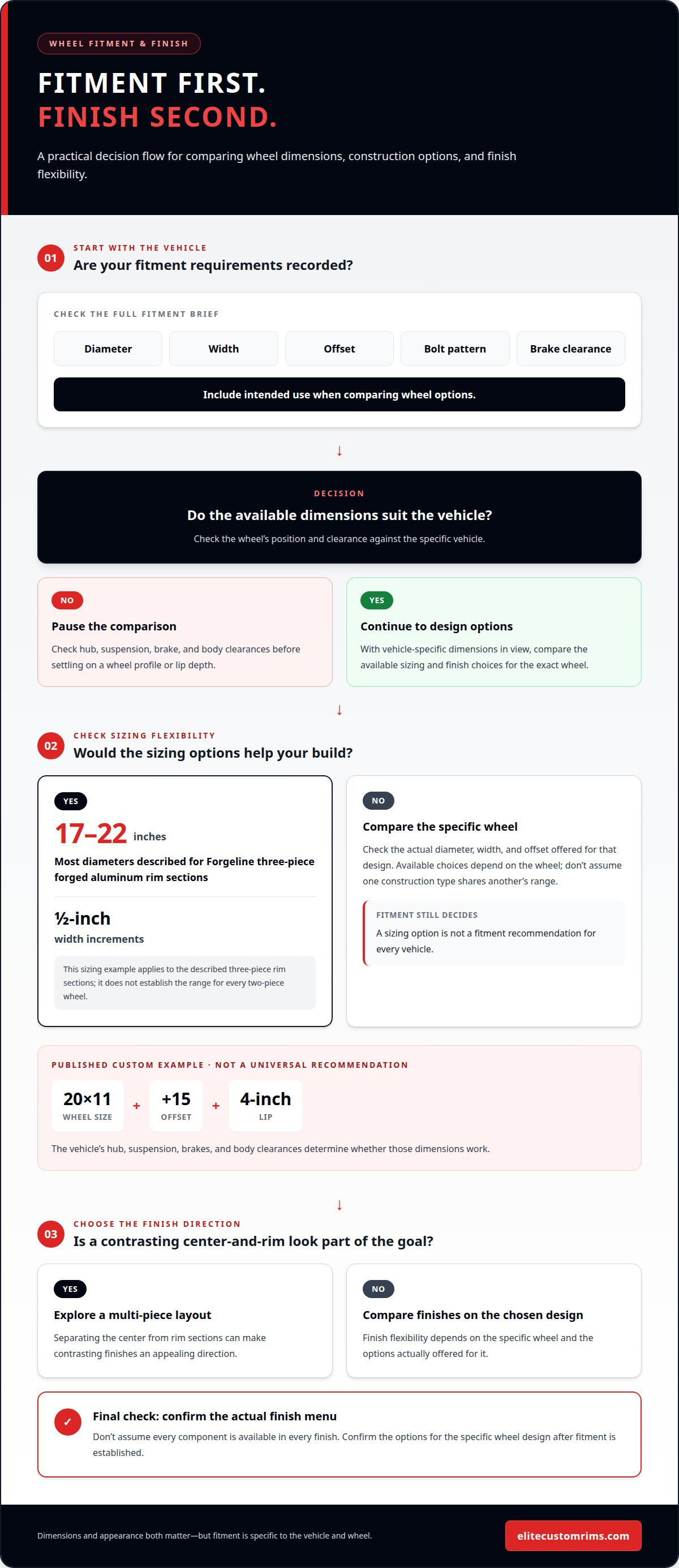
Fitment starts with the vehicle, not the wheel’s construction label. Record the required diameter, width, offset, bolt pattern, and brake clearance before comparing a monoblock with a multi-piece design. Each measurement affects how the wheel sits and clears surrounding components. The right visual style still needs dimensions suited to the specific vehicle.
Forgeline describes its three-piece forged aluminum rim sections as available in most diameters from 17 to 22 inches, with width options in half-inch increments. Its construction combines a forged aluminum center with spun aluminum inner and outer rim sections. Those options illustrate how a multi-piece wheel can offer a range of sizing choices; they don’t establish that every two-piece wheel has the same range.
A published custom example is a 20x11 +15 wheel with a 4-inch lip. Treat those figures as an illustration, not a universal fitment recommendation. The vehicle’s hub, suspension, brakes, and body clearances determine whether a particular width and offset work. Compare those points before settling on a profile or lip depth.
Finish flexibility depends on the design and options offered for the specific wheel. A multi-piece layout visually separates the center from the rim sections, which can make contrasting finishes an appealing direction. Don’t assume every component is available in every finish. Identify your preferred look, then compare the actual finish options for that wheel design.
Use this practical sequence for a street build or show car:
- Write down the vehicle’s fitment requirements and intended use.
- Compare available diameter, width, offset, and brake clearance.
- Choose a finish treatment that suits the wheel’s construction and your build.
In the Forgeline one-piece monoblock versus two-piece bolt-together comparison, the deciding advantage is the match between dimensions and design priorities. A monoblock may suit a clean, unified look; a multi-piece format may appeal when section proportions and a layered appearance matter. Start with verified fitment, then refine the finish.
Price and cost
A construction label alone can’t predict a wheel’s final cost. Compare the exact wheel specifications, materials, finish, and included hardware. For example, a forged center paired with a carbon fiber barrel uses different materials from a one-piece forged wheel. Those choices affect what you’re buying, but don’t establish a universal price difference.
Build a like-for-like comparison before judging value. Match diameter, width, offset, vehicle application, and finish, then compare the same number of wheels with equivalent specifications. Forgeline’s Carbon+Forged design uses a forged aluminum center, a carbon fiber barrel, and forty ARP fasteners. Compare that complete construction with the monoblock alternative rather than comparing labels alone.
Ownership costs can also depend on maintenance and repair. Forgeline describes three-piece wheels with separate forged centers and spun inner and outer rim sections. Replaceable parts may matter over long-term use, but that benefit applies to the relevant multi-piece construction, not automatically to every two-piece wheel. Keep this distinction in mind when evaluating lifetime value.
For three-piece wheels, a well-maintained RTV or gasket seal can last many years under normal street use, and periodic seal inspection is recommended. A 5-7-year street-use example illustrates why replaceable sections may factor into long-term value. It isn’t a lifespan guarantee or a cost estimate. Properly engineered three-piece hardware is designed to handle the same load paths as a monoblock.
- Compare the same fitment and finish, not different wheel specifications.
- Separate initial purchase value from repairability and maintenance considerations.
- For a three-piece option, include seal inspection and replaceable sections in your ownership assessment.
Choose the construction whose features fit your driving plans and ownership priorities, not the one with the most impressive label. Explore wheel options for your vehicle as you narrow down the style and fitment that suit your build.
Elite Custom Rims: Audi Wheels
Elite Custom Rims helps you move from comparing wheel construction to choosing wheels for your vehicle. If your build is an Audi, explore Audi Wheels and consider how fitment, appearance, and intended use align with your priorities. The same approach applies to Chevy/GMC Wheels, Mercedes Wheels, and Porsche Wheels. Compare the specifications and styling that matter for your vehicle, then narrow your options to wheels suited to your build. Construction is one part of the decision; the right wheel also needs to work with your vehicle and the look you want.
Visit elitecustomrims.com to explore Audi Wheels and other options for your vehicle.
Turn Your Priorities Into a Wheel Choice
Make the decision practical by writing down what matters most for your build before choosing a construction. Put those priorities in order, then use them to assess each candidate wheel. This keeps an appealing finish or construction detail from overshadowing your vehicle’s requirements.
Your Forgeline one piece monoblock versus two piece bolt together decision should leave you with a clear reason for choosing one design. Note the intended use, required fitment, preferred appearance, and ownership priorities. If a wheel meets those needs, keep it on your shortlist. If it doesn’t, move on.
Use that shortlist to focus your next conversation on the vehicle and the result you want. Contact Elite Custom Rims for wheel advice and take the next step toward a setup that feels right for your build.
Frequently Asked Questions
Which should you buy?
Choose the wheel that best matches your vehicle, intended use, and design priorities. For a street-focused build, prioritize correct fitment and a style you’ll enjoy every day. For track use, weigh the complete wheel specifications and documented application. For a show build, decide how much the construction and finish options contribute to your desired look. Compare equivalent sizes before making your choice.
What is the difference between Forgeline one-piece monoblock and two-piece wheels?
A one-piece monoblock is made as a single wheel structure, while a two-piece wheel joins separate components. Forgeline’s Carbon+Forged design pairs a forged aluminum center with a carbon fiber barrel. This material combination distinguishes it from a forged monoblock. The practical choice depends on the wheel’s specifications and your priorities, not simply the number of pieces.
How are Forgeline monoblock wheels manufactured compared with two-piece wheels?
Forgeline’s VV1R Beadlock is machined from one forging of 6061-T6 aluminum. Its Carbon+Forged wheel instead combines a precision-machined forged aluminum center and carbon fiber barrel, secured with forty ARP fasteners. The manufacturing distinction is whether the wheel is formed as one piece or assembled from separate components. Compare the construction of the exact wheel design you’re considering.
How do Forgeline one-piece and two-piece wheels compare in weight and strength?
Neither construction is automatically lighter or stronger across every size and application. Compare actual weights for wheels with matching dimensions, then consider the complete wheel-and-tire combination. Forgeline states that properly engineered three-piece hardware is designed to handle the same load paths as a monoblock. That statement describes engineering intent, not a universal strength ranking for every two-piece design.
How do Forgeline monoblock and two-piece wheels compare in price?
There’s no useful price comparison based only on construction type. The final cost depends on the specific wheel, materials, dimensions, finish, and configuration. Compare equivalent applications and included components rather than a monoblock with a differently sized or specified multi-piece wheel. Then weigh the features you’ll use against your build’s overall ownership priorities.
How do wheel width, offset, and fitment options differ between Forgeline monoblock and two-piece wheels?
Fitment depends on the exact wheel design and vehicle, not just whether it’s one-piece or two-piece. Compare width and offset alongside the bolt pattern, brake clearance, and space around suspension and bodywork. For example, a wider wheel can affect clearance and positioning. Confirm the full specification against your vehicle before selecting a finish or finalizing the build.