
Why does your high-performance Tesla or Audi often feel sluggish off the line, despite having hundreds of horsepower at your disposal? The culprit is likely your heavy factory wheels. Most luxury owners feel stuck between two frustrating options: keeping heavy OEM alloys that dull handling or risking brittle, cheap cast wheels that crack on the first pothole they hit. You want the elite performance of flow formed wheels, but you shouldn't have to pay a small fortune to get it.
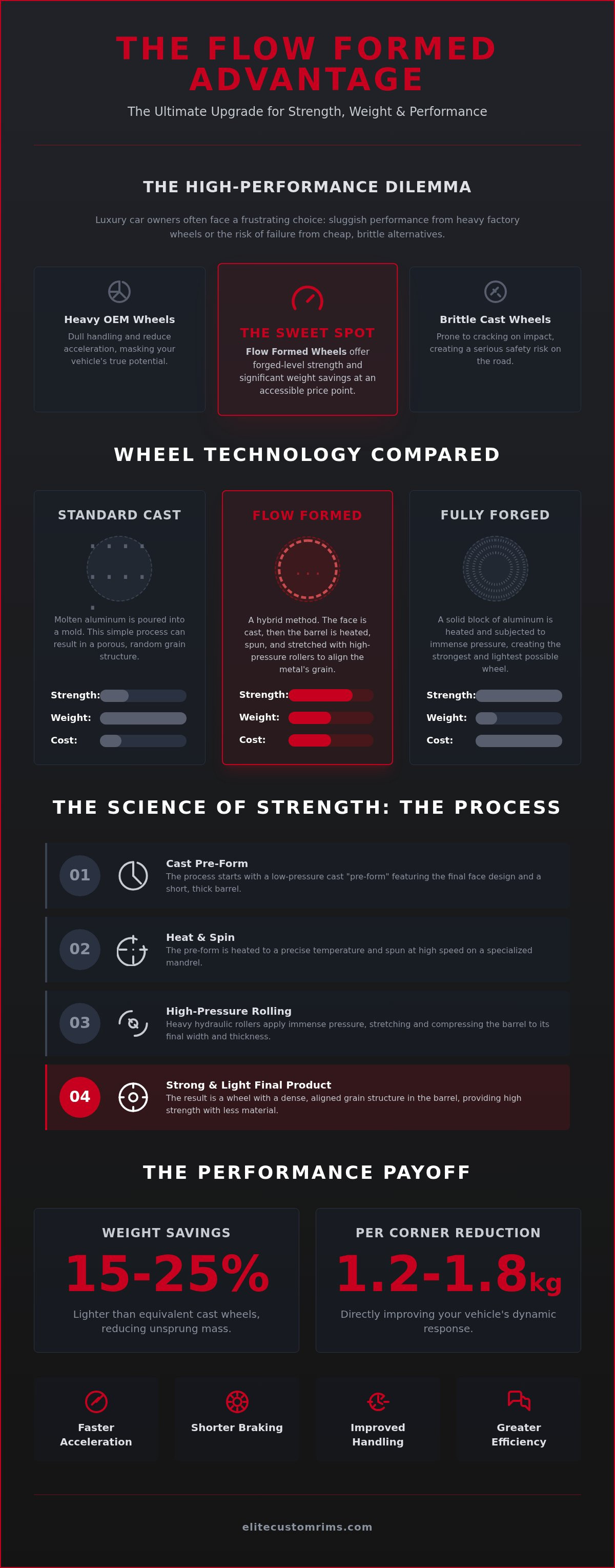
We promise to show you why these wheels are the ultimate "sweet spot" for luxury vehicles, offering forged-level strength and massive weight savings at a fraction of the cost. This guide explores how the flow forming process creates a grain structure similar to high-end forged steel, resulting in products that are 15% to 25% lighter than standard cast options. You'll discover how shedding 1.2 to 1.8 kg per corner improves your vehicle's acceleration, braking, and efficiency. It's the premium aesthetic upgrade your luxury vehicle deserves; it's a smart investment in both style and performance.
Key Takeaways
- Master the hybrid manufacturing process that uses heat and high-pressure rollers to create a high-tensile, lightweight inner barrel.
- Discover why flow formed wheels are the ideal performance choice for luxury owners who demand forged-level strength without the premium price tag.
- See how shedding unsprung weight directly improves acceleration and extends battery range for performance EVs like the Tesla Model Y.
- Learn to match load ratings and offsets for a perfect, flush fitment on heavy luxury SUVs and high-performance sedans.
What Are Flow Formed Wheels? Understanding the Hybrid Process
You've likely heard the term flow formed wheels tossed around in enthusiast circles or at the dealership. It isn't just marketing fluff; it's a specific engineering achievement. Think of it as the ultimate hybrid. The process begins with a specialized low-pressure cast "pre-form." This initial piece looks like a shorter, thicker version of the final wheel. It has the face design already cast in, but the barrel is waiting for its transformation.
This is where the magic happens. The pre-form is placed on a specialized machine that spins it at high speeds while heating it to a precise metallurgical temperature. Heavy hydraulic rollers then apply immense pressure to the barrel. They stretch and compress the aluminum over a mandrel, shaping it into its final width. This flow forming process fundamentally changes the metal's properties. By mechanically manipulating the aluminum, the grain structure is compressed and aligned. This results in a barrel with a grain density similar to a fully forged wheel, providing high-tensile strength without the massive price tag of a forged block.
Industry professionals often call this "Flow Forging" or "Rim Rolling." While those names sound different, they describe the same goal: creating a wheel that is significantly stronger and lighter than a traditional cast rim. You get the best of both worlds. The face remains cast, allowing for the complex, deep-concave designs seen on modern Teslas and Audis, while the barrel becomes wrought and incredibly resilient. It's a smart, value-driven evolution in wheel technology.
The Anatomy of a Flow Formed Rim
A flow formed wheel is a tale of two halves. The cast face is where the style lives. Because it's cast, designers can create intricate spoke patterns and aggressive aesthetics that are difficult to achieve with traditional forging. The wrought barrel is where the performance lives. Because the metal is stretched and thinned during the rolling process, it requires less material to achieve higher strength. This is how you save weight. The molecular structure of the aluminum is literally pulled into alignment, making the barrel more resistant to impacts and potholes.
A Brief History of Flow Forming in Motorsports
This technology didn't start in a luxury showroom. It started on the track. Performance teams needed wheels that could handle high G-forces and curb strikes without the weight penalty of heavy casting. For years, this was an elite racing secret. Eventually, the technology transitioned to the premium consumer aftermarket. Today, luxury brands are increasingly adopting flow formed wheels for their factory "Performance" packages. They recognize that for heavy, high-torque vehicles like a Mercedes or a Porsche, a standard cast wheel just doesn't cut it anymore. It's no longer just for racers; it's the new standard for the modern luxury enthusiast.
For enthusiasts who demand the same high-end performance and comfort in every journey, you can discover Epic Limousines for premium chauffeur-driven services in Switzerland utilizing an elite Mercedes-Benz fleet.
The Science of Strength: How Flow Forming Works
Understanding the shift from a basic cast wheel to a high-performance component requires looking at the mechanical transformation. It starts with a precision-engineered pre-form. This isn't your standard finished wheel; it’s a specialized, low-pressure cast piece with a thick, abbreviated barrel and a fully formed center disk. This pre-form acts as the foundation for the entire engineering cycle, providing the raw material needed for the subsequent stretching phase.
Next, the pre-form enters a thermal stage. It’s heated to a specific metallurgical temperature, ensuring the aluminum alloy reaches a state of high ductility without losing its structural form. Once heated, the wheel is mounted on a mandrel and spun at high speeds. Hydraulic rollers then descend, applying immense pressure to "stretch" and compress the barrel to its final width. This mechanical work is exactly why The Science of Strength: How Flow Forming Works is so critical for modern performance vehicles. The process yields a barrel with mechanical properties that rival fully forged wheels but at a significantly lower production cost.
If you're ready to see how this engineering translates to style, explore our latest collection of flow formed wheels for luxury brands.
Grain Alignment and Tensile Strength
Think of grain flow like the fibers in a piece of wood. In a standard cast wheel, the aluminum molecules are random and disorganized. This can lead to porosity, which are tiny microscopic air bubbles that weaken the metal. Flow forming changes the game. As the rollers compress the barrel, they align these "grains" in a continuous, longitudinal direction. This alignment eliminates air pockets and creates a much tighter molecular bond. Increased material density through flow forming leads directly to higher impact resistance and structural integrity.
Heat Treatment and Final Finishing
Strength isn't just about pressure; it's about stability. After the rolling process, the wheels undergo T6 heat treatment. This multi-stage thermal process stabilizes the alloy, locking in the strength gains achieved during flow forming. Following heat treatment, the wheels are moved to CNC machining stations. Here, every millimeter is checked for perfect balance and runout to ensure a vibration-free ride. Finally, every design is tested against JWL and VIA standards to ensure they can handle the heavy load ratings required for a Cadillac Escalade or a Tesla Model X.
Flow Formed vs. Cast vs. Forged: Which Is Right for You?
Choosing between manufacturing methods shouldn't be a guessing game. It's a balance of physics and finance. Cast wheels serve as the budget-friendly entry point. They're affordable but come with a weight penalty. Because the metal is less dense, manufacturers must use more of it to ensure safety, leading to a sluggish feel behind the wheel. Fully forged wheels represent the elite peak. They are carved from a solid block of aluminum for maximum density. They're the lightest and strongest, but the price tag often exceeds what a daily driver requires.
Flow formed wheels occupy the high-value middle ground. You get the design flexibility of a cast face with the structural integrity of a forged barrel. It's the smartest return on investment for any luxury enthusiast. You aren't just buying a look. You're buying a mechanical advantage that transforms how your car interacts with the road. It delivers the performance characteristics of a high-end racing wheel without the extreme price tag of fully forged alternatives.
Weight Comparison and Performance ROI
Weight matters. Specifically, unsprung rotational mass matters. Switching to flow formed options typically yields weight savings of 15% to 25% compared to standard gravity cast wheels. For a typical 18 to 20-inch fitment, this translates to shedding roughly 1.2 to 1.8 kg per corner. This is a massive reduction for any high-performance setup.
This reduction does more than just look good on a spec sheet. It directly improves your 0-60 mph times by making it easier for your engine or electric motor to spin the wheels. Braking distances shrink. Suspension response sharpens. Your car feels lighter on its feet because the dampers don't have to fight heavy, oscillating mass at every bump. For Audi performance sedans or Porsche owners, this translates to a more visceral, connected driving experience.
Durability and Pothole Resistance
Strength isn't just about carrying a static load. It's about how the wheel fails under stress. Standard cast wheels are often brittle; a severe pothole strike can cause them to shatter or crack. Flow formed barrels possess a compressed grain structure that allows them to bend rather than break. This ductility is a lifesaver for heavy luxury vehicles like the Land Rover, Cadillac Escalade, or Rolls Royce.
Before you commit to a specific style, understand the Custom Wheels pillar basics regarding offset and width. Ensuring a perfect fitment is the first step toward long-term reliability. For high-torque EVs and heavy SUVs, the increased structural integrity of flow forming provides essential peace of mind on unpredictable roads. You get a premium aesthetic and the confidence that your wheels can handle the daily grind.
Performance Benefits: Why Your Tesla or Audi Needs Flow Forming
Most drivers underestimate how much their factory wheels hold them back. Replacing heavy OEM alloys with flow formed wheels is the single most effective way to unlock hidden performance. It isn't just about total vehicle weight. It's about where that weight is located. Improved acceleration. Sharper braking. Enhanced efficiency. These aren't just buzzwords; they're the direct result of reducing rotational mass.
Losing 5 lbs of unsprung weight per wheel can feel like removing 100 lbs of dead weight from your trunk. This is because rotational mass requires significantly more energy to accelerate and decelerate than static cargo. Unsprung weight refers to the mass of components not supported by your vehicle's springs, and reducing it directly extends the service life of your shock absorbers and bushings. Beyond simple physics, the increased material density in the barrel conducts heat away from your rotors more efficiently. This prevents brake fade during spirited driving. You also gain the ability to run aggressive, "deep concave" profiles that define modern luxury styling without the weight penalty of a thick cast rim.
Maximizing Tesla Efficiency
Every Tesla owner watches their range. Heavier wheels increase your "Watt-hours per mile" (Wh/mi), effectively shrinking your usable battery capacity. By switching to a lighter flow formed setup, you reduce the strain on your electric motors during rapid acceleration. This efficiency boost helps preserve your range while maintaining the car's signature instant torque feel. It's a smart investment for any EV enthusiast. Check out our Tesla Model Y wheels guide for specific fitment data and range-optimized designs.
Handling Precision for Audi and Mercedes Sedans
Heavy wheels act like a gyroscope, resisting rapid changes in direction. Lighter wheels reduce steering effort and provide a much sharper "turn-in" feel when you enter a corner. This allows your suspension to track road imperfections with surgical accuracy. Instead of the wheel crashing over a bump, the suspension can react quickly, keeping the tire contact patch stable. The result is a more visceral, connected driving experience that factory wheels simply can't match.
Ready to transform your ride? Upgrade your driving dynamics today by browsing our curated selection of flow formed wheels.
Choosing Your Flow Formed Setup at Elite Custom Rims
Precision is everything. When you transition from factory alloys to performance-grade wheels, the technical details determine whether you feel an upgrade or a headache. Selecting the right diameter and offset is the first step toward achieving a flush, OE-style fitment. An incorrect offset can cause wheels to sit too far inside the wheel well or, worse, rub against the suspension components. We take the guesswork out of this process by verifying every fitment for your specific luxury make and model.
Load ratings are non-negotiable, especially for high-torque EVs and heavy luxury SUVs. A Tesla Model X or a Cadillac Escalade carries significantly more weight than a standard sedan. You need flow formed wheels that are engineered to handle these specific stresses. We ensure that your chosen setup meets or exceeds the load requirements of your vehicle, providing peace of mind during high-speed travel or heavy cornering. Integrity isn't just a feature; it's a safety requirement.
Vibration-free driving requires a hub-centric design. Many generic aftermarket wheels use a large center bore to fit multiple cars, often leading to steering wheel shake at highway speeds. We focus on designs that match your vehicle's hub diameter exactly or utilize high-quality hub-centric rings. This ensures the wheel is perfectly centered on the axle. It's the final detail that separates a professional installation from a DIY disappointment.
Fitment Spotlight: Audi and Porsche
Achieving the perfect stance for an Audi Q7 or a Porsche Cayenne requires a deep understanding of brake clearance. These vehicles often feature massive multi-piston performance calipers that can interfere with standard wheel spokes. Our curated selection of flow formed wheels accounts for these clearances while maintaining an aggressive, concave aesthetic. For a deeper dive into specific measurements, consult our Audi Q7 wheels guide to ensure your new setup is flawless from day one.
The Elite Custom Rims Advantage
We're the authoritative specialist in luxury wheel compatibility. Our team doesn't just sell parts; we provide a curated experience for enthusiasts who demand the best. Every order undergoes a rigorous fitment verification process to eliminate any chance of rubbing or clearance issues. You get the latest styles, elite performance gains, and the security of expert support. We offer fast national shipping to get your upgrade to your door without delay. Don't settle for "close enough" when it comes to your vehicle's performance and safety.
Browse our Flow Formed Wheel Collection and discover the perfect match for your vehicle today.
Elevate Your Performance and Style Today
The hybrid manufacturing process delivers the ultimate "sweet spot" for modern driving. Choosing flow formed wheels means you're no longer compromising between the sluggish weight of standard casting and the extreme cost of fully forged options. You get a high-tensile barrel that sharpens your handling, improves your Tesla’s efficiency, and protects your investment against daily road hazards. It's the smartest performance ROI available for any luxury enthusiast.
At Elite Custom Rims, we specialize in high-quality, performance-tested lightweight alloys designed specifically for brands like Audi, Porsche, and Mercedes. We take the guesswork out of the equation with guaranteed fitment for every luxury brand we support. Our professional assurance means no rubbing, no vibrations, and no stress. With fast national shipping on all premium orders, your vehicle's transformation is only a few clicks away.
Upgrade your performance today with Elite Flow Formed Wheels. Your vehicle is a masterpiece; ensure it's riding on the precision engineering it deserves.
Frequently Asked Questions
Are flow formed wheels as strong as forged wheels?
Flow formed wheels offer a massive strength advantage over standard cast options, though they aren't quite as dense as fully forged wheels. The manufacturing process compresses the aluminum barrel, creating a grain structure that mimics the tensile strength of forging. It's the ideal middle ground for daily performance. You get high-impact resistance and structural integrity without the extreme cost associated with carving a wheel from a solid forged block.
Do flow formed wheels improve gas mileage or EV range?
Yes, reducing rotational mass directly improves vehicle efficiency. Because flow formed wheels are roughly 15% to 25% lighter than traditional cast alloys, your engine or electric motor works less to spin them. For Tesla owners, this translates to lower Watt-hours per mile and extended battery range. For gas vehicles, it results in better fuel economy during stop-and-go driving. It’s a smart investment for any efficiency-conscious driver.
Can flow formed wheels be repaired if they get curb rash?
Flow formed wheels can be repaired using standard alloy wheel restoration techniques. Since the face is made from a specialized cast pre-form, curb rash can be sanded, filled, and refinished to look like new. Structural repairs to the barrel are also possible but should always be handled by a specialist. Always ensure the repair shop understands the metallurgical properties of the wheel to maintain its safety and balance.
What is the weight difference between flow formed and cast wheels?
The weight savings are substantial, typically ranging from 15% to 25% compared to standard gravity cast wheels. For a common 19-inch fitment, this often means a reduction of 1.2 to 1.8 kg per corner. While it sounds small, this reduction in unsprung weight feels like removing significantly more weight from the cabin. It transforms your car’s turn-in response and makes the suspension feel much more composed over road imperfections.
Are flow formed wheels suitable for heavy SUVs like the Cadillac Escalade?
Absolutely, provided the wheels carry the correct load rating for your specific SUV. Flow forming is actually preferred for heavy vehicles like the Cadillac Escalade or Land Rover because the compressed barrel is more resistant to bending under heavy loads. The increased density handles the high-torque and high-weight demands of modern luxury SUVs better than brittle cast alternatives. Always verify the load capacity before finalizing your purchase.
How can I tell if a wheel is flow formed or just cast?
Check the inner barrel or the manufacturer’s specifications for terms like "Flow Formed," "Rotary Forged," or "Rim Rolled." Visually, these wheels often feature thinner barrels and more aggressive, deep-concave faces that aren't possible with heavy casting. The weight is the ultimate giveaway. If a 20-inch wheel feels surprisingly light for its size, it’s likely utilized the flow forming process. Trust reputable specialists to provide verified technical data.
Why are flow formed wheels more expensive than standard alloy wheels?
The higher price reflects the advanced machinery and additional manufacturing steps required. Unlike simple gravity casting, flow forming involves specialized hydraulic rollers and precise thermal management to stretch the barrel. This extra labor and technology create a superior product with better performance characteristics. You're paying for a wheel that is both stronger and lighter, representing a significant engineering step up from basic, entry-level alloy wheels.
Do flow formed wheels require special tires or lug nuts?
No special tires are required, but you should always match the tire size to the new wheel’s width and offset. Regarding lug nuts, most aftermarket flow formed wheels use a conical seat rather than the ball seat often found on OEM luxury wheels. We always recommend checking the seat type and thread pitch during installation. Using the correct hardware ensures a secure fit and prevents damage to your new performance upgrade.