
What if the best defense against curb rash isn’t a wheel accessory, but a few better parking habits? Learning how to avoid curb rash on expensive rims starts with managing the space between the wheel and the curb. That margin can feel especially small with wider wheels or low-profile tires, making everyday parking stressful.
It’s reasonable to worry about a scrape. A curb can catch a rim during a tight turn or a rushed parking maneuver, and protective products can’t replace careful clearance. The good news is that small, repeatable adjustments can lower the risk without making every parking spot a guessing game.
This guide explains what causes curb rash and how to build safer habits, from using mirrors and cameras to stopping and repositioning when you’re unsure. You’ll also learn how wheel dimensions and tire sidewalls affect clearance, which protectors may help with impact, and why coatings won’t prevent a scrape. If damage happens, you’ll know what to inspect promptly and when to seek a professional assessment.
Key Takeaways
- Learn how to avoid curb rash on expensive rims by managing wheel-to-curb clearance instead of relying on a single protective product.
- Understand how wheel diameter, width, offset, tire sidewalls, and vehicle geometry can affect clearance.
- Compare practical prevention options and their limits, including careful parking, visual aids, and rim protectors.
- Use a simple parking routine: approach slowly, monitor the wheel’s position, and stop to reassess when clearance is uncertain.
- Document visible damage after an impact, but don’t assume a wheel is safe based on appearance alone.
What Is Curb Rash on Expensive Rims, and When Does It Happen?
Curb rash is visible damage to a wheel’s outer edge caused when it scrapes or strikes a curb or another hard surface. It may appear as a light scrape, chipped finish, or deeper gouge along the rim lip. The damage often happens at low speed, which can make it seem minor. But appearance alone can’t confirm whether an impact has affected the wheel’s structure.
A superficial mark may be limited to the finish. A deeper gouge can remove material or expose the wheel beneath its coating. After a hard impact, don’t assume the wheel is safe just because the mark looks small. Watch for changes such as vibration or air loss, and have concerning damage assessed by a qualified professional.
The risk is easy to underestimate because drivers judge a parking space from the seat, not from the wheel’s outer edge. The rim is the outer part of the wheel assembly; this overview of a wheel rim explains the component in more detail. Knowing where the rim sits relative to the tire helps explain why a small steering adjustment can bring it close to a hard edge.
Which everyday situations make rim contact more likely?
Parallel parking leaves little room for error as you ease toward the curb and straighten the vehicle. In a tight garage, a wall, post, or neighboring car may limit your angle and make it harder to judge the wheel’s position. A narrow driveway can create a similar squeeze. Approaching a curb at an angle may bring one wheel close before the rest of the car looks aligned.
Rushing makes these situations harder. Poor light, rain, glare, or a blocked view can hide the curb’s exact position. An unfamiliar vehicle adds uncertainty because you may not yet know how its front wheels track during a turn or how far the body extends beyond them. Even a familiar parking spot can catch you out if you focus on the bumper and lose sight of the wheel path.
Why can expensive or low-profile rims feel more vulnerable?
Price alone doesn’t determine how exposed a wheel is. The wheel-and-tire setup matters: a shorter tire sidewall can leave less visible rubber cushioning between the rim edge and a curb. Wheel width and its position on the vehicle also affect how close the outer edge sits to nearby obstacles. The full setup and vehicle geometry shape clearance, so no single detail tells the whole story.
A premium wheel isn’t automatically more protected, and a less expensive one isn’t immune to scraping. Distinctive finishes can also make a fresh mark stand out, even when the visible damage seems limited. Treat the wheel edge as vulnerable during close maneuvers, whatever the wheel’s price or material.
How Wheel Fitment, Tire Sidewalls, and Visibility Affect Curb-Rash Risk
Fitment influences where the wheel sits, how much of its edge is exposed, and how clearly you can judge its position from the driver’s seat. Wheel diameter describes the wheel’s size across its center. Width measures from one side of the wheel to the other. Offset describes where the wheel’s mounting surface sits in relation to its centerline. Together with the tire and vehicle design, these dimensions shape the setup’s clearances.
Correct fitment supports vehicle compatibility; careful parking still prevents contact. A wheel can be compatible with a vehicle and still need cautious handling near curbs. Fitment isn’t a substitute for checking your surroundings, and no single measurement predicts how close the rim will come during every turn or parking maneuver.
What wheel offset and width can tell you about rim exposure
Offset is the distance between the wheel’s centerline and the surface that mounts to the vehicle. A change in offset can move the wheel inward or outward. Width matters too: a wider wheel may extend farther on one or both sides, depending on its offset. That can change how close the outer lip sits to a curb, but the vehicle’s body, suspension, and original geometry matter as well.
Consider diameter, width, and offset as a combination, not as isolated numbers. If you’re choosing a replacement setup, compare the listed dimensions and compatible vehicle models, then have fitment verified for your exact year, make, model, and trim. Elite Custom Rims specialists verify fitment daily and can help with brake-caliper clearance questions. Call 855-222-1223 or email Info@EliteCustomRims.com for verification before ordering.
How tire sidewall and vehicle visibility change your margin
The tire sidewall sits between the wheel and the road. A taller sidewall can appear to provide more rubber beyond the rim edge, while a shorter sidewall may leave that edge more exposed. Appearance isn’t a guarantee of protection: tire shape and fit vary, and even a visible strip of rubber can’t prevent every scrape. Don’t choose a tire size based on curb clearance alone; vehicle-specific fitment matters.
Your view adds another variable. Mirrors show the car’s sides, but may not reveal the exact distance between the wheel lip and a curb. Cameras can help you see obstacles, yet their angle and display don’t always make the wheel edge easy to judge. Vehicle width, body shape, seating position, and steering angle all affect what you can see. Move slowly, use available visual aids, and stop to reassess rather than relying on a guessed margin.
For drivers learning how to avoid curb rash on expensive rims, fitment information is useful context, not a parking shortcut. If you’re choosing replacement wheels, explore vehicle-specific wheel options and use the listed dimensions and compatibility details as part of a properly verified setup.
Which Curb-Rash Prevention Methods Help Most in Everyday Parking?
The most dependable approach is to manage clearance as you park. Accessories can add a layer of defense, but none replaces a slow maneuver and a clear view of the wheel’s path. Choose aids based on the situation, and stop to reassess if you can’t judge the gap confidently.
| Method | Best use | Limitation |
|---|---|---|
| Slow, deliberate parking | Any close approach, especially parallel parking | Requires attention and doesn’t help if the curb is hidden from view |
| Mirrors, cameras, or sensors | Checking obstacles and the vehicle’s position in tight spaces | May not show the exact wheel edge or full clearance |
| Tire sidewall coverage | Adding visible rubber between the rim and nearby edges | Coverage varies by tire and setup, and isn’t impact-proof |
| Rim protectors | Adding a sacrificial barrier at the wheel edge | May not prevent damage, especially with a forceful or awkward contact |
Parking habits versus visual aids
Approach at a walking pace or slower when space is tight, and use your mirrors to track the side of the vehicle as you move. Pause before the wheel gets close to the curb. Parking sensors can warn that an obstacle is nearby, while cameras can improve your view of the surrounding space. Treat both as supplementary: their coverage and perspective may not reveal precisely where the rim sits.
If the view is uncertain, don’t keep inching forward based on guesswork. Stop, check the space from a safe position, or ask a spotter to guide you while you remain attentive to your surroundings. Repositioning takes less effort than dealing with a scrape.
Tire and rim protection: what it can and cannot do
Some tires have a rim-protection feature, where extra sidewall material projects near the wheel edge. Depending on the tire and fitment, that profile may create a buffer during light contact. It isn’t a guarantee: protection varies with the setup and the angle and force of contact. Don’t select a tire size without vehicle-specific fitment guidance.
Rim protectors attach near the wheel lip and are intended to take some contact in place of the wheel finish. They may suit drivers who regularly park close to curbs, but the barrier has limits and can itself be damaged. Ceramic coatings serve a different purpose: they help protect the finish from contaminants such as brake dust, not from curb impact. Keep that distinction clear when comparing products.
When considering how to avoid curb rash on expensive rims, prioritize awareness first, then consider add-on protection as a secondary measure. Careful maneuvering manages the risk; accessories may offer another layer, but no method makes curb contact harmless. Drivers choosing replacement wheels can explore vehicle-specific wheel options with dimensions and compatibility in mind.
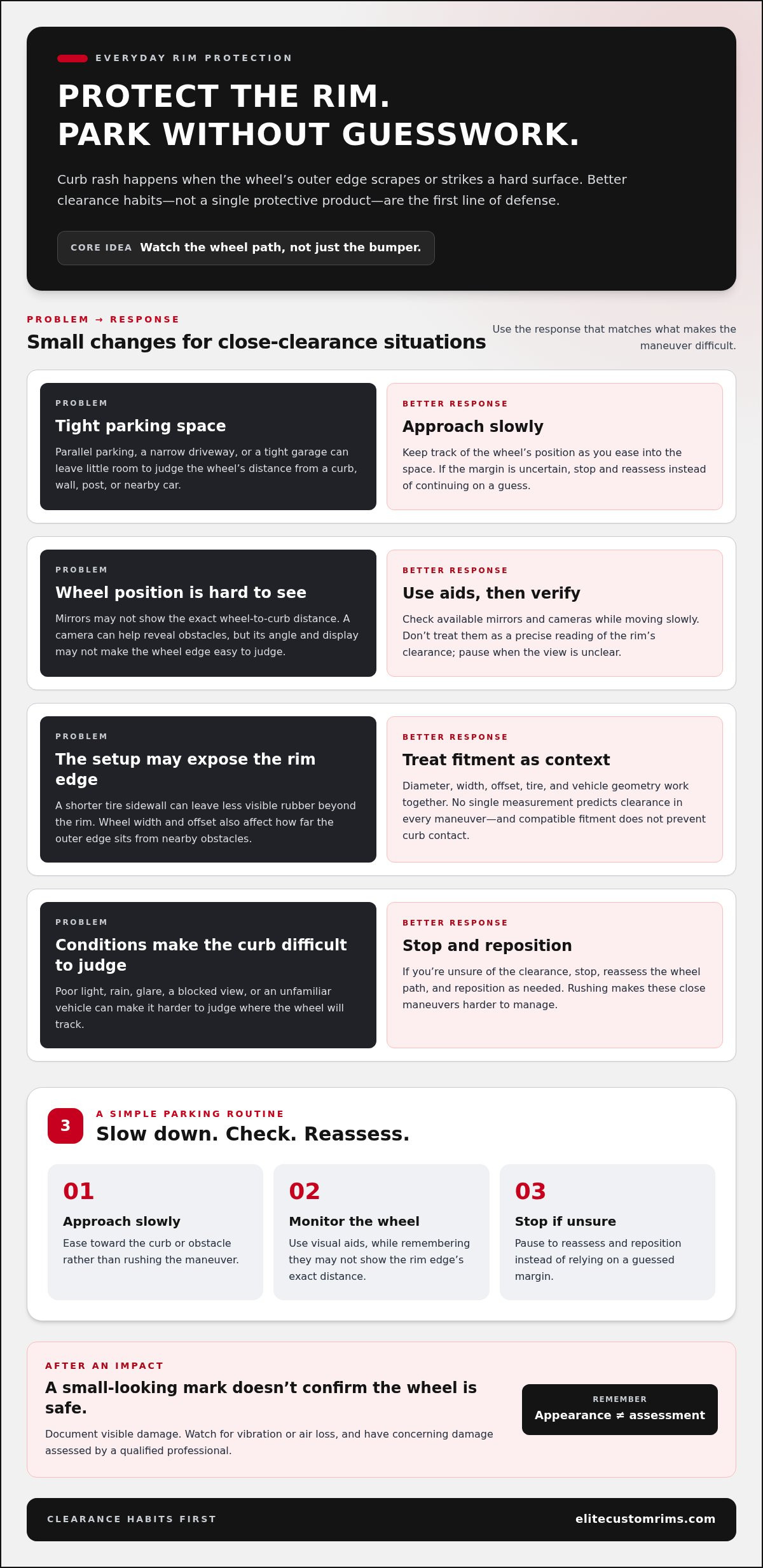
How to Park Step by Step Without Scraping Your Rims
A repeatable routine helps you judge space before the wheel gets close to a curb. Use the same sequence for parallel parking, a narrow garage, or a tight driveway. Move slowly, keep checking your surroundings, and reset if you can’t confidently see the clearance.
A simple approach-and-parking routine
- Assess the space. Before moving, check the curb or garage edge, the angle of the space, and obstacles such as posts, parked cars, or low barriers. Make sure there’s room to maneuver without forcing a sharp turn close to an edge.
- Set up your approach. Position the vehicle to give yourself a manageable path into the space. For parallel parking, consider how the car will move as you turn in and straighten. For a garage, account for the full vehicle width, not just the mirrors or front bumper.
- Move slowly. Ease forward or backward while using your mirrors to monitor the vehicle’s side. Keep your attention on the space ahead and around you. Don’t rely on a single mirror view to show exactly where the wheel edge is.
- Pause before the final adjustment. Stop while you still have room to correct your position. If you’re unsure how close the wheel is to the curb, don’t make another small steering or driving adjustment based on guesswork.
- Recheck and reset if needed. Review your position using the available views. If the car is too close or the angle feels awkward, pause and reposition with a clear path rather than forcing the maneuver.
How to check clearance without relying on guesswork
Mirrors help track the vehicle’s sides, while a camera can reveal obstacles that are difficult to see directly. Parking sensors may also indicate that something is nearby. Use these tools alongside your own observation; their view or alerts may not show the exact gap between the rim and the curb. A spotter can help guide you in a tight space, but agree on clear signals and keep watching your surroundings.
If you can’t see enough to judge the gap, stop completely. Don’t lean out of a moving vehicle, open a door toward traffic, or step into an unsafe area to inspect the wheel. If you’re in a safe place to get out, secure the vehicle first and check from a safe position. Otherwise, reposition slowly or choose a space that gives you more room.
In parallel parking, the rear wheel may approach the curb as the car turns, even if the front appears clear. In a garage, a small correction can bring a wheel close to a wall or stored item. Take each adjustment separately: move, pause, check, then continue only when the path is clear. That steady rhythm is a practical part of how to avoid curb rash on expensive rims.
Choosing replacement wheels? Explore vehicle-specific wheel options and use verified fitment details as a starting point, then keep the same careful parking routine.
After Curb Rash: How Fitment Affects Your Next Choice
After a scrape, document what you can see before deciding what it means. Photograph the wheel from several angles while the vehicle is safely parked, and note any change in how the car feels or behaves. A surface mark may look minor, but appearance alone can’t confirm that a wheel is structurally sound. This section focuses on assessing what you notice and making a considered replacement choice, not on repair instructions.
When a scrape deserves closer attention
Look for visible signs such as a crack, a bent-looking rim edge, or damage that appears deeper than a finish scuff. Pay attention to symptoms too, including air loss, unusual vibration, or a change in handling after the impact. These are reasons to stop driving when it’s safe to do so and seek an appropriate professional assessment. Don’t try to determine a wheel’s safety from a photo or a quick visual check alone.
Keep your notes factual: where the impact happened, what you can see, and whether you’ve noticed a change afterward. Don’t scrape, sand, or otherwise attempt a repair based on appearance. Cosmetic marks and structural concerns call for different decisions, and a qualified assessment can help determine what the damage means for safe use.
Use fitment details to make a considered replacement choice
If you’re considering replacement, start with compatibility, not appearance alone. A wheel’s size, offset, and bolt pattern affect whether it suits the vehicle, while the specific model matters too. Product listings at Elite Custom Rims specify wheel size, offset, bolt pattern, and compatible vehicle models. These details help narrow the options, but vehicle-specific verification is still important.
Provide the vehicle’s year, make, model, and trim so a wheel specialist can verify fitment and help address brake-caliper clearance questions before ordering. Contact a specialist at 855-222-1223 or Info@EliteCustomRims.com for fitment or other verification. For a vehicle-specific example, the Audi Q7 wheel guide can help you explore options for that model; its fitment information shouldn’t be assumed to apply to a different vehicle.
Choosing a replacement wheel is separate from preventing another scrape. The right dimensions support compatibility, but parking habits still matter. Keep using a slow approach, check your clearance, and reset the maneuver if you’re unsure. That practical routine remains central to how to avoid curb rash on expensive rims.
If you’re weighing replacement options, explore vehicle-specific wheels with your vehicle details in hand. A specialist can help verify the fitment before you choose.
Make Careful Clearance Your Default
Build a moment of patience into every close maneuver. Before turning toward a curb or easing into a narrow space, take a breath, check your view, and move only when you can judge the path. With practice, that pause becomes part of your routine, not a last-second reaction. It’s a steady way to protect your wheels while staying confident behind the wheel.
Understanding how to avoid curb rash on expensive rims also means making deliberate choices if you’re replacing a wheel. Use vehicle-specific information rather than choosing by appearance alone. Listings specify wheel size, offset, bolt pattern, and compatible vehicle models, and specialists can verify fitment using your year, make, model, and trim.
Ready to find a wheel option suited to your vehicle? Explore vehicle-specific wheel options, then keep that careful clearance check in your parking routine. A little attention at the right moment can help you enjoy your wheels with greater peace of mind.
Frequently Asked Questions
Can curb rash be prevented completely?
No parking habit or accessory can eliminate the risk entirely. A curb may be hidden by poor lighting, a nearby obstacle can limit your view, or another driver may leave less room than expected. The practical goal of learning how to avoid curb rash on expensive rims is to reduce avoidable contact: take extra time in tight spaces, pause when unsure, and don’t treat a protector or sensor as a guarantee.
Do tire sidewalls protect rims from curb rash?
They can provide some cushioning, but they can’t ensure the rim stays untouched. A tire with a rim-protection feature has sidewall material that extends near the wheel edge, though the amount of coverage varies with the tire and wheel setup. A glancing touch may affect the tire differently from a direct strike. Treat sidewall coverage as a possible buffer, not permission to park closer to a curb.
Are rim protectors worth using on expensive wheels?
They may be worthwhile if you want an added barrier at the wheel lip, especially in parking situations where close approaches are common. Their usefulness depends on the protector, wheel-and-tire setup, and contact angle. A protector can also be damaged and shouldn’t be viewed as a way to make impacts harmless. Consider it a supplemental layer, while keeping careful clearance checks as your main defense.
Can parking sensors prevent curb rash?
No. Sensors can alert you to nearby obstacles, but they don’t necessarily show the exact gap between a curb and the wheel’s outer edge. Their alerts are one source of information, not a complete view of the parking space. Keep watching your mirrors and surroundings, move at a controlled pace, and stop if the wheel’s position is unclear. Use a camera view as an additional check where available.
Does a wider wheel increase the risk of curb rash?
It can increase exposure if the wheel extends closer to or beyond the vehicle’s body, but width alone doesn’t determine curb clearance. Offset, tire shape, and the vehicle’s design all affect where the outer edge sits. For example, the same width can occupy a different position with a different offset. Consider the full vehicle-specific setup rather than assuming a wider wheel will always be more vulnerable.
What should I do if I scrape an expensive rim?
Photograph the affected area and note whether anything changes afterward, such as air loss, vibration, or unusual handling. Don’t assume the wheel is safe because the mark looks superficial, and don’t attempt a repair based only on a photo. If you notice concerning symptoms or visible bending or cracking, stop driving when it’s safe and arrange an appropriate professional assessment before using the vehicle again.
Does changing wheel offset help avoid curb rash?
Changing offset can move a wheel inward or outward, but choosing a different number solely to reduce curb contact may create fitment or clearance problems. The suitable setup depends on the vehicle and the wheel dimensions together. Before ordering a replacement, provide your year, make, model, and trim for specialist verification. Contact a wheel specialist at 855-222-1223 or Info@EliteCustomRims.com for fitment or brake-caliper clearance questions.