
The right wheels do more than match a car’s paint; they should feel true to its era. To learn how to choose wheels that match your car's character, pair a style and finish that suit its design with correct fitment, adequate clearance, and a tire diameter that fits your driving priorities.
It’s easy to focus first on spoke shape or color. But a wheel that looks sharp in a photo may feel out of place on a classic, or change the ride if its size and tire profile don’t suit the car. The best choice brings appearance and practicality together. Use the car’s era as a style guide, coordinate the finish with its paint and trim, and consider how the setup fits your driving needs. Then check the technical details, including bolt pattern, offset, and brake and suspension clearance. Make the look intentional and keep the setup suited to the car.
Key Takeaways
- Use your car’s era as a style guide, then choose a wheel design that complements its original character rather than competing with it.
- Compare finishes with the paint and exterior details to create a coordinated look or a deliberate contrast.
- Balance wheel diameter and tire sidewall to suit your preferred ride feel, driving conditions, and clearance needs.
- Confirm bolt pattern, offset, width, and brake and suspension clearance together; matching only the lug count isn’t enough.
Wheel style and finish
Choose a wheel design and finish that suit your vehicle’s era and exterior details. Use the steps below to make a considered visual choice without overlooking cost or everyday care.
-
Match Finishes to Trim and Accents
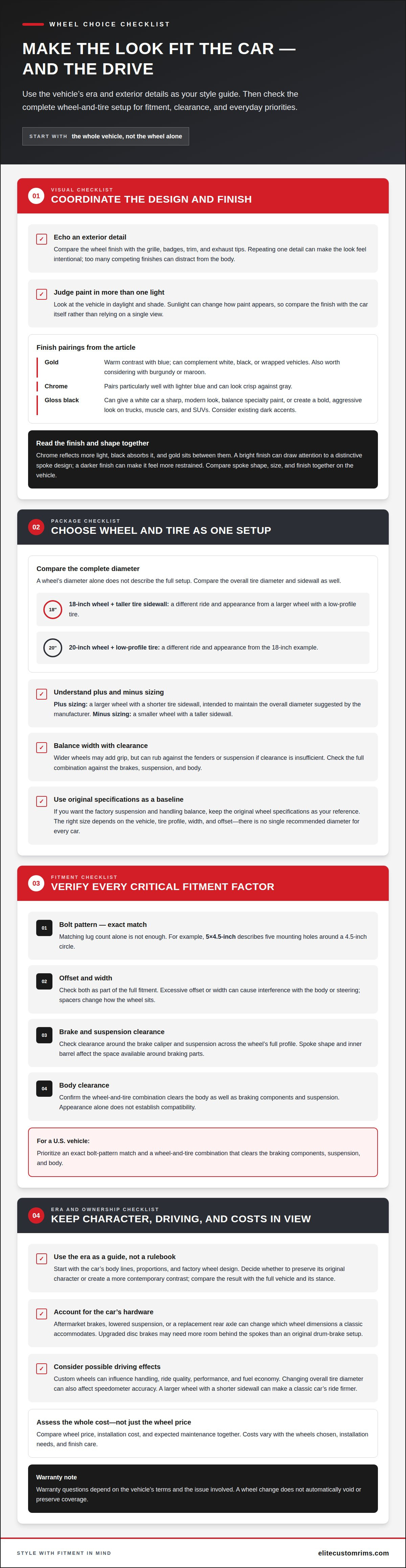
Compare the wheel finish with the vehicle’s grille, badges, trim, and exhaust tips. Echoing one of these details can make the overall look feel intentional, while too many competing finishes can distract from the body. For example, gloss black milled wheels create a bold, aggressive look on trucks, muscle cars, and SUVs. Consider how that contrast will work if the vehicle already has prominent dark accents.
-
Compare Finishes with Paint Colors
Look at the paint in daylight and shade before choosing a finish; sunlight can change how a color appears. Gold can create warm contrast with blue paint and complement white, black, or wrapped vehicles. Chrome pairs particularly well with lighter blue. Gloss black machined wheels give a white car a sharp, modern look, while chrome can appear crisp against gray. On burgundy or maroon, consider gold; gloss black can balance specialty paint.
-
Balance Wheel Shape, Size, and Finish
Judge spoke shape, wheel size, and finish together on the vehicle, not as separate choices. Chrome reflects more light, black absorbs it, and gold sits between them. A bright finish can draw attention to a distinctive spoke design; a darker finish can make the same design feel more restrained. To choose wheels that match your car's character, compare the complete combination against the vehicle’s proportions.
Compare the wheel price, installation cost, and expected maintenance before deciding. These costs vary with the wheels you choose, installation needs, and finish care, so assess them together rather than judging the purchase by wheel price alone. Weigh these practical considerations alongside the look you want when choosing wheels that match your car's character.
Overall wheel-and-tire diameter and clearance
Choose the wheel and tire as one package: diameter, width, and clearance all affect fit. An 18-inch wheel with a taller tire sidewall creates a different ride and appearance from a 20-inch wheel with a low-profile tire.
-
Check Diameter, Width, and Clearance
Compare the complete tire diameter, not just the wheel diameter. Plus sizing pairs a larger wheel with a shorter tire sidewall to maintain the overall diameter suggested by the manufacturer; minus sizing uses a smaller wheel with a taller sidewall. Check that the full combination clears the brakes, suspension, and body. Wider wheels may add grip, but can rub against the fenders or suspension if there isn’t enough clearance.
-
Review Fitment Factors and Recommendations
Keep the original wheel specifications as your baseline if you want the factory suspension and handling balance. The right size depends on the vehicle, tire profile, width, and offset, so there is no single recommended diameter for every car. The bolt pattern must match exactly; five lugs alone don’t ensure compatibility. For example, a 5×4.5-inch pattern describes five mounting holes around a 4.5-inch circle. Explore vehicle-specific wheel options with those factors in mind.
-
Consider Fitment Rules and Safety
For a U.S. vehicle, prioritize an exact bolt-pattern match and a wheel-and-tire combination that clears the braking components, suspension, and body. These are essential fitment criteria; appearance alone doesn’t establish compatibility. Check clearance around the brake caliper and suspension across the wheel’s full profile. The spokes and inner barrel shape affect the space available around braking parts.
-
Assess Possible Vehicle Effects and Risks
Consider how the complete setup may affect vehicle behavior. Custom wheels can influence handling, ride quality, performance, and fuel economy; changing the overall tire diameter can also affect speedometer accuracy. Excessive offset or width can cause interference with the body or steering, while spacers change how the wheel sits. Warranty questions depend on the vehicle’s terms and the issue involved, so don’t assume a wheel change automatically voids or preserves coverage.
Matching wheel style to a car’s era
Use the vehicle’s era as a visual reference, not a strict rulebook. Compare its original design language with your preferred update, then make sure the fitment and handling still suit the car.
- Start with the car’s original appearance. Look at its body lines, proportions, and factory wheel design, then identify what gives it a period-correct feel. With a classic muscle car, for example, decide whether you want to preserve its original character or create a more contemporary contrast. That choice gives your wheel decisions a clear direction.
- Decide how closely the wheel should follow the vehicle’s era. A design that echoes the original look can make a restoration feel cohesive; a visibly modern design can make a classic feel intentionally updated. Avoid mixing styles by accident. Compare the wheel with the full vehicle, including its stance and exterior details, rather than judging it alone.
- Balance appearance with the way the car drives. A larger wheel with a shorter tire sidewall can make a classic car’s ride firmer, and changing wheel diameter also changes the tire profile needed. Keep handling in view as you refine the look. If you drive the car regularly, make sure a dramatic visual update still suits your comfort and road-use priorities.
- Review fitment before committing to an era-inspired look. Aftermarket brakes, lowered suspension, or a replacement rear axle can change which wheel dimensions a classic car accommodates. Upgraded disc brakes may also need more room behind the spokes than an original drum-brake setup. The spoke profile and inner barrel affect that space, so match the design to the car’s hardware.
The takeaway: let the car’s original era set the visual direction, then decide how faithfully to follow it. A coherent wheel choice respects the vehicle’s identity while keeping fitment and handling in view.
How do wheel size, width, offset, and bolt pattern affect fitment?
Check these specifications together. A wheel can look right yet interfere with the brakes, suspension, steering, or bodywork if a dimension is wrong.
- Start with wheel diameter and width. Diameter affects the tire profile needed, while width determines how the tire sits across the wheel. A wider wheel may provide more grip, but it can reduce clearance at the fender or suspension. Consider the complete wheel-and-tire combination, not diameter alone.
- Match the bolt pattern exactly. The pattern describes the number and arrangement of the wheel’s mounting holes. For example, 5×4.5 inches means five holes around a circle measuring 4.5 inches across. A wheel with five holes does not automatically fit every five-lug vehicle. The pattern’s spacing must match the vehicle.
- Consider offset and backspacing together. These measurements affect how far the wheel sits inward or outward, changing its clearance from the fender and suspension. Incorrect offset can cause interference with the body or steering components, affect turning radius, or add stress to wheel bearings. Check the center bore too, so the wheel fits properly against the vehicle’s hub.
- Confirm clearance around the brakes, suspension, and body before finalizing the setup. Spoke profile and inner barrel shape determine available room around the brake caliper; upgraded disc brakes may need more space than original drum brakes. Test-fitting the wheel before mounting the tire allows clearance checks. Explore wheels for your vehicle with these fitment measurements in mind.
- Use the owner’s manual, factory service documentation, or a vehicle-specific fitment guide to identify the original specifications. Correct wheel fitment is important for a vehicle’s handling and braking. Treat bolt pattern, center bore, offset, width, and brake clearance as one fitment decision, not separate style choices.
Elite Custom Rims
Elite Custom Rims helps you narrow your options by vehicle and preferred look, with wheels selected for specific makes and models. Explore Audi Wheels, Chevy/GMC Wheels, Mercedes Wheels, and Porsche Wheels, then compare each design with your car’s era, exterior style, and driving needs. This is a useful next step when you’ve settled on a direction and want to focus on options suited to your vehicle. Share your preferred style and vehicle details with a wheel specialist to confirm fitment and focus your selection. Contact Elite Custom Rims to discuss your wheel choices.
Make Your Next Wheel Choice Count
The right set of wheels can make your vehicle feel more distinctly yours. Treat the decision as a personal design choice, not just a finishing touch: choose a direction that feels right for the car and your plans for it. Knowing how to choose wheels that match your car's character gives you a clear starting point, and exploring options for your specific vehicle can help turn that idea into a confident selection.
Elite Custom Rims offers Audi Wheels, Chevy/GMC Wheels, and Mercedes Wheels. Explore the options with your preferred look in mind, then take the next step toward a wheel setup that feels at home on your vehicle. Connect with Elite Custom Rims about your wheel selection and move forward with a look that’s distinctly yours.
Frequently Asked Questions
How to choose wheel styles that suit a car’s body shape and design era?
Match the wheel’s visual weight to the body’s proportions and original design cues. A large-bodied vehicle can carry a substantial spoke pattern, while a lower, sleeker profile may look more balanced with finer spokes. On a restored classic, use the original styling as a reference; for a modern reinterpretation, make the contrast intentional. Judge the wheel from the side, where its shape meets the body lines.
Which wheel finishes and colors complement different car paint colors?
Decide whether the wheel should blend into the vehicle’s palette or become a focal point. Consider paint undertones and nearby details, including trim and visible brake calipers, before choosing a finish. For example, a neutral body paired with a high-contrast finish draws attention to the wheels; a closer tonal match keeps the body design in focus. Consider the full color combination, not the wheel in isolation.
How do wheel diameter and tire sidewall affect ride comfort, grip, and performance?
A taller tire sidewall generally adds cushioning, while a shorter sidewall can make steering response feel more direct. The tradeoff is ride comfort: a low-profile setup can feel firmer over rough pavement. Wheel diameter alone doesn’t determine grip or performance; tire design, vehicle setup, and the complete wheel-and-tire combination matter too. Choose based on the roads you drive and the balance of comfort and response you prefer.
How to check wheel load rating, brake clearance, and hub compatibility?
Compare the wheel’s load rating with the vehicle’s requirements in its owner documentation, and consider how the vehicle is loaded. For hub compatibility, match the wheel’s center bore to the vehicle hub and account for any required hub-centric fit. Brake clearance depends on spoke shape and inner barrel, not diameter alone. Share the vehicle’s year, make, model, and trim with a wheel specialist to confirm clearance and other fitment details before ordering.