
A wheel can bolt on and still sit off-center. To tell if a wheel is hub-centric for your car, compare its center-bore diameter with your vehicle’s hub diameter. A matching bore fits snugly over the hub; a larger bore leaves a gap that a correctly sized hub-centric ring can fill. A smaller bore won’t fit over a larger hub.
It’s easy to focus on the bolt pattern, but the center bore matters too. When the wheel is centered properly, its bore fits over the hub as designed. If the bore is larger than the hub, a ring can take up the extra space.
This guide explains how the wheel and hub fit together, how to compare their measurements, and when rings are useful. You’ll also learn what vibration can indicate and why rings won’t solve every wheel or tire problem. With the fitment details clear, you can make a more confident choice for your next set of wheels.
Key Takeaways
- Learn why a wheel that wobbles or vibrates at speed may be off-center, and why rings won’t correct every cause of vibration.
- Find out how the wheel’s center bore and your vehicle’s hub determine whether the fit is direct or needs a ring.
- Understand the difference between hub-centric and lug-centric fitment, including why a properly installed lug-centric wheel can work without rings.
- See how the hub, wheel, and lug hardware work together to keep a hub-centric wheel in position.
How to tell if wheels are hub-centric?
Knowing how to tell if a wheel is hub-centric for your car starts with comparing the wheel’s center bore with the vehicle’s hub. A matching bore centers the wheel on the hub; a larger bore may need a correctly sized ring. Lug-centric wheels, by contrast, center through their lug holes.
Vibration as a Fitment Clue
Wobble or vibration can signal that a wheel sits off-center, but it doesn’t identify the cause by itself. Miscentering may produce steering-wheel vibration between 50 and 70 mph, or vibration that appears only above 55 mph. Note when it starts and where you feel it; those details help distinguish a fitment clue from a general balance problem.
Vibration at highway speeds can point to a gap between the hub and wheel bores, especially if the wheel wasn’t centered during installation. But rings address only vibration caused by an off-center wheel. They won’t fix an unbalanced tire, bent wheel, worn wheel bearing, or warped rotor. Treat wobble or vibration as a reason to inspect the fit, not proof that the wheel is lug-centric.
Hub-Centric and Lug-Centric Fitment
A hub-centric wheel has a center bore that matches the vehicle’s hub, while a lug-centric wheel is centered by its lug holes and lug nuts. To tell which type you have, compare the wheel’s center bore with the vehicle’s hub diameter. Manufacturer specifications or a caliper can provide the bore measurement. A larger bore may leave space for a ring.
Vibration can also come from tire balance or another component, even when the wheel’s centering method is correct. If symptoms appear around 50 to 70 mph, consider fitment alongside other possible causes. The key clue is the relationship between the wheel’s center bore and the vehicle hub, not vibration alone.
How wheel center bores fit over vehicle hubs
The wheel’s center bore must fit over the vehicle’s hub lip. Compare both diameters before installation; the bolt pattern alone doesn’t establish a correct center fit.
Center Bore and Vehicle Hub Fit
The center bore is the opening at the wheel’s center, and the hub lip is the raised section it fits over. When their diameters match, the wheel sits directly on the hub. A larger opening leaves a gap; a smaller opening cannot pass over the hub.
Aftermarket wheels may use a larger center bore to fit vehicles with different hub sizes. For example, many GM trucks have a 73.1 mm hub diameter, while many BMWs use 66.6 mm. Those examples aren’t interchangeable specifications; use the measurement for the exact vehicle.
Checking Center-Bore Measurements and Specifications
Measure the wheel’s center bore across its inner opening with a caliper, or use the wheel manufacturer’s specification. Record the measurement in millimeters and compare it with the vehicle’s hub-bore specification. Measure the raised hub lip, not the bolt pattern or the diameter of the lug holes.
To find your car’s hub-bore size by make, model, and year, consult the vehicle-specific specifications for that exact configuration. For context, most Hondas have a 56.1 mm hub, while the Honda Civic Type R uses 64.1 mm. Model names matter: don’t assume one Honda figure applies to every vehicle.
Consequences of Ignoring Center Bore
A wheel with a larger bore may sit off-center if the gap isn’t addressed. A correctly sized hub-centric ring fills that space; a wheel machined to match the hub needs no ring. A smaller bore is a separate issue because it cannot fit over the hub lip.
Ignoring the measurements can lead to a poor fit and vibration while driving. The bolt pattern can match even when the center bore doesn’t, so treat those as separate specifications. Once you have the vehicle’s hub size, explore Audi and Mercedes wheel options with the center-bore measurement in mind.
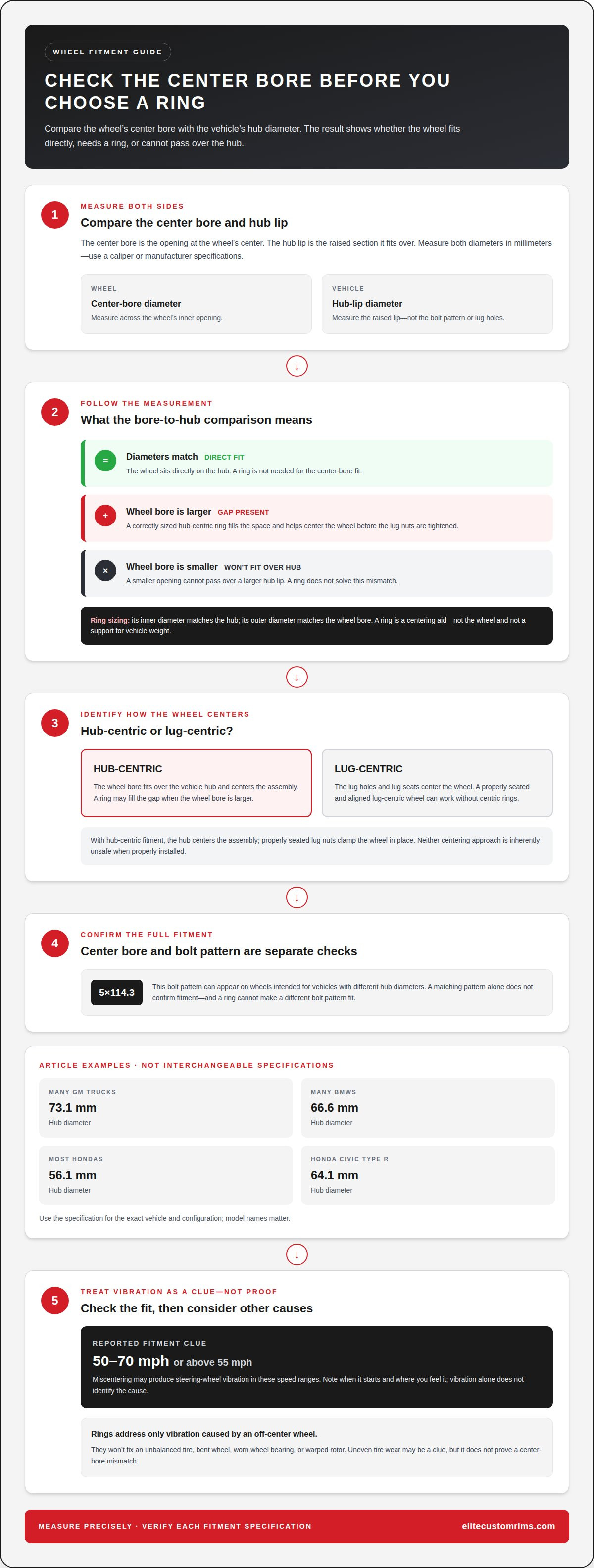
How do I know if I need hub-centric rings?
Compare the wheel’s center bore with the vehicle’s hub. A hub-centric wheel’s bore matches the hub; a hub-centric ring fills the gap when an aftermarket wheel’s bore is larger. The ring helps center the wheel before the lug nuts are tightened, but it isn’t the wheel itself or a support for vehicle weight.
Comparing Hub-Centric and Lug-Centric Fitment
Hub-centric fitment uses the wheel bore and hub to center the assembly; lug-centric fitment relies on the lug seats. A lug-centric wheel can be installed without centric rings when the lugs seat and align it correctly. Hub-centric fitment can make alignment easier, but neither approach is inherently unsafe when properly installed. This distinction helps you decide whether a ring addresses a bore-size gap or the wheel is designed to center through its lugs.
Fitment Checks Before Ordering
Before ordering, compare the wheel’s center-bore specification with the hub diameter, then confirm the bolt pattern separately. For example, a 5x114.3 pattern can appear on wheels intended for vehicles with different hub diameters. A matching bolt pattern alone doesn’t confirm fitment. Manufacturer specifications identify the bore; a caliper can measure it. If the wheel bore is larger, the ring’s inner and outer diameters must match the hub and wheel.
Check the complete fitment, not just whether rings are needed. The wheel must have the correct bolt pattern and center-bore relationship for the vehicle. A ring can address an oversized bore, but it cannot make a different bolt pattern fit.
Uneven tire wear can be a clue that wheels aren’t properly fitted, though it doesn’t prove a center-bore mismatch. Look at the fitment alongside steering or driving symptoms. Plastic rings have been associated with vibration in a reported case, but vibration can have other causes. Rings are centering aids, not a substitute for correct wheel specifications or proper installation.
How hub-centric wheels fit around the vehicle hub
A hub-centric wheel fits over the vehicle’s hub lip, with matching diameters guiding it into a centered position. The hub centers the assembly, while properly seated lug nuts clamp the wheel in place.
During installation, the wheel’s center bore slides over the hub lip. If both diameters match, the wheel sits evenly against the hub. If the wheel bore is larger, the gap leaves room for a hub-centric ring. A correctly sized ring fills that gap and helps locate the wheel before the lug nuts are tightened.
The ring is a centering aid, not a replacement for correct wheel fitment or properly tightened lug nuts. It doesn’t change the bolt pattern, offset, or center-bore diameter. Almost all aftermarket wheels are lug-centric, with a larger bore intended to fit more vehicles; some applications use a ring to match that bore to the hub. Check the ring’s inner diameter against the hub and its outer diameter against the wheel bore.
Material alone doesn’t establish whether a ring will center a wheel correctly. A reported case described vibration with plastic rings between 50 and 65 mph that stopped after replacement with aluminum rings. That example doesn’t mean aluminum rings always correct vibration. A wrong size, uneven seating, or an unrelated issue such as tire imbalance can still leave vibration.
If a ring is damaged or doesn’t fit flush, replace it with one that matches both measured diameters. Don’t force a ring into place or use it to compensate for a wheel bore that’s too small for the hub. The key is a snug, even fit around the hub lip, followed by correct lug-nut installation.
Ready to match wheel options to your vehicle? Explore wheel fitment options.
Elite Custom Rims
Elite Custom Rims offers wheel options for Audi, Chevrolet, Mercedes, and Porsche vehicles, with dedicated fitment options to help match wheels to your vehicle. If you've identified your hub diameter and center bore, use those details alongside the vehicle's make, model, and year when narrowing your choices. A matching center bore fits directly; a larger bore may require a correctly sized ring, while a smaller bore won't fit over the hub.
Fitment is about more than appearance. Keep the hub measurement and bolt pattern in view as you compare wheel options, so you can focus on choices suited to your car while learning how to tell if a wheel is hub-centric for your car rather than relying on the bolt pattern alone. Contact Elite Custom Rims to discuss wheel options for your vehicle.
Make your next wheel choice with confidence
Knowing how to tell if a wheel is hub-centric for your car gives you a useful starting point for choosing wheels that suit your vehicle and style. Treat fitment details as part of the decision, not as a final check after settling on a design. This helps appearance and compatibility guide the same choice from the start.
As you narrow your options, keep the vehicle details and fitment measurements together. This makes it easier to compare suitable wheel choices and discuss what you’re looking for without relying on memory. Elite Custom Rims offers wheel options for several vehicle brands, so your next step can be a focused conversation about your needs. Contact Elite Custom Rims for fitment help, and move ahead with a clearer plan for your next set of wheels.
Frequently Asked Questions
What is wheel center bore?
The wheel center bore is the circular opening through the middle of a wheel, measured by its diameter. It fits around the vehicle’s hub lip or, when larger, leaves room for a centering ring. Don’t confuse it with the bolt pattern: the bore is the central opening, while the pattern describes the arrangement of the lug holes.
What does hub-centric mean for a wheel?
A hub-centric wheel uses the fit between its center opening and the vehicle’s hub to locate the wheel centrally. If the wheel bore and hub diameter match, the wheel fits directly over the hub. A wheel with a larger bore may use a ring to take up the difference. The lug hardware still secures the wheel.
How can I measure a car's hub bore diameter?
Measure across the vehicle’s raised hub lip with a caliper, keeping the tool square to the lip for a useful diameter reading. Clean dirt or debris from the surface first, since buildup can affect the measurement. Record the result in millimeters, then compare it with vehicle-specific specifications for the correct make, model, and year.
Where is the center bore size listed on a wheel?
Look in the wheel manufacturer’s specifications or product listing, where the center-bore diameter may appear alongside other fitment details. If it isn’t shown, measure the wheel’s center opening with a caliper. Measure across the opening rather than estimating from its appearance, and keep the wheel measurement separate from the vehicle’s hub measurement.
What size hub-centric ring do I need for my car and wheels?
Choose a ring whose inner diameter matches the vehicle’s hub and whose outer diameter matches the wheel’s center bore. The ring must bridge the difference between those measurements and fit both surfaces snugly. Use measured diameters or manufacturer specifications, not the bolt pattern, to determine ring size.
Can incorrect center bore or hub-centric rings cause vibration or damage?
Yes. A wheel that sits off-center because of an incorrect bore or poorly fitting ring can contribute to vibration while driving. Improperly fitted wheels may also contribute to premature tire wear and strain on other vehicle parts. Vibration can have other causes, including an unbalanced tire or bent wheel, so a ring won’t correct every problem.