
The brand name alone doesn’t determine wheel quality. A useful Rohana vs TSW wheels quality review compares how cast and cross-forged construction affect your options, then considers how wheel size can increase exposure to pothole impacts. The right fit depends on the balance you want between construction and everyday road conditions.
It’s easy to focus on styling first, but construction and wheel size also affect how well a setup suits your driving and the roads you use. Larger wheels can leave less tire sidewall to absorb impacts, so appearance is only one part of the decision.
This review explains the construction differences and why size matters when potholes are part of your route. Use it to compare Rohana and TSW more practically, weigh the trade-offs, and narrow down a setup that fits your priorities.
Key Takeaways
- Compare manufacturing information for the specific wheel model instead of assuming one origin applies to every wheel from a brand.
- Use construction method as one comparison point, not a stand-alone verdict on strength or impact resistance.
- For a meaningful weight comparison, match wheel size and specifications; consider how wheel diameter can affect tire sidewall and pothole exposure.
- Assess finish and corrosion resistance alongside your driving conditions, then narrow your choice by the fitment your vehicle needs.
Where are Rohana and TSW wheels manufactured?
A Rohana or TSW name identifies the brand, not the country where a wheel was made. You can’t determine manufacturing location from the brand name alone. For a precise answer, check the country-of-origin marking or manufacturer documentation for the exact wheel model. Keep the distinctions clear: brand identity, design origin, manufacturing location, and shipping route describe different parts of a wheel’s journey.
Delivery timing also doesn’t reveal where a wheel was made. One Rohana owner was told the order would take 4 weeks to complete, then reported arrival about 8 weeks later. The owner was accustomed to a 12- to 16-week wheel production timeline. Those figures describe one order experience, not a factory location or a standard Rohana schedule. Production completion and delivery are separate milestones.
Use a consistent process to compare Rohana and TSW. Identify the exact model and configuration instead of relying on assumptions about the whole brand. Then check the wheel’s origin marking against the documentation for that specific item, and keep the model details with your findings. A different design or configuration may have different manufacturing information.
For example, if a Rohana wheel’s marking identifies one country, that supports a claim about that wheel, not every Rohana model. Apply the same standard to TSW. Don’t treat a retailer’s location, a brand’s headquarters, or the shipping origin as proof of manufacturing country. The most useful comparison records each model’s stated origin separately, then moves on to construction, weight, and finish. This prevents an order’s 4-week completion estimate or 8-week arrival report from being mistaken for evidence about factory location.
How do Rohana and TSW wheels compare for strength, durability, and impact resistance?
You can’t rank Rohana and TSW by brand name alone. Strength depends on the exact wheel’s construction, materials, design, and rated load. Comparing a cast Rohana with a forged TSW conflates brand with manufacturing method. A Rohana vs TSW wheels quality review should compare similar specifications and construction types before drawing conclusions about performance.
Casting involves pouring molten alloy into a mold, where it solidifies into the wheel shape. Forging forms metal under pressure. Cross-forged describes a forging approach, though the process can vary by manufacturer. These methods shape wheels differently, but neither label alone establishes how a particular model will respond to every impact.
Pothole impact also depends on the complete setup, including wheel design and dimensions and the tire sidewall. For example, a lower-profile tire leaves less cushioning between the road and rim than a taller-sidewall setup. That can increase impact exposure, regardless of whether the wheel carries a Rohana or TSW badge.
Compare specifications for the exact models you’re considering: construction method, rated load, wheel dimensions, and vehicle fitment. Then factor in your regular roads and tire profile. A wheel that meets your vehicle’s load requirements is a more useful choice than one selected by appearance alone. Everyday durability also depends on avoiding curb strikes, maintaining correct tire pressure, and addressing visible damage.
For a practical Rohana vs TSW wheels quality review, record each model’s construction and specifications side by side. Don’t treat “forged” as a universal impact-proof label, or assume every model from either brand uses the same method. If you’re choosing wheels for a specific vehicle, explore vehicle-specific wheel options as a next step.
What are the weights of comparable Rohana and TSW wheel models and sizes?
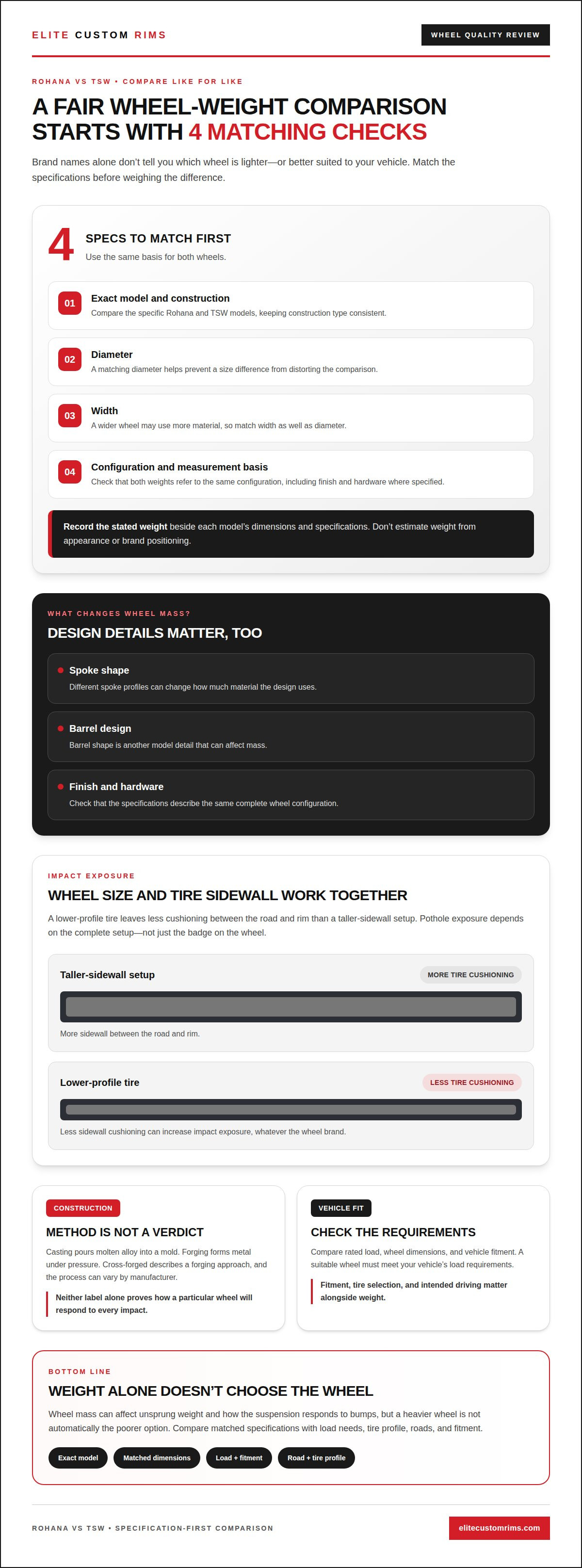
A fair Rohana-versus-TSW weight comparison starts with exact model specifications. Brand names alone don’t tell you a wheel’s weight. Compare wheels with the same diameter, width, and construction type. A wider wheel may use more material, while spoke shape and barrel design also affect mass. Matching these details helps distinguish a true model difference from one caused by size.
Use each brand’s model-specific specification sheet and record weight alongside the wheel dimensions. For example, compare a Rohana wheel with a TSW wheel of matching diameter and width, not with a smaller TSW model. Keep construction consistent too. A cast design and a forged design are not like-for-like comparisons, even when their listed sizes match. Don’t infer weight from appearance or brand positioning.
Offset and configuration can complicate the comparison. Two wheels with the same diameter may still differ in width, spoke profile, or barrel shape, changing how much material the design uses. Finish and hardware can also affect the complete wheel’s measured weight, so check that both specifications describe the same configuration. Compare like with like before deciding which is lighter.
Use this quick checklist for Rohana and TSW:
- Match the exact model and construction method.
- Match diameter and width.
- Compare the same configuration and measurement basis.
- Record each stated weight beside its specifications.
Then consider what the difference means for your setup. Wheel mass can affect the vehicle’s unsprung weight, the portion not supported by the suspension. This can influence how the suspension responds to bumps and how the vehicle feels. But weight alone doesn’t settle the choice. Fitment, load requirements, tire selection, and intended driving all matter. A heavier Rohana or TSW wheel isn’t automatically the poorer option; compare its specifications with your vehicle’s needs.
Rohana vs TSW: Finish Quality and Corrosion Resistance
Compare Rohana and TSW finishes model by model, not by brand reputation. Finish names alone don’t establish durability. Check the exact wheel’s coating description, surface treatment, and care instructions. A painted finish and a machined face, for example, may show wear differently. For a consistent comparison, look at wheels with the same finish type and similar designs.
Corrosion resistance depends on how well the finish protects the wheel’s metal from moisture and contaminants. Road salt, brake dust, and trapped grime can challenge that protective surface. A chip near a spoke edge can expose the material beneath, while damage around a lug opening may worsen with repeated cleaning or mounting. Neither Rohana nor TSW wheels are immune to finish damage.
Inspect both candidate wheels under the same conditions. Look closely at spoke edges, lug holes, the center area, and the barrel. Check for even color, consistent gloss, and visible blemishes. Then compare the manufacturer’s care guidance for each model. Use compatible cleaning products and avoid abrasive tools that could scratch the coating. Remove brake dust and road residue promptly rather than letting deposits build up.
For a useful Rohana-versus-TSW assessment, record each model’s finish description and care requirements together. Consider your driving environment, including winter roads where salt exposure is common. Factor in the design too: intricate spokes can be harder to clean and inspect than simpler surfaces. These practical details affect long-term appearance, even when two wheels start with comparable finishes.
Prioritize the finish you can maintain consistently. A careful inspection after cleaning can reveal chips, peeling, or discoloration before they spread. Use the same lighting and viewing angle when comparing Rohana and TSW samples, so reflections don’t distort the color difference. If you’re also choosing wheels for your vehicle, explore wheel options for your fitment.
Elite Custom Rims: Audi Wheels
Elite Custom Rims offers Audi Wheels for drivers ready to turn their research into a vehicle-specific selection. After comparing construction, weight, and finish, focus on your Audi’s fitment requirements and the look you want. Matching wheel specifications to your vehicle helps keep the decision practical as well as style-focused.
The same approach applies if you’re shopping for Chevy/GMC Wheels, Mercedes Wheels, or Porsche Wheels. Start with your vehicle, then narrow the options by the dimensions and appearance that suit it. Clear priorities make your comparison more useful.
Contact Elite Custom Rims to explore Audi wheel options for your vehicle.
Choose a Wheel Setup That Fits Your Next Drive
Turn your comparison into a clear shortlist. Decide what matters most for your vehicle, then weigh those priorities against the exact wheel models you’re considering. A thoughtful Rohana vs TSW wheels quality review is a starting point; the next step is choosing wheels that suit your vehicle and the look you want.
For Audi owners, Elite Custom Rims offers Audi Wheels. The selection also includes Chevy/GMC Wheels and Mercedes Wheels. Explore the options with your vehicle in mind, focusing on fitment that complements its design and intended use.
Explore wheel options at Elite Custom Rims and take the next step toward a setup that feels right for your vehicle.
Frequently Asked Questions
What do owners and independent reviewers report about Rohana and TSW wheel quality?
Owner reports offer specific experiences, but they don’t establish a universal quality ranking between Rohana and TSW. One Rohana owner described a setup with 30/35-profile tires and less sidewall than before, then considered front spacers to adjust fitment. That illustrates why reviews should be read in context: note the wheel model, tire setup, vehicle, and driving conditions before applying one owner’s experience to your own choice.
What are typical U.S. prices for Rohana versus TSW wheels?
The article doesn’t provide typical U.S. prices for TSW wheels.