
Did you know that the average luxury SUV in 2026 now tips the scales at over 6,000 lbs? This massive increase in vehicle weight means your choice of luxury car wheels is no longer just about aesthetics. It's a critical safety decision. You've likely felt the frustration of staring at complex spec sheets. Terms like offset, backspacing, and bolt patterns often feel like a foreign language. It's natural to worry about spending money on a set of rims only to find they don't fit or, even worse, they can't handle the structural demands of a modern heavy-duty chassis.
We're here to take the guesswork out of your next upgrade. This guide promises to turn you into a technical expert on manufacturing standards and fitment principles. You'll gain the confidence to distinguish between standard cast rims and elite 3D-forged components that offer superior strength. We'll preview the latest 2026 trends, from monoblock minimalism to carbon fiber hybrids. Follow this roadmap to select wheels that deliver both breathtaking style and uncompromising performance.
Key Takeaways
- Master the critical differences between cast, flow-formed, and forged manufacturing to ensure your wheels can support the weight of modern luxury vehicles.
- Decode complex technical specifications like offset, backspacing, and bolt patterns to achieve a perfect, rub-free fitment every time.
- Discover how to choose high-performance luxury car wheels that balance aerodynamic efficiency for EVs like Tesla with the iconic styling of brands like Mercedes-Benz.
- Learn to evaluate finish quality and powder coating standards to protect your investment from the elements and maintain a premium aesthetic.
- Understand the importance of structural warranties and manufacturing certifications when selecting elite-level rims for high-speed performance.
Anatomy of Car Rims: Understanding the Essential Components
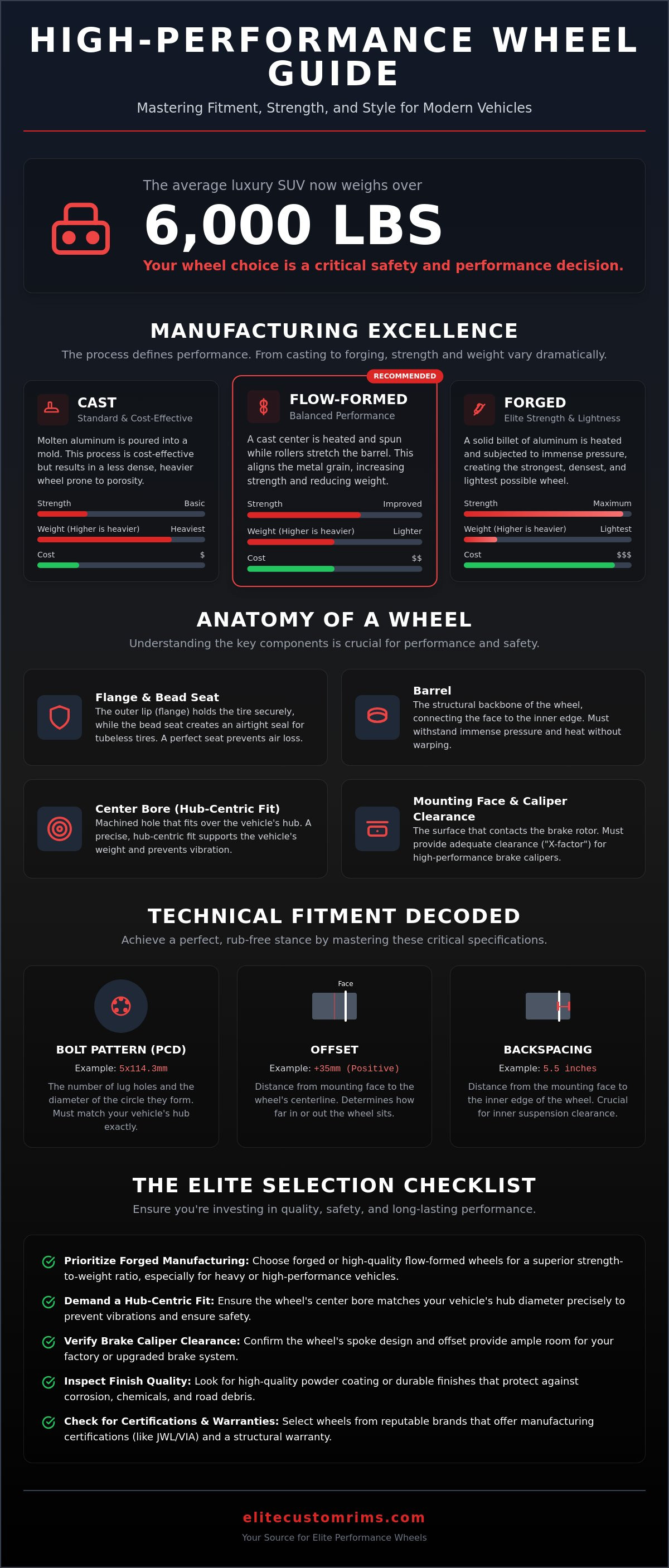
Your vehicle's performance starts where the rubber meets the metal. Most drivers use the terms "rim" and "wheel" interchangeably, but for the serious enthusiast, the distinction is vital. The wheel is the entire rotating assembly. The rim is specifically the outer edge that holds the tire in place. Understanding this anatomy is the first step toward selecting high-performance luxury car wheels that don't just look elite but function with precision.
The barrel is the unsung hero of wheel design. It connects the outboard face to the inboard edge, providing the structural backbone for the entire unit. In high-end Alloy wheels, the barrel must withstand immense pressure and heat without warping. It supports the tire bead, ensuring that your vehicle maintains its footprint even under heavy cornering loads. Reliability depends on a perfect seal. The flange and bead seat work together to create an airtight environment for modern tubeless tires. Without a perfect seat, you risk slow leaks or catastrophic pressure loss during spirited driving.
The Outer Edge: Flanges and Beads
The flange is the curved lip of the rim. It prevents the tire from slipping off the wheel during aggressive lateral maneuvers. Most luxury sedans and SUVs utilize a J-type profile. This standard shape provides the ideal balance of tire retention and ease of mounting. In contrast, K-type profiles are often found on heavy-duty applications or specific classic fitments. Rim width also dictates your tire's sidewall behavior. A wider rim stretches the sidewall, sharpening steering response. However, it also reduces the "bulge" of the tire, which can expose the rim edge to curb damage. Match your width to your performance goals.
The Core: Center Bore and Mounting Face
Precision fitment is non-negotiable. The center bore is the machined hole in the middle of the wheel that slides over the vehicle's hub. Choosing the right center bore is what separates professional-grade luxury car wheels from budget alternatives. We always recommend hub-centric designs. This ensures the weight of the car is supported by the hub itself rather than just the lug nuts. Lug-centric wheels often lead to persistent vibrations and premature bearing wear. This is a significant safety risk on high-performance builds.
The mounting face is the flat surface that presses against the brake rotor. For owners of a Porsche or a Mercedes, caliper clearance is the primary concern. High-performance brakes require specific "X-factor" clearance to avoid contact between the spokes and the calipers. Always verify that the mounting face provides enough room for your upgraded stoppers before finalizing your purchase. Take the guesswork out of your upgrade by following these technical standards:
- Verify Hub-Centricity: Ensure the center bore matches your vehicle's hub diameter exactly.
- Check Caliper Clearance: Confirm the spoke design accommodates your specific brake package.
- Select the Right Profile: Stick with J-type flanges for modern tubeless tire compatibility.
- Inspect the Bead Seat: Look for smooth, machined surfaces to prevent air pressure loss.
Manufacturing Excellence: Cast vs. Forged Car Rims
Luxury performance starts with engineering. Choosing the right luxury car wheels requires more than just picking a design that looks good in a showroom. You need to understand how the metal is formed. The manufacturing process directly dictates how your car handles mid-corner bumps and how quickly it stops in an emergency. It's the difference between a wheel that simply rotates and one that actively enhances your driving dynamics.
Understanding Cast Aluminum Wheels
Cast wheels are the most common entry point for aftermarket upgrades. Gravity casting involves pouring molten aluminum into a mold. It's cost-effective. It works well for standard replacement parts. However, the metal is less dense. This makes cast wheels heavier and more susceptible to porosity, which are tiny air pockets that can lead to structural failure under stress. Low-pressure casting is a step up. It uses pressure to pull the metal into the mold, creating a denser part. While these are suitable for some luxury SUVs, they often lack the extreme durability required for high-performance driving.
Flow-forming offers a middle ground. This process starts with a low-pressure cast "blank" that is then heated and spun. Roller arms stretch the barrel, aligning the grain structure. This results in a wheel that is lighter and stronger than a standard cast rim without the full cost of a forged unit. It's an excellent hybrid approach for owners who want weight reduction without the premium price of a fully forged set.
The Forged Advantage for Performance
Forged aluminum is the gold standard for Mercedes and Porsche owners. Unlike casting, the forged wheel manufacturing process involves taking a solid billet of 6061-T6 aluminum and subjecting it to thousands of tons of pressure. This compression creates a continuous grain structure. It makes the metal incredibly dense. You get a wheel that can be thinner and more intricate while remaining significantly stronger than any cast alternative. Forged wheels represent the absolute pinnacle of strength-to-weight ratio in the 2026 automotive market.
The primary benefit of forging is the reduction of unsprung weight. This is the mass not supported by your car's suspension. Lighter luxury car wheels allow your suspension to react faster to road imperfections. You'll notice sharper turn-in, shorter braking distances, and more responsive acceleration. If you're ready to upgrade, explore our collection of precision-engineered wheels to find the perfect match for your chassis.
Consider these performance factors when comparing manufacturing styles:
- Weight: Forged wheels can be up to 25% lighter than cast wheels of the same size.
- Durability: Forged aluminum resists cracking and bending under high-impact loads.
- Detailing: The strength of forged metal allows for sharper, more aggressive spoke designs.
- Heat Dissipation: Denser metals often manage brake heat more effectively during spirited driving.
The Technical Fitment Framework: Offset, Bolt Pattern, and Backspacing
Engineering a flawless stance requires more than an eye for design. It demands mathematical precision. Even the highest quality luxury car wheels can ruin a driving experience if the fitment geometry is off. You aren't just bolting on a part; you're altering the vehicle's suspension dynamics. Fitment is a science. Accuracy is everything.
Offset is the distance from the wheel's mounting surface to its true centerline. Positive offset pushes the mounting surface toward the front of the wheel. This tucks the assembly into the fender. Negative offset does the opposite, pushing the wheel outward for a wide, aggressive stance. Getting this wrong impacts your scrub radius. This is the distance between the steering axis and the center of the tire's contact patch. If this distance changes significantly, your steering feel becomes numb or overly sensitive. Incorrect offset also leads to unpredictable handling and accelerated tire wear.
Backspacing serves as the critical measurement for internal clearance. While offset is measured from the center, backspacing is the distance from the mounting surface to the back edge of the rim. It's the number that determines if your wheel will clear the brake calipers and inner fender liners. If your backspacing is too deep, you'll rub against the strut or the inner liner. This is especially dangerous during high-speed cornering when the chassis flexes.
Calculating the Perfect Offset
Positive offset is the factory standard for most modern luxury sedans. It maintains the intended suspension geometry and keeps the wheels flush with the bodywork. Negative offset is popular for creating a "deep-dish" look, primarily on trucks or wide-body performance builds. Always follow the 5mm rule. You need at least 5mm of clearance between the wheel and any suspension component. This gap accounts for heat expansion and minor chassis movement under load.
Mastering Bolt Patterns and Center Bores
Bolt patterns, or Pitch Circle Diameter (PCD), must match your hub exactly. Standard patterns for luxury car wheels vary by brand. Audi and Mercedes typically utilize 5x112, while many Toyota and older BMW models rely on 5x120. To measure a 5-lug pattern without a manual, measure from the center of one lug hole to the back of the hole directly across from it.
Precision requires a hub-centric approach. Many aftermarket wheels feature a universal center bore larger than your vehicle's hub. In these cases, hub-centric rings are essential. These rings fill the gap. They ensure the wheel centers perfectly on the hub rather than relying on the lug studs to carry the weight. This eliminates high-speed vibrations and ensures a safe, professional-grade installation.
Vehicle-Specific Dynamics: From Tesla to Heavy-Duty Trucks
Performance isn't universal. A setup that works for a lightweight sports coupe will fail on a heavy-duty SUV or a modern electric vehicle. Selecting luxury car wheels requires a deep understanding of your specific vehicle's physics. You aren't just buying a style. You're investing in a component that must manage thousands of pounds of pressure while maintaining factory-level refinement. Precision engineering is the only way to ensure your upgrade doesn't compromise the driving experience.
Mercedes-Benz owners often seek the "OE-plus" aesthetic. This approach focuses on maintaining the brand's sophisticated DNA while adding a more aggressive, custom stance. High-performance AMG wheels are designed to handle high-speed autobahn runs while providing the necessary clearance for massive multi-piston calipers. Similarly, those looking for Audi Q7 wheels in 2026 should prioritize designs that offer high-speed stability and efficient brake cooling. These larger platforms demand wheels that can dissipate heat rapidly during heavy braking cycles.
Electric Vehicle (EV) Wheel Optimization
Electric vehicles redefine the rules of wheel selection. Weight kills range. For a Tesla Model 3 or Model Y, every extra pound of rotational mass directly reduces battery efficiency. You need lightweight forged options to offset the heavy battery packs. Diameter also plays a critical role. While 21-inch rims look stunning, they can decrease range by up to 10 percent compared to 19-inch alternatives. Always select rims that are specifically tested for the high torque loads of EV motors and the unique stresses of regenerative braking systems.
Luxury SUV and Truck Fitment
The Cadillac Escalade and GMC Sierra occupy a different category of engineering. Load rating is the most overlooked specification in the aftermarket world. These heavy-duty luxury vehicles require wheels rated for their specific Gross Vehicle Weight Rating (GVWR). Using a standard passenger car rim on a 6,000-lb SUV is a recipe for catastrophic failure. For the ultimate in luxury, our Rolls Royce wheels collection features designs engineered for maximum structural integrity without sacrificing the "magic carpet" ride quality the brand is known for.
Ride quality remains a primary concern when moving to 22-inch or 24-inch rims. Larger diameters mean thinner tire sidewalls. This reduces the air cushion between the road and your suspension. To maintain a smooth ride, you must choose wheels with superior dampening characteristics and pair them with high-quality tires. Don't let a bad fitment ruin your vehicle's comfort. Ready to find your perfect match? You can shop our vehicle-specific collections today to ensure a guaranteed fit for your specific make and model.
- EV Focus: Prioritize aerodynamic efficiency and low weight to preserve battery range.
- SUV Safety: Always verify that the wheel's load rating exceeds your vehicle's maximum loaded weight.
- Brake Clearance: Ensure the spoke profile accommodates high-performance AMG or Audi S-line calipers.
- Ride Balance: Use 22-inch rims as the sweet spot for style and comfort on modern luxury SUVs.
The Elite Selection Process: Investing in Quality Rims
Selecting the right luxury car wheels is the final step in a precision automotive build. It's a high-stakes investment. You've already mastered the technical specifications and manufacturing methods. Now, you must evaluate the longevity of the finish and the reliability of the provider. A wheel that performs well but loses its luster in six months isn't a premium product. Excellence requires both structural integrity and a flawless, durable aesthetic.
Generic online calculators often fail to account for the nuances of high-performance braking systems or specific suspension clearances. Professional fitment verification is the only way to ensure your upgrade is seamless. It eliminates the risk of 404-style errors in your physical setup, such as unexpected fender rubbing or caliper contact. Relying on expert human oversight takes the guesswork out of the equation. It guarantees that your vehicle's safety systems and handling characteristics remain exactly as the engineers intended.
Evaluating Finish and Durability
Your maintenance habits should dictate your choice of finish. Chrome offers a classic, mirror-like shine but requires constant attention to prevent pitting. Gloss finishes provide a high-impact look that's easy to wipe down. Satin and matte options are increasingly popular for modern builds because they hide road grime and brake dust more effectively. Regardless of the style, the clear coat is your primary line of defense. High-quality clear coats act as a barrier against corrosive road salts and the abrasive metallic particles found in high-performance brake dust. Finish durability is just as critical as structural strength because it protects the integrity of the underlying alloy from environmental degradation and oxidation.
The Elite Custom Rims Difference
We've built our reputation on precision and professional assurance. Elite Custom Rims focuses exclusively on brand-specific fitment for Audi, Porsche, and Land Rover. We don't deal in used or refurbished inventory. Every wheel we sell is a new, high-performance component ready for national delivery. Our team acts as your authoritative specialist, removing the anxiety from the shopping process. We understand the specific load ratings and offset requirements for your exact model, ensuring a perfect match every time.
Getting expert advice is simple. Our consultants are ready to discuss your performance goals and aesthetic preferences to find the ideal solution for your chassis. We value your time and provide straightforward, no-nonsense solutions that deliver immediate results. Before you finalize your purchase, use this final checklist to ensure your upgrade meets the elite standard:
- Confirm Load Rating: Double-check that the wheels are rated for your vehicle's specific GVWR.
- Verify Finish Type: Ensure the coating matches your maintenance style and local climate conditions.
- Review Structural Warranty: Only invest in luxury car wheels that carry a comprehensive structural guarantee.
- Validate Hub-Centricity: Confirm the center bore matches your hub or that the correct rings are included.
- Inspect Clear Coat Quality: Look for multi-stage finishes that offer superior UV and chemical resistance.
Precision is the difference between a standard upgrade and an elite transformation. Trust the experts to guide you through the final steps of your selection process.
Elevate Your Driving Experience with Precision Engineering
You've mastered the technical landscape of modern wheel design. From the structural density of forged aluminum to the mathematical precision of offset and backspacing, you now have the tools to make an informed investment. Choosing the right luxury car wheels is no longer a matter of guesswork. It's a strategic decision that balances aesthetic impact with the physical demands of your chassis. You understand why load ratings matter for heavy SUVs and why lightweight forging is essential for EV range.
We specialize in high-performance fitment for the world's most prestigious brands. Whether you need precision-engineered wheels for your Audi, Mercedes, or Tesla, our team ensures a perfect match every time. We exclusively carry new, high-performance inventory ready for national shipping to your doorstep. Don't settle for generic solutions. Your vehicle deserves a bespoke fitment designed for your specific performance goals.
Take the next step in your vehicle's transformation. Browse our curated collection of elite wheels and rims today. Your perfect stance is just a few clicks away.
Frequently Asked Questions
What is the difference between car rims and wheels?
The wheel is the entire rotating assembly, while the rim is specifically the outer edge that holds the tire in place. Most drivers use these terms interchangeably in casual conversation. However, for technical fitment, it's vital to recognize that the rim is just one component of the total wheel structure. Understanding this helps you communicate more effectively with specialists during a performance upgrade.
How do I find the correct bolt pattern for my car?
Consult your owner's manual or look up your specific year, make, and model in a fitment database. You can also measure the Pitch Circle Diameter (PCD) yourself. For a 5-lug setup, measure from the back of one lug hole to the center of the hole directly across from it. Accuracy is essential because even a few millimeters of difference will prevent a safe installation.
Will aftermarket rims void my vehicle warranty?
Installing aftermarket luxury car wheels does not automatically void your factory warranty. Under the Magnuson-Moss Warranty Act, a dealer must prove that the aftermarket part directly caused a specific failure to deny a warranty claim. Upgrading your wheels is a safe, standard practice. It allows you to customize your vehicle's aesthetic without sacrificing your structural or powertrain coverage under the law.
What is wheel offset and why does it matter for fitment?
Offset is the distance from the wheel's mounting surface to its true centerline. It determines how far the wheel sits inside or outside the fender. Correct offset is vital because it prevents the tire from rubbing against suspension components or the outer fender lip. It also maintains your vehicle's factory steering geometry, ensuring that your handling remains predictable and sharp during high-speed maneuvers.
Are forged rims really worth the extra cost over cast rims?
Forged wheels are a superior investment for heavy luxury SUVs and high-performance electric vehicles. They offer significantly higher structural integrity and lower unsprung weight than cast alternatives. This extra cost translates to better acceleration, shorter braking distances, and a rim that is far less likely to crack when hitting a pothole. For performance enthusiasts, the gains in durability and handling are unmistakable.
Can I use the same lug nuts with my new aftermarket rims?
Most aftermarket luxury car wheels require new lug hardware. Factory bolts often use a "ball seat" profile, while many aftermarket designs require a 60-degree "conical seat." Using the wrong hardware prevents the wheel from seating properly against the hub. This can lead to persistent vibrations or the hardware becoming loose during operation. Always verify the seat type before completing your installation.
How does changing rim size affect my car’s speedometer?
Your speedometer is calibrated to the outer diameter of your factory tires. If you increase the wheel size without reducing the tire sidewall height, the larger circumference makes your speedometer read lower than your true speed. Always use a tire size calculator to keep your total rolling diameter within 3 percent of the original factory specification. This ensures your safety systems and odometer remain accurate.
What are hub-centric rings and do I need them?
Hub-centric rings are adapters that fill the gap between a wheel's center bore and the vehicle's hub. You need them if your aftermarket wheels feature a universal bore size larger than your hub. These rings ensure the wheel is perfectly centered during mounting. This prevents high-speed vibrations and takes the stress off your lug studs by transferring the vehicle's load directly to the hub.