
Your 6,000-pound electric SUV doesn't care how good a wheel looks if the barrel cracks under the pressure of instant torque. It is a harsh reality for many luxury owners. You want the perfect stance for your Tesla or Porsche, but the marketing jargon surrounding forged vs cast wheels often creates more confusion than clarity. You aren't just buying a style. You're investing in a critical component that dictates how your vehicle handles, stops, and survives a sudden pothole.
We understand the anxiety of adding unnecessary unsprung weight to an EV or worrying about structural failure on a heavy Cadillac Escalade. This guide cuts through the noise. You will learn exactly how manufacturing processes affect your car's performance ceiling and daily reliability. We will explore why forged wheels are the gold standard for high-performance RS or AMG models while identifying when a high-quality cast wheel is a smart, aesthetic choice for your daily driver. We are stripping away the guesswork. By the end, you'll have the technical confidence to make a high-ticket purchase that balances elite aesthetics with uncompromising safety for your specific vehicle.
Key Takeaways
- Grasp the structural science behind molten casting versus high-pressure forging to ensure your wheels handle modern performance standards.
- Master the forged vs cast wheels debate to unlock better handling and steering response by reducing critical unsprung weight.
- Explore the flow-formed middle ground to secure the best balance of strength and value for daily-driven luxury sedans.
- Verify load ratings against your vehicle's total mass to prevent structural failure on heavy-duty luxury SUVs and electric vehicles.
- Match your specific model, from a Porsche 911 to a Cadillac Escalade, with the manufacturing process that aligns with your lifestyle goals.
Understanding the Core Difference: Cast vs. Forged Science
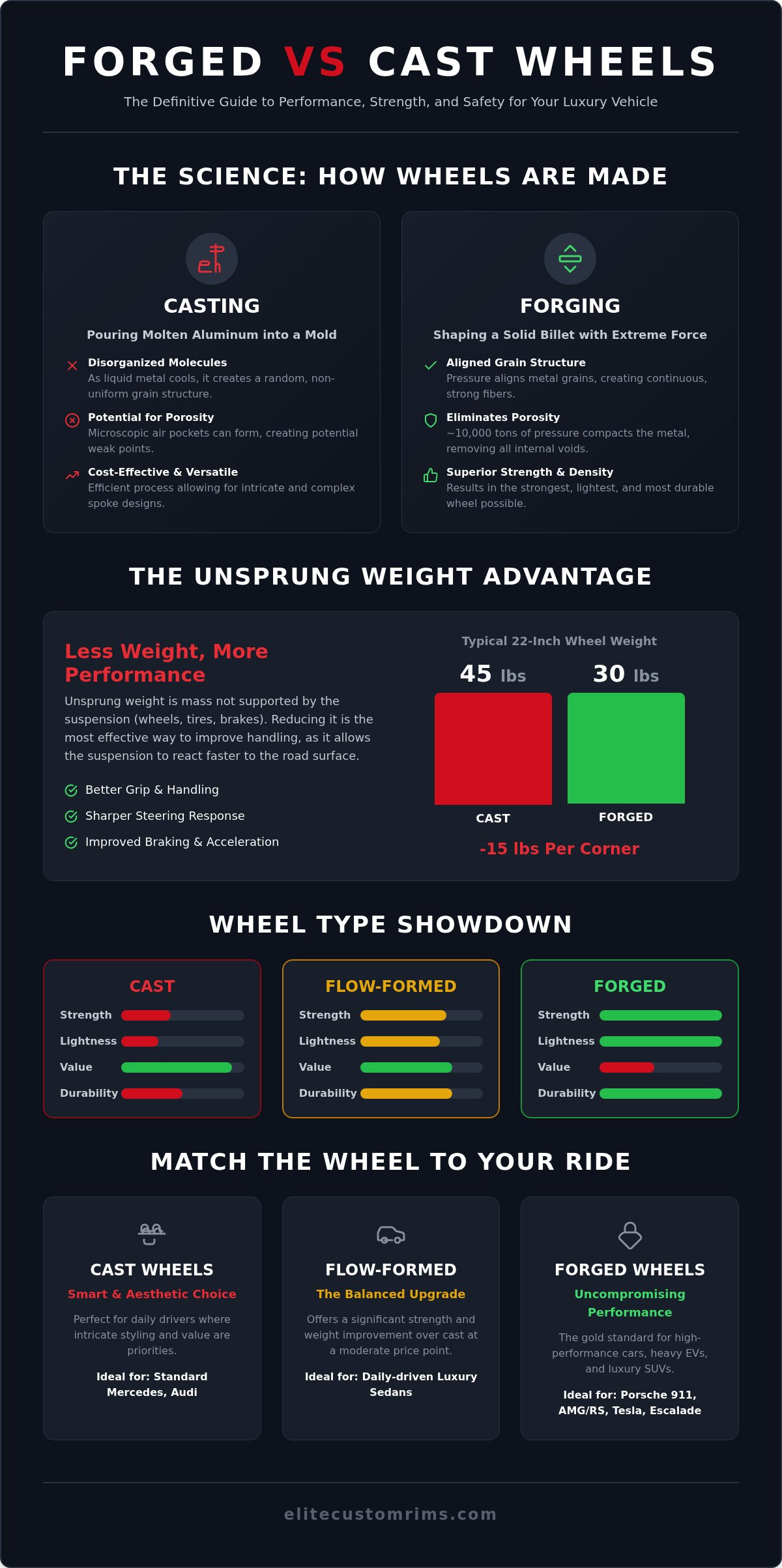
The performance of your vehicle starts where the rubber meets the rim. Choosing between forged vs cast wheels isn't just about aesthetics; it's a decision rooted in metallurgy. At the most basic level, the difference lies in the state of the aluminum during the manufacturing process. Casting involves pouring liquid metal into a pre-made mold. Forging shapes a solid block of aluminum using extreme force. This fundamental distinction dictates how your car handles every corner and pothole.
Manufacturing methods change the molecular DNA of the wheel. In a cast wheel, the aluminum molecules are disorganized. As the liquid cools, microscopic air pockets, known as porosity, can form. Forging solves this by taking a solid billet and subjecting it to intense heat and pressure. This process creates a continuous, directional grain structure. It's inherently denser, stronger, and more resilient to impact than a cast alternative. The manufacturing method ultimately determines the final weight and the maximum load rating the rim can support.
The Casting Process: Efficiency and Versatility
Casting remains the standard for most Alloy Wheel Manufacturing due to its efficiency. Most OEM wheels found on a standard Mercedes or Audi are produced this way. Gravity casting is the simplest method, letting the metal settle naturally. Low-pressure casting is superior, using pressurized gas to push molten aluminum into the mold more quickly. This reduces bubbles and increases density. Because liquid metal flows into every corner of a mold, casting allows for incredibly intricate spoke designs that would be too costly or difficult to machine from a solid block.
The Forging Process: Structural Integrity
Forging is the elite choice for high-performance applications. The process typically starts with a solid billet of 6061-T6 aluminum. This billet is crushed under roughly 10,000 tons of pressure. This massive force eliminates porosity entirely. It creates a metal structure that's significantly stronger than any cast equivalent. Because the metal is so much stronger, engineers can use less of it. This allows for thinner spokes and lighter barrels without sacrificing the load rating required for a heavy Tesla Plaid or a Cadillac Escalade. After the initial forging, a CNC machine carves out the final design with surgical precision. Understanding the technical specs of forged vs cast wheels helps you see why the former is the standard for the track.
- Structural Density: Forged wheels eliminate internal voids found in cast versions.
- Material Efficiency: Forging achieves higher strength with less overall mass.
- Grain Alignment: Forging aligns the metal's internal grain for better fatigue resistance.
Why Forged Wheels are the Elite Choice for Performance
Upgrading to forged wheels is the most effective way to sharpen your vehicle's dynamics. While cast wheels serve as a reliable baseline, the forged vs cast wheels comparison reveals a massive performance gap when you push your car to its limits. Forged wheels aren't just lighter; they're structurally superior. They offer a transformative reduction in unsprung weight, meaning your suspension can track the road with surgical precision. This translates to more grip, better steering feedback, and a car that feels significantly more agile.
Beyond weight, thermal management is a hidden advantage. High-performance braking generates immense heat. Forged aluminum, due to its dense molecular structure, sheds this heat faster than porous cast metal. This keeps your brake fluid cooler and prevents brake fade during spirited driving. Additionally, because each set is CNC machined, you can achieve a flush fitment. You can mill exact offsets for your Porsche or Tesla without relying on spacers. If you're looking for the ultimate setup, explore our Custom Wheels: The Definitive Reference for Luxury & Performance Fitment (2026) to see how fitment impacts performance.
Strength-to-Weight Ratio: The Performance Math
The numbers don't lie. A typical 22-inch cast rim can easily weigh 45 pounds or more. In contrast, a forged equivalent often tips the scales at just 30 pounds. This 15-pound difference per corner is massive. Unsprung mass refers to any component not supported by your springs, and reducing it allows your shock absorbers to control wheel movement more effectively. Lighter wheels also lower rotational inertia. Your engine spends less energy spinning the wheels and more energy accelerating the car. It's a performance win you can feel every time you touch the throttle.
Longevity and Repairability
Durability is where the investment pays off. When you understand the forging process, you see why these wheels survive where others fail. Cast wheels are brittle; a severe pothole hit can cause them to shatter or crack. Forged wheels are ductile. They tend to bend rather than break under extreme impact. This often makes them repairable, saving you from replacing an entire set. Forged wheels are a long-term investment. They hold their value and can often be refinished to look brand new years later. If you want a wheel that matches the engineering of your Audi or Mercedes, check out our latest forged inventory to find your perfect match.
Cast Wheels and the Flow-Formed Middle Ground
Not every luxury vehicle requires a track-ready monoblock. For many owners, the decision between forged vs cast wheels comes down to balancing high-end style with a sensible budget. While forged wheels represent the pinnacle of engineering, modern casting techniques have evolved significantly. The most notable advancement is flow-forming. This hybrid process bridges the gap between traditional casting and elite forging. It offers a sophisticated solution for drivers who want a premium look without the five-figure price tag associated with custom forged sets.
The flow-forming process is a masterclass in manufacturing efficiency. It starts with a cast wheel face. Then, specialized hydraulic rollers apply intense pressure to stretch and compress the barrel while the wheel spins at high heat. This process changes the molecular structure of the aluminum in the barrel, creating a grain structure similar to a forged wheel. You're effectively getting 80% of the strength of a fully forged unit at roughly 50% of the cost. It's a smart, value-oriented play for the savvy enthusiast.
Aesthetic freedom is another major win for the casting category. Because liquid metal flows easily into complex molds, cast wheels offer the widest variety of intricate spoke designs and finishes. If you're chasing a specific deep-concave look or a trendy multi-spoke pattern for your Audi or Mercedes, casting provides the most diverse catalog. These wheels are built for the digital consumer who values currency and style as much as technical specs.
Who Should Buy Cast Wheels?
Cast wheels are the ideal choice for the budget-conscious enthusiast looking for an immediate visual transformation. If you prioritize a "flush" stance over shaving tenths of a second off a lap time, a high-quality flow-formed wheel is your best friend. These rims are perfectly safe for standard highway speeds and typical commuting conditions. They also make excellent winter setups. Road salt and winter grime are brutal on expensive finishes. Using a durable cast wheel for the off-season protects your primary investment while keeping your vehicle looking sharp.
Rotary Forged vs. True Forged
Don't let marketing jargon cloud your judgment. Terms like "rotary forged" or "spin forged" are frequently used to describe flow-formed wheels. They are not true forged wheels. A true forged wheel is machined from a single, solid aluminum billet. A rotary forged wheel still features a cast face. While the barrel strength is vastly superior to a standard cast rim, the face remains susceptible to the same porosity issues as any other cast product. Understanding this distinction is vital when weighing forged vs cast wheels for a heavy-duty application like an EV or a luxury SUV.
Critical Considerations: Load Ratings and Vehicle Mass
Luxury vehicles are getting heavier. Between massive battery packs in modern EVs and the sheer scale of full-size SUVs, your wheels are under more stress than ever before. When weighing forged vs cast wheels, the most critical factor isn't how they look in the driveway. It's the Gross Vehicle Weight Rating (GVWR). A wheel's load rating must exceed the maximum possible weight applied to that specific axle. Ignoring this technical math leads to bent rims or catastrophic structural failure at highway speeds.
High-performance electric vehicles deliver instant, brutal torque. This force travels from the motor through the hub and directly into the wheel spokes. Inexpensive cast wheels often lack the structural density to withstand these repeated high-torque launches without developing fatigue cracks. Forging provides the necessary safety margin for these modern powerhouses. It ensures the wheel remains round and true even under the most demanding dynamic loads. Don't let a "budget" wheel compromise the safety of a six-figure vehicle.
Tesla Efficiency: Forging for Range
Reducing rotational mass is the secret to unlocking extra mileage. Every pound saved on a wheel is equivalent to removing multiple pounds of static weight from the vehicle's cabin. Switching to lightweight forged options can extend your battery range by approximately 3% to 5% depending on your driving habits. This is a vital consideration for those researching Tesla Model Y wheels where maximizing efficiency is a top priority. Lower wheel inertia allows for more effective regenerative braking because the electric motors spend less energy overcoming the wheel's own momentum to slow the vehicle down. It's a rare case where a performance upgrade actually pays for itself in energy savings.
Heavy Duty Luxury: Escalade and GMC Fitment
Full-size luxury SUVs and trucks require massive load ratings that standard passenger wheels cannot provide. A Cadillac Escalade or a GMC Sierra often weighs over 6,000 pounds before you add passengers or cargo. You need wheels rated for at least 2,500 pounds per corner to operate safely. "Style-only" cast wheels found on discount marketplaces often fail to meet these rigorous standards, leading to vibrations or barrel failure. Forging is the superior choice for Chevy Silverado wheels, especially if you plan on towing or frequenting off-road trails. Choose a wheel built for the actual mass of your machine. Secure your high-load-rated wheel set today and drive with absolute confidence in your equipment.
Making the Investment: Which Wheel Type Fits Your Lifestyle?
Choosing between forged vs cast wheels isn't just a financial decision. It's about aligning your vehicle's hardware with your personal driving profile. If your garage holds a Porsche, an Audi RS, or a Mercedes AMG, forged wheels are the standard. These machines are engineered for peak performance. A heavy cast wheel would only stifle their agility. You need the extreme strength-to-weight ratio that only forging provides to handle high-speed cornering and aggressive thermal loads without compromise.
For the luxury commuter, the priorities often shift toward presence and poise. Drivers of a Mercedes S-Class or a Rolls Royce frequently choose forged wheels for their exclusivity and mirror-like finishes. However, if you're looking for a sharp visual upgrade for a daily-driven sedan, high-quality cast wheels are a viable option. Just ensure any cast wheel you buy carries JWL and VIA certifications. These stamps guarantee the wheel has passed rigorous safety testing, providing peace of mind for every mile.
The final verdict is simple:
- Splurge on Forged: If you drive a high-performance EV, a heavy luxury SUV, or a track-ready sports car where weight and strength are critical.
- Save on Cast: If you want a stylish visual upgrade for a daily commuter or a dedicated winter setup that doesn't see track use.
Matching the Wheel to the Brand
Specific vehicles demand specific engineering. Forged wheels perfectly complement the precision of Mercedes S-Class wheels, where every component must meet exacting tolerances. Conversely, you can achieve stunning Audi Q7 wheels upgrades using high-quality cast options that offer a wide variety of contemporary styles. For those at the pinnacle of luxury, the prestige factor remains unmatched when selecting forged Rolls Royce wheels.
Next Steps: Securing Your Professional Fitment
Technical specs matter, but fitment is king. Even the most expensive forged wheel is useless if the offset is wrong or the center bore doesn't match your hub. Precise fitment data is the most important part of the forged vs cast wheels equation. At Elite Custom Rims, we take the guesswork out of the process. We guarantee fitment for the world's most prestigious luxury and performance brands. Our experts verify every order to ensure your new setup clears your brake calipers and sits perfectly flush with your fenders. Upgrade your vehicle with our curated selection of premium wheels today and experience the Elite difference.
Elevate Your Driving Experience with Precision Engineering
The right choice in the forged vs cast wheels debate depends entirely on your vehicle's mass and your personal performance goals. You now understand that forged wheels represent a structural investment in durability and range for heavy EVs and high-performance Porsche or Audi models. Meanwhile, high-quality cast and flow-formed options offer the perfect aesthetic bridge for daily luxury commuters who value style and value. Every decision you make impacts how your car handles the road and handles the corners.
Don't leave your fitment to chance. We provide expert technical support for performance enthusiasts and guaranteed fitment for Audi, Mercedes, and Porsche. Our team takes the guesswork out of the equation so you can focus on the drive. For comprehensive care beyond wheels, Grand Prix Cafe offers professional vehicle services and sales for classic and high-performance cars. We offer national shipping on all premium wheel orders to ensure your upgrade arrives safely and quickly at your doorstep. It's time to transform your vehicle's profile with absolute confidence and professional assurance.
Ready to redefine your stance? Shop the Elite Collection of Forged and Cast Wheels and make the ultimate upgrade for your luxury vehicle today.
Frequently Asked Questions
Are forged wheels really worth the extra cost for daily driving?
Forged wheels are worth the investment if you prioritize long term durability and suspension health. While cast wheels are suitable for smooth highways, forged rims resist the bending and cracking caused by deep urban potholes. This protects your expensive tires and delicate suspension components from impact damage. They are a one-time purchase that typically lasts the entire life of your luxury vehicle.
Can you tell the difference between forged and cast wheels just by looking at them?
It is difficult for many to distinguish them at a distance, but forged wheels often feature crisper, sharper edges and thinner spokes. Because the metal is inherently stronger, designers can create more aggressive, slim profiles that casting cannot support. Look for a "forged" engraving on the rim or hub area. Cast wheels usually have slightly softer, more rounded edges where the molten metal settled.
Do cast wheels break more easily than forged wheels?
Cast wheels are more brittle due to their porous internal structure. Under extreme impact, a cast wheel is more likely to crack or shatter completely. Forged wheels are denser and more ductile. They tend to bend rather than break during a severe hit. This structural characteristic can be the difference between a controlled stop and a total loss of tire pressure during a road incident.
What does "flow-formed" or "rotary forged" actually mean?
These terms describe a hybrid manufacturing process where the wheel face is cast and the barrel is spun and stretched under intense heat. This increases the strength of the barrel significantly compared to standard casting. It is a middle ground option that reduces weight and increases durability without the full cost of a monoblock forged wheel. It remains an excellent value choice for many enthusiasts.
Why do forged wheels improve a car’s acceleration and braking?
Forged wheels reduce rotational inertia by being significantly lighter than their cast counterparts. When comparing forged vs cast wheels, the weight savings mean the engine and brakes don't have to work as hard to spin or stop the mass. This leads to more immediate throttle response and shorter stopping distances. It is a mechanical advantage that transforms the dynamic feel of any high performance vehicle.
Are forged wheels better for heavy vehicles like the Cadillac Escalade or Tesla Model X?
Forging is the superior choice for high GVWR vehicles due to its higher load bearing capacity. Heavy SUVs and EVs place immense stress on wheel spokes during cornering and rapid acceleration. Forged wheels handle these dynamic loads with a much higher safety margin. This prevents the structural fatigue that can plague less dense cast wheels over thousands of miles of heavy duty use.
How do I know if a wheel has a high enough load rating for my truck?
Check the load rating stamp on the back of the wheel and compare it to your vehicle's Gross Axle Weight Rating. You should divide the highest GAWR by two to find the minimum required capacity per wheel. Always look for a rating that offers a safety buffer for towing or cargo. Our technical support team can verify these specifications for your specific truck or SUV model.
Do forged wheels come with better warranties than cast wheels?
Manufacturers often provide longer structural warranties for forged wheels because of their inherent strength. While finish warranties are usually similar across both types, the structural guarantee on a forged rim reflects the manufacturer's confidence in its resilience. You should always review the specific warranty documentation for any high ticket purchase to understand the coverage for structural defects versus standard road hazard damage.