
What is a bespoke wheel program, and does “bespoke” mean designing a wheel from scratch? The phrase can describe anything from a tailored fitment selection to a one-off design. Knowing the difference helps you set realistic expectations and choose wheels that suit your vehicle.
If terms like offset and bolt pattern are hard to interpret, you’re not alone. A suitable wheel choice balances your vehicle’s specifications with your goals for appearance and use. Understanding what is a bespoke wheel program helps you distinguish a personalized selection process from custom manufacturing.
This guide explains what a program may involve, how it differs from standard aftermarket shopping, and which details shape a suitable fitment, including vehicle model, bolt pattern, wheel diameter, width, and offset. You’ll also see how model-specific options can narrow the search. Elite Custom Rims offers new brand-specific wheels for vehicles including Audi, Mercedes, Porsche, Tesla, Land Rover, and Toyota. Start with accurate vehicle details, and it becomes easier to assess the options.
Key Takeaways
- Learn what is a bespoke wheel program and why the phrase can describe different levels of tailoring.
- Follow a practical sequence for turning your style and driving priorities into wheel specifications.
- See how OEM terminology differs from aftermarket options, and what to consider when comparing them.
- Prepare key vehicle details before browsing, including the measurements that need to work together for fitment.
- Explore how model-focused wheel options can help narrow the search for your vehicle.
What Is a Bespoke Wheel Program? A Clear Definition
A bespoke wheel program is a tailored approach to choosing or specifying wheels around a particular vehicle and its owner’s preferences. It can help narrow the options by considering fitment requirements alongside the look the owner wants.
In short: a bespoke wheel program guides a buyer through a selection shaped by their vehicle and preferences. The phrase is not a single standardized industry term, so its meaning varies by program.
“Bespoke” generally describes something made or arranged to a particular specification. As the reference on What is 'Bespoke'? explains, the term is associated with individualized requirements. In wheel shopping, that can mean choosing from existing designs and fitments rather than commissioning an entirely new wheel. The label alone doesn’t define what choices are available.
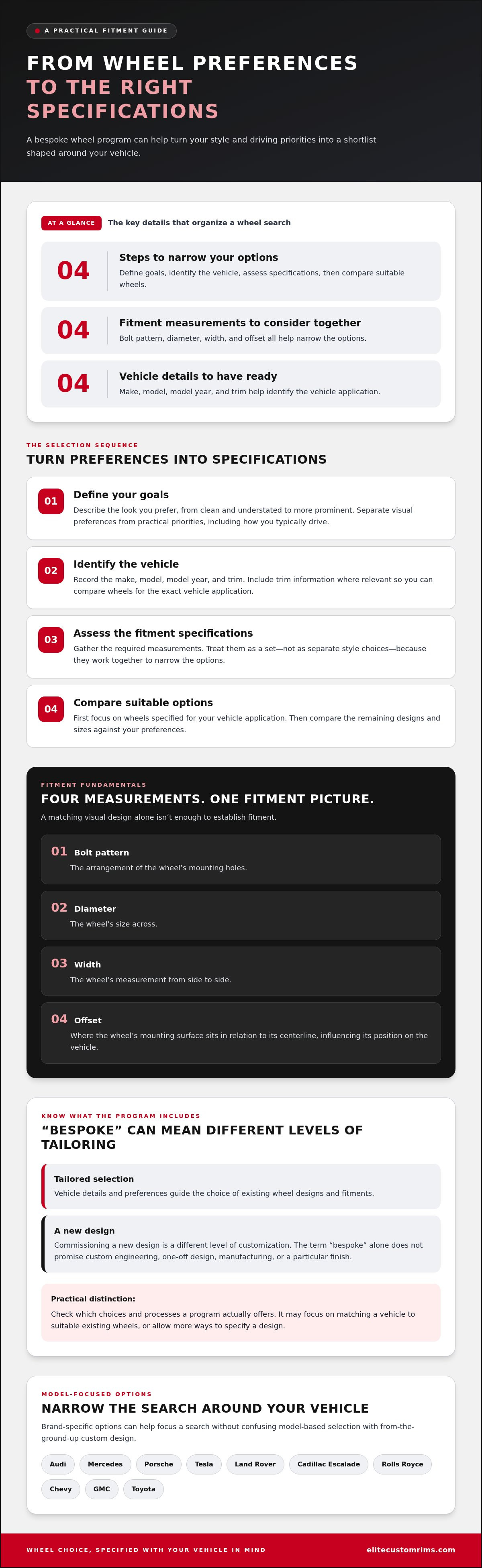
Program scope depends on the options offered. One program may focus on matching a vehicle to suitable existing wheels; another may allow more ways to specify a design. Don’t assume the phrase promises custom engineering, a one-off design, manufacturing, or a particular finish. Assess the available choices and process to understand what “bespoke” means in practice.
What can “bespoke” mean in wheel shopping?
It may mean a focused selection process in which preferences and vehicle details guide the choice. Decisions could involve wheel style, size, and vehicle-specific fitment. The practical distinction is whether you’re choosing and specifying an existing wheel or commissioning a new design. Those are different levels of customization, even if both are described with similar language.
Who might consider a bespoke wheel approach?
This approach may suit owners who want a distinctive look while keeping fitment in view. A luxury sedan owner, a performance-car enthusiast, and someone choosing wheels for a utility vehicle may have different priorities. Much like cyclists who consult specialist retailers such as The Cycle Centre to match frame geometry and wheelsets to their riding needs, vehicle owners benefit from balancing purpose with design. A tailored selection can help organize those preferences, but it isn’t essential for every buyer. Standard shopping may be enough if you already know the wheel and fitment you want.
Start with the vehicle, then clarify your priorities. Are you mainly looking for a different visual character, a particular size, or options selected for your model? Separating those goals makes the term less vague and gives you a clearer basis for comparing wheel choices.
Model-focused options can make the search more manageable. Elite Custom Rims offers new wheels for Audi, Mercedes, Porsche, Tesla, Land Rover, Cadillac Escalade, Rolls Royce, Chevy, GMC, and Toyota, with dedicated fitment choices for specific vehicle models. These brand-specific options help you focus your search without confusing model-based selection with from-the-ground-up custom design.
How a Bespoke Wheel Program Turns Preferences into Specifications
A tailored wheel choice starts with more than a style reference. The goal is to turn your preferences and how you use the vehicle into a shortlist that accounts for its requirements. Fitment and design should be considered together: appearance matters only if the wheel’s specifications suit the vehicle application.
In practical terms, a bespoke wheel program is a sequence for narrowing options, not a reason to choose by looks alone. Work through these steps:
- Define your goals. Note the appearance you prefer, such as a clean, understated look or a more prominent design. Separate that from practical priorities, including how you typically drive.
- Identify the vehicle. Record its make, model, model year, and trim. These details help distinguish the exact vehicle application when comparing wheels.
- Assess specifications. Gather the required fitment information, including bolt pattern, diameter, width, and offset. Treat the measurements as a set, not as independent style choices.
- Compare suitable options. Narrow the selection to wheels specified for your vehicle application. Then compare the remaining designs and sizes against your preferences.
Start with the vehicle and the owner’s priorities
Write down the vehicle details before browsing, including trim information where relevant. Then make two short lists: what you want visually and what matters in everyday use. For example, you might want a more distinctive appearance while still keeping the vehicle’s usual driving role in mind. This brief focuses your search without assuming one setup fits every version of a model.
Translate the brief into wheel specifications
Bolt pattern describes the arrangement of the wheel’s mounting holes. Diameter is the wheel’s size across, while width measures it from side to side. Offset describes where the wheel’s mounting surface sits in relation to its centerline, influencing its position on the vehicle. These figures work together to narrow the options. A matching visual design alone isn’t enough to establish fitment.
Offset can feel abstract at first. The article What Is Wheel Offset? A Professional Technical Guide explains the measurement in more detail. For broader context, SAE International’s Wheel Standards Committee works on automotive wheel standards.
Keep your vehicle details and fitment information together as you browse. Model-focused selections, such as the brand-specific wheel options at Elite Custom Rims, help you focus on choices for your vehicle rather than sorting through an undirected mix. Use your preferences to guide the look and the vehicle specifications to guide fitment.
Bespoke, OEM, and Aftermarket Wheels: What’s the Difference?
These terms describe different aspects of wheel shopping. Bespoke refers to a tailored approach to selection or specification. OEM relates to original equipment, while aftermarket broadly describes wheels offered beyond a vehicle’s original equipment. They aren’t mutually exclusive categories: you can take a tailored approach to choosing aftermarket wheels.
| Term | Meaning | Selection approach | Typical buyer consideration |
|---|---|---|---|
| Bespoke | A tailored selection or specification process, with scope varying by program. | Shape the choice around vehicle details and owner preferences. | Understand which decisions the program actually lets you tailor. |
| OEM or OEM-style | OEM refers to original equipment; OEM-style generally describes a wheel intended to resemble an original-equipment design. | Choose an original-equipment-related replacement or similar look. | Check the specific wheel’s application and specifications, not appearance alone. |
| Aftermarket | A broad category of wheels made for sale beyond a vehicle’s original equipment. | Choose from wheels offered outside the original equipment range. | Compare fitment, design, and intended use; the label alone doesn’t promise customization or better performance. |
Think of the labels as answering separate questions. “Bespoke” describes how a choice is shaped. “OEM” relates to the vehicle’s original equipment. “Aftermarket” describes a broad source or category. A wheel may be aftermarket and selected through a tailored process without being newly designed for one buyer.
Bespoke versus OEM-style wheels
An OEM-style search often starts with the goal of replacing a wheel with one that has a similar original-equipment appearance. A bespoke approach starts with the owner’s preferences and vehicle application, then narrows the choices accordingly. Similar styling doesn’t prove a wheel fits: appearance can’t establish that its specifications suit a particular vehicle. For a model-specific example, the article Perfect Fitment: Choosing the Best Rims for Your Audi considers fitment in the context of Audi options.
Bespoke versus aftermarket wheels
Aftermarket is an umbrella term, not a customization level. You can personalize a selection by weighing design preferences and vehicle fitment, yet still choose from existing wheels rather than commission a new design. The distinction is useful: “aftermarket” tells you the category, while a tailored process describes how you narrow the options. For broader selection context, see The Art of Selecting Custom Wheels and Rims.
So, what is a bespoke wheel program compared with a standard aftermarket search? It’s a more preference-led way to evaluate possibilities, not automatically a promise of one-off manufacturing. Keep the terms separate, then judge each wheel by its application and specifications as well as its appearance.
What to Consider Before Choosing Wheels Through a Bespoke Program
A strong shortlist starts with accurate vehicle information and clear priorities. Before browsing, separate details you know from assumptions, especially if your vehicle has a particular trim or previous modifications. The exact application matters: a wheel that looks right in a photo isn’t necessarily appropriate for your vehicle.
Appearance is only one part of an appropriate wheel choice. Gather these details and preferences first:
- Vehicle identification: Make, model, model year, and trim.
- Current setup: Any confirmed wheel specifications or changes from the original configuration.
- Fitment information: Bolt pattern, diameter, width, and offset, based on reliable vehicle or wheel records.
- Style preferences: The look you want, such as understated, sporty, or more visually prominent.
- Use and priorities: How you use the vehicle and what matters most in your selection.
Mark each item as confirmed or still to be verified. Don’t treat a measurement remembered from another vehicle, or a visual match online, as proof of compatibility. This simple distinction keeps assumptions from becoming selection criteria.
Which fitment details should buyers understand?
The bolt pattern is the layout of the wheel’s mounting points, so it must correspond to the vehicle’s hubs. Diameter and width describe the wheel’s size, while offset relates to the position of its mounting surface. Consider these measurements together because changing one specification can affect whether a wheel is suitable for the application. The guide How to Measure Your Wheel Bolt Pattern Accurately covers how to identify this key measurement.
Use confirmed vehicle information to build your shortlist, not a guess based on the make alone. If you don’t have a specification to hand, treat it as unknown rather than filling in a likely value. This matters when comparing wheels that look similar but have different dimensions or mounting layouts. The objective is a choice supported by vehicle details, not just a visual impression.
How should style and intended use guide the shortlist?
Think about the vehicle’s purpose alongside the look you want. A daily-use vehicle, a performance-oriented car, and a utility vehicle may lead their owners to different priorities. Note which design qualities matter most, then compare them with the vehicle’s application. Don’t assume a material or construction label guarantees a particular performance result; focus on the listed specifications and fitment information.
Keep your preferences flexible. A favorite spoke design, finish, or overall profile can help narrow choices, but it can’t override fitment requirements. If an appealing option doesn’t match the application, it isn’t the right shortlist candidate. A model-focused selection can make browsing more targeted by organizing wheel choices around specific vehicles and their fitment needs.
Ready to narrow your options by vehicle and fitment? Explore brand-specific wheel options for your vehicle.
Explore Brand-Specific Wheel Options with Elite Custom Rims
Understanding what is a bespoke wheel program helps you approach wheel shopping with clearer expectations: a tailored selection doesn’t automatically mean a one-off design or custom manufacturing. Elite Custom Rims is an online retailer of new wheels for luxury, performance, and utility vehicles, with brand-specific options and dedicated fitment choices for specific vehicle models.
Starting with your vehicle brand and model can make a broad search more focused. Explore options related to your vehicle, then compare them against your fitment details and personal priorities. That’s a practical route from inspiration to a more considered shortlist.
Turn your preferences into a focused wheel search
Begin with your vehicle’s make, model, and relevant details. Then decide what matters most: a particular visual character, a model-focused selection, or a balance between appearance and everyday priorities. Elite Custom Rims offers new wheels for Audi, Mercedes, Porsche, Tesla, Land Rover, Cadillac Escalade, Rolls Royce, Chevy, GMC, and Toyota. This selection spans a range of luxury, performance, and utility vehicles.
Use your preferences to guide your browsing, not to assume every style suits every vehicle. Compare options with your vehicle information in mind, and treat fitment as part of the selection rather than a detail to consider after choosing a look.
Take the next step with a better-informed shortlist
A useful shortlist brings three things together: accurate vehicle details, relevant fitment specifications, and the style you want. Keep confirmed information separate from assumptions as you compare. If a specification is uncertain, resolve that before treating a wheel as a suitable match. A distinctive look is most useful when the choice also makes sense for the vehicle application.
Take your time, browse relevant brand-specific wheel options, and compare the choices for your vehicle against your priorities. The aim is a selection that reflects your taste while keeping the technical details in view.
Ready to explore? Explore wheel options at Elite Custom Rims.
Make Your Next Wheel Choice with Confidence
Before comparing options, decide what matters most. Choose the visual qualities you want, note which details are non-negotiable, and stay open to alternatives that suit your vehicle. That gives you a clear standard for judging a tailored selection, whatever a program calls itself.
Understanding what is a bespoke wheel program means looking beyond the label. Focus on the choices involved and how they relate to your vehicle. A well-prepared shortlist makes it easier to compare new wheel options, including dedicated fitment choices for specific models across luxury, performance, and utility vehicles.
Use your vehicle details as a guide and let your style preferences shape the shortlist without replacing fitment considerations. Explore options for your vehicle and find a direction that suits your goals.
Explore wheel options at Elite Custom Rims and take the next step with confidence.
Frequently Asked Questions
What is a bespoke wheel program?
A bespoke wheel program is a tailored way to specify and select wheels around a vehicle and its owner’s preferences. Scope varies: it may guide a shopper through existing options rather than create a unique wheel. The phrase alone doesn’t promise new engineering or manufacturing. For example, a buyer might personalize style and sizing choices while selecting from available designs. In every case, the vehicle’s application and fitment remain central.
Are bespoke wheels the same as custom wheels?
Not necessarily. The terms can overlap, but they don’t always describe the same thing. “Bespoke” may refer to a selection process shaped around a buyer’s needs, while “custom wheels” can describe aftermarket designs or particular customization options. Neither label, by itself, proves that a wheel is made from scratch. Focus on the specific design and fitment choices available.
Can a bespoke wheel program work with my vehicle?
It depends on your vehicle and the wheel specifications available for it. Make, model, year, and trim can help identify the correct application; bolt pattern, diameter, width, and offset further narrow the choices. Two wheels may look alike yet differ in ways that affect fitment. Use accurate details from your vehicle records or current wheel information, and weigh compatibility alongside appearance rather than relying on a visual match.
How is a bespoke wheel program different from OEM wheels?
OEM refers to original-equipment-related wheels or specifications; bespoke describes an approach to selecting or specifying wheels around a buyer’s needs. The terms address different things, so a tailored search might include OEM-related options. Keep the exact product and application in view: an OEM-style appearance doesn’t prove that a wheel matches your vehicle. A similar spoke pattern alone can’t establish that its mounting layout and dimensions are appropriate.
Do bespoke wheels have to be made from scratch?
No. The phrase doesn’t automatically mean a wheel is newly engineered or manufactured for one customer. A program might help narrow existing designs based on a vehicle’s application and the owner’s preferences. Its scope depends on the program. Distinguish choosing and specifying from available options from commissioning a unique design. That distinction sets realistic expectations before you focus on aesthetics or technical details.
What information should I have before choosing bespoke wheels?
Gather your vehicle’s make, model, year, and relevant trim details, plus any known wheel specifications. Bolt pattern, diameter, width, and offset can help narrow the selection; note whether each detail is verified or only assumed. Also write down the style you prefer and how you use the vehicle. A design that appeals visually still needs to suit the vehicle’s application, so don’t let taste replace fitment information.
Are bespoke wheels only for luxury cars?
No. “Bespoke” describes a tailored approach, not a vehicle class. Owners of performance cars or utility vehicles may also want to weigh appearance against vehicle-specific fitment. Options differ by make and model, so don’t assume the same designs or specifications suit every vehicle. In the same way that drivers seeking dedicated upgrades for particular makes might look to specialized retailers such as TheChiDrive for brand-specific automotive accessories, choosing the right wheels requires prioritizing exact vehicle fitment. Start with your vehicle details, then consider how a tailored selection could help you compare relevant choices with your priorities in mind.