
The finish may matter less to cleaning time than the shape of the spokes. If brake dust and road grime collect where your brush can’t reach, the best wheel designs for easy cleaning are usually those with open layouts, fewer spokes, and fewer tight crevices. A simple five-spoke style can be easier to maintain than an intricate mesh design, even when both have a similar finish.
You don’t have to choose practicality over appearance. The right balance depends on how much time you want to spend on upkeep, the look you want for your vehicle, and the wheel’s surface details. A finish may protect the surface, but it won’t make hard-to-reach areas easier to clean.
This guide compares wheel layouts and finish considerations so you can weigh the trade-offs. You’ll learn which design details affect cleaning access, how simpler and more intricate styles differ, and how to narrow vehicle-specific wheel options to a look that suits your routine.
Key Takeaways
- Compare spoke spacing, recessed areas, and inner-barrel access to judge how easily you can reach grime-prone spots.
- The best wheel designs for easy cleaning depend on both the layout and how much detailed upkeep you’re willing to do.
- Assess finish and surface details separately from spoke geometry. Appearance alone won’t tell you how accessible a wheel is to clean.
- Use a simple selection framework: define your maintenance preference, compare layouts, inspect surfaces, then check vehicle fitment.
- Explore vehicle-specific new wheel options from Elite Custom Rims to balance the style you want with your care routine.
Best Wheel Designs for Easy Cleaning: What Makes a Wheel Low-Maintenance?
An easy-clean wheel design makes its surfaces simpler to reach and wipe. Look beyond the finish: spoke spacing, recessed pockets, the inner barrel, and your usual care routine all affect how much effort cleaning takes. A smooth, open face can be easier to access than a wheel with tight gaps and overlapping details, but no design is maintenance-free.
Cleanability is how easily you can reach and wipe a wheel’s visible face, spoke edges, recesses, and inner barrel. Use this as a practical way to compare layouts while shopping. It doesn’t mean a wheel will stay clean longer or clean itself.
Materials and manufacturing shape a wheel’s construction and finish, while its geometry determines where grime can collect and how easily you can reach it. For background on wheel materials and production, see Alloy Wheel Composition and Manufacturing. To compare everyday cleanability, focus on the surfaces you’ll need to access.
How wheel spokes and recesses affect cleaning access
Open space between spokes can give your hand or cleaning tool a more direct path to inner surfaces. Consider these design examples:
- Open five-spoke face: Fewer, wider spokes leave larger openings and fewer narrow gaps to work around.
- Dense multi-spoke or mesh face: More spokes and intersections create additional edges and smaller spaces where access may be limited.
- Deep-pocket or overlapping-spoke face: Recesses and layered details can make some surfaces harder to reach than the face itself.
These are design comparisons, not guarantees. Spoke thickness, curvature, and the space behind each spoke also matter. A wheel can look open from straight ahead yet have deep pockets or a narrow route to its inner barrel. Check the wheel from different angles. Look for whether you can see and reach the surfaces behind the spokes, not just the front face.
Why cleaning routine matters as much as wheel style
Your driving and upkeep habits shape what feels low-maintenance. Frequent driving can mean more regular exposure to road grime and visible brake dust. If you prefer a quick exterior wipe-down, a design with broad, accessible faces may be easier to work with. If you’re comfortable giving the inner barrel and detailed areas closer attention, an intricate layout may suit your routine.
Be realistic about the time you’ll spend. A wheel with many narrow gaps may call for more deliberate attention, especially if you want to clean beyond the visible face. Finish matters too, but it can’t remove obstacles created by spoke geometry. The best wheel designs for easy cleaning are the ones whose access and detailing match the care you’re willing to give them.
Which Spoke Patterns Make Wheels Easier to Clean?
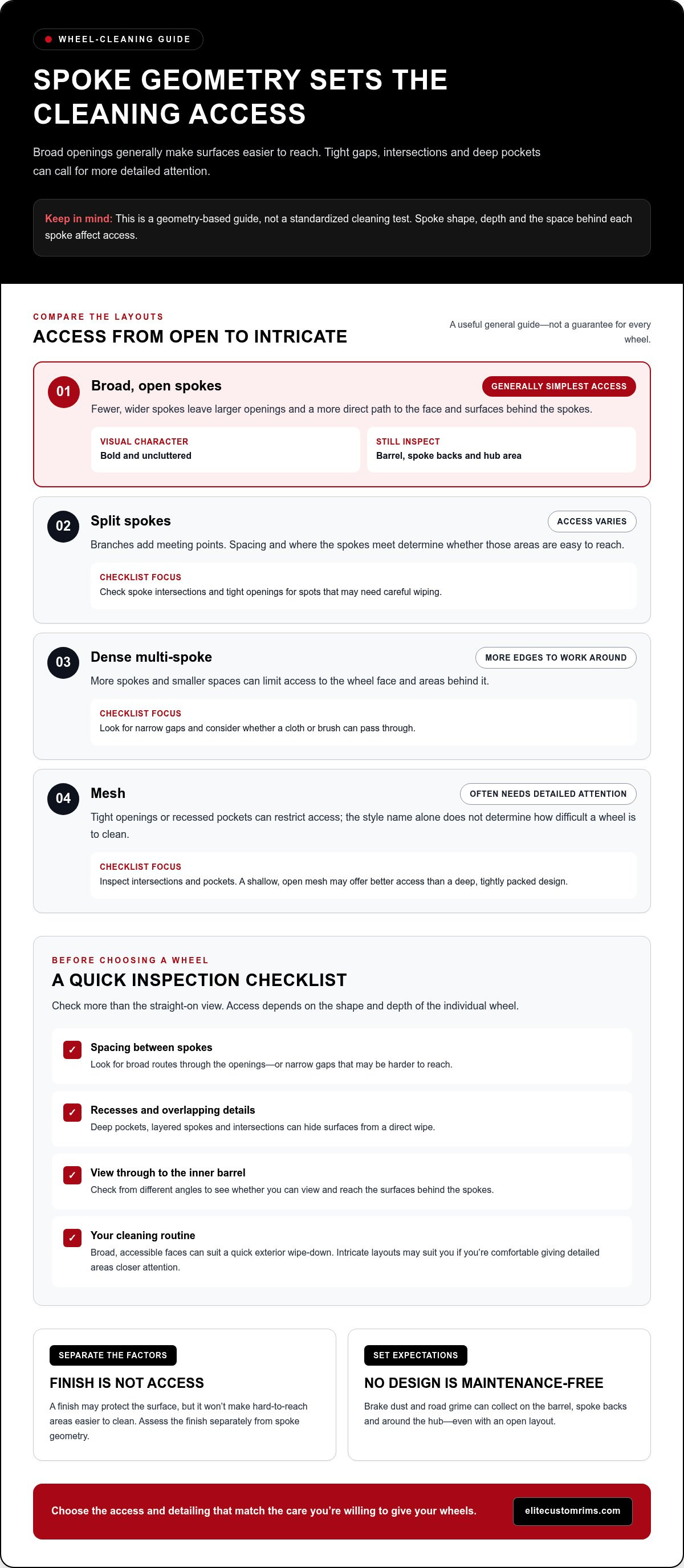
Spoke layout shapes how directly you can reach the wheel face, the areas behind each spoke, and the inner barrel. Broad openings generally offer easier access. Tight intersections and deep recesses can call for more careful attention. That’s a useful comparison, not a guarantee: actual access depends on each wheel’s shape and depth.
For cleaning access, broad open spokes are generally simplest, split spokes and dense multi-spoke layouts add more edges, and mesh designs with tight gaps or deep pockets can demand the most detailed attention. Treat this as a geometry-based guide, not the result of a standardized cleaning test.
| Spoke pattern | Relative access | Visual character | Likely cleaning attention |
|---|---|---|---|
| Broad, open spokes | More direct access to the face and spaces behind spokes | Bold, uncluttered | Less work around narrow gaps; barrel and spoke backs still need attention |
| Split spokes | Varies with spacing and where the branches meet | More layered and detailed | Check intersections and tight openings for areas that may need careful wiping |
| Dense multi-spoke | Smaller spaces can limit access | Fine, intricate lines | More edges and gaps to work around |
| Mesh | Often restricted where openings are narrow or recessed | Complex, interwoven appearance | Inspect intersections and pockets for detailed cleaning needs |
Open-spoke and broad-spoke designs
Fewer, widely spaced spokes expose more of the wheel face and leave larger routes toward the inner surfaces. That can make it easier to see where dust has collected and guide a cloth or brush through the openings. Still, an open design doesn’t mean effortless cleaning. Grime can remain on the barrel, spoke backs, and around the hub. This layout is one practical option, not the right look for every vehicle or owner.
Multi-spoke, mesh, and split-spoke designs
Additional spokes create more edges, while branching spokes add meeting points that may be awkward to reach. Mesh patterns can have especially narrow openings, but the label alone doesn’t determine cleaning difficulty. A shallow, open mesh may offer better access than a deep, tightly packed split-spoke face. Judge the individual shape, not just the style name.
Inspect wheel images from more than one angle. Look for narrow gaps between spoke pairs, dark recessed pockets, overlapping details, and a clear view through to the barrel. A straight-on image can hide depth, so use angled product views when available. Consider whether a cleaning tool could pass through the openings and reach the surfaces behind them.
If you’re comparing styles for your vehicle, assess access alongside the appearance you want. The vehicle-specific wheel options at Elite Custom Rims let you explore new designs for different makes and models. To find the best wheel designs for easy cleaning, prioritize visible access, then decide how much detailing you’re willing to do for the style you prefer.
Wheel Finishes and Details: What Helps, or Hinders, Easy Cleaning?
Finish and spoke geometry affect different parts of cleaning. Geometry determines how easily you can reach a surface; contours and surface details affect how a cloth moves across it. Finish describes the wheel’s appearance and surface treatment, but it isn’t enough on its own to determine whether one wheel will be easier to maintain than another.
A smooth, visually simple face may have fewer shaped details to work around than a heavily sculpted face. Yet a smooth face doesn’t automatically make every area accessible. The spokes may still have tight edges, and inner surfaces may be recessed. Judge the whole wheel, not just the finish shown in a product photo.
Smooth faces, intricate surfaces, and visible brake dust
Contours can create corners and transitions where a cloth needs to change direction. Raised details may be easy to see but harder to wipe around; recessed areas may require more careful access. Brake dust can also look different depending on the wheel’s color and finish, lighting, and driving conditions. Don’t assume a particular shade will hide dust or eliminate regular care.
Compare how a design looks from different angles and under different lighting when possible. Notice which features are flat, raised, or recessed, and whether dust would be visible in those areas. These observations help you anticipate where attention may be needed without treating appearance as proof of cleaning performance.
Balancing distinctive style with maintenance effort
A detailed design can give a vehicle a distinctive look, and choosing one doesn’t mean you’re making the wrong practical choice. The useful question is whether its small spaces and contours fit the amount of attention you’re willing to give them. If quick, straightforward wipe-downs are your priority, compare the layout carefully before letting a finish or visual effect make the decision for you.
Before choosing, review clear product photos from the front and at an angle. Look for:
- Face contours: Check for grooves, ridges, or stepped surfaces that may take extra passes to wipe.
- Spoke details: Notice whether edges meet at tight junctions or create layered recesses.
- Surface visibility: Consider whether the finish makes dust easy for you to notice, rather than assuming it will conceal buildup.
- Access behind the face: Look for views that show how open or recessed the areas behind the spokes appear.
Keep your preferences in balance. A simple-looking wheel isn’t automatically the best personal choice if you love a more detailed style and are comfortable giving it more attention. The best wheel designs for easy cleaning combine accessible geometry with a finish and appearance you’re happy to maintain.
For a broader view of how style choices connect with vehicle fitment, explore this custom wheels reference guide. Use it alongside close-up product photos to compare looks, surface details, and the upkeep each design may call for.
How to Choose Easy-Clean Wheels for Your Vehicle and Routine
Make the choice in a clear order: decide how much upkeep suits you, compare spoke layouts, inspect surface details, then confirm fitment. This keeps appearance and cleaning effort in view without letting either distract from compatibility. A wheel can look ideal and still be unsuitable for your vehicle’s exact application.
- Set your maintenance preference. Think about how often you want to clean your wheels and whether you usually do a quick face wipe or include less visible areas. Be realistic about the time you’ll give detailed surfaces.
- Compare spoke layouts. Look at the openings, gaps, spoke intersections, and visibility through to the inner barrel. Broad, open shapes may suit shoppers seeking simpler access; intricate layouts may appeal if you’re comfortable giving them more attention.
- Inspect the surfaces. Check for contours, recesses, and layered details that could make some areas harder to reach. Use more than one product view where possible, since a straight-on image may not show depth.
- Check vehicle fitment. Narrow your choice to wheels intended for your vehicle and exact application. Style and cleanability don’t establish compatibility.
Match design complexity to your cleaning habits
If simple routine cleaning is your priority, start by comparing open, accessible shapes with tighter patterns. If you’re willing to spend more time on wheel care, a detailed design may suit your preferences. There’s no universal style ranking that works for every driver. Choose an appearance you enjoy, then decide whether its details fit your regular upkeep.
Your routine may also change with how you use the vehicle. A daily driver exposed to regular road grime may call for a different maintenance commitment than a vehicle used less often. That isn’t a reason to rule out any design. Consider whether you’ll be comfortable cleaning the areas its shape creates.
Keep vehicle fitment in the decision
Fitment is separate from ease of cleaning. Don’t guess bolt pattern, offset, diameter, or clearance from a wheel’s appearance or a photo. Visual similarity doesn’t establish that a wheel suits your exact vehicle. Review the application details as you compare designs, and use a wheel fitment reference to understand how style and fitment relate.
The best wheel designs for easy cleaning balance reachable surfaces, a look you want to live with, and correct vehicle fitment. Keep those priorities side by side as you browse. Explore vehicle-specific new wheel options to compare designs for your vehicle and find a style that fits both your taste and care routine.
Shop New Wheels That Balance Easy Cleaning and Standout Style
The right wheel choice brings together accessible spokes, a manageable level of detail, an appearance you enjoy, and fitment suited to your vehicle. No single style works for every owner. Use your cleaning habits to narrow the design choices, then compare actual wheel images and application details before deciding. A label such as “mesh” or “split-spoke” can suggest a look, but it can’t tell you everything about access or compatibility.
Turn your cleaning priorities into a short buying checklist
Keep these preferences in view as you compare options. They make it easier to assess the specific wheel rather than choosing by style name alone.
- Spoke openness: Decide whether you prefer broad spaces that are easier to see through or a denser pattern with a more intricate appearance.
- Detail level: Consider how much time you’re willing to spend on small gaps, spoke intersections, and recessed areas.
- Finish appearance: Choose a look you like, but don’t assume a color or finish will hide brake dust or eliminate regular care.
- Vehicle fitment: Keep compatibility as a requirement, not a styling preference. A wheel that looks right still needs to suit your vehicle and application.
Use clear images from more than one angle to inspect the face, spoke edges, and visible areas behind the spokes. Product specifications and fitment details matter too. Photos can help you judge visual access, but they can’t establish technical compatibility on their own.
Keep your expectations realistic. Open designs can make some surfaces more accessible, while detailed designs may call for extra attention in tight areas. Either way, wheels need appropriate routine cleaning. Choose a design you’ll be happy to see on your vehicle and comfortable caring for over time, rather than chasing a universal “easiest” winner.
Browse vehicle-specific wheel options
Elite Custom Rims offers new wheels for luxury, performance, and utility vehicles, including Audi, Chevy and GMC, Mercedes, Porsche, Tesla, Land Rover, Toyota, Cadillac Escalade, and Rolls-Royce applications. Compare options by vehicle, then use the checklist to weigh each design’s spoke layout, visible details, preferred finish appearance, and fitment information. This gives you a practical way to evaluate style without assuming every wheel has the same cleaning demands.
Ready to narrow your choices? Browse new wheels by vehicle and compare designs that bring together the look you want, manageable detail, and application-specific fitment. Your best match is the one that suits both your vehicle and your real-world care routine.
Make Your Next Wheel Choice with Confidence
Let your real care routine guide the final decision. A style that looks striking on screen should also feel manageable to maintain and suit your vehicle’s exact application. Keep your priorities close as you browse, and compare specific designs rather than relying on a style label to predict how they’ll fit your life.
Elite Custom Rims offers new wheels for luxury, performance, and utility vehicles, with dedicated fitment options across several vehicle brands and models. Use those vehicle-specific options to focus your search, then weigh each wheel’s appearance and details against the upkeep you prefer. The best wheel designs for easy cleaning aren’t simply the most minimal; they balance access, personal style, and a suitable fit for your vehicle.
Ready to find a look that feels right for both your vehicle and your routine? Explore new wheels for your vehicle. Compare vehicle-specific options and choose a design that suits your style and care routine.
Frequently Asked Questions
Are wheels with fewer spokes easier to clean?
Often, yes. Fewer spokes can mean fewer edges and wider openings, which may make it easier to reach the wheel face. But spoke count alone doesn’t determine the effort: broad, curved spokes can create deep pockets, while a more intricate design may have relatively open spacing. Compare how the spokes meet the rim and hub, and check whether you can reach the areas behind them.
How often should I clean my wheels?
There’s no single interval that suits every vehicle. Check your wheels regularly and clean them when you notice brake dust or road grime building up, adjusting for how often and where you drive. If you’re washing the car, include the wheels rather than letting dirt accumulate. Clean only when the wheels are cool and out of direct sunlight, and follow the wheel maker’s care guidance.
Can the wrong wheel cleaner damage a wheel finish?
Yes. A cleaner that’s too harsh or unsuitable for the wheel’s finish may cause damage, and some manufacturers warn that harsh aftermarket cleaners can affect warranty coverage. Choose a mild, pH-neutral soap and water unless the wheel maker specifies another method. Always follow product directions, and don’t apply cleaner to hot wheels or let it dry on the surface.
Do larger wheels take longer to clean?
Not automatically. A larger wheel may have more surface area to wipe, but cleaning time also depends on spoke spacing, recesses, and how much of the inner barrel you clean. For example, a relatively open large wheel may be simpler to work around than a smaller wheel with closely packed details. Compare the actual shape and access, not diameter alone, when estimating upkeep.
Are black wheels easier to keep clean?
Not necessarily. Black is an appearance choice, not a guarantee of less cleaning. How noticeable dust looks can depend on the exact finish, lighting, driving conditions, and the type of residue on the wheel. A dark wheel may make some marks less obvious in one setting and more noticeable in another. Choose black for the look you prefer, and plan on routine care either way.
Does a wheel's spoke design affect brake-dust buildup?
Spoke design can affect where dust collects and how visible it is, but it doesn’t by itself determine how much brake dust the vehicle produces. Tight gaps, spoke intersections, and recessed pockets may make residue harder to reach during cleaning. If buildup is your concern, compare the wheel’s shape with your driving and maintenance habits, and inspect both the front face and the areas behind the spokes.
Are mesh wheels difficult to clean?
They can take more attention, especially if the pattern has narrow openings, many intersections, or deep recesses. Those details may limit access for a cloth and leave more small areas to wipe. Mesh designs vary, though, so don’t judge by the name alone. Look at clear product views from the front and at an angle to assess the spacing and depth before choosing.