
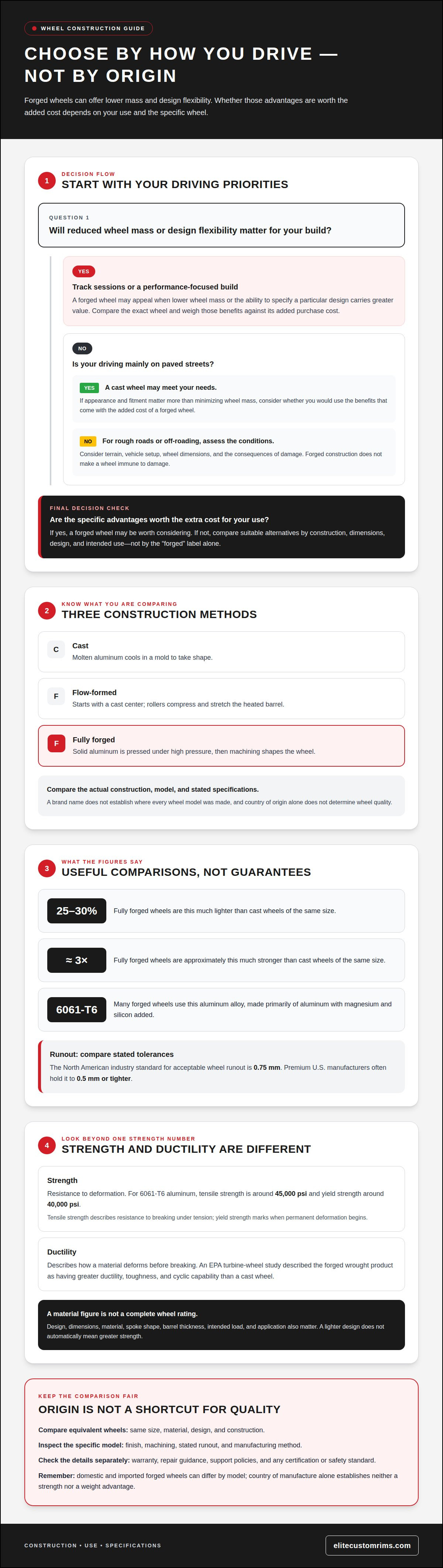
Made in the USA doesn’t automatically mean a forged wheel is better. Whether forged wheels made in the USA are better depends on what matters most to you: construction, strength, finish quality, or cost. Fully forged wheels are 25 to 30 percent lighter than cast wheels of the same size and approximately three times stronger, but those advantages come from the manufacturing method, not simply the country of origin.
It’s reasonable to expect a premium wheel to look as good as it performs. But an American-made label alone doesn’t establish finish quality; the design and execution matter, too. This comparison helps you weigh American and imported options without treating origin as a shortcut for quality. You’ll see how forging differs from casting, what strength and finish can tell you, and when forged wheels may be worth the added cost for your vehicle and priorities.
Key Takeaways
- Separate manufacturing method from country of origin when comparing forged and cast wheels.
- Look beyond appearance to understand what construction and finishing can tell you about a wheel’s quality.
- Weigh strength and ductility against your driving conditions to decide whether forged wheels suit your needs.
- Compare the factors behind American and imported wheel costs before choosing a wheel that fits your vehicle and priorities.
Forged versus cast wheel construction
Wheel construction influences weight and design, but country of origin alone doesn’t determine quality. Compare the manufacturing method, stated tolerances, and specific wheel model.
Forged, Flow-Formed, and Cast Construction
A cast wheel takes shape as molten aluminum cools in a mold. Forging presses solid aluminum under high pressure, then machining shapes the wheel. Flow-forming starts with a cast center, while rollers compress and stretch the heated barrel. These processes produce different structures, so compare the actual construction instead of relying on a label.
Fully forged wheels are 25 to 30 percent lighter than cast wheels of the same size. Many use 6061-T6 aluminum, an alloy made primarily of aluminum with magnesium and silicon added. For dimensional consistency, wheel runout matters: the North American industry standard for acceptable runout is 0.75 mm, while premium U.S. manufacturers often hold it to 0.5 mm or tighter.
Forged Wheel Advantages and Disadvantages
Forging can produce a lighter wheel with design flexibility and a strong structure. Those benefits may suit performance-focused builds where reducing wheel mass is a priority. The trade-off is cost: forged manufacturing and machining can make these wheels more expensive than cast alternatives. Flow-formed wheels offer a middle ground, but their cast centers distinguish them from fully forged designs.
Warranty coverage, repairability, and customer support don’t automatically improve with U.S. origin. They depend on each manufacturer’s warranty terms, damage guidance, and support policies. Likewise, don’t infer a certification or safety standard from a wheel’s country of manufacture; origin and certification are separate details.
There’s no single domestic brand list that applies across every wheel model. Production location can vary by product line, so a brand name alone doesn’t establish where a particular wheel was made. For the same reason, “made in USA” doesn’t prove a better finish. Evaluate the actual finish, machining, stated runout, and construction on the wheel you’re considering.
Forged wheels compared with cast wheels
Choose a wheel by matching its construction to your driving priorities, not by treating “forged” as an automatic upgrade. A cast wheel may suit a street-focused build where appearance and fitment matter more than minimizing wheel mass. A forged wheel can appeal when reduced mass, design flexibility, or the demands of track driving carry greater value. The right comparison starts with your vehicle and use.
For street driving, weigh the expected benefits against the added purchase cost. If your daily route is mainly paved, a cast wheel may meet your needs without paying for capabilities you won’t use. For track sessions, a driver may value lower wheel mass and the ability to specify a particular design. The right choice depends on your priorities, not a universal winner.
Off-roading brings different considerations. A truck on rough terrain faces impacts and conditions unlike ordinary road use. Forged construction doesn’t make a wheel immune to damage; a CorvetteForum member reported bending a forged wheel after hitting a pothole. Consider the terrain, vehicle setup, wheel dimensions, and consequences of damage before choosing.
A useful cost comparison considers more than the manufacturing label. A wheel’s dimensions, design, finish, and production method all affect its value. Imported and domestic forged wheels can differ in these details, so origin alone can’t explain a price gap. Compare equivalent designs and intended uses rather than assuming every forged option offers the same value.
Use this decision sequence: identify your main driving environment, decide whether lower wheel mass matters, then compare construction and design across suitable options. A street-driven sedan and a track-focused car, for example, may call for different choices, even if both drivers want a premium appearance. Forged wheels are worth the extra cost when their specific advantages suit your use, not simply because they’re forged.
Wheel strength and ductility
Strength describes resistance to deformation; ductility describes how a material deforms before breaking. Fully forged wheels are approximately three times stronger than cast wheels of the same size. That comparison describes a manufacturing category, not every individual wheel. Design, dimensions, material, and intended load still matter when assessing a specific wheel for your vehicle.
For 6061-T6 aluminum, tensile strength is around 45,000 psi, while yield strength is around 40,000 psi. Tensile strength describes resistance to breaking under tension; yield strength marks when permanent deformation begins. Those figures help explain material behavior, but they aren’t a complete wheel rating. Spoke shape, barrel thickness, and wheel dimensions also influence how a finished wheel handles loads.
Ductility matters because a wheel’s response to force involves more than one strength number. In a turbine-wheel study, the U.S. Environmental Protection Agency described the forged wrought product as having greater ductility, toughness, and cyclic capability than a cast wheel. That study supports a material comparison, not a guarantee about every forged wheel or driving situation.
Are U.S.-made forged wheels stronger or lighter than imported forged wheels? Country of manufacture alone establishes neither advantage. Compare wheels of the same size, material, design, and construction; those details provide a more useful basis than origin alone. Domestic and imported forged wheels may differ by model, not simply by where they’re made.
For a practical comparison, start with the exact wheel specifications and vehicle application. Then consider the intended use, such as daily street driving, track sessions, or rough roads. A high strength figure doesn’t explain how a wheel responds to repeated impacts or cyclic loading. Likewise, a lighter design doesn’t automatically mean greater strength. Assess the complete wheel, including its dimensions and construction, rather than relying on one material property or its country label.
American-made versus imported forged wheel costs
Compare equivalent wheels before attributing a price difference to origin. First match the diameter, width, design, finish, and vehicle application. A performance-car wheel may not be comparable to a truck wheel. Asking whether forged wheels made in the USA are better value makes sense only after you’ve matched the products’ specifications and intended use.
Production method matters, too. A U.S.-made cast or flow-formed wheel can cost about as much as a forged wheel, so domestic origin doesn’t automatically mean a lower price. Compare construction and purpose alongside cost. A cast center with a flow-formed barrel differs from a fully forged design, even when both are made domestically.
Truck and off-road fitment can narrow the options. High-end forged-wheel brands have few, if any, 17-inch choices suited to trucks or off-roading. One reported U.S.-made 17-inch option fits the Ford Raptor. This example shows why vehicle fitment and wheel size belong in your comparison, alongside origin and construction.
Imported origin doesn’t automatically mean lower quality or lower cost. Original-equipment beadlock wheels on one vehicle were reported as made in China. That example shows why a country label alone can’t explain a wheel’s construction, purpose, or value. Compare the specific model and application rather than treating all imported wheels as one category.
Build a useful comparison by grouping options by vehicle, size, and construction. Then weigh finish, design, fitment, and the features that matter for your driving. A buyer looking for an off-road truck wheel has different priorities from someone choosing a street wheel for a luxury car. Whether forged wheels made in the USA offer better value depends on how well their specific features meet those priorities.
Use those criteria to narrow your shortlist, then explore wheel options suited to your vehicle.
Elite Custom Rims
Elite Custom Rims helps you move from comparing wheel construction to choosing wheels for your vehicle. When weighing forged and cast options, consider fitment, design, and intended use alongside country of origin. A domestic label alone doesn’t determine which option suits your build.
Explore wheels for Audi, Chevy/GMC, Mercedes, and Porsche vehicles, then narrow your options by the look and fitment you want. A useful comparison starts with your vehicle and priorities, not a manufacturing label in isolation.
Contact Elite Custom Rims to discuss wheel options for your vehicle.
Choose the Wheels That Fit Your Priorities
There’s no way to determine whether U.S.-made forged wheels are better based on origin alone. Let your vehicle, driving plans, and preferred look guide the decision. That keeps your choice focused on what you want from the finished build, rather than a label that can’t tell the whole story.
Narrow your wheel options by your vehicle and the style you want to achieve. A clear direction makes it easier to compare designs and find a setup that suits your plans. You don’t need to chase a premium label to make a considered choice. Start with your priorities, then explore suitable options.
Contact Elite Custom Rims to discuss wheel options for your vehicle. Move forward with a choice that reflects your taste and how you drive.
Frequently Asked Questions
Does wheel finish quality differ between American-made and imported wheels?
Not automatically; finish quality depends on the specific wheel and its finishing process, not simply its country of origin. Inspect paint consistency across spokes, edges, and recessed areas. Look for even lines and visible blemishes at machined transitions, too. Close-up images can reveal details a full-wheel view hides, helping you compare the finish itself rather than relying on a country label.
How can I tell if a wheel is genuinely made in the USA versus imported?
Use product-specific origin information, not a brand’s headquarters or a general “American” label. Compare the country-of-origin marking with the product description and manufacturer documentation for the exact wheel model. If the wheel or packaging shows a part or model number, match it to the listing. These details help distinguish domestic manufacture from an American-designed wheel made elsewhere.
What aluminum is used in genuine premium forged wheels?
6061-T6 aluminum is a material used in forged wheels. The alloy designation identifies the aluminum grade and temper, but it doesn’t establish the complete quality of a finished wheel. For a useful comparison, consider the material alongside the wheel’s design, dimensions, machining, and intended vehicle application. Two wheels using the same alloy can still differ in construction and performance characteristics.
What does made in USA mean for a custom forged wheel specifically?
For a custom forged wheel, the phrase alone doesn’t tell you which production stages took place domestically. Design, forging, machining, and finishing are distinct steps, and a country label doesn’t explain each one. Look for origin details specific to the wheel rather than assuming every stage happened in the same place. This distinction separates domestic manufacturing from an American-designed wheel made elsewhere.
Why do American-made forged wheels cost more than imported alternatives?
There’s no single cost difference that applies to every American and imported wheel. The price can reflect design, material, machining, finish, production scale, and distribution. Custom dimensions or intricate spoke details can add manufacturing work regardless of origin. Compare wheels with similar specifications and intended uses; otherwise, a price difference may reflect a different product rather than its country of manufacture.
What wheel strength and impact tests do forged wheels undergo?
Wheel testing can assess resistance to impact and repeated loading, but the specific tests vary by manufacturer and product. Impact testing examines how a wheel responds to a sudden strike; fatigue testing examines repeated stress over time. Results apply to the tested design and conditions, not every wheel from the same brand. Look for model-specific test information rather than inferring performance from construction alone.