
That aggressive, flush stance you're chasing isn't a gamble; it's a calculation. You've spent hours browsing the perfect set of rims for your Tesla or Porsche. The last thing you want is that gut-wrenching screech the first time you take a sharp corner. We understand the frustration of wasted money and the fear of shredded sidewalls. You deserve a setup that looks elite and performs flawlessly. This guide reveals the technical secrets of how to avoid wheel rubbing by mastering offset and tire geometry.
We'll show you how to achieve a perfect, rub-free fitment that respects your vehicle's luxury bodywork. From understanding 2026 safety regulations to calculating precise clearance, you're about to gain the confidence to shop for high-end wheels like a pro. We'll break down the math of offset, explain the impact of state-specific protrusion laws, and give you the tools to secure a flawless look. Let's eliminate the guesswork and get your fitment right the first time.
Key Takeaways
- Identify critical friction points like the inner wheel well and suspension to stop destructive contact before it ruins your ride.
- Master the technical balance of offset and backspacing to achieve a flush, aggressive stance without compromising performance.
- Learn how to avoid wheel rubbing by matching tire section width and aspect ratio to your vehicle's specific geometry.
- Use professional diagnostic methods like the "Chalk Test" to find and fix invisible interference points before you hit the road.
- Eliminate the guesswork by choosing brand-specific, new wheels engineered for a perfect fit on luxury and performance models.
What Causes Wheel Rubbing? Identifying the Friction Points
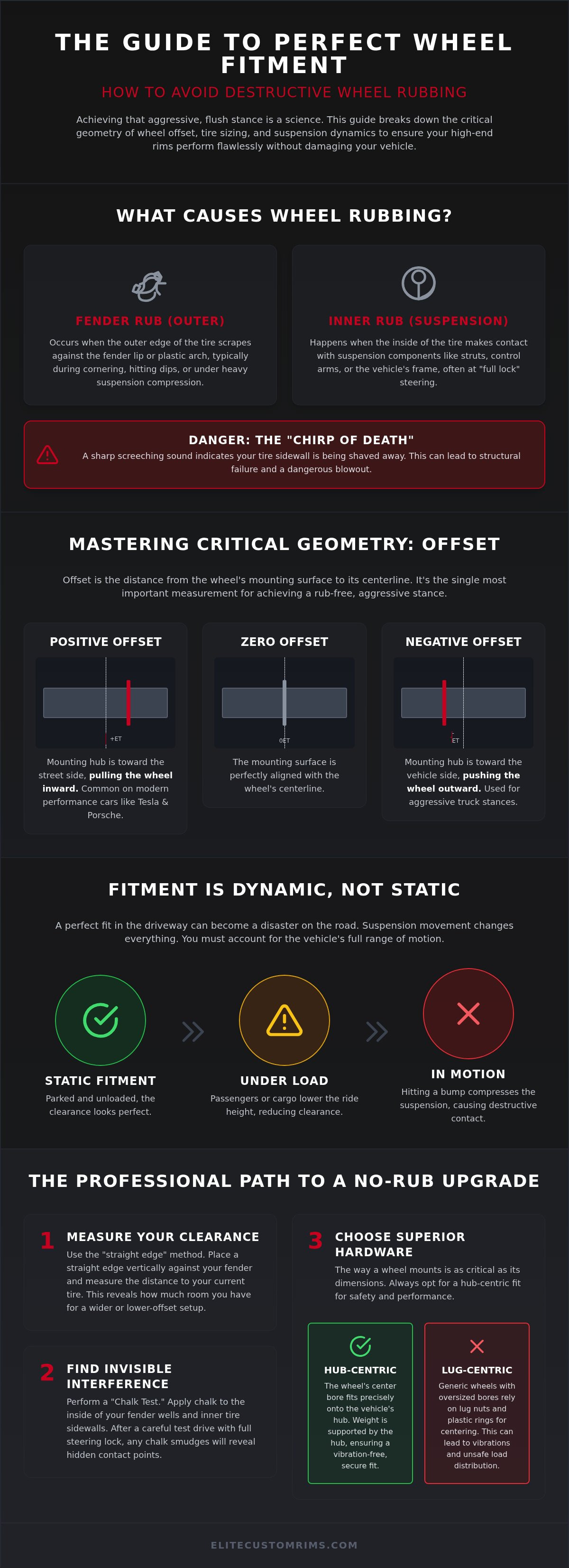
Wheel rubbing isn't a mystery. It's a physical collision between your tire and your vehicle's body or suspension components. This contact is destructive. It's the enemy of a clean, high-end build. When your tires make contact with anything other than the road, you risk more than just paint damage. You risk a total tire failure at high speeds. Learning how to avoid wheel rubbing starts with identifying exactly where the friction occurs.
Most enthusiasts encounter "Full Lock" rubbing first. This happens when you turn your steering wheel to its absolute limit, causing the tire to bite into the inner wheel well or brush against the suspension. "Fender Rub" is the opposite. This occurs when the outer edge of your tire meets the fender lip or plastic arch, usually while cornering or hitting a dip. If you hear the "Chirp of Death," a sharp, high-pitched screech, stop immediately. That sound is your tire sidewall being shaved away by metal or hard plastic. Ignoring it leads to structural tire damage and potential blowouts.
If you suspect that rubbing has already compromised your sidewalls, it is vital to have them inspected by professionals. Mobile services like EasyTire can come to your home or workplace to provide expert tire balancing and repair, ensuring your high-performance setup remains safe on the road.
Inner vs. Outer Clearance
Precision fitment requires a balance between two distinct zones. Inner clearance issues typically involve the tire sidewall making contact with the strut, control arms, or the frame itself. These problems often stem from incorrect backspacing. To ensure your luxury vehicle remains safe, Mastering Wheel Offset and Backspacing is essential for calculating how deep the wheel sits in the well. Outer clearance problems occur at the fender lip or the plastic liners. A critical factor here is the scrub radius. Scrub radius is the distance between the steering axis and the center of the tire's contact patch, which dictates the specific arc the tire follows when you turn the wheel. If this radius is off, your tires will swing too wide and catch the fender edge.
The Role of Suspension Compression
A wheel that looks perfect in your driveway might become a nightmare on the highway. This is because fitment is dynamic, not static. When you hit a pothole or a bridge expansion joint, your suspension compresses, moving the wheel vertically into the wheel arch. This compression changes the wheel's position relative to the bodywork. If you've loaded your Chevy Silverado with gear or have a full set of passengers in your Tesla Model Y, the lowered ride height reduces your available clearance. You must account for this "squat" when choosing your setup. Elite fitment means your wheels clear the body even under maximum load and full suspension travel. Don't settle for a setup that only works on flat pavement.
Mastering Wheel Offset and Backspacing for Rub-Free Fitment
Offset is the most critical measurement in your fitment journey. It's the distance between the hub-mounting surface and the wheel's centerline. If you get this wrong, your wheels will either bury themselves in the suspension or poke out past the fenders. Positive offset means the mounting surface is moved toward the front of the wheel, pulling the rim inward. This is standard for modern Mercedes, Audi, and Tesla models. Negative offset pushes the mounting surface toward the back, forcing the wheel outward. You see this often on aggressive Chevy or GMC truck builds. Understanding these numbers is the first step in how to avoid wheel rubbing effectively. Backspacing is equally vital. It measures from the hub to the inner edge of the rim, dictating exactly how much room you have before hitting a strut or control arm.
Calculating the Perfect Offset
Precision is everything. A mere 10mm change can be the difference between a clean turn and a shredded tire sidewall. When you invest in custom wheels, precise offset is non-negotiable. You can measure your current clearance using the "straight edge" method. Place a straight edge against your fender and measure the distance to your current tire. This tells you exactly how much room you have to push the wheel out without making contact. Following The Professional Path to No-Rub Upgrades ensures your modifications remain within safe operational limits. If you're unsure about the math, our specialists can help you select the right Porsche or Tesla wheels with guaranteed fitment.
The Hub-Centric Advantage
Precision isn't just about the width; it's about how the wheel sits on your car. Hub-centric wheels are designed so the center bore fits perfectly over the vehicle's hub. This ensures the weight of the car is supported by the hub, not just the lug bolts. Generic wheels often use oversized center bores, relying on plastic rings to fill the gap. This can lead to vibrations and shifting under load. For high-performance vehicles, a direct hub-centric fitment is the only way to maintain alignment. It stabilizes the wheel's position in the well and is a key part of how to avoid wheel rubbing during high-speed maneuvers. Don't compromise on center bore accuracy when shopping for elite rims.
Tire Geometry: Why the Wrong Rubber Ruins Great Rims
Picking the right rim is only half the battle. The tire you mount determines if that rim becomes a masterpiece or a mechanical disaster. Tires aren't static blocks of rubber; they are geometric variables that change shape under load. When enthusiasts ask how to avoid wheel rubbing, they often overlook section width and sidewall profile. A tire labeled as 265mm from one brand might actually be wider than a 265mm from another. This discrepancy is usually found in the "shoulder" of the tire. Square shoulders provide a larger contact patch for track performance but are the primary culprits for fender contact. Rounded shoulders offer more clearance, allowing the tire to tuck into the wheel well during suspension compression.
Some builders use "tire stretching" to gain those final few millimeters of clearance. By mounting a slightly narrower tire on a wider rim, the sidewalls angle inward. This pulls the tread away from the fender lip. It's a popular aesthetic for a flush look, but it comes with trade-offs. Stretched tires can feel less stable during hard cornering and offer less protection for your expensive rims. You must weigh the aggressive look against your driving style. If you want a setup that's rub-free without stretching, you need to master the relationship between rim width and tire section width from the start.
The 3% Rule for Tire Diameter
Maintaining the correct overall diameter is non-negotiable for modern luxury vehicles. You should always stay within 3% of the original OEM wheels diameter. If you exceed this limit, you'll likely face more than just rubbing. Oversized tires confuse your car's ABS, traction control, and speedometer. Consider the math: moving from a 245/35 to a 245/40 profile increases the sidewall height by 12.25mm. That adds nearly an inch to the total diameter. This change can be the difference between a smooth ride and a tire that catches the inner liner every time you hit a bump. Precision matters when you're protecting high-end bodywork.
Suspension Interaction
Your suspension setup dictates how your tires behave in the real world. Lowering springs or coilovers don't just drop the car; they change the camber angle. This "Natural Camber" often tilts the top of the tire inward as the suspension compresses. This can actually help a tire tuck under the fender, but only if you've calculated the clearance correctly. For instance, Tesla Model Y wheels require specific sidewall considerations to maintain aerodynamic efficiency and clear the unique suspension uprights. Understanding these interactions is a core part of how to avoid wheel rubbing on lowered performance vehicles. Always account for how your car moves, not just how it sits on the shop floor.
Step-by-Step: How to Test for Wheel Rubbing Before You Drive
Bolting on a new set of rims and immediately hitting the road is a rookie mistake. Professional fitment requires a methodical testing phase to protect your investment. Start with the Static Test. Turn your steering wheel to full lock in both directions while the car is stationary. Get out and inspect the inner wheel wells. You are looking for any contact with the plastic liners or suspension struts. Use the Finger Test as your baseline. If you cannot fit a finger, roughly 10mm, between the tire and the closest vehicle component, your clearance is too tight. Body roll and road vibrations will close that gap the moment you move.
For a more advanced diagnostic, use the "Chalk Test." Apply common sidewalk chalk to the inner sidewall of the tire and the inner lip of the fender. Drive the vehicle slowly in a safe, flat area while performing tight figure-eight turns. Inspect the chalk. If it has been wiped away, you have identified a friction point that was invisible while parked. This is a technical secret for how to avoid wheel rubbing that only experts use. Finally, perform the Ramp Test. Drive one front wheel up a ramp or a high curb to compress the suspension on that corner. This simulates hitting a bump while turning and reveals if your fenders are at risk during real-world driving.
Adjusting Your Setup
If you find a minor rub, you have options. Fender rolling is a common solution for outer clearance issues. This process uses a specialized tool to fold the inner metal lip of the fender flat, providing a few extra millimeters of space. Only perform this on metal fenders; composite or carbon fiber panels will crack. Wheel spacers can solve inner clearance problems by pushing the wheel away from the strut. However, spacers are often a band-aid for the wrong offset. If you use them, ensure they are hub-centric to maintain safety. Sometimes, a simple alignment adjustment is the answer. Dialing in a small amount of negative camber tilts the top of the tire inward, which is a proven way how to avoid wheel rubbing on the fender arch.
Truck-Specific Clearance (Chevy/GMC/Toyota)
Trucks and SUVs require a different approach due to their larger wheel wells and suspension travel. When fitting aggressive Chevy Silverado wheels, you may need to perform the "NorCal Mod." This involves trimming the plastic liners and occasionally pulling back the metal behind the liner to clear 22-inch or larger rims. Lift kits complicate this further. They change the pivot point of the front wheels, often creating rub points at the rear of the wheel well that didn't exist at stock height. Always re-test your clearance after any suspension modification. Ready to upgrade with total confidence? Browse our curated wheel collections to find a guaranteed rub-free fitment for your specific model today.
Elite Fitment: The Professional Path to No-Rub Upgrades
Achieving a flush, aggressive stance shouldn't be a gamble. It's a precision project. Most wheel retailers sell "universal" fitments designed to work on as many vehicles as possible. This approach is the primary cause of clearance issues. Choosing a specialist who uses vehicle-specific geometry is the most reliable way to learn how to avoid wheel rubbing permanently. At Elite Custom Rims, we utilize exact data for luxury and performance models to ensure every millimeter is accounted for. We only stock new, high-performance wheels. This ensures structural integrity that meets the latest safety standards, including the evolving requirements seen in the 2026 Tire Safety Modernization Act. Investing in a rub-free setup isn't just about aesthetics. It's about protecting your vehicle's long-term value and your safety on the road.
Luxury Brand Specialization
High-end vehicles require a higher level of technical accuracy. We focus on the unique offsets and brake clearances required for elite marques. For example, our Mercedes S-Class wheels are curated to maintain the sophisticated ride quality and air suspension functionality of the vehicle. Whether you're driving a Porsche 911 or an Audi RS6, the goal is to maintain factory performance standards while elevating the visual appeal. OE-style wheels often provide the best balance. They offer the aggressive look of an aftermarket upgrade with the clearance and hub-centric reliability of an original equipment part. This specialized focus is the ultimate secret of how to avoid wheel rubbing on luxury platforms.
Final Checklist for Your Purchase
Before you finalize your order, run through this technical checklist to ensure a perfect fit. Accuracy at this stage prevents headaches later. Consult with an Elite specialist if you're planning a custom application or have modified your suspension. We're here to take the guesswork out of the process. Follow these steps for a guaranteed result:
- Confirm your exact bolt pattern and center bore for a hub-centric fit.
- Verify the offset matches your desired stance and suspension travel.
- Check your local state laws regarding tire protrusion and fender coverage.
- Ensure the tire aspect ratio stays within 3% of the original diameter.
Ready to transform your ride with total peace of mind? Explore our curated collections of luxury wheels and find the perfect, rub-free fitment for your vehicle today.
Achieve the Ultimate Rub-Free Stance
Your journey to a perfect fitment ends here. You now have the technical knowledge to master wheel offset, understand tire geometry, and perform the essential tests required for a safe, aggressive look. Knowing how to avoid wheel rubbing is the difference between a high-end masterpiece and a costly mechanical failure. By focusing on brand-specific data and hub-centric precision, you protect your luxury vehicle's bodywork and performance standards for years to come.
Elite Custom Rims is your partner in this transformation. We offer a curated selection of high-performance rims with guaranteed fitment for luxury brands like Tesla, Mercedes, and Porsche. Our expert technical support is available for every order to ensure your transition is seamless and secure. Stop guessing and start building with confidence. Your vehicle deserves a setup that performs as well as it looks. Don't settle for universal compromises when you can have precision engineering.
Shop Rub-Free Precision Wheels for Your Vehicle and experience the elite difference today. Your perfect fitment is just a click away.
Frequently Asked Questions
Is it okay if my tires rub just a little bit at full lock?
No, any amount of contact is a problem. While it might seem harmless at low speeds, repeated rubbing compromises the integrity of your wheel well liners. Over time, this friction can damage electrical wiring or brake lines hidden behind the plastic. If you're looking for how to avoid wheel rubbing, you must ensure total clearance even at the steering limits. Don't settle for a setup that compromises your vehicle's safety.
Will wheel spacers stop my tires from rubbing on the fender?
Generally, wheel spacers will make fender rubbing worse. Spacers reduce your effective offset, pushing the wheel further toward the outer edge of the car. While this solves inner clearance issues with struts or calipers, it brings the tire closer to the fender lip. If your tires are already clipping the arch, adding spacers will likely result in immediate body damage. Always prioritize a wheel with the correct native offset instead.
Does wheel rubbing cause tires to blow out?
Yes, persistent rubbing is a major safety hazard that can lead to a blowout. Friction generates intense heat and physically removes rubber from the sidewall. Once the internal cords are exposed or the sidewall is thinned, the tire can no longer hold pressure under load. This is especially dangerous at highway speeds. A rub-free setup is essential to maintain the structural integrity of your high-performance tires.
Can an alignment fix a wheel rubbing issue?
An alignment can resolve minor outer clearance issues but it isn't a universal fix. By adjusting the camber, a technician can tilt the top of the tire inward to clear the fender. However, aggressive camber changes can lead to uneven tire wear and unpredictable handling. It's better to select wheels with the correct geometry from the start rather than trying to mask fitment errors with alignment tweaks.
How much clearance should there be between the tire and the fender?
You should maintain a minimum of 10mm of clearance between the tire and any part of the vehicle. This "finger-width" gap is necessary because your tires move dynamically while you drive. Suspension compression and body roll during hard cornering will quickly close smaller gaps. Ensuring this space is the most effective way how to avoid wheel rubbing when the vehicle is under load or navigating uneven road surfaces.
Will lowering my car always cause the wheels to rub?
Lowering your vehicle doesn't guarantee rubbing if you plan the setup correctly. When you drop the ride height, you reduce the available vertical travel. You can avoid contact by using stiffer springs that limit travel or by choosing wheels with a higher positive offset to tuck the tires. Many Porsche and Tesla owners achieve a lowered, aggressive look without any interference by using brand-specific wheel data.
What is fender rolling and is it safe for luxury cars?
Fender rolling involves using a specialized tool to fold the inner metal lip of the wheel arch flat. It's a common modification for steel fenders to create more outer clearance. However, it's not safe for all luxury cars. Many modern high-end vehicles use composite or carbon fiber fenders that will crack under the pressure. Always verify your fender material before attempting this process to avoid ruining expensive bodywork.
How do I know if the offset is too high for my car?
You'll know the offset is too high if the wheel sits too deep in the well. This often causes the inner rim or tire sidewall to strike the suspension struts or brake calipers. High offset is common in modern Audi and Mercedes models, but exceeding the factory limits will lead to immediate inner interference. If the wheel won't even bolt flat against the hub, your offset is likely too high.