
Your 6,000-pound luxury SUV is only as reliable as the four points where it touches the pavement. It's a high-stakes decision. You want a sharp aesthetic upgrade, but you can't afford to compromise safety or add sluggish unsprung weight to your EV. Most owners feel the same anxiety when comparing forged vs cast wheels for their daily driver. You've seen marketing terms like "flow-formed" or "rotary forged" and wondered if they're just expensive buzzwords. We get it. You need professional clarity, not a sales pitch.
This guide helps you master the technical landscape for 2026. You'll learn exactly how manufacturing impacts structural integrity and track-ready performance. We'll break down the differences between entry-level cast, mid-tier flow-formed, and premium forged options. From managing the massive torque of a Tesla Plaid to ensuring the structural safety of a loaded Cadillac Escalade, you'll gain the expertise to make a high-ticket purchase with total confidence. We'll cover everything from SAE J2530 standards to unsprung weight impacts. Let's find the elite fitment your vehicle deserves. It's time to take the guesswork out of your next upgrade.
Key Takeaways
- Understand the structural science behind forged vs cast wheels to determine which manufacturing process meets your vehicle's specific stress requirements.
- Learn how forged wheels reduce unsprung weight to transform the handling and acceleration of high-performance models like the Porsche 911 or Tesla Plaid.
- Discover the flow-forming "sweet spot" that offers a significant strength-to-weight advantage at a fraction of the cost of fully forged options.
- Identify critical load ratings to ensure your new wheels can safely support the massive GVWR of heavy hitters like the Cadillac Escalade or Land Rover.
- Match your driving profile to the ideal wheel type, from track-focused Audi RS upgrades to sophisticated stylistic refinements for the Mercedes S-Class.
Understanding the Core Difference: Cast vs. Forged Science
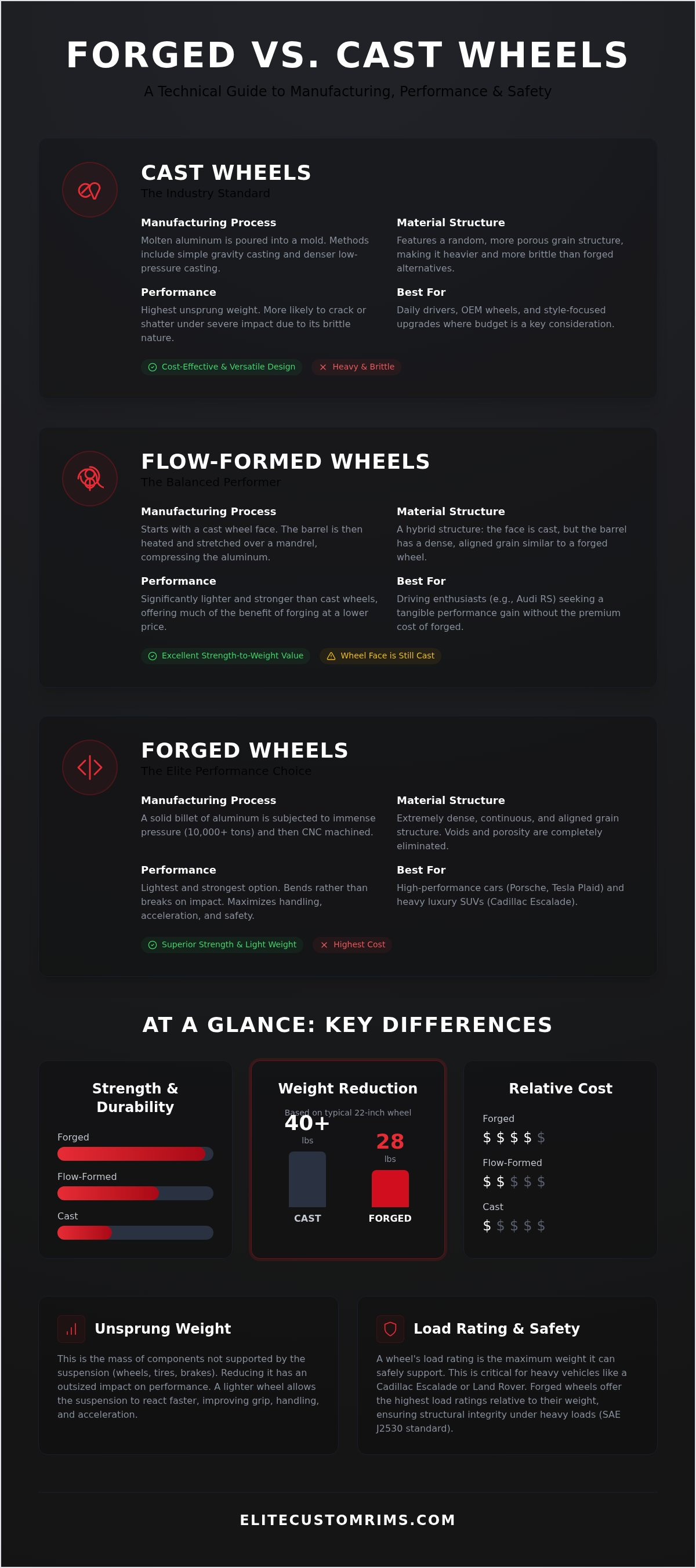
Choosing the right wheel starts with metallurgy. The debate between forged vs cast wheels isn't just a matter of price. It's about physics. At its core, Understanding the Core Difference: Cast vs. Forged Science reveals that the manufacturing method determines the grain structure of the metal. Cast wheels have a random molecular arrangement. Forged wheels feature a dense, continuous, and directional grain. This structural alignment is what allows a wheel to survive a high-speed impact or a punishing pothole. Manufacturing dictates everything from the final weight of the rim to its ultimate strength.
The Casting Process: Efficiency and Versatility
Casting is the most common manufacturing method in the automotive world. It's efficient. It's reliable. The process involves heating aluminum until it's molten and pouring it into a pre-made mold. Gravity casting is the simplest form, relying on the weight of the metal to fill the mold. Low-pressure casting is more advanced; it uses air pressure to push the metal in faster. This technique creates a denser part with fewer air pockets than standard gravity methods.
Manufacturers choose casting for its incredible design freedom. Since the metal is liquid, it flows into intricate, complex spoke patterns that are difficult to machine from a solid block. This is why most OEM wheels for brands like Toyota or Land Rover are cast. They provide a stylish, premium look for daily driving without the extreme cost of high-performance manufacturing. It's the smart choice for mass production and aesthetic variety.
The Forging Process: Structural Integrity
Forging is an entirely different beast. It begins with a solid billet of high-grade aluminum. This block is heated and subjected to upwards of 10,000 tons of pressure. This intense force crushes the metal into its rough shape. It eliminates internal voids and porosity completely. The result is a wheel that is significantly stronger at a molecular level than any cast alternative. Forging creates a structural integrity that casting simply cannot match.
Because the metal is so much denser, engineers can use less of it. They can design thinner spokes and lighter barrels while still exceeding the load ratings of a much heavier cast wheel. After the initial forging, a CNC machine carves the final design with surgical precision. For owners of a Porsche GT3 or a Tesla Model S Plaid, this manufacturing precision is a performance requirement. Forging creates a wheel that is both lighter and tougher, providing the ultimate balance for high-torque, high-performance vehicles. It's the elite standard for the modern enthusiast.
Why Forged Wheels are the Elite Choice for Performance
Performance isn't just about horsepower. It's about how that power translates to the asphalt. When comparing forged vs cast wheels, the most immediate benefit is the massive reduction in unsprung weight. Every pound saved at the wheel is worth significantly more than weight saved inside the cabin. It transforms the steering feel of a Porsche and sharpens the responsiveness of an Audi RS. Forged aluminum also sheds heat remarkably fast. This superior thermal dissipation keeps your braking system cooler during spirited drives or while managing the heavy mass of a luxury SUV. It's a functional upgrade that you feel in every corner.
Strength-to-Weight Ratio: The Performance Math
Consider the raw numbers. A standard 22-inch cast rim often tips the scales at 40 pounds or more. A forged equivalent can weigh as little as 28 pounds. This difference matters because of rotational inertia. Your engine spends less energy spinning the wheel and more energy propelling the car forward. Unsprung mass refers to the weight of components not supported by the vehicle's springs, such as the wheels and tires, which directly affects how quickly shock absorbers can react to road imperfections. By shedding this weight, your suspension stays planted and your ride quality improves. It's a night-and-day difference for high-torque EVs and heavy luxury hitters.
Longevity and Repairability
Forged wheels are a structural investment. In the technical world of Cast Wheels and the Flow-Formed Middle Ground, standard cast metal is inherently brittle. Hit a deep pothole and a cast wheel is likely to shatter or crack, leaving you stranded. Forged metal is different. Because of its dense grain structure, it tends to bend rather than break under extreme impact. This often makes it repairable, saving you from replacing an entire set after one bad road encounter. It's a multi-vehicle investment that maintains its value and integrity over time.
Precision matters for a flush, professional look. Forged manufacturing allows for custom milling of exact offsets. This ensures your wheels sit perfectly within the fenders of your Mercedes or Tesla without the need for sloppy spacers. For a deeper dive into technical fitment specs, check out our guide on Custom Wheels: The Definitive Reference for Luxury & Performance Fitment (2026). If you want to maximize your vehicle's ceiling, explore our latest Porsche Wheels to see the forged difference firsthand. We take the guesswork out of elite performance upgrades.
Cast Wheels and the Flow-Formed Middle Ground
The choice between forged vs cast wheels isn't always a binary decision. For many luxury owners, the middle ground provides the perfect balance of aesthetics and economics. Standard cast wheels remain the industry benchmark for visual variety. Because the molten aluminum fills a mold, designers can create intricate, multi-spoke patterns that are cost-prohibitive to machine from a solid block. If you want a specific deep-dish look or a complex mesh design for your Mercedes S-Class, casting often provides the most diverse catalog of finishes and styles. It's the smart move for a visual transformation that doesn't require track-level specs.
Flow-forming is the "sweet spot" for the modern enthusiast. This hybrid process starts with a specialized cast "blank." High-pressure rollers then heat and stretch the barrel, which significantly increases the tensile strength of the aluminum. While it differs from a full forging process for aluminum wheels, the result is a barrel with a grain structure similar to a forged rim. You effectively gain about 80% of the structural integrity of a forged wheel at roughly 50% of the cost. It's a high-value upgrade for those who want a lighter, tougher wheel for their daily commute without the premium price of a monoblock forged set.
Who Should Buy Cast Wheels?
Cast wheels are the ideal solution for the budget-conscious enthusiast. If your primary goal is a sharp, aggressive stance for your luxury sedan, cast options deliver. They are perfectly safe for standard highway speeds and everyday driving conditions. Many owners also prefer cast wheels for dedicated winter setups. They allow you to protect your high-end summer rims from road salt and grit while maintaining a premium look. For drivers who prioritize street style over shaving seconds off a lap time, high-quality casting is a reliable, professional choice.
Rotary Forged vs. True Forged
Don't let the marketing jargon confuse you. Terms like "rotary forged" or "spin forged" are frequently used to describe flow-formed wheels. It's a clever way to highlight the forged barrel, but it isn't a "true" forged wheel. In a hybrid flow-formed wheel, the face remains cast. This means the grain structure of the spokes is random, while the barrel is directional. A true forged wheel is forged from the center out to the lip. While rotary forging is a massive step up from standard casting, knowing the difference ensures you aren't overpaying for marketing labels. We believe in total transparency so you can invest in the right tech for your vehicle weight and performance goals.
Critical Considerations: Load Ratings and Vehicle Mass
Luxury vehicle weight, or Gross Vehicle Weight Rating (GVWR), is the most frequently overlooked factor in aftermarket wheel selection. It's a dangerous oversight. When you compare forged vs cast wheels for a standard sedan, the stakes are relatively low. However, for heavy hitters like the Cadillac Escalade or GMC Sierra, the wheel's load rating is a non-negotiable safety spec. These vehicles can easily exceed 6,000 pounds. Each wheel must be engineered to support that mass under the extreme forces of cornering and braking. Cheap, style-focused cast wheels often lack the structural density to handle these loads long-term, leading to hairline fractures or total failure.
The rise of high-performance electric vehicles has changed the math again. EVs deliver instantaneous torque that can twist or deform a weak wheel center. Because of their massive battery packs, EVs are significantly heavier than their internal combustion counterparts. A Tesla Model X, for example, requires a wheel that can withstand both high weight and high torque simultaneously. Choosing a forged option provides a necessary safety margin that standard casting cannot offer. It ensures your wheels remain true even under the most aggressive acceleration.
Tesla Efficiency: Forging for Range
For EV owners, every pound of rotational mass matters. Switching to a lightweight forged setup can extend your battery range by 3-5% by reducing the energy required to get the wheels spinning. This is particularly vital for those looking at Tesla Model Y wheels, where efficiency is a top priority. Lower wheel inertia allows the regenerative braking system to capture energy more effectively because the motors have less rotating mass to counteract. It's a rare upgrade that pays you back in miles per charge while sharpening the car's dynamic response.
Heavy Duty Luxury: Escalade and GMC Fitment
Load rating math is simple but critical. You must ensure your wheels are rated for at least 2,500 pounds per corner for full-size luxury SUVs and trucks. Forging is the recommended standard for Chevy Silverado wheels, especially if you plan on towing or hauling heavy loads. A "style-only" cast wheel might look the part, but it can't match the 10,000 tons of pressure used to create a forged monoblock. Don't risk your safety for a bargain price. Invest in wheels that are engineered for your vehicle's actual mass. Explore our inventory of Cadillac Escalade Wheels to find a fitment that balances elite style with uncompromising strength.
Making the Investment: Which Wheel Type Fits Your Lifestyle?
Deciding between forged vs cast wheels ultimately comes down to your vehicle's performance ceiling and your daily driving habits. If you're pushing a Porsche 911 or an Audi RS model to its limits, the structural investment of a forged wheel is non-negotiable. It's the only way to ensure the rim can handle high-speed lateral loads without deforming. For those prioritizing a visual refresh on a daily-driven luxury sedan, high-quality cast wheels offer a smart aesthetic upgrade. Always look for JWL and VIA certifications on the back of the wheel. These stamps confirm the rim has passed rigorous safety and durability testing. It's the simplest way to separate premium manufacturing from low-quality replicas.
The performance profile is clear. Forged wheels are the elite choice for track-ready vehicles and high-torque EVs. They provide the lightest possible rotational mass, which sharpens every aspect of the driving experience. The luxury commuter profile is more flexible. If your goal is to enhance the curb appeal of a Mercedes S-Class or a Rolls Royce without frequent track use, a high-quality cast or flow-formed wheel provides excellent value. You get the high-end look you want while keeping the project within a sensible budget. Splurge on forged when performance is the priority; save on cast when style is the primary driver.
Matching the Wheel to the Brand
Precision engineering demands a matching wheel. Forged Mercedes S-Class wheels complement the vehicle's advanced air suspension by reducing the workload on the dampers. This keeps the ride composed even over rough pavement. In contrast, Audi Q7 wheels can often be high-quality cast options. Since the Q7 serves as a premium family SUV, a robust cast wheel provides the durability needed for urban environments while offering a massive catalog of modern finishes. Finally, for the ultimate in prestige, Rolls Royce wheels should almost always be forged. The sheer mass and prestige of the brand demand a wheel that matches its uncompromising engineering standards. It's about maintaining the integrity of the vehicle's design and dynamics.
Next Steps: Securing Your Professional Fitment
Professional fitment data is often more important than the manufacturing method itself. A forged wheel with the wrong offset can ruin your suspension geometry just as easily as a cheap cast rim. We specialize in taking the guesswork out of the equation. Our database ensures that every wheel we offer meets the exact load ratings and clearance requirements for your specific luxury brand. The Elite Custom Rims promise is simple: we guarantee precise fitment for the most demanding luxury and performance brands in the world. We don't just sell rims; we provide a curated upgrade experience that prioritizes your vehicle's safety and style. Don't settle for "universal" fitment when you can have a tailored solution. Upgrade your vehicle with our curated selection of premium wheels today and experience the difference that expert precision makes.
Elevate Your Driving Dynamics Today
You've mastered the essential science of forged vs cast wheels. You now understand that while cast wheels offer incredible stylistic versatility for daily commuting, forged wheels remain the structural gold standard for high-torque EVs and track-ready performance models. Whether you're managing the massive load rating requirements of a Cadillac Escalade or seeking to maximize the range of your Tesla, the right choice depends on your vehicle's mass and your specific performance goals. Precision engineering is the difference between a simple visual change and a true performance transformation.
Don't leave your upgrade to chance. We provide guaranteed fitment for Audi, Mercedes, and Porsche to ensure your new setup performs exactly as engineered. Our team offers expert technical support for performance enthusiasts who demand precision and reliability. We handle the logistics with national shipping on all premium wheel orders. It's time to transform your vehicle with confidence and style. Your vehicle deserves a wheel that matches its engineering excellence. Let's get started on your ultimate upgrade today.
Shop the Elite Collection of Forged and Cast Wheels
Frequently Asked Questions
Are forged wheels really worth the extra cost for daily driving?
Forged wheels are worth the investment if you prioritize long term durability and improved fuel efficiency. While they carry a higher price tag, their ability to withstand potholes without cracking saves you money on replacements. For a standard commuter who values budget over performance, cast wheels are often sufficient. However, for those driving high torque EVs or heavy SUVs, the added strength and reduced weight of forged options provide a noticeable upgrade in ride quality.
Can you tell the difference between forged and cast wheels just by looking at them?
You can often spot the difference through the precision of the design spokes. Because forged wheels are CNC machined from a solid block, they usually feature much sharper edges and thinner, more intricate spokes. Cast wheels often have softer, more rounded edges because the liquid metal must be able to release from a mold. If you look at the back of the wheel, cast rims frequently have raised lettering, while forged rims have engraved or stamped markings.
Do cast wheels break more easily than forged wheels?
Cast wheels are more brittle than their forged counterparts. When a cast wheel hits a severe road hazard, the metal is more likely to crack or shatter. Forged wheels are more ductile. This means the metal is more likely to bend rather than break under extreme stress. This difference is a major safety factor, as a bent wheel might still hold air and allow you to pull over safely, whereas a shattered cast wheel results in immediate failure.
What does "flow-formed" or "rotary forged" actually mean?
These terms describe a hybrid manufacturing process that sits between the two main types. The face of the wheel is cast, but the barrel is heated and stretched using high pressure rollers. This process creates a barrel with a grain structure similar to a forged wheel, offering better strength and lower weight than a standard cast rim. It's an excellent middle ground for enthusiasts who want better performance without the full cost of a monoblock forged set.
Why do forged wheels improve a car’s acceleration and braking?
Forged wheels reduce rotational inertia by shedding weight at the outermost part of the vehicle's drivetrain. When you compare forged vs cast wheels, the lighter forged option requires less energy from the engine to start spinning. This results in faster acceleration. Similarly, the braking system has less rotating mass to stop, which can shorten braking distances and reduce brake fade during spirited driving. It's a functional performance gain you can feel immediately.
Are forged wheels better for heavy vehicles like the Cadillac Escalade or Tesla Model X?
Forged options are the superior choice for heavy duty luxury vehicles. These trucks and SUVs exert massive pressure on wheel centers during cornering and braking. A forged wheel's dense molecular structure handles this weight without deforming over time. For EVs like the Tesla Model X, the lighter weight of forged wheels also helps offset the heavy battery mass, which can lead to a slight increase in total driving range and better suspension response.
How do I know if a wheel has a high enough load rating for my truck?
Look for the load rating stamp on the inner barrel or the back of the wheel hub. This number represents the maximum weight a single wheel can safely support. To find your requirement, check your vehicle’s Gross Axle Weight Rating (GAWR) on the driver’s side door jamb. Your wheels must be rated for at least half of the heaviest axle's weight. Never install a wheel with a load rating lower than your vehicle's factory specifications.
Do forged wheels come with better warranties than cast wheels?
Forged wheels typically carry more robust structural warranties. Because the manufacturing process is so controlled and the material is so strong, many premium forged brands offer lifetime structural warranties to the original owner. Cast wheels usually come with more limited coverage, often ranging from one to three years. This reflects the manufacturer's confidence in the material's ability to survive real world driving conditions over the long term. It's a key part of the value proposition.