
What if the wheel brand with the most Formula 1 heritage isn't actually the best fit for your specific track build? Choosing between BBS vs Forgeline forged wheels for track use is about more than just aesthetics; it's about trust. You've likely felt that nagging anxiety before a heavy braking zone, wondering if your hardware can truly handle the heat and side-loading of aggressive racing slicks. We understand that you need absolute confidence when diving into a corner at triple-digit speeds.
This comparison cuts through the marketing noise to reveal which forged powerhouse delivers the weight reduction and structural stiffness required for elite performance. You'll discover how BBS's legendary die-forging stacks up against Forgeline's bespoke CNC-machined monoblocks. We'll break down critical factors like big brake kit (BBK) clearance, 2026 lead times, and the durability required to shave seconds off your personal best. Whether you're chasing podiums in a Porsche GT3 or dialing in a custom Audi RS setup, this guide ensures your next set of wheels is a smart, high-performance investment. Let's eliminate the guesswork and get you back on the apex.
Key Takeaways
- Understand how internal grain flow and CNC precision dictate wheel strength during high-speed cornering.
- See how cutting unsprung weight per corner transforms your vehicle's turn-in and braking response.
- Compare BBS vs Forgeline forged wheels for track use to find the perfect fitment for massive brake calipers.
- Review 2026 lead times and repairability options to ensure your wheel choice matches your racing schedule.
- Determine if your Porsche or Audi build requires the prestige of BBS or the bespoke engineering of Forgeline.
The Battle for Track Supremacy: BBS vs Forgeline
Unsprung weight is the most critical factor in your car's handling. It's the mass that isn't supported by the suspension, including your wheels, tires, and brakes. Every pound you remove from a wheel has a multiplier effect on performance. It allows the dampers to react faster, keeps the tire contact patch consistent over curbs, and reduces the energy required to accelerate or stop. Choosing between BBS vs Forgeline forged wheels for track use determines how your vehicle communicates at the limit. These aren't just upgrades; they're precision instruments designed to survive extreme G-loads.
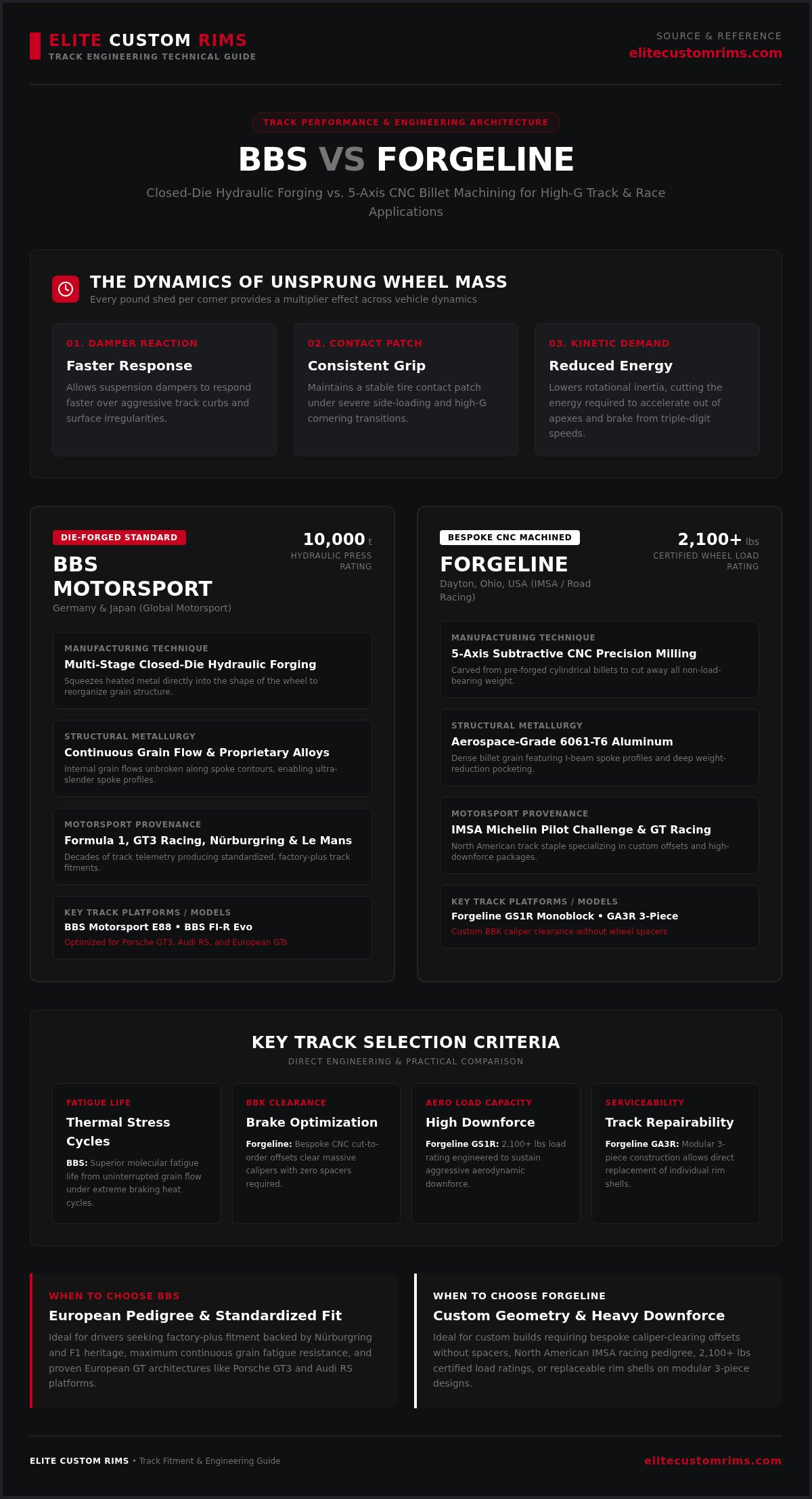
The tier-one landscape is divided by engineering philosophy. While many brands claim to offer "forged" products, few operate at this level. True performance forging involves massive hydraulic pressure and aerospace-grade materials to ensure structural integrity. BBS Japan utilizes multi-stage closed-die hydraulic presses rated up to 10,000 metric tons. This process forces the metal into the shape of the wheel, creating a continuous grain flow. Forgeline takes a different path, starting with an aerospace-grade 6061-T6 cylindrical billet and using 5-axis CNC milling to carve out the design. Both methods produce wheels that far exceed the strength of cast or flow-formed alternatives.
BBS: The Global Standard of Motorsport
BBS is a name synonymous with the winner's circle. Their motorsport division, based in Germany and Japan, produces wheels for the world's most demanding series, including Formula 1 and GT3 racing. Their strength lies in standardized, highly-optimized fitments. If you drive a Porsche or an Audi, BBS provides a factory-plus experience with a focus on maximum fatigue life. The BBS Motorsport E88 and FI-R Evo represent the pinnacle of this engineering. They offer a proven European racing pedigree for drivers who want a "plug-and-play" solution. You're buying decades of data from the Nürburgring and Le Mans. It's a choice rooted in prestige and technical perfection.
Forgeline: The King of Custom Engineering
Forgeline dominates the North American road racing scene, including the IMSA Michelin Pilot Challenge. Based in Dayton, Ohio, they specialize in bespoke manufacturing. This is where you find the flexibility that off-the-shelf brands can't match. Every wheel is cut to order, allowing for precise offsets that clear massive big brake kits (BBK) without the need for spacers. Forgeline is the tactical choice for custom builds or platforms with unique fitment requirements. They offer incredible design flexibility and the ability to replace individual rim shells on three-piece designs like the GA3R. If you need a specific load rating for a high-downforce aero package, Forgeline delivers the exact engineering your build demands.
Forged Engineering: Die-Forging vs CNC-Machining
A common misconception in the paddock is that all forged wheels are created equal. They aren't. The primary difference between BBS vs Forgeline forged wheels for track use lies in how they reach their final shape. BBS Japan utilizes a multi-stage, closed-die forging process. This method uses massive hydraulic presses, often exceeding 10,000 metric tons, to squeeze heated aluminum into the specific shape of the wheel. This isn't just about shaping; it's about reorganizing the metal at a molecular level.
Forgeline takes a more surgical approach. They start with a pre-forged cylinder of aerospace-grade 6061-T6 aluminum. This "puck" has already been compressed under high pressure to ensure a dense grain structure. From there, Forgeline uses 5-axis CNC machines to mill away every unnecessary gram of material. While BBS forces the metal to flow into a mold, Forgeline carves it out with extreme precision. This allows Forgeline to offer certified load ratings of 2,100+ lbs per wheel on models like the GS1R, providing a significant safety net for high-downforce GT cars. When comparing BBS vs Forgeline forged wheels for track use, the manufacturing method dictates how the wheel manages thermal stress.
The Science of Grain Flow
Die-forging creates a continuous grain flow that follows the contours of the spokes. This results in a denser molecular structure, which is why BBS can design such incredibly slender spokes without sacrificing strength. Conversely, CNC-machining allows for deep pocketing and "I-beam" spoke profiles that maximize stiffness while shedding mass. Fatigue life is the ability of a wheel to withstand repeated stress cycles from track heat and cornering loads without structural failure. Because BBS's grain flow is never interrupted by a cutting tool, their wheels often exhibit superior long-term fatigue resistance under extreme heat cycles.
Material Matters: 6061-T6 vs Proprietary Alloys
Forgeline relies on the gold standard of the industry: 6061-T6 aluminum. It's predictable, durable, and handles the heat of heavy braking sessions with ease. BBS often goes a step further by using proprietary alloys or even forged magnesium for their highest-tier motorsport offerings. Magnesium provides a weight reduction of approximately 30% over aluminum but requires specialized coatings to prevent corrosion. For most club racers, the 6061-T6 used by Forgeline offers the best balance of cost and performance. If you're ready to upgrade your setup, you can explore our selection of Porsche and Audi track wheels to find the right fitment for your next event.
Track Performance Metrics: Weight vs Stiffness
Reducing unsprung weight by just 2 lbs per corner changes how your car talks to you. It's the difference between a suspension that "skips" over curbing and one that stays glued to the apex. When evaluating BBS vs Forgeline forged wheels for track use, you're looking for the sweet spot between mass and rigidity. Lower rotational inertia means you'll accelerate faster out of the hairpin and find more bite during threshold braking. It's a transformative upgrade that you'll feel in every steering input.
Brake clearance is another non-negotiable metric for elite track builds. Modern Porsche and Audi platforms often feature massive 380mm to 410mm rotors, especially those equipped with carbon ceramics. If your wheels don't have the radial drop clearance to accommodate these, you're out of the game. Both brands excel here. Forgeline's GS1R is engineered with an open-lug center and specific barrel contours to clear the largest ceramic setups. BBS Motorsport designs, like the E88, utilize specific center bowl configurations to ensure the spokes never interfere with wide calipers.
Weight Comparison: Monoblock vs Multi-Piece
Monoblock wheels are the undisputed kings of weight reduction. A BBS FI-R Evo in a 20x9.5" fitment weighs a staggering 17.82 lbs. Compare that to a 3-piece BBS E88 in 18x10", which tips the scales at roughly 20.5 lbs due to the added hardware and assembly bolts. Forgeline's monoblock GS1R in an 18x10" setup typically ranges between 18.5 and 19.2 lbs, depending on the specific offset and hub pocket machining.
While 3-piece wheels offer the advantage of easier repairability, monoblock designs provide superior structural integrity for pure track duty. Forgeline minimizes mass through aggressive I-beam spoke profiles. They carve material from the sides of the spokes, leaving a central "web" that maintains strength while shedding ounces. This ensures you aren't carrying any dead weight through the corners.
Stiffness and Deflection under Load
A wheel that flexes under high G-loads is a wheel that's stealing your grip. When a wheel deflects, the tire's contact patch becomes inconsistent. This leads to unpredictable handling at the limit. BBS focuses heavily on rim barrel stiffness to maintain roundness even when hammered over aggressive curbing. Their die-forging process ensures the wheel resists "egging" under extreme vertical loads.
Forgeline's competition series wheels are engineered for zero deflection. Their CNC-machined 6061-T6 construction is designed to handle sustained side-loading from racing slicks. With certified load ratings exceeding 2,100 lbs per wheel, Forgeline provides the structural safety net needed for high-downforce builds. You want a wheel that acts as a solid bridge between your suspension and the asphalt. BBS vs Forgeline forged wheels for track use both offer this level of security, but the choice often comes down to whether you prioritize the ultimate lightness of a BBS monoblock or the customized rigidity of a Forgeline build.
Serviceability and Customization: The Practical Choice
Performance data matters, but logistics win championships. When you're deciding between BBS vs Forgeline forged wheels for track use, you have to consider what happens after you leave the shop. BBS operates as a global giant. If your desired fitment is sitting in a US warehouse, you can have it in days. However, if you're chasing a backordered set of magnesium monoblocks from Japan or Germany, lead times often stretch to 12 or 24 weeks. This wait can sideline a car for half a racing season.
Forgeline offers a different rhythm. Because they manufacture everything in Dayton, Ohio, their build-to-order lead times typically stay within 4 to 8 weeks. You aren't limited to a fixed catalog. Forgeline cuts each wheel to your exact specifications, ensuring your setup is current and optimized for your specific suspension geometry. Their finish durability is also top-tier. They use high-quality powder coatings designed to withstand the corrosive nature of aggressive track pads and the constant sandblasting of track debris.
Repairing Track Damage
Track use is hard on hardware. A heavy hit on a FIA curb or a minor off-track excursion can easily bend a rim. Forgeline's modular 3-piece wheels, like the GA3R, offer a massive tactical advantage here. If you damage an outer lip, you don't need to buy a new wheel. You can ship it back to their Ohio facility for a re-hoop, which usually costs a fraction of a full replacement. BBS monoblock wheels are legendary for their strength, but a significant crack or bend typically results in a total loss. Choosing a wheel based on repairability is a critical decision for racers because it dictates whether a mid-season incident ends your racing year or just your weekend.
Fitment Flexibility for Luxury Performance
Achieving a flush, functional fitment is complex on modern luxury platforms. Porsche owners using center-lock systems require extreme precision to maintain factory safety standards. Audi and Mercedes builds often feature wide-body kits or aggressive aero that demand millimeter-perfect offsets to avoid rubbing under compression. Forgeline excels in this bespoke space, cutting center bores and offsets to suit your specific big brake kit. For a deeper dive into these technical requirements, check out our Custom Wheels Reference Guide. If you need to verify fitment for your specific chassis right now, contact our specialists for a professional consultation. We take the guesswork out of your track build to ensure your wheels clear your calipers and fill your fenders perfectly.
The Verdict: Which Wheel Should You Buy?
Choosing between BBS vs Forgeline forged wheels for track use ultimately comes down to your car's platform and your specific racing goals. You've seen the data on weight, stiffness, and manufacturing. Now, you need to decide which engineering philosophy aligns with your build. Both brands represent the top tier of the industry, but they serve different masters on the tarmac. Your choice will dictate your confidence in the braking zone and your ability to maintain a consistent line through high-speed sweepers.
If you're chasing the absolute minimum unsprung weight and want a wheel with a direct link to Formula 1, BBS is your winner. If you need a bespoke offset to clear a custom suspension upright or want the peace of mind that comes with domestic repairability, Forgeline takes the trophy. Don't make this decision based on style alone. Evaluate your track frequency, your budget for potential repairs, and your platform's specific fitment quirks.
Choosing for Your Vehicle Brand
BBS remains the definitive Porsche wheel choice for a reason. The engineering synergy between BBS and Porsche's GT department is unmatched; it's a partnership forged at the Nürburgring. For Audi and Mercedes owners who prioritize a factory-plus motorsport aesthetic, BBS offers a level of prestige that's hard to beat. If you're looking for precision fitment on other luxury platforms, our Mercedes S-Class Wheel Guide demonstrates how we apply these same standards of precision to every vehicle we service.
Forgeline holds a clear edge in the domestic and custom-build market. If you're building a wide-body Corvette or a specialized track-focused BMW, Forgeline's ability to cut a wheel to your exact millimeter of offset is invaluable. You won't have to compromise with spacers or "close enough" fitments. They provide the tactical flexibility required for North American club racing where every build is unique.
Next Steps for Your Track Build
Avoid track-day disasters by verifying your measurements before you pull the trigger. You must measure for radial brake clearance and full suspension travel under compression. A wheel that fits in the paddock might rub at the bottom of a high-G dip. Consulting with a fitment specialist is the best way to eliminate guesswork and ensure your investment delivers the performance you expect. We focus on getting the technical details right the first time. It's time to stop worrying about your hardware and start focusing on your lap times. Browse our curated collection of performance wheels today and find the set that will transform your driving experience.
Master the Apex with the Right Forged Setup
Deciding between BBS vs Forgeline forged wheels for track use is a high-stakes choice that defines your vehicle's performance at the limit. You now understand the fundamental trade-offs between BBS's legendary die-forged grain flow and Forgeline's precision CNC-machined customization. Whether you prioritize the elite motorsport heritage of a BBS monoblock or the bespoke, repairable flexibility of an Ohio-built Forgeline set, your hardware must match your racing ambition. Don't let technical anxiety or fitment guesswork hold you back from your next personal best.
We're here to ensure your investment is accurate and effective. As an authorized retailer of new performance inventory, we provide expert fitment verification for Audi, Porsche, and Mercedes platforms. Our team handles the complex offsets and brake clearances so you don't have to. We offer national shipping with guaranteed accuracy to get you on the grid without delay. Shop Premium Forged Wheels at Elite Custom Rims and secure the competitive edge your car deserves. Your faster lap times are waiting.
Frequently Asked Questions
Which is lighter, BBS or Forgeline wheels?
BBS monoblock wheels like the FI-R Evo are typically the lighter option when comparing BBS vs Forgeline forged wheels for track use. While Forgeline's GS1R is incredibly light at roughly 18.5 lbs for an 18x10" setup, BBS utilizes multi-stage die-forging and specialized alloys to push the limits of mass reduction. This results in some of the lowest rotational inertia ratings available for Porsche and Audi platforms.
Can Forgeline wheels be custom-made for center-lock Porsches?
Yes, Forgeline specializes in bespoke engineering for Porsche center-lock systems. Unlike off-the-shelf brands, Forgeline cuts each set to your exact order specifications. This ensures perfect compatibility with factory center-lock hubs while allowing for custom offsets that aren't available in standard catalogs. It's a top choice for GT3 and GT2 RS owners who need a precise, track-ready fitment without compromise.
Are 3-piece wheels safe for heavy track use?
High-quality 3-piece wheels from these brands are specifically engineered to handle the rigors of heavy track use. Models like the Forgeline GA3R and BBS E88 use forged centers and high-strength rim halves to manage extreme cornering G-loads. While monoblocks offer slightly superior lateral stiffness, 3-piece wheels provide the repairability required for competitive racing where curb impacts or minor damage might occur during a session.
What is the typical lead time for Forgeline forged wheels in 2026?
The typical lead time for Forgeline forged wheels in 2026 stays between 4 to 8 weeks for standard monoblock and 3-piece builds. During peak racing seasons, this window can extend to 10 weeks. This domestic production timeline is often much faster than importing specialized BBS fitments from Japan or Germany. It allows you to get your car dialed in and back on the track without losing half the season.
How do I know if BBS wheels will clear my big brake kit?
Verifying big brake kit clearance requires checking the radial drop and spoke profile of the specific wheel model. BBS Motorsport wheels often use different center bowl configurations to accommodate wide calipers on performance Audi and Mercedes builds. We recommend consulting with our fitment specialists at Elite Custom Rims to verify your specific setup. We use precise manufacturer data to take the guesswork out of your purchase.
Is die-forging better than CNC-machined forging?
Die-forging creates a continuous internal grain flow that follows the shape of the wheel, offering superior fatigue life under repeated heat cycles. CNC-machining from a forged billet allows for incredible design flexibility and bespoke offsets. Neither is objectively better for every driver. BBS's die-forging is ideal for standardized high performance, while Forgeline's CNC process is the tactical choice for custom builds requiring specific, non-catalog fitments.
What is the best way to clean brake dust off forged track wheels?
The best way to clean aggressive brake dust is using a pH-neutral wheel cleaner and a soft microfiber brush. Don't use acidic cleaners that can etch the powder-coated or anodized finishes of your forged wheels. Regular cleaning after every track event prevents hot dust from embedding into the surface. Applying a high-quality ceramic coating before your first event makes this maintenance significantly easier and protects your investment.
Do forged wheels come with a structural warranty for track use?
Structural warranties for track use vary significantly between street-legal and dedicated competition lines. While most manufacturers offer a lifetime structural warranty for street use, track environments carry different terms due to extreme stress. Forgeline's competition series is specifically engineered for these high-load environments. Always check the specific warranty documentation for your chosen wheel model to understand how your coverage applies during competitive racing or track days.