
Could a single pothole turn your luxury wheel upgrade into a four-figure repair bill? It's the nightmare every Tesla and Porsche owner faces when choosing between aesthetics and structural integrity. Understanding the debate of forged vs cast wheels is no longer just for track enthusiasts. In 2026, with heavy electric vehicles and high-torque engines becoming the standard, molecular strength matters. Your rims are either a precision instrument or a liability.
You want an elite look. You're likely tired of deciphering jargon like unsprung weight and load ratings. It's frustrating to feel like you're guessing on a premium investment for a Mercedes or Land Rover. This guide eliminates the confusion. You'll master the technical differences between forged and cast manufacturing. Ensure your next set of wheels handles the road as well as they look in the driveway. We'll break down why forged options are 20 to 30 percent stronger, how flow-forming fits the middle ground, and which choice justifies the investment for your specific performance goals.
Key Takeaways
- Understand the structural differences between molten casting and high-pressure forging to ensure your rims meet 2026 performance standards.
- Discover why the forged vs cast wheels debate is critical for heavy electric vehicles that require high load ratings and superior durability.
- Learn how reducing unsprung weight by up to 30% with forged aluminum directly improves your vehicle’s acceleration and steering response.
- Identify which manufacturing process offers the best balance of aesthetic flexibility and structural security for your specific luxury model.
- Gain the technical confidence to justify a premium wheel investment based on your driving style and long-term vehicle goals.
The Foundation of Performance: Understanding the Forged vs. Cast Debate
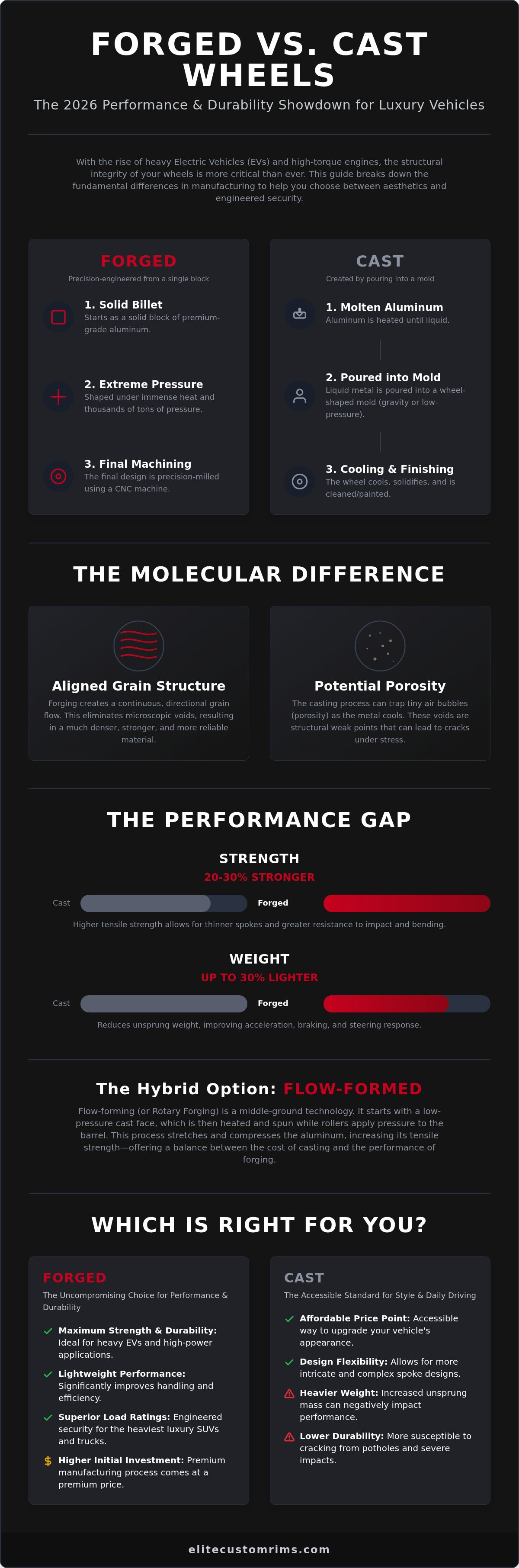
The choice between forged vs cast wheels defines how your vehicle interacts with the road. It isn't just a matter of price. It's a fundamental difference in metallurgy that impacts every mile you drive. Cast wheels are created by heating aluminum until it's liquid and pouring it into a pre-shaped mold. This process is the industry standard for mass production because it allows for intricate spoke designs at a lower cost. Forged wheels take a different path. They start as a solid block of premium aluminum, known as a billet, which is crushed into shape under extreme heat and pressure. This mechanical force changes the metal at a microscopic level. Understanding Alloy Wheel Manufacturing helps you see why the process dictates the performance of your high-end vehicle.
The Molecular Difference: Why Forging Wins
Forging creates a continuous, directional grain flow that follows the shape of the wheel. Imagine the difference between a block of wood with the grain running straight through it versus a pile of sawdust glued together. Cast wheels often suffer from microscopic porosity, which are tiny air bubbles trapped during the cooling process. These voids are structural weak points that can lead to cracks under stress. Forging eliminates these gaps entirely, creating a much denser and more reliable part. Tensile strength is the maximum amount of pulling or stretching stress a wheel material can withstand before structural failure occurs. Because forged wheels have higher tensile strength, they can be engineered with thinner, more elegant spokes while remaining significantly stronger than their cast counterparts.
Why Manufacturing Matters in 2026
The automotive world is changing rapidly. Modern luxury SUVs and EVs, like the Tesla Model X or the Cadillac Escalade, carry massive battery packs that push curb weights to record highs. A standard cast wheel might meet minimum safety ratings, but it isn't always optimized for the constant load of a 6,000-pound vehicle. High-quality custom wheels provide the precise load ratings required for these heavy-duty applications. Choosing the right manufacturing method ensures your rims won't crack when you hit a surprise pothole at highway speeds. When you evaluate forged vs cast wheels for your 2026 upgrade, you're choosing between basic utility and engineered security. It's about protecting your investment and your long-term safety.
Cast Wheels: The Accessible Standard for Daily Driving
Cast wheels are the industry's workhorse. Most vehicles leaving the showroom floor today roll on cast alloy rims. When weighing forged vs cast wheels for a daily driver, the focus shifts toward accessibility and style. In the forged vs cast wheels comparison, casting represents the ideal balance between modern aesthetics and a manageable budget. Two main methods exist in this category: gravity and low-pressure casting. Low-pressure casting is the superior choice for high-quality aftermarket rims. It uses air pressure to fill the mold from the bottom up. This reduces the chance of air pockets and creates a more consistent finish than the basic gravity-fed method.
The Gravity Casting Process
This method is the simplest form of wheel manufacturing. Molten aluminum fills the mold using nothing but its own weight. This often leads to a less dense metal structure. Because the aluminum isn't compressed during the process, tiny pores can form as the metal cools. Engineers compensate for this lower structural density by adding more material. This is why cast wheels are typically thicker and heavier than forged alternatives. They need the extra mass to maintain safety standards and handle the stress of daily road hazards. While effective for standard use, this added thickness is the primary reason for the weight penalty associated with cast rims.
Pros and Cons of Cast Rims
The primary advantage is value. You can transform your vehicle's appearance without a massive financial commitment. Casting also allows for extreme design flexibility. Since the metal takes the shape of a mold, designers can create intricate spoke patterns that would be too costly or complex to machine from a solid billet. The downside is performance. Increased unsprung weight means your car has more mass to rotate, accelerate, and stop. It puts more strain on your suspension components over time.
For a heavy-duty application like Chevy Silverado wheels, cast options provide the necessary durability for towing and off-road styling while keeping costs manageable. If you prioritize aesthetics and daily reliability over shaving seconds off a lap time, high-quality cast rims are an excellent choice. You get a premium look with practical reliability. Explore our latest inventory to find a set that matches your vehicle's personality and performance needs.
Forged Wheels: The Uncompromising Choice for Luxury and Power
Forged wheels represent the pinnacle of automotive engineering. While cast rims focus on production volume, forged wheels focus on structural perfection. The process utilizes 6061-T6 aluminum, an aerospace-grade alloy known for its incredible strength-to-weight ratio. Manufacturers take this solid billet and subject it to intense hydraulic pressure. This aligns the metal's grain structure into a dense, unbreakable pattern. When comparing forged vs cast wheels, the structural integrity of a forged rim is vastly superior. It's a premium product for owners who refuse to settle for average performance.
The weight reduction is the most immediate benefit you'll notice. Forged wheels are often 20 to 30 percent lighter than cast equivalents of the same size. This isn't just about making the car lighter overall. It's about reducing rotating mass. Lighter wheels require less energy to spin up and slow down. You'll feel the difference in your throttle response and braking distance. Investing in forged technology also preserves your vehicle's value. High-end forged wheel sets maintain a much higher resale value than cast alternatives. They're seen as a long-term asset rather than a disposable upgrade.
Strength Without the Bulk
Forging allows engineers to push the limits of design. Because the metal is so dense, spokes can be made much thinner without sacrificing safety. You get a skeletal, aggressive look that cast wheels simply can't replicate without becoming brittle. This reduction in unsprung weight allows your suspension to react faster to road imperfections. Your tires stay in contact with the pavement more consistently. This is why mercedes s-class wheels often feature forged construction. It preserves the legendary ride quality while adding a sharp, performance-oriented edge to the handling.
Monoblock vs. Multi-Piece Forged
You have two main paths when choosing forged construction. Monoblock wheels are carved from a single piece of aluminum. They offer the highest levels of structural rigidity and the lowest possible weight. They're the go-to choice for track-focused performance and clean aesthetics. Multi-piece wheels, including 2-piece and 3-piece designs, offer unparalleled customization. You can mix different finishes for the lips, faces, and hardware. This versatility is essential for bespoke builds. It's a common requirement for rolls royce wheels, where every detail must reflect the owner's personal style. Whether you choose the purity of a monoblock or the artistry of a multi-piece setup, you're choosing the best the industry has to offer.
The Performance Gap: Strength, Weight, and Load Ratings
The performance gap between forged vs cast wheels is most visible when you hit a surprise pothole or push a heavy EV through a sharp corner. It isn't just about weight. It's about how the metal handles sudden stress. Cast wheels are relatively brittle. When they reach their structural limit, they tend to crack or shatter. Forged wheels are ductile. Under extreme impact, they're more likely to bend than break. This is a critical safety distinction for high-speed highway driving. A bent wheel might get you home; a shattered one won't.
Heat dissipation is another technical advantage. Forged aluminum has superior thermal conductivity compared to cast alloys. This helps pull heat away from your brake rotors and calipers. It prevents brake fade during spirited driving or while descending steep grades in a heavy SUV. You get more consistent stopping power and longer life from your braking components. It's a functional benefit that justifies the premium investment for performance-minded owners.
Handling and Unsprung Weight
Weight matters everywhere, but it matters most at the corners of your car. A common rule in automotive engineering is that 5 lbs of unsprung wheel weight is equivalent to roughly 20 lbs of static chassis weight. This 1:4 ratio explains why lighter wheels transform a vehicle's personality. Your suspension reacts faster to road imperfections. The steering feels more communicative and precise. For owners seeking maximum efficiency, especially with tesla model y wheels, switching to forged construction can noticeably improve your range. Less energy is required for every rotation, making your EV more responsive and economical.
Durability Under Heavy Loads
Modern luxury vehicles are heavier than ever. Vehicles like the Tesla Model X or GMC Yukon place immense pressure on the rim's bead seat. This is the critical edge where the tire seals to the wheel. Low-quality cast wheels can suffer from bead seat failure or deformation under these intense loads. A wheel's load rating is the maximum weight capacity a single rim is certified to carry safely during a vehicle's most demanding maneuvers. Forged wheels offer significantly higher load ratings while using less physical material. They provide the structural security required for a 6,000-pound luxury vehicle. Don't settle for "good enough" when your safety is on the line. Browse our high-performance forged inventory to find a set that matches your vehicle's specific weight and power requirements.
Making the Investment: Which Wheel Type Suits Your Vehicle?
Choosing the right wheel isn't just about the price tag. It's about matching the rim's capabilities to your vehicle's specific needs. When evaluating forged vs cast wheels, start with your driving habits. A weekend track enthusiast has different requirements than a city commuter. Cast wheels provide a stylish, cost-effective solution for most standard applications. They're perfect for refreshing a vehicle's look without over-investing. Forged wheels are the choice for those who demand peak performance. High-torque vehicles like a Porsche 911 or an Audi RS require the molecular density of a forged rim to handle aggressive cornering and rapid acceleration.
Budgeting for your upgrade requires a long-term view. While forged sets have a higher entry cost, they're more resistant to the cracks and bends that plague cheaper alternatives. They're a financial hedge against future repairs. If you're planning on keeping your vehicle for several years, the durability of a forged setup often pays for itself. It is a smart investment for the savvy owner. You get better handling today and higher resale value tomorrow.
Matching Wheels to Your Brand
Different vehicles demand different priorities. Your choice of forged vs cast wheels should reflect your car's core engineering. Precision fitment is the goal. Use these brand-specific guidelines to narrow your search:
- Tesla Owners: Efficiency is king. Choose forged wheels to reduce rotating mass. This preserves your battery range and sharpens the steering feel during regenerative braking.
- Truck and SUV Owners: Strength is mandatory. If you're driving a heavy GMC or Cadillac, prioritize high load ratings. Forged wheels provide the necessary security for heavy payloads.
- Luxury Sedan Owners: Aesthetics matter most. Forged wheels allow for deeper concave profiles and premium brushed finishes that define high-end style.
The Final Verdict
The "Elite" choice for 2026 is clear. If your vehicle is heavy, powerful, or used for spirited driving, forging is the only way to go. It's an investment in safety and handling that standard cast rims can't match. Before you buy, use this final checklist: Verify the load rating, confirm precise fitment, and choose a manufacturing process that suits your environment. Don't leave your vehicle's performance to guesswork. Take the time to consult with a specialist. Ensure your new rims are a perfect match for your hub and your lifestyle. Elevate your driving experience with confidence.
Browse our curated collection of luxury wheels to find your ultimate upgrade today.
Elevate Your Drive with Precision Engineering
Your choice in the forged vs cast wheels debate defines your vehicle’s relationship with the road. You now understand that while cast rims offer excellent design flexibility for daily use, forged wheels provide the structural security necessary for heavy luxury EVs and high-performance engines. This decision impacts everything from your steering response to your long-term safety. It’s about matching molecular strength to your car’s specific weight and power. A premium vehicle deserves a wheel that can handle the pressure of modern driving standards.
Don’t settle for generic fitment or guesswork. We are an authorized dealer of elite aftermarket brands, offering expert fitment for Audi, Mercedes, and Porsche. We provide nationwide shipping on all new performance wheels to ensure your vehicle gets the premium treatment it deserves, no matter where you're located. Upgrade your vehicle's performance with our premium wheel collection and experience the transformative difference that precision manufacturing makes. Your vehicle is a masterpiece of engineering; your wheels should be too.
Frequently Asked Questions
Are forged wheels really stronger than cast wheels?
Yes, forged wheels are typically 20 to 30 percent stronger due to their compressed molecular structure. The forging process eliminates the internal voids and porosity often found in cast aluminum. This increased density allows the wheel to withstand higher impacts without cracking. For performance drivers, this means a rim that maintains its integrity under extreme lateral loads. It's a significant safety upgrade for high-torque vehicles.
Can you tell the difference between forged and cast wheels by looking at them?
You can often identify forged wheels by their thinner spokes and sharper, more defined edges. Because forged metal is denser, manufacturers don't need as much mass to achieve safety standards. Cast wheels usually have thicker, more rounded spokes to compensate for lower structural density. Additionally, forged rims often feature intricate machining marks or brushed finishes that are difficult to replicate on standard cast surfaces.
Why are forged wheels so much more expensive?
The higher cost reflects the complex manufacturing process and the grade of material used. Forging requires massive hydraulic presses and precision CNC machining; these are more time-intensive than pouring molten metal into a mold. You're also paying for aerospace-grade 6061-T6 aluminum. When comparing forged vs cast wheels, the price difference is an investment in superior strength, lighter weight, and long-term durability for your luxury vehicle.
Do forged wheels improve gas mileage or EV range?
Yes, reducing rotating mass directly improves efficiency by requiring less energy to spin the wheels. Forged wheels are significantly lighter than cast alternatives, which is especially beneficial for heavy electric vehicles. Owners of the Tesla Model Y often see range improvements after switching to lighter forged setups. Every pound saved in unsprung weight helps your motor or engine work less during acceleration and cruising speeds.
Is it safe to use cast wheels on a heavy SUV or truck?
It's safe as long as the wheel is specifically certified for the vehicle's load rating. Many high-quality cast wheels are engineered for heavy-duty applications like the Chevy Silverado or Cadillac Escalade. However, you must verify the weight capacity on the back of the rim. Forged wheels offer a higher safety margin for towing because they are less likely to deform under the stress of maximum load.
What happens if a cast wheel hits a major pothole compared to a forged wheel?
A cast wheel is more likely to crack or shatter upon high-speed impact because the metal is more brittle. In contrast, a forged wheel is ductile and will typically bend rather than break. A bent rim often maintains tire pressure long enough for you to pull over safely. This structural difference in the forged vs cast wheels debate is a major safety consideration for anyone driving on poorly maintained roads.
Are 'flow formed' wheels the same as forged wheels?
No, flow-formed wheels are a hybrid that starts as a cast piece. The barrel is then heated and stretched over a mandrel to increase strength and reduce weight. While they are lighter and stronger than traditional cast wheels, they don't match the total structural integrity of a fully forged rim. They represent a middle ground in performance and price for many luxury car enthusiasts.
How do I check the load rating on a set of aftermarket rims?
You can find the load rating stamped directly onto the back of the wheel hub or on the inner barrel. It's usually expressed in kilograms or pounds. Always compare this number to your vehicle's Gross Axle Weight Rating found on the door jamb sticker. Ensuring your new wheels meet or exceed these standards is vital for preventing structural failure on heavy luxury SUVs and electric vehicles.