
A single millimeter is the difference between an automotive masterpiece and a multi-thousand-dollar mistake. You've finally found the perfect set of forged wheels for your Tesla or Audi, but that nagging doubt remains. Ordering premium wheels feels like a high-stakes gamble when you aren't 100% certain about your Pitch Circle Diameter (PCD). It's a common frustration. Most enthusiasts worry about the technical gap between metric and imperial measurements or the notorious difficulty of measuring 5-lug patterns. Learning how to measure wheel bolt pattern correctly is the only way to protect your investment. It's about ensuring your vehicle performs as well as it looks.
We're here to turn that technical anxiety into professional assurance. This guide provides the definitive process for mastering your vehicle's lug pattern with absolute precision. You'll gain the confidence to purchase high-end rims for everything from a Mercedes-Benz to a Cadillac Escalade without fearing a fitment disaster. We'll cover the specific tools you need, the math behind different lug counts, and exactly how bolt patterns relate to your overall wheel fitment strategy. Take the guesswork out of the equation. Get the perfect stance every time.
Key Takeaways
- Understand why a 2mm discrepancy in your Pitch Circle Diameter (PCD) can jeopardize vehicle safety and wheel integrity.
- Master the geometric techniques for how to measure wheel bolt pattern on both even and complex odd configurations.
- Identify the essential professional tools, such as digital calipers, required to achieve surgical accuracy for high-end fitment.
- Learn why hub-centric precision is the non-negotiable standard for luxury brands like Audi, Tesla, and Mercedes-Benz.
- Integrate hub bore, offset, and backspacing into your final wheel selection to ensure a perfect, rub-free stance.
Understanding the Bolt Pattern: The Foundation of Wheel Fitment
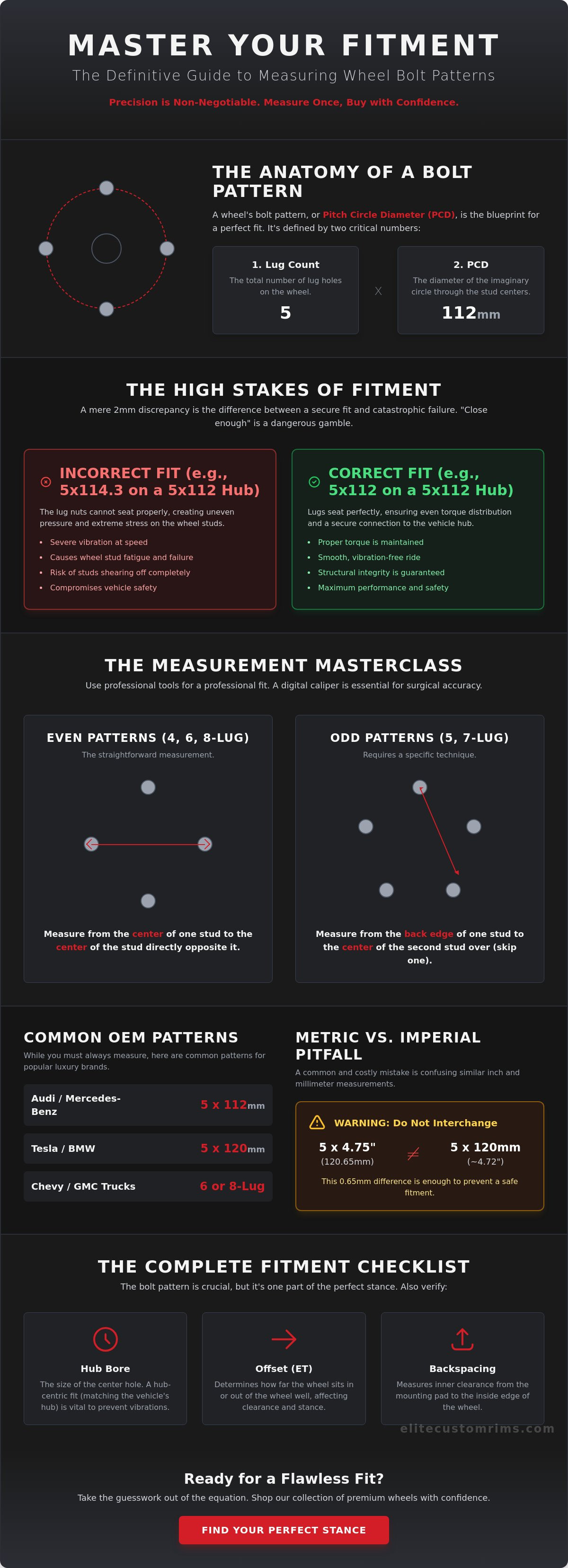
Every professional wheel upgrade starts with a technical blueprint. A bolt pattern, or Pitch Circle Diameter (PCD), consists of two primary components: the lug count and the diameter of the circle they form. Pitch Circle Diameter is the diameter of an imaginary circle passing through the center of all wheel studs. Accuracy is non-negotiable in this space. Even a 2mm difference, such as attempting to fit a 5x114.3 wheel onto a hub designed for 5x112, can lead to catastrophic wheel failure. Modern luxury vehicles, particularly those from Audi or Tesla, utilize specific patterns that demand exact verification before you commit to a purchase. Precision is the only way to ensure your vehicle maintains its performance integrity.
Why "Close Enough" Never Works with Performance Wheels
Forcing a fitment is a dangerous gamble that never pays off. When a bolt pattern is slightly off, the lug nuts cannot seat properly in the wheel's lug seats. This creates inconsistent torque across the hub and leads to extreme stud fatigue. You won't just feel a vibration; you're actively compromising the structural connection between your car and the road. The bolt pattern plays a critical role in centering the wheel on the hub assembly. Without this perfect alignment, the resulting stress can cause the studs to shear off entirely at high speeds. Mastering how to measure wheel bolt pattern is about more than aesthetics. It's about fundamental safety.
Metric vs. Imperial: Navigating the Conversion Landscape
The automotive world is currently split between two measurement systems. Most modern performance wheels and European imports use metric measurements (mm), while some domestic trucks and vintage platforms still utilize imperial inches. Understanding Wheel Sizing Basics is vital to avoid common conversion traps that plague the aftermarket industry. For example, a 5x4.75 inch pattern is often mistakenly swapped for a 5x120.65mm pattern. While they appear nearly identical to the naked eye, the slight variance prevents a safe seat. Knowing how to measure wheel bolt pattern with a set of digital calipers will save you from these costly errors. If you're driving a Mercedes or Audi, you're likely looking for a 5x112 pattern. Tesla and BMW owners typically require a 5x120 configuration. Always verify your specific model's requirements to ensure a seamless, professional fitment.
Selecting the right wheels requires a methodical approach. Don't guess. Use the right tools and stick to the manufacturer's specifications. Whether you're upgrading a Cadillac Escalade or a Porsche, the math must be perfect. Reliability starts with the numbers.
The Anatomy of Lug Patterns: Lug Counts and Spacing
Lug counts are the first visible indicator of a vehicle's performance capabilities and structural requirements. Most modern vehicles utilize configurations ranging from 4 to 8 lugs. This number isn't a stylistic choice; it's an engineering necessity dictated by curb weight, engine torque, and load ratings. Luxury sedans and electric vehicles like Tesla almost exclusively use 5-lug patterns. This setup provides an optimal weight-to-strength ratio for high-speed stability and efficient braking. Conversely, heavy-duty applications like Chevy and GMC truck wheels require 6 or 8-lug patterns to manage significant towing capacities and off-road stress. Some aftermarket manufacturers produce dual-drill wheels, which feature two sets of bolt holes to accommodate multiple patterns on a single rim. This versatility is efficient, but it makes knowing how to measure wheel bolt pattern even more critical to ensure you're utilizing the correct set of mounting points.
The 4-Lug and 5-Lug Standards
The 4-lug pattern is becoming a rarity in the modern performance segment. It was once the standard for compact cars, but as curb weights and power outputs have increased, manufacturers have shifted toward the 5-lug standard. Brands like Mercedes, Porsche, and Audi rely on 5-lug configurations because they allow for a "star" tightening pattern. This specific sequence distributes clamping force more evenly across the hub than a 4-lug setup. It reduces the risk of rotor warping and ensures the wheel remains perfectly seated during aggressive cornering. If you're struggling to visualize the spacing, a printable wheel bolt pattern guide is an excellent resource for physical verification before you order your next set of rims.
Heavy-Duty 6-Lug and 8-Lug Configurations
Trucks and SUVs operate under different physical demands than luxury sedans. The 6x139.7mm (6x5.5") pattern is the dominant standard for both domestic and import trucks. It provides the necessary surface area to secure wheels under heavy stress. For 2500 and 3500 series utility vehicles, 8-lug patterns are the only choice for safe, reliable operation. These patterns are essential for handling the massive vertical loads found in gooseneck towing or commercial hauling. These heavy-duty hubs are the perfect foundation for bold upgrades, like fitting 22 inch rims on a GMC Sierra. Mastering how to measure wheel bolt pattern on these larger hubs ensures your truck stays as capable as it is stylish. Explore our collection of premium truck wheels to find a fitment that matches your vehicle's raw power and prestige.
Measuring Even vs. Odd Lug Patterns: Technical Techniques
Geometry dictates your fitment strategy. Even patterns like 4, 6, or 8-lug hubs allow for a direct center-to-center measurement across the hub. Odd patterns, specifically the ubiquitous 5-lug configuration, require specialized geometry because no two studs sit directly opposite each other. Understanding these distinctions is the only way to master how to measure wheel bolt pattern with professional accuracy. While manual measurement is possible, investing roughly $15 in a physical bolt pattern gauge is the smartest move for any custom wheel buyer. It eliminates the margin for error that leads to costly returns and ensures your Porsche or Tesla gets the precision it deserves. This small tool acts as a template, allowing you to slide it over the studs to identify the PCD instantly.
If you don't have a gauge, you must rely on the "Center-to-Imaginary-Circle" method. This involves measuring from the center of a stud to the center of the hub and doubling that figure. It requires a steady hand and a sharp eye. Professionals often prefer the "Back-to-Center" approach for a more grounded reading. By measuring from the back of one lug hole to the center of another, you can bypass some of the visual guesswork inherent in center-to-center estimations. Every millimeter counts when you're ordering bespoke wheels for a Rolls Royce or a Land Rover.
The Direct Method for Even Lug Counts
Measuring an even lug pattern is straightforward. For a 4-lug wheel, measure from the center of one stud to the center of the stud directly opposite. This same logic applies to 6-lug and 8-lug truck hubs found on heavy-duty Chevy or GMC platforms. Imagine a straight line that bisects the hub bore perfectly. By measuring center-to-center across this line, you find the true diameter of the bolt circle. It's efficient. It's accurate. It's the standard procedure for any professional technician. Always double-check your reading to ensure the tape measure or caliper hasn't slipped off the center point of the stud.
The Geometry of the 5-Lug Measurement
Don't make the mistake of measuring 5-lug patterns straight across. Because the studs are offset, a straight-line measurement between two studs will always be shorter than the actual Pitch Circle Diameter. To get it right, use the "Center to Outboard" technique. Measure from the center of one hole to the furthest edge of the second hole away. This specific distance approximates the true PCD. For a deeper dive into these technical nuances, consult this guide on How to Measure Wheel Bolt Pattern to see how mathematical adjustments reach the exact figure. Precision here is vital for vehicles like the Cadillac Escalade or high-performance Audi models where fitment tolerances are razor-thin. Getting the math wrong here means your premium wheels won't just look bad; they simply won't fit.
Step-by-Step Guide: How to Measure Your Bolt Pattern Like a Pro
Precision isn't optional when you're investing in premium wheels. To get a definitive reading, you must remove the wheel to expose the hub for the most accurate measurement. Measuring through the spokes or over a hubcap introduces variables that lead to fitment failure. Before you start, ensure your vehicle is secure on jack stands and your workspace is clean. You'll need a set of digital calipers for surgical accuracy, though a high-quality tape measure can work in a pinch. Keep a notepad nearby to record your findings. Professional measurement is the only way to eliminate the technical anxiety that comes with custom ordering. Don't guess when you can know.
Execution: Measuring the Hub
Success lies in the sequence. Follow these steps to determine your vehicle's specific requirements:
- Step 1: Count the studs. This establishes the first half of your technical profile, such as the "5" in a 5x112 configuration.
- Step 2: The 5-lug shortcut. For the most common luxury setups, measure from the back of one stud to the center of the third stud, skipping one in between. This specific distance provides your Pitch Circle Diameter (PCD) without needing complex geometric formulas.
- Step 3: Convert to millimeters. If you're using a standard tape measure, multiply your inch reading by 25.4. Most high-end manufacturers, especially those producing Tesla or European wheels, operate exclusively in the metric system.
Once you've mastered how to measure wheel bolt pattern on your own hub, you're ready to select a set that matches your vehicle's engineering. If you're ready to upgrade, browse our premium wheel fitment guide to find the perfect match for your verified specs.
Verifying with Vehicle Data
Physical measurements should always be cross-referenced with OEM specifications to ensure total compatibility. Manufacturers often stick to signature patterns across their lineups. For instance, Audi almost universally utilizes 5x112, while the Tesla Model 3 and Model Y rely on a 5x114.3 configuration. Porsche enthusiasts will typically find a 5x130 pattern on their hubs. If your physical measurement differs significantly from these standards, you might be dealing with a modified hub. Always check for bolt pattern adapters or spacers that a previous owner may have installed. These components can change your effective PCD and require a different wheel selection entirely. Reliability starts with verifying every layer of the assembly. Take the time to double-check your math against the manufacturer's data before finalizing any high-end purchase.
Beyond the Bolt Pattern: Ensuring a Professional Fitment
Mastering how to measure wheel bolt pattern is the vital first step, but it isn't the final one. A perfect stance requires a holistic view of wheel geometry. Hub bore, offset, and backspacing complete the fitment puzzle. Generic guides often stop at the lugs; we don't. Luxury vehicles demand hub-centric precision to eliminate vibrations and ensure long-term mechanical health. Performance cars frequently utilize staggered wheels, which changes the ordering process. Front and rear measurements might differ in width and offset even if the bolt pattern remains identical. Elite Custom Rims eliminates the guesswork by verifying every technical specification for every order. We act as your final line of defense against fitment errors. Trust our expertise to deliver a flawless result.
The Importance of Hub Bore and Center-Bore
Hub bore is the diameter of the center hole on the wheel. It must match your vehicle's hub exactly to achieve a hub-centric fit. When these surfaces mate perfectly, the hub carries the vehicle's weight rather than the lug studs. If the wheel's bore is larger than the hub, you'll need high-quality hub-centric rings to fill the gap. High-end brands like Rolls Royce require zero-tolerance hub fitment to maintain their legendary ride quality. Lug-centric wheels rely solely on the studs for centering. This is unacceptable for luxury performance. It leads to microscopic shifting and high-speed vibrations that compromise the driving experience. We ensure your hub-to-wheel connection is seamless and secure.
Offset and Brake Clearance
Wheel offset, often labeled as ET, determines the wheel's position relative to the suspension and fenders. It dictates if your new rims will rub against the calipers or protrude past the bodywork. Calculating clearance is essential for performance brake kits found on Audi RS or Tesla Performance trims. Even if you know how to measure wheel bolt pattern perfectly, a wrong offset can render a beautiful wheel useless. Check your backspacing to ensure the inner barrel doesn't strike suspension components. Use this final checklist before hitting the "Buy" button: verify the PCD, confirm the hub bore, and validate the offset against your specific brake configuration. We're here to ensure every measurement translates into a masterpiece. Your vehicle deserves nothing less than absolute precision. Don't settle for anything less than a perfect fit.
Secure Your Perfect Stance
You now have the technical foundation to verify your PCD with surgical precision. Understanding how to measure wheel bolt pattern is the difference between a high-performance upgrade and a mechanical setback. By mastering the geometry of 5-lug hubs and accounting for hub-centric requirements, you've eliminated the guesswork that keeps most enthusiasts from ordering custom rims. Accuracy is the ultimate form of security when investing in your vehicle's aesthetics and safety.
We take that security a step further. Every order at Elite Custom Rims undergoes expert fitment verification to ensure your new wheels match your vehicle's specific engineering. Our specialized inventory for Audi, Tesla, Mercedes, and Porsche is curated for enthusiasts who demand the best. With national shipping and professional technical support, we make luxury accessibility a reality. We're here to act as your reliable advocate from measurement to mounting.
Browse Our Curated Collection of Precision-Fit Luxury Wheels and transform your vehicle today. Your car deserves the absolute certainty of a professional fit. Drive with confidence.
Frequently Asked Questions
Can I use a 5x114.3 wheel on a 5x112 vehicle with "wobble bolts"?
No. We do not recommend using wobble bolts for performance or luxury fitments. While these bolts allow for a minor 2.4mm variance, they compromise the seating of the lug nut. For a precision-engineered vehicle like an Audi or Mercedes, you must use the exact 5x112 pattern. Safety is the priority. Stick to the manufacturer's specifications to ensure your wheels remain secure under high-speed stress and heavy cornering.
How do I know if my bolt pattern is in inches or millimeters?
Check your vehicle’s origin. Modern European, Japanese, and domestic vehicles almost exclusively use metric measurements. Older domestic trucks and classic American cars typically use imperial inches. If you measure 4.5 inches, your metric equivalent is 114.3mm. Learning how to measure wheel bolt pattern in both systems is vital for cross-referencing aftermarket options. Most luxury wheel brands now list their products in millimeters to match modern hub standards.
What is the most common bolt pattern for Tesla Model Y and Model 3?
The Tesla Model 3 and Model Y utilize a 5x114.3mm bolt pattern. This is a prevalent standard in the automotive industry. When selecting wheels for these EVs, you must also consider load ratings and brake clearance. Measuring your hub directly confirms this PCD and allows you to shop with confidence. We specialize in Tesla-specific fitments that account for the unique weight and performance demands of electric platforms.
Is it better to measure the wheel itself or the vehicle hub?
Measure the vehicle hub. This provides the most reliable data for your fitment project. Aftermarket wheels sometimes feature dual-drill patterns or varying lug seat designs that can complicate a direct measurement. By measuring the hub studs, you establish the exact Pitch Circle Diameter your car requires. This professional approach takes the guesswork out of the process and ensures your new rims seat perfectly against the hub assembly.
What happens if I install wheels with the wrong bolt pattern?
Catastrophic mechanical failure is the most likely outcome. If the bolt pattern is even slightly off, the lug nuts cannot center the wheel properly. This creates massive stress on the studs, leading to vibrations, steering instability, and eventually sheared studs. The wheel could detach while the vehicle is in motion. Never compromise on fitment. A perfect match is the only way to guarantee safety and performance.
Do I need a special tool to measure my lug pattern accurately?
A digital caliper is the preferred professional tool for surgical accuracy. However, a bolt pattern gauge is a faster, more accessible option for most enthusiasts. This template slides directly over the studs to identify your PCD instantly. If you are using a tape measure, remember that 5-lug patterns require specific geometric formulas. Investing in the right tool eliminates technical anxiety and ensures your luxury wheels fit with absolute precision.
Are all Audi wheels the same bolt pattern?
Not necessarily. While 5x112mm is the dominant pattern for modern Audi sedans and SUVs, variations exist across different generations. Older Q7 models, for instance, used a 5x130 pattern before switching to the 5x112 standard. Always verify your specific model year. Knowing how to measure wheel bolt pattern on your own hub is the best way to avoid ordering the wrong set. Accuracy ensures your Audi maintains its factory performance and aesthetic.
How can I find my bolt pattern without removing the wheel?
Consult your owner's manual or check for a stamp on the back of your current wheels. Most manufacturers include the PCD and offset information behind the spokes. You can also search verified OEM databases using your VIN. While these methods are helpful, they don't account for aftermarket hub modifications. Physical measurement remains the only definitive way to confirm your fitment before investing in a premium set of custom rims.