
Did you know that many tire manufacturers slash your mileage warranty by as much as 50 percent the moment you install staggered wheels? It is a steep trade-off for style, yet performance enthusiasts continue to choose this setup for its undeniable engineering advantages. You want that aggressive, wide-track stance and the superior rear-wheel drive traction that only a wider footprint provides. We understand the hesitation. The fear of accelerated tire wear or the risk of damaging a sensitive AWD system is enough to make any driver pause.
It's time to eliminate the guesswork and take control of your fitment. This guide helps you master the technical and aesthetic nuances of staggered wheel setups to transform your vehicle's handling and appearance. We'll examine how modern engineering allows the upcoming 2027 BMW M2 with M xDrive to run 19-inch fronts and 20-inch rears straight from the factory. You'll learn to calculate offsets with professional precision, understand the requirements for the latest performance EVs like the 2026 Tesla Model Y, and choose the right widths for a perfect, rub-free fit. Gain the confidence to build a stance that performs as well as it looks.
Key Takeaways
- Differentiate between staggered and square setups to choose the configuration that best aligns with your driving style and utility needs.
- Explore the historical engineering behind why performance-oriented rear-wheel drive vehicles prioritize a wider rear track for superior traction.
- Master the technical nuances of staggered wheels, including precise width and offset calculations to ensure a rub-free, aggressive stance.
- Learn how to maintain drivetrain health while running aggressive fitments on modern all-wheel drive systems.
- Identify why forged wheel construction is the elite choice for high-performance applications on brands like Porsche, Audi, and Tesla.
Defining Staggered Wheel Fitment: More Than Just a Stance
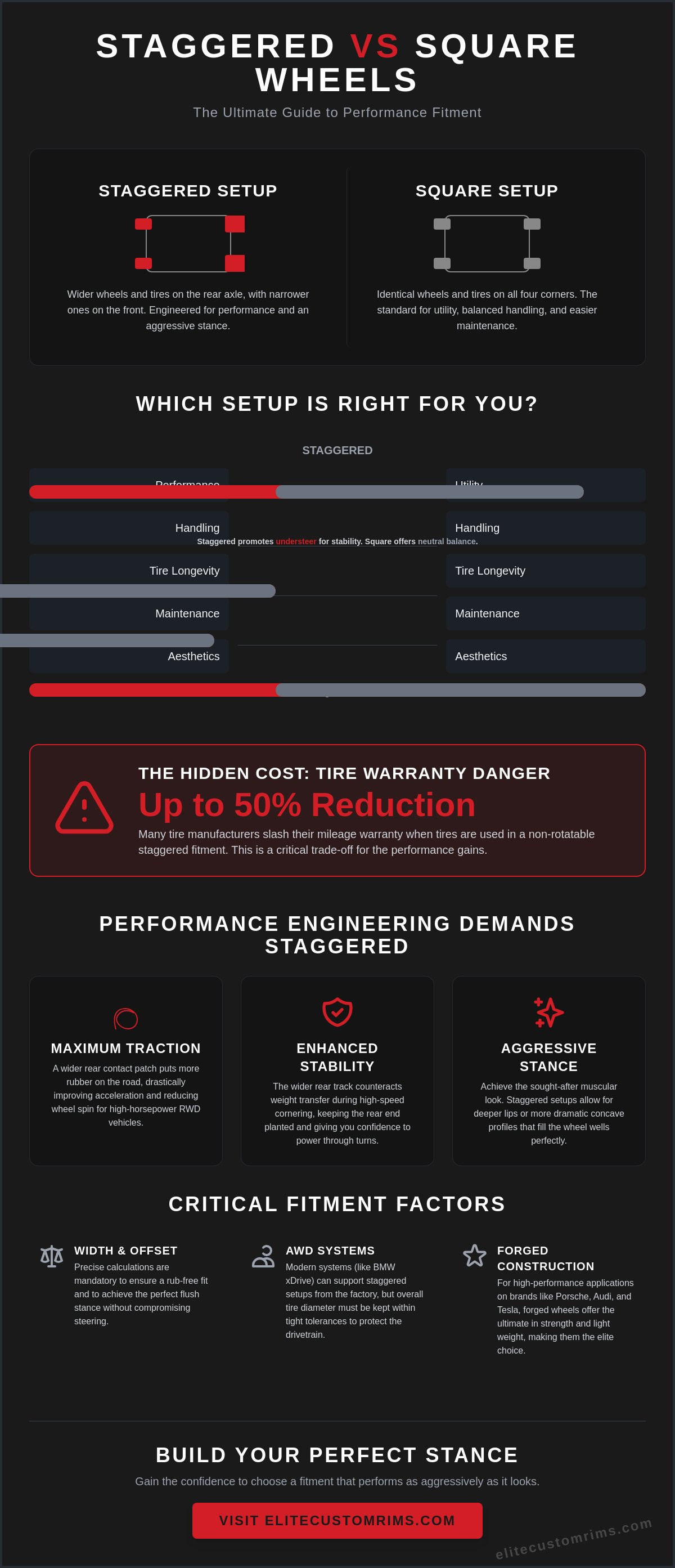
Staggered wheels are the hallmark of a purpose-built performance machine. This configuration is simple but effective. You install wider wheels and tires on the rear axle while maintaining a narrower profile up front. It is a deliberate engineering choice that prioritizes function over uniformity. While many drivers start their journey looking for that aggressive, wide-track aesthetic, the roots of this design are found on the racetrack. High-horsepower, rear-wheel drive (RWD) vehicles pioneered this look to manage the massive torque sent to the pavement.
Staggered wheel fitment is now a factory-standard feature for elite brands like Porsche and Mercedes-AMG. These manufacturers recognize that a uniform square setup often compromises the potential of a rear-biased chassis. Beyond the performance gains, the visual impact is undeniable. A staggered setup allows for a deep-dish barrel or a dramatic, flush concave profile in the rear that a standard setup simply cannot match. It signals power and stability before you even turn the key. It's the ultimate upgrade for those who demand both presence and precision.
The Anatomy of a Staggered Setup
Precision is everything. In a staggered context, we focus primarily on wheel width rather than just diameter. While some setups use a larger diameter in the rear, most street applications keep the diameter consistent while increasing the width. A common configuration for a performance sedan might feature 8.5-inch wide wheels in the front paired with 10-inch wide wheels in the rear. These wider rear barrels change the car’s visual profile, creating a muscular, planted appearance. It is about filling the wheel well perfectly and achieving that sought-after flush look without sacrificing steering response. You get the aggressive stance you want with the technical accuracy your vehicle requires.
Why Performance Engineering Demands Staggered Rims
Engineering dictates the design. The primary goal of staggered wheels is to increase the contact patch where it matters most. For RWD vehicles, more rubber on the road means better acceleration and reduced wheel spin. This setup also provides critical lateral stability during high-speed cornering. By running a wider rear track, you effectively counteract the weight bias found in rear-engine or mid-engine layouts like those in a Porsche 911. It keeps the rear end planted, giving you the confidence to power out of corners with professional assurance. You get maximum grip where the power hits the ground, ensuring every bit of horsepower is used efficiently and safely.
Staggered vs. Square Setups: Which is Right for You?
Choosing between a staggered or square setup is more than a technical decision. It's a choice about your vehicle's soul. A square setup uses identical wheels and tires on all four corners. It is the gold standard for utility and balance. Conversely, staggered wheels prioritize raw performance and a muscular rear-end aesthetic. Most high-performance machines require this offset width to handle power effectively. You need to weigh the initial investment against long-term maintenance. While staggered sets often carry a higher entry price, the real cost appears in tire replacement intervals. Since you cannot rotate tires from front to back, the rear tread will inevitably wear faster. In fact, many tire manufacturers reduce their mileage warranty by as much as 50 percent when tires are used in a staggered fitment. Evaluating the pros and cons of staggered wheels helps you decide if the trade-off in longevity is worth the gain in grip.
Your driving style should dictate your final choice. Are you a daily commuter navigating stop-and-go traffic? Or are you a weekend enthusiast seeking the perfect line through a mountain pass? A commuter might favor the predictability of a square setup. An enthusiast will crave the planted feel of a staggered rear. It's about matching the equipment to the mission. Beyond maintenance, consider your resale value. For many enthusiasts, maintaining the original equipment (OE) staggered look is essential for preserving the vehicle's market appeal and factory-engineered feel. Don't settle for a generic fitment when your car was designed for something more specific and powerful.
The Square Setup Advantage
Utility drives the square setup. The primary benefit is ease of tire rotation. This simple maintenance task extends tread life significantly and keeps your long-term costs manageable. For front-wheel-drive based platforms, a square configuration provides neutral handling characteristics. It reduces the tendency for the car to push through corners. Ordering replacement rims is also less complex. You don't have to worry about managing two different part numbers for a single set. It is a reliable, no-nonsense approach for those who value efficiency and logistical ease above all else.
When Staggered is Non-Negotiable
For certain vehicles, compromising on fitment isn't an option. Maintaining the factory-intended dynamics of a luxury sports sedan requires specific widths. This is especially true when filling out the massive rear fenders on ultra-luxury vehicles. If you are upgrading your Rolls Royce wheels, a staggered fitment is essential to preserve that commanding Spirit of Ecstasy presence. High-torque electric vehicles also benefit immensely. Maximizing launch performance in a Tesla requires a massive rear contact patch to transfer instant torque to the tarmac without spinning. It transforms the driving experience from standard to spectacular. If you're ready to elevate your vehicle's capabilities, you can explore our curated wheel collections to find the perfect fit for your specific model.
The Impact on Handling, Traction, and Understeer
Handling dynamics change the moment you move to a staggered wheel setup. It is a calculated shift in how your vehicle interacts with the road. By increasing the rear tire width, you fundamentally alter the traction balance. This is vital for high-horsepower, rear-biased machines. A wider rear footprint helps settle the chassis during aggressive acceleration. It prevents the "tail-happy" sensation that can unsettle a driver on the track. While some worry about heavy steering, keeping the front wheels at a factory-recommended width ensures your turn-in remains sharp and responsive. You get the grip you need without sacrificing the agility you crave.
Engineering your vehicle for performance requires understanding weight distribution. Staggered wheels balance the heavy rear bias of mid-engine or high-output RWD cars. This isn't just about straight-line speed; it's about cornering confidence. A wider rear track provides lateral stability that keeps the car planted through high-speed sweepers. It counteracts the natural tendency of powerful cars to rotate too quickly. You gain a level of professional assurance that a standard square setup cannot provide. It transforms a nervous chassis into a precision instrument.
Maximizing Traction for High-Torque Vehicles
Electric vehicles and modern muscle cars deliver torque instantly. This requires a massive contact patch to avoid wasted energy. The 2026 Dodge Charger Daytona utilizes this strategy with 305mm front tires and massive 325mm rears to manage its immense power. Similarly, the 2026 Tesla Model Y Performance features Arachnid 2.0 wheels, running a 9.5-inch front and 10.5-inch rear staggered configuration. These wider rear barrels support high-performance tire compounds that can handle the heat and stress of aggressive launches. You reduce wheel spin and maximize every bit of available power.
Addressing the Understeer Myth
Understeer occurs when the front tires lose grip before the rears, causing the car to "push" wide in a corner. Because staggered wheels provide more rear grip, some enthusiasts fear this setup will ruin their handling. This is a myth that proper tuning can solve. You can use what the offset in wheels means to your advantage. By adjusting the wheel's position relative to the hub, you can widen the front track to restore front-end bite. Combine this with suspension adjustments, such as stiffening the rear sway bar, to achieve a perfectly neutral balance. You don't have to choose between traction and turn-in; you just need the right technical strategy.
Critical Fitment Factors: Width, Offset, and AWD
Achieving the perfect fitment requires more than just picking a style you like. It is a game of millimeters. When you install staggered wheels, your primary concern is fender clearance. A wider rear wheel increases the risk of rubbing against the inner liner or the outer fender lip. You must select a width that supports your desired tire contact patch while staying within the physical limits of your vehicle's wheel wells. Precision engineering ensures your upgrade doesn't result in body damage or compromised safety. It's the difference between a professional build and a costly mistake.
Wheel offset, or ET, is the silent partner in this equation. It determines how far the wheel sits in or out from the hub. To achieve a flush look where the wheel face aligns perfectly with the fender, you need calculated offset adjustments. This is especially critical for performance vehicles with large multi-piston brake calipers. Your wider rear barrels must provide enough backspacing to clear performance rotors and calipers without the need for spacers. It's about combining high-end aesthetics with practical reliability. If you're ready to start your build, consult our fitment specialists to ensure total compatibility and a perfect install.
The AWD/4WD Staggered Challenge
Running a staggered setup on an all-wheel-drive vehicle is a complex engineering feat. The "Rolling Diameter" rule is non-negotiable. Your front and rear tire circumferences must remain within 1 percent of each other. If the difference is too great, you risk overheating the center differential or triggering persistent traction control errors. You must calculate the total wheel and tire height with absolute accuracy. This is a common requirement for luxury SUVs where stance is a priority. When selecting Audi Q7 wheels, we ensure the staggered configuration respects these strict drivetrain tolerances. It protects your mechanical investment while delivering the aggressive, wide-track look you desire.
Measuring for the Perfect Flush Stance
Accuracy starts at the hub. You must begin by knowing how to measure wheel bolt pattern accurately to ensure the wheels seat correctly. From there, focus on the rear lip depth. A deeper lip or a more aggressive concavity defines the staggered aesthetic. You want to avoid "poke," where the wheel sticks out past the bodywork, or "tuck," where it looks lost in the arch. Calculated offset adjustments allow you to find that sweet spot. Follow these steps for a professional result:
- Verify your specific bolt pattern and center bore diameter.
- Measure the distance from the hub face to the inner fender lip.
- Check for suspension component clearance at full suspension compression.
- Select an offset that pushes the wheel face flush with the vehicle's body lines.
Selecting Your Elite Staggered Wheel Set
Choosing the right set of staggered wheels is the final step in defining your vehicle's character. It is about more than just dimensions. You are selecting a component that must honor your car's heritage while pushing its performance limits. For owners of elite marques like Audi, Mercedes, or Porsche, the wheel choice must be as sophisticated as the engineering behind the hub. Material choice is the first pillar of a premium selection. We prioritize forged wheel construction because it offers a superior strength-to-weight ratio compared to traditional cast options. Forged wheels reduce unsprung mass, which sharpens steering response and improves suspension travel. It is a smart investment in both aesthetics and track-ready durability.
Finishing options provide the ultimate aesthetic bridge. Whether you are looking for a high-gloss black to match a night-style trim or a classic brushed silver for a timeless look, the finish must be flawless. A staggered setup creates a unique visual depth, often allowing for a more aggressive concavity or a deeper lip in the rear. This creates a high-end, custom appearance that standard square setups cannot replicate. Our focus is on providing new, high-performance wheel hardware that meets the exacting standards of the world's most prestigious automotive brands. You get the look you want with the practical reliability you expect.
Brand-Specific Staggered Options
Precision fitment varies by manufacturer. For Tesla Model 3 and Model Y owners, the challenge is balancing aerodynamic efficiency with an aggressive profile. The 2026 Tesla Model Y Performance features new 21-inch forged staggered wheels, running 9.5 inches in the front and 10.5 inches in the rear. This setup maximizes grip for instant electric torque. Mercedes-Benz enthusiasts often seek the classic AMG-style wide-rear look, which requires specific offsets to fill out the fenders without rubbing. Porsche owners must maintain the iconic 911-style rear-biased geometry. This ensures the car handles exactly as the engineers in Stuttgart intended. Each brand requires a tailored approach to width and offset.
The Elite Custom Rims Difference
We take the guesswork out of the equation. Our expertise is rooted in brand-specific fitment for luxury and performance vehicles. We understand the nuances of staggered wheels and how they interact with modern suspension systems and brake clearances. Our process is methodical and organized.
- Curated selections for Porsche Wheels, Mercedes Wheels, and Audi Wheels.
- Expert consultation to ensure rolling diameter compatibility for AWD systems.
- Focus on the latest 2026 and 2027 market trends and OEM specifications.
- Guaranteed fitment accuracy to eliminate technical anxiety.
Master Your Vehicle's Stance and Performance
Achieving the perfect fitment is a definitive statement of intent for your car's profile and grip. We've explored the technical precision of offsets, the handling benefits of increased rear traction, and the strict rolling diameter rules for AWD systems. Choosing staggered wheels doesn't have to be a gamble. It's about combining aggressive aesthetics with the mechanical integrity your luxury vehicle demands. Whether you're balancing the instant torque of a Tesla or maintaining the iconic geometry of a Porsche, accuracy is non-negotiable. You don't have to sacrifice reliability for a world-class stance.
Our team provides specialized fitment expertise for Tesla, Mercedes, and Porsche to eliminate the guesswork from your build. We offer nationwide shipping on all premium wheel orders and provide expert technical support for complex offset and width calculations. You deserve a setup that performs as flawlessly as it looks. Take the next step in your vehicle's transformation and browse our curated selection of staggered wheels for luxury vehicles. Your ideal stance is just a few clicks away. Let's build something extraordinary together and get your vehicle exactly where it needs to be.
Frequently Asked Questions
Can I put staggered wheels on an all-wheel-drive (AWD) car?
Yes, you can install them on AWD vehicles if the rolling circumference stays within 1 percent. This technical requirement prevents excessive strain on the center differential. Many modern performance AWD systems are now factory-tuned to handle these specific width differences without mechanical issues. Always verify your drivetrain's specific tolerances before finalizing your fitment.
Do staggered wheels affect the car's speedometer or odometer?
They won't affect your readings if you maintain the correct overall tire diameter. Speedometers track the revolutions of the wheel assembly. By selecting a tire with a shorter sidewall for your wider rear wheels, you keep the total height consistent with the front wheels. Your speed and mileage tracking will remain accurate and reliable.
Why can't I rotate tires on a staggered wheel setup?
You can't rotate them because the front and rear wheels have different physical widths and offsets. A wider rear wheel simply won't clear the front suspension components or fenders. This is the primary trade-off for superior traction and a more aggressive stance. You'll need to replace tires per axle rather than as a full set of four.
Will staggered wheels improve my car's handling on the track?
They provide a significant advantage by increasing the rear contact patch for better power delivery. This helps you put power down more effectively when exiting corners. It also increases lateral grip, making the car feel more planted during high-speed transitions. It is a proven strategy for reducing lap times and increasing cornering confidence.
Do staggered wheels wear out tires faster than square setups?
Rear tires generally wear out faster because they handle the majority of the acceleration forces. Since you can't rotate them to the front, the wear is concentrated on a single axle. It is a common characteristic of high-performance setups. Plan for more frequent rear tire replacements to maintain peak grip and safety levels.
What happens if I use the same size tires on staggered wheels?
This creates a "stretched" fitment on the wider rear wheel that can compromise safety. It can lead to poor bead seating and increased vulnerability to curb rash. Always select tire sizes that correspond to the specific width of each wheel in your staggered wheels setup to ensure optimal performance and structural integrity.
Are staggered wheels only for rear-wheel-drive cars?
No, they are now widely used on all-wheel-drive performance models and luxury SUVs. While they originated on RWD cars to manage torque, modern engineering uses them to balance handling and stance across various platforms. They are a functional choice for any performance-oriented drivetrain that requires a wider rear footprint for stability.
How do I know if my car can handle a staggered setup without rubbing?
You need to verify the wheel offset and width against your car's specific fender and suspension clearances. Measuring the distance from the hub to the fender lip at full suspension compression is a critical first step. Our technical team uses professional fitment databases to guarantee your staggered wheels install without any rubbing or body interference.