
At nearly 6,000 pounds, your 2026 Mercedes-AMG G 63 exerts more pressure on its footprint than almost any other luxury SUV on the road. Choosing the wrong Mercedes G-Wagon wheels isn't just a blow to your aesthetic; it's a genuine safety concern that can lead to structural failure or poor handling. You want a stance that commands attention, but the fear of rubbing fenders or ruining that signature ride quality often keeps owners stuck with stock options. It's frustrating to navigate technical specs like a 5x130 bolt pattern and 84.1mm hub bores when you just want a look that reflects your personal style.
We understand that precision is everything for a vehicle of this caliber. You deserve an upgrade that balances rugged heritage with modern luxury without the technical guesswork. This 2026 guide breaks down everything from the rise of forged monoblock designs to the critical load ratings required for heavy-duty performance. You'll learn how to select the perfect offset for a flush fitment and which finishes are dominating the streets this year. Let's transform your G-Class into a head-turning masterpiece that feels as good as it looks.
Key Takeaways
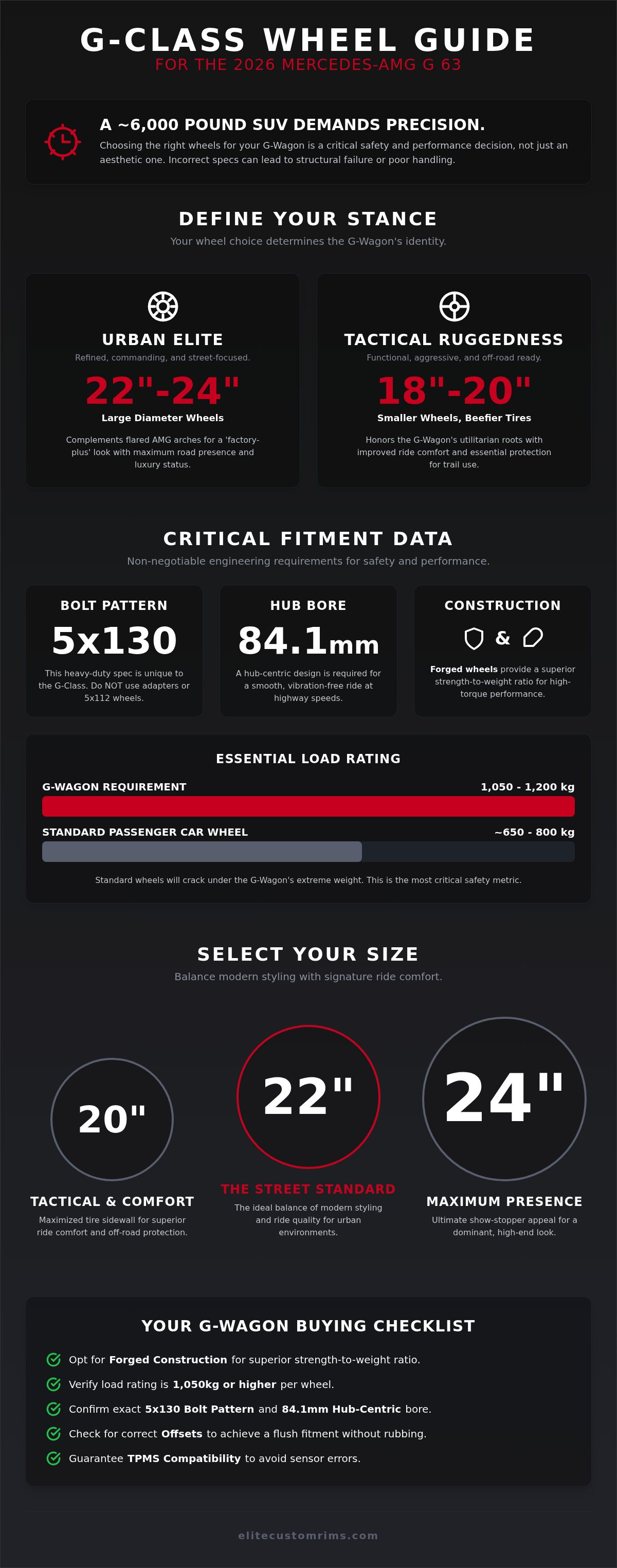
- Define your vehicle's identity by choosing between a rugged off-road stance or a refined urban luxury aesthetic.
- Master the technical requirements for Mercedes G-Wagon wheels, including the unique 5x130 bolt pattern and heavy-duty load ratings.
- Evaluate size options from 20 to 24 inches to balance modern "factory-plus" styling with signature ride comfort.
- Opt for forged construction to secure a superior strength-to-weight ratio capable of handling high-torque performance.
- Guarantee a flawless, flush fitment by verifying specific offsets and TPMS compatibility before you buy.
The G-Wagon Aesthetic: Balancing Urban Luxury and Off-Road Heritage
The G-Wagon is a rolling contradiction. It's a military-grade machine that somehow became the ultimate status symbol for high-end city streets. Your choice of Mercedes G-Wagon wheels is the single most influential factor in determining which side of that personality wins. A quick look at the Mercedes-Benz G-Class history shows a vehicle born for the battlefield but refined for the boulevard. Modern wheel designs must respect this dual DNA while pushing the boundaries of 2026 styling trends.
Every set of wheels tells a story about how you use your vehicle. They define the stance, which is the physical presence and posture of the G-Class on the road. A well-chosen set eliminates the awkward gap between the tire and the fender, creating a cohesive, purposeful look. Whether you're chasing an aggressive off-road vibe or a sleek, urban finish, the goal is to enhance the vehicle's natural boxy silhouette without losing its soul. You aren't just buying parts. You're curating an identity.
The Urban Elite: 22-Inch and 24-Inch Trends
Large-diameter wheels are the current gold standard for the modern G-Wagon market. In 2026, 22-inch wheels have become the street standard, while 24-inch options offer the ultimate show-stopper appeal. These sizes complement the flared arches of the G63 AMG body style perfectly. Monoblock and thin-spoke designs are particularly popular right now. They provide a factory-plus aesthetic that looks like it could have come from the AMG studio but with more character. These wheels emphasize the vehicle's luxury status and create a commanding, high-performance presence that is impossible to ignore.
Tactical Ruggedness: The 18-Inch and 20-Inch Appeal
There is a powerful resurgence in the tactical look. This trend favors smaller 18-inch or 20-inch setups paired with beefier, high-profile tires. The appeal is purely functional. A taller sidewall provides significantly more ride comfort on uneven pavement and offers essential protection during trail use. Many owners are opting for beadlock-style aesthetics to achieve a rugged, ready-for-anything appearance. This direction honors the G-Wagon's utilitarian roots. It's a bold choice for those who value rugged capability and want a vehicle that looks as tough as it actually is.
Mastering the Technical Specs: G-Class Fitment and Load Ratings
Engineering takes precedence over aesthetics when you're dealing with a vehicle of this magnitude. A 2026 Mercedes-AMG G 63 tips the scales at approximately 5,842 pounds. This massive curb weight means your Mercedes G-Wagon wheels must be more than just stylish; they must be structurally capable of supporting extreme vertical loads and high-torque acceleration. Choosing wheels based solely on looks without verifying technical data is a recipe for vibration, poor handling, or even structural failure.
Precision fitment ensures your vehicle maintains its legendary road presence while staying safe. For a deeper look at how these specifications impact high-end builds, explore our comprehensive guide on custom wheels. We eliminate the guesswork by focusing on hub-centric designs. Unlike lug-centric wheels that rely on the bolts to center the wheel, hub-centric designs use an 84.1mm center bore to sit perfectly on the vehicle's hub. This transfer of weight directly to the hub is the only way to guarantee a smooth, vibration-free ride at highway speeds.
Understanding the 5x130 Bolt Pattern
The G-Class uses a 5x130 bolt pattern. This is a heavy-duty specification that sets it apart from almost every other SUV in the Mercedes-Benz lineup, which typically uses a 5x112 pattern. This 5x130 configuration is shared with high-performance Porsche models, but the G-Wagon requires specific offsets to clear its massive brake calipers. This pattern has remained consistent from the classic W463 generation through the modern W463A chassis. Never use adapters or "wobble bolts" to force a different pattern onto your G-Class. The sheer weight and torque of the vehicle will eventually compromise these components, leading to dangerous failures on the road.
Load Rating: The Often Ignored Safety Metric
Load rating is the most critical safety metric for any SUV upgrade. For a G-Wagon, each wheel should ideally carry a load rating between 1,050 kg and 1,200 kg. Standard passenger car wheels are often rated for much less and will likely crack under the stress of a 5,800-pound SUV. Reputable manufacturers adhere to SAE International wheel standards, specifically the J2530 protocol, to test for radial fatigue and impact strength. At Elite Custom Rims, we strictly vet our inventory to ensure every wheel meets these heavy-duty requirements. If you're ready to upgrade with confidence, you can browse our Mercedes collection to find a set that matches these rigorous safety standards.
Size Matters: Comparing 20-Inch, 22-Inch, and 24-Inch Options
Choosing the diameter of your Mercedes G-Wagon wheels isn't just a matter of style. It's a decision rooted in physics. Every inch you add to the wheel diameter changes the vehicle's unsprung weight. This is the mass not supported by the suspension. Heavier wheels force the engine to work harder during acceleration and put more strain on the braking system. For a vehicle that already weighs 5,842 pounds, these marginal gains in weight can noticeably dull the driving experience. You need to decide if you're building for the trail, the commute, or the show floor.
A smart selection framework starts with your primary driving environment. If you spend 90% of your time on rough city streets, a massive rim with a thin tire might lead to constant repair bills. Conversely, if you want that aggressive, modern stance for a weekend cruiser, smaller wheels might look underwhelming in those cavernous arches. We recommend prioritizing the balance between structural integrity and the "factory-plus" look that defines the 2026 aesthetic.
The 20-Inch Sweet Spot for Daily Driving
For the driver who values utility, 20 inches is the gold standard. It's the minimum size required to clear the high-performance brake calipers found on the AMG G 63. This diameter allows for a generous tire sidewall. That extra rubber acts as a critical cushion, soaking up road vibrations and protecting your rims from pothole damage. You'll find the widest selection of all-terrain tires in this size, making it the only real choice for owners who actually intend to use their G-Class off the pavement. It's a compliant, reliable setup that respects the vehicle's rugged heritage.
Going Big: The Pro and Cons of 22-Inch and 24-Inch Rims
22-inch wheels are currently the "street standard" for a reason. They fill the G-Wagon’s massive wheel arches perfectly, creating a flush, aggressive profile. You'll experience sharper steering response and improved cornering stability. The shorter tire sidewall flexes less, making the vehicle feel more planted during spirited driving. However, the trade-off is a significantly stiffer ride. Every bump is felt more clearly in the cabin.
Stepping up to 24 inches offers the ultimate "wow factor." It's a transformative upgrade that commands attention. But it comes with technical baggage. Rubbing is a common issue with 24-inch setups, particularly during full-lock turns. The tire can catch on the inner fender liners if the offset isn't perfectly calculated. You'll also need to be hyper-vigilant about tire pressure and curb heights. These larger rims leave very little room for error. If you're chasing the urban elite look, 24s are the answer, but they require a commitment to careful driving and precise fitment.
Elevating Style with Premium Finishes and Forged Construction
The aesthetic of your Mercedes G-Wagon wheels should never come at the expense of structural integrity. For a vehicle with this much torque and mass, the manufacturing process is the foundation of your safety. You have three primary choices: cast, flow-formed, or forged construction. While cast wheels are accessible, they often lack the density required for a 6,000-pound SUV. Forged wheels are the pinnacle of performance. They are carved from a single block of aerospace-grade aluminum, resulting in a wheel that is both lighter and significantly stronger than its cast counterparts.
Flow-forming offers a smart middle ground. This process uses hydraulic rollers to stretch the wheel barrel, increasing its tensile strength without the high price tag of full forging. If you want the ultimate in durability and weight savings, forged is the only way to go. We apply the same rigorous standards to our G-Class inventory that you'll find in our mercedes s-class wheels guide. Precision matters across every chassis.
Forged vs. Cast: Why Strength is Non-Negotiable
Forged aluminum provides a superior strength-to-weight ratio. This is critical for heavy vehicles. Reducing unsprung weight improves your acceleration and braking response. It also reduces the stress on your suspension components. Cast wheels rely on thicker cross-sections to achieve strength, which adds unnecessary bulk. Forged wheels achieve higher load ratings with thinner, more elegant spoke designs. It's a win for both performance and aesthetics. Strength isn't a suggestion; it's a requirement for the G-Class DNA.
Trending Finishes for the Modern G-Class
In 2026, the "Murdered Out" look remains a dominant force. Gloss and satin black finishes seamlessly integrate with the Mercedes-Benz Night Package trims. This creates a stealthy, unified appearance that accentuates the vehicle's boxy silhouette. However, we're seeing a rise in brushed bronze and tinted chrome. Brushed bronze offers a warm, industrial feel that suggests a custom, bespoke build. Tinted chrome provides a deep, smoky luster that is more subtle than traditional bright chrome. These finishes provide a sophisticated contrast, especially on darker paint colors.
Contrast finishes, such as machined lips, are also making a comeback. They create a visual break in the wheel design, making the rim appear larger and more detailed. These options are perfect for breaking up the massive side profile of the G-Class. Maintenance is key to protecting these premium surfaces. Avoid harsh chemicals and automated car washes with stiff brushes. Use a pH-neutral cleaner and a soft microfiber mitt to prevent micro-scratching. To secure the perfect look for your build, explore our curated Mercedes wheel collection today. We focus on new, high-performance inventory that sets the trend rather than following it.
Securing the Perfect Set: Your Mercedes G-Wagon Buying Checklist
Finalizing your build requires a meticulous eye for detail. You've selected the style and the size, but the technical execution must be flawless to protect your investment. For a vehicle as heavy as the 2026 G-Class, precision isn't optional. Verifying your offset (ET) is the first step toward achieving that perfect, flush stance. It's the difference between wheels that sit tucked too deep or poke out awkwardly. We ensure every set of Mercedes G-Wagon wheels we ship meets your specific chassis requirements for a vibration-free experience. Your build depends on these final calculations.
Don't overlook the secondary components that keep your SUV functional. Your Tire Pressure Monitoring System (TPMS) must be compatible with your new rims to avoid persistent dashboard alerts. Similarly, the lug bolts are the only hardware holding your 5,842-pound SUV to the road. Aftermarket wheels often require different seat types, such as conical instead of the factory ball seat. Reusing old bolts on a new seat is a safety risk you can't afford. Choosing a reputable national retailer ensures you receive the correct hardware and fitment guarantees before the first mile is driven.
Avoiding Common Fitment Mistakes
The "measure twice, buy once" philosophy is vital for high-end builds. The most common error is ignoring the massive AMG brake calipers. Even if the bolt pattern is a correct 5x130, the internal spoke design must provide enough backspacing to clear the performance hardware. Incorrect offsets don't just look bad; they can cause significant suspension rubbing and accelerate wear on your wheel bearings. We take the guesswork out of the equation by vetting every fitment for structural clearance. Accuracy eliminates anxiety.
Ready to Upgrade Your Vehicle?
A premium wheel upgrade is the single most transformative change you can make to your G-Wagon. It bridges the gap between factory standard and personal masterpiece. By focusing on load-rated, hub-centric designs, you maintain the ride quality Mercedes intended while projecting the aggressive presence you desire. It's time to stop settling for stock and start building the G-Class you've always envisioned. Our curated selection offers the perfect balance of rugged heritage and modern luxury. Explore our exclusive wheel collection for your next upgrade and experience the Elite Custom Rims difference.
Transform Your G-Class with Precision and Style
Upgrading your vehicle is a high-stakes balance between honoring its rugged heritage and embracing modern luxury. You now have the technical roadmap to navigate 5x130 bolt patterns, heavy-duty load ratings, and the performance trade-offs of various diameters. Selecting the perfect set of Mercedes G-Wagon wheels is the most impactful decision you'll make for your build. We're here to ensure that decision is backed by expert data and trend-conscious style. Precision engineering meets high-end aesthetics in every set we curate.
Our team provides guaranteed fitment support and reliable national US shipping across the country. We're an authorized dealer for premium brands, dedicated to eliminating the guesswork and technical anxiety from your next project. It's time to give your G-Class the stance it deserves with a quality investment that lasts. Shop Premium Wheels for Your Next Custom Project. Your vehicle's transformation starts here.
Frequently Asked Questions
What is the standard bolt pattern for a Mercedes G-Wagon?
The standard bolt pattern for all modern Mercedes-Benz G-Class models, including the W463 and the newer W463A, is 5x130mm. This heavy-duty pattern is designed specifically to handle the significant torque and weight of the G-Wagon. You must ensure your aftermarket wheels are drilled to this 5x130 specification to maintain a safe, hub-centric fit. Avoid using adapters or multi-fit patterns, as they compromise the structural integrity required for this vehicle's massive curb weight.
Can I fit 24-inch wheels on a stock G-Wagon?
You can fit 24-inch wheels on a stock G-Wagon, particularly on the newer W463A models with wider arches. This setup requires low-profile tires to keep the overall rolling diameter close to factory specs. While the visual impact of 24-inch Mercedes G-Wagon wheels is unmatched, be prepared for a firmer ride and decreased off-road capability. We recommend professional fitment advice to select the correct offset, ensuring the wheels sit flush without rubbing during turns.
Do I need specific load-rated wheels for a G-Class?
High load ratings are absolutely necessary because a 2026 G-Wagon weighs approximately 5,842 pounds. Standard passenger car wheels lack the structural integrity to support this mass, especially during heavy braking or trail use. You should look for wheels with a load rating of at least 2,000 to 2,500 lbs per wheel. At Elite Custom Rims, we strictly vet our inventory to ensure every wheel meets these heavy-duty safety standards for long-term performance and reliability.
What is the best offset for a flush G-Wagon stance?
The best offset depends on whether your G-Class has standard fenders or AMG wide-body flares. Generally, an offset (ET) between +20mm and +35mm is ideal for achieving a flush or slightly aggressive stance. A lower offset pushes the wheels outward toward the fender edge, while a higher offset keeps them tucked inside the wheel well. Always verify your specific model year and fender width before finalizing your purchase to guarantee a perfect, rub-free fit.
Will aftermarket wheels void my Mercedes-Benz warranty?
Your Mercedes-Benz warranty remains protected under the Magnuson-Moss Warranty Act in the United States. A manufacturer cannot void your entire warranty just because you installed aftermarket parts. However, if a specific failure, such as a wheel bearing issue, is directly caused by an improperly fitted or excessively heavy wheel, that specific repair might not be covered. Choosing high-quality, correctly fitted Mercedes G-Wagon wheels from specialists like Elite Custom Rims significantly minimizes this logistical risk.
What is the difference between forged and cast wheels for a G-Wagon?
Forged wheels are the elite choice for the G-Wagon because they offer superior strength-to-weight ratios. These wheels are carved from a solid block of aerospace-grade aluminum, making them much denser and lighter than cast alternatives. Cast wheels are made by pouring molten aluminum into a mold, which is more affordable but less durable under extreme stress. Given the G-Wagon's high torque and weight, forged construction provides the ultimate level of safety and vehicle performance.