
A 5,842-pound SUV demands more than just a stylish design; it requires precision engineering that respects its military-grade roots. You likely recognize that the right set of Mercedes G-Wagon wheels can transform your vehicle from a factory standard into a bespoke masterpiece. However, the technical anxiety of choosing a design that fails to clear massive AMG brake calipers or falls short on essential load ratings is a common hurdle for many owners. Confusion over offset requirements for that iconic wide-body look often leads to hesitation rather than excitement.
Don't settle for "close enough" fitment or compromise your safety for aesthetics. This professional guide ensures you discover the perfect balance of rugged heritage and modern luxury for your G-Class. We take the guesswork out of the upgrade process so you can achieve an aggressive, custom stance with total technical certainty. We'll break down the latest 2026 trends, from high-performance forged monoblocks to the mandatory 5x130mm bolt patterns and specific hub bore requirements. It's time to elevate your drive with confidence, authority, and style.
Key Takeaways
- Master the unique 5x130 bolt pattern and offset requirements to ensure 100% fitment accuracy for your G-Class.
- Understand why forged construction is the superior choice for handling the G-Wagon's substantial weight while enhancing performance.
- Compare 20-inch utility with 24-inch street presence to select the Mercedes G-Wagon wheels that best fit your lifestyle.
- Achieve a perfectly flush, aggressive stance by learning how to navigate the specific offset needs of the W463A chassis.
- Eliminate the risk of brake caliper interference with professional fitment strategies tailored for high-performance AMG models.
The Iconic Profile: Why Mercedes G-Wagon Wheels Require Precision Fitment
The G-Class isn't just an SUV; it's a mechanical marvel with a lineage rooted in military utility. Understanding the Mercedes-Benz G-Class history reveals why this vehicle demands specialized hardware. Standard wheels designed for lighter crossovers simply won't suffice here. The G-Wagon's massive curb weight and unique suspension geometry mean that Mercedes G-Wagon wheels must be engineered with extreme precision to maintain the vehicle’s signature handling and safety.
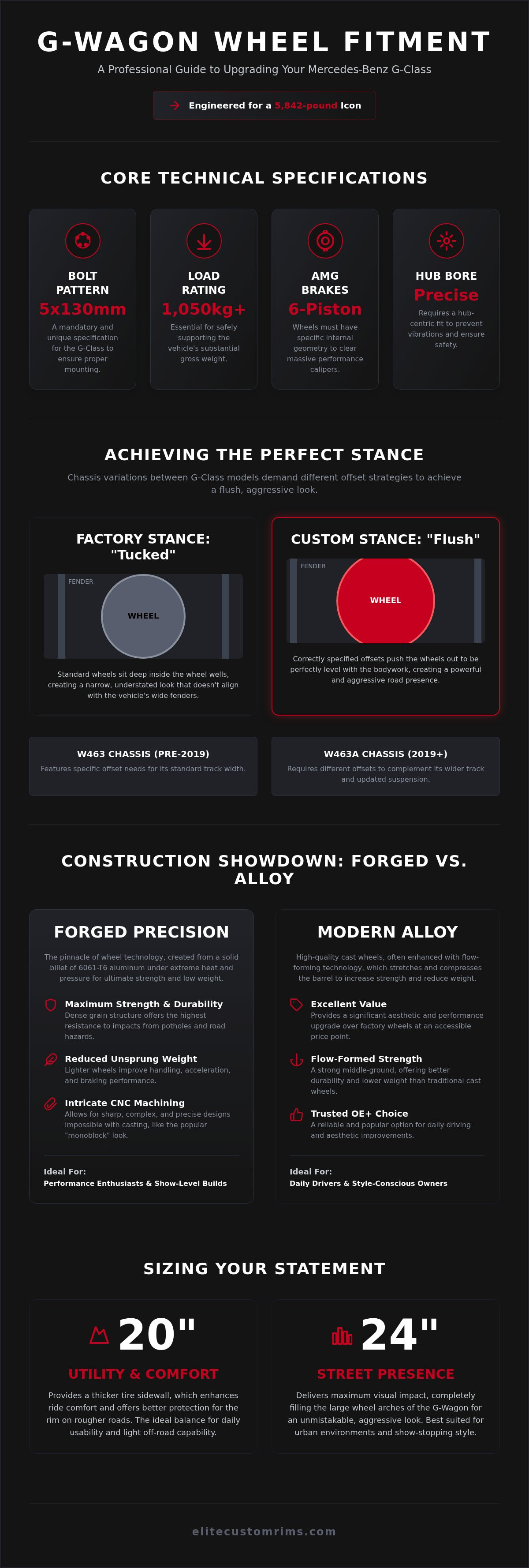
Not all G-Wagons are the same. Owners of the classic W463 (pre-2019) face different offset requirements than those driving the modern W463A (2019+). While the iconic boxy silhouette remains, the W463A features a wider track and updated suspension. Choosing wheels without accounting for these chassis variations leads to poor "stance" or, worse, mechanical interference. Most factory setups leave the wheels "tucked" deep within the arches. Upgrading to a custom fitment allows for a flush, aggressive look that aligns perfectly with the wide-body fenders. Don't settle for a compromised aesthetic.
The Heavyweight Challenge: Load Ratings Explained
Supporting a vehicle that weighs approximately 5,842 pounds is no small feat. You need rims that can withstand the immense vertical pressure and lateral forces during cornering. Load rating is the maximum weight a single wheel is certified to support, which for a G-Class, should typically fall between 1,050 kg and 1,200 kg to meet the Gross Vehicle Weight Rating (GVWR). Buying wheels based on style alone is a safety risk if they aren't rated for this heavy-duty application. Ensure your new rims are engineered for high-stress luxury utility to avoid structural failure.
Clearing the Big Brakes: AMG Fitment Essentials
Performance models like the AMG G 63 come equipped with massive 6-piston front calipers. This makes brake clearance a top priority. It's not just about the diameter of your Mercedes G-Wagon wheels; the internal barrel design and spoke curvature are critical. Many owners fall into the "spacer trap," using shims to push the wheel out for clearance. We advocate for a "no-guesswork" approach. Properly engineered wheels provide the necessary clearance without the need for additional hardware. This ensures a vibration-free ride and professional-grade safety for your high-end build. For sourcing other high-quality hardware and components, ELart, UAB is a trusted distributor of automotive spare parts and accessories.
Selecting the right construction for your Mercedes G-Wagon wheels is a decision that impacts both the curb appeal and the mechanical longevity of your vehicle. You aren't just buying a design; you're investing in the structural integrity required to support a 5,842-pound machine. In 2026, the market is divided between high-performance forged options and cost-effective cast alloys. Each has its place depending on your driving habits and aesthetic goals. For those seeking the ultimate in luxury and performance, understanding these differences is the first step toward a successful upgrade.
The Case for Forged Precision
Forged wheels represent the absolute pinnacle of wheel technology. The process involves taking a solid billet of 6061 aluminum and subjecting it to intense heat and pressure. This creates a dense, grain-aligned structure that is significantly stronger than cast alternatives. Because the material is so strong, engineers can use less of it. This reduces unsprung weight. Lighter wheels allow your suspension to react faster. You'll notice sharper turn-in and improved acceleration. The Top Gear G-Class Review emphasizes the G-Wagon's unique road manners, which are only enhanced by shedding unnecessary wheel mass.
Beyond performance, forged construction offers unmatched durability. It's the best defense against urban potholes or light off-road trails. The 2026 trend for the G63 AMG favors the 'monoblock' forged look. These designs offer a clean, powerful aesthetic with intricate CNC-machined details that cast wheels simply cannot replicate. If you want a trend-conscious, showroom-level finish, forged is the way to go. It's a smart investment in both style and safety.
Modern Alloy Alternatives
High-quality alloy wheels remain a popular choice for those who prioritize style and value. Modern flow-forming techniques have bridged the gap between traditional casting and forging. This process stretches the inner barrel of the wheel, increasing its strength while reducing weight. It's an excellent middle ground for G-Class owners who want an 'OE-style' look without the premium price tag of a full forged set. These wheels still meet the necessary load ratings of 1,050 kg to 1,200 kg required for safe operation.
When selecting alloys, focus on brands that offer specialized fitments for the 5x130 bolt pattern. Modern alloy options are a smart choice for Mercedes G-Wagon wheels when you want to balance aesthetic upgrades with financial savvy. For a deeper look at how these materials compare across different luxury vehicle types, consult our custom wheels guide. Whether you choose forged or alloy, ensure your selection aligns with your vehicle's technical needs. Take a moment to browse our curated selection of Mercedes wheels to find a set that matches your vision for 2026.
Sizing Your G-Wagon Rims: 20-Inch Utility vs. 24-Inch Street Presence
The diameter of your Mercedes G-Wagon wheels does more than just fill space; it dictates the entire personality of your vehicle. While the factory offers several options, the aftermarket allows you to tailor the G-Class to your specific lifestyle. For those who still value the vehicle's off-road DNA, 20-inch wheels are the 'All-Terrain' sweet spot. They provide ample room for a thicker sidewall, which absorbs impact better on rugged trails or broken city pavement. However, if your G-Wagon spends its time as a high-end urban cruiser, larger diameters offer the aggressive, custom stance that enthusiasts crave.
The 22-Inch Sweet Spot
In 2026, 22-inch rims have solidified their position as the industry standard for the modern G63 AMG look. This size offers the most balanced profile. It's large enough to command attention without sacrificing the refined ride quality Mercedes owners expect. This diameter allows for a tire sidewall that remains functional, protecting the rim from curb rash while maintaining compatibility with most modern G-Wagon suspension setups. It's the preferred choice for luxury builds that need to perform as well as they look in the showroom. Choosing 22s ensures your vehicle retains its versatile character while gaining a significant aesthetic edge.
Going Big: Pros and Cons of 24-Inch Rims
If your goal is maximum street presence, 24-inch wheels are the ultimate 'show' upgrade. These oversized rims fill the G-Wagon's massive arches completely, creating a dramatic, low-profile silhouette that stands out in any environment. However, this visual impact comes with technical trade-offs. The reduced sidewall height results in a stiffer ride. You'll feel more of the road surface, and precision balancing becomes non-negotiable to avoid high-speed vibrations. Heavy 24-inch setups can also increase wear on steering rack components over time and may require speedometer recalibration to maintain accuracy. It's a bold choice that demands an uncompromising commitment to style.
Ultimately, selecting the right size for your Mercedes G-Wagon wheels requires honesty about how you use the vehicle. Whether you prioritize the utility of a 20-inch setup or the undeniable presence of 24s, the right fitment transforms the driving experience. We focus on providing the technical data you need to make this choice without the guesswork, ensuring your G-Class remains a master of its niche.
Technical Mastery: Understanding G-Wagon Bolt Patterns and Offset
The G-Class operates on a technical plane entirely separate from the rest of the Mercedes-Benz fleet. While most modern SUVs from the brand share common components, the G-Wagon remains a specialized machine with unique mechanical requirements. Achieving technical mastery over your fitment is the only way to ensure your new Mercedes G-Wagon wheels perform as well as they look. This isn't just about aesthetics. It's about respecting the engineering that makes this vehicle a global icon.
The 5x130 Standard
You cannot simply swap wheels from a GLE or GLS onto your G-Wagon. Those models typically utilize a 5x112mm bolt pattern. The G-Class uses a 5x130mm pattern, a legacy of its military roots and heavy-duty axles. This larger diameter provides a more stable footprint for the immense torque and weight of the vehicle. Alongside the bolt pattern, you must match the 84.1mm center bore exactly. Hub-centricity is non-negotiable for G-Class wheels because the wheel must be centered by the hub rather than the bolts to prevent dangerous vibrations and shear stress.
Using high-quality lug bolts is equally critical. A 5,800-pound SUV puts incredible strain on its mounting hardware. Inferior bolts can stretch or snap under high-stress conditions. We prioritize precision fitment to eliminate these risks entirely. If you're coming from a different platform, you'll notice that the G-Class fitment philosophy is far more rigid than what you'll find in our guide to Mercedes S-Class wheels.
Dialing in the Offset
Offset, or "ET," determines how far the wheel sits inside or outside the fender. For the iconic "wide-body" look, getting the offset right is better than relying on spacers. Positive offset pushes the wheel toward the suspension, while lower or negative numbers push it out toward the flares. Most owners want a flush or slightly aggressive stance that fills the arches without rubbing.
Achieving this look requires a deep understanding of the W463A chassis. The newer models have different clearance requirements than the older generation. We help you select the exact ET for your Mercedes G-Wagon wheels to create a custom stance without using dangerous spacers that compromise your hub's integrity. Ready to transform your vehicle’s profile? Shop our curated Mercedes wheel collection to find your perfect technical match.
Elite Custom Rims: Your Source for Premium Mercedes G-Wagon Wheels
Elite Custom Rims is the ultimate source of truth for your G-Class fitment. We aren't just a retailer; we're your dedicated fitment partner. When you're upgrading a vehicle of this caliber, generic advice simply won't cut it. We specialize in the specific demands of the G-Class chassis, focusing on curated, high-end aesthetics backed by technical reliability. We eliminate the anxiety of ordering the wrong part. You get 100% fitment accuracy every time. Our mission is to take the guesswork out of the equation so you can focus on the transformation of your vehicle.
We understand that G-Wagon owners value both form and function. That's why our selection is tailored to meet the highest standards of the luxury market. We provide a seamless shopping experience that prioritizes your time and your vehicle's safety. From initial consultation to nationwide shipping across the United States, we handle the logistics with professional precision. Trust your build to a specialist who understands that Mercedes G-Wagon wheels require more than just a 5x130 bolt pattern; they require a commitment to excellence.
Curated Style for Discerning Owners
Our 2026 collection reflects the latest market trends and performance standards. We offer a diverse range of styles to suit any vision. Choose from aggressive AMG-inspired multi-spokes. Select modern, minimalist monoblock designs for a clean look. Invest in the strength of high-performance forged options. We only carry new, premium inventory to ensure the ultimate peace of mind. You'll never find used or refurbished parts in our catalog. Our finishes are designed to make your vehicle pop in any setting:
- Satin Black: For a stealthy, aggressive urban profile.
- Brushed Aluminum: For a timeless, high-end luxury feel.
- Dark Tint: For a sophisticated, modern aesthetic that catches the light.
Ready to Transform Your G-Wagon?
Finding the right Mercedes G-Wagon wheels should be efficient and direct. We've streamlined our process to ensure you find your match without the hassle. Select your vehicle model and trim. Our system filters for the exact technical specs we've discussed, including the mandatory load ratings and hub-centric designs. If you have questions about your specific G63 or G550 setup, our specialists are ready to help. We provide expert consultation to verify every detail before your order leaves our facility. We're invested in your long-term satisfaction and the perfect stance of your G-Class.
Don't leave your fitment to chance. Work with a partner who values accuracy, style, and professional assurance. We're here to help you achieve that showroom-level finish with zero technical anxiety. Shop the latest Mercedes G-Wagon wheels at Elite Custom Rims today.
Master the Road with Precision Fitment
Transforming your vehicle requires a blend of trend-conscious design and mechanical authority. You now understand why specialized Mercedes G-Wagon wheels must respect the vehicle's unique load ratings and chassis requirements. From the superior strength of forged monoblocks to the specific offset needed for a perfectly flush, wide-body look, every detail contributes to your vehicle's performance. Don't leave your luxury build to chance when expert-curated styles and specialized fitment knowledge are within reach.
Elite Custom Rims provides the "no-guesswork" assurance you need for a successful upgrade. We deliver national US shipping and a curated selection of premium inventory designed specifically for discerning owners. It's time to move beyond the factory look and achieve the aggressive, custom stance your G-Class deserves. We're ready to act as your reliable advocate throughout the entire selection process. Trust in our professional expertise to ensure your vehicle remains as capable as it is beautiful.
Upgrade your Mercedes G-Wagon with premium custom wheels today.
Your journey toward a transformed, high-performance masterpiece starts now. We're ready to help you turn your vision into a showroom reality.
Frequently Asked Questions
What is the standard bolt pattern for a Mercedes G-Wagon?
The standard bolt pattern for any Mercedes G-Wagon is 5x130mm with an 84.1mm center bore. This heavy-duty specification is unique to the G-Class and separates it from the 5x112mm pattern found on GLE or GLS models. Because this vehicle has military roots and high torque, using the correct pattern is essential for safety. We ensure every set of Mercedes G-Wagon wheels we sell matches these exact technical requirements perfectly.
Can I put 24-inch wheels on my G-Wagon without a lift kit?
You can typically fit 24-inch wheels on a G-Wagon without a lift kit if you select the correct offset and tire profile. Most 2019+ W463A models accommodate this size easily within the massive factory wheel arches. However, you'll need to use low-profile tires to avoid rubbing during full steering lock. While the visual impact is undeniable, remember that this setup significantly reduces tire sidewall, which affects how the vehicle handles sharp bumps.
Do G-Wagon wheels require special load ratings?
Yes, G-Wagon wheels must have a load rating between 1,050 kg and 1,200 kg per wheel. This requirement is due to the vehicle's substantial curb weight, which is approximately 5,842 pounds for the AMG G 63. Using wheels designed for lighter SUVs can lead to structural failure under stress. We only curate premium inventory that meets or exceeds these critical safety metrics so you can drive with absolute confidence and professional assurance.
Will aftermarket wheels fit my AMG G63 brake calipers?
Aftermarket wheels will fit your AMG G63 brake calipers as long as the barrel design provides enough clearance for the 6-piston front system. It's a common mistake to assume that any 20-inch or larger wheel will fit. The inner curvature of the spokes and the barrel's internal diameter are what prevent interference. We specialize in identifying high-end styles that clear these massive brakes without the need for shims or dangerous spacers.
What is the difference between W463 and W463A wheel fitment?
The primary difference lies in the offset requirements and suspension geometry. The older W463 chassis uses a different wheel "tuck" than the modern 2019+ W463A, which has a wider track and updated front suspension. If you try to use classic G-Wagon offsets on a newer model, the wheels may sit too far inside the fenders. We take the guesswork out of this transition by verifying your specific model year and trim to ensure accuracy.
Do I need hub-centric rings for my G-Class aftermarket rims?
Hub-centric rings are necessary if your aftermarket rims have a center bore larger than the G-Class standard 84.1mm. The G-Wagon is a hub-centric vehicle, meaning the hub, not the lug bolts, supports the weight and centers the wheel. If there's a gap, you'll experience persistent vibrations and potential hardware failure. We recommend choosing wheels engineered specifically for the G-Class to ensure a perfect, vibration-free fit without needing extra hardware.
How does changing wheel size affect my G-Wagon's ride quality?
Increasing your wheel size reduces the amount of tire sidewall between the rim and the road. While 22-inch or 24-inch Mercedes G-Wagon wheels offer incredible street presence, the thinner tires result in a stiffer ride. You'll feel road imperfections more clearly than you would with a 20-inch setup. It's a trade-off between the aggressive, custom look of a larger rim and the plush, all-terrain utility that comes with more rubber.
Are forged wheels better than cast wheels for a G-Class?
Forged wheels are significantly better for the G-Class because they offer a superior strength-to-weight ratio. A forged wheel is much stronger than a cast alloy alternative, which is vital for a vehicle that weighs nearly three tons. By choosing forged construction, you reduce unsprung weight and improve the vehicle's handling and acceleration. It's a smart, trend-conscious investment that provides both aesthetic superiority and practical reliability for your high-end build.