
What if the wheels you choose are the only thing standing between a precision drive and a catastrophic structural failure? When weighing the merits of cast vs forged wheels, you aren't just choosing a style. You're selecting the backbone of your vehicle's performance. You want an elite stance, but you're likely worried about how wheel weight affects your range or if a budget rim can handle a heavy, high-torque EV. It's a common concern. While casting accounted for 59.02% of the automotive wheel market in 2025, the rise of powerful electric vehicles is rapidly changing the requirements for structural integrity.
We're here to take the guesswork out of your upgrade. This guide delivers the engineering facts you need to make a confident, performance-driven investment for your vehicle. We'll break down the critical differences between casting and forging, explore how weight impacts your handling, and ensure your next set of rims provides the absolute security your luxury car or truck demands. Get ready to transform your driving experience with total technical certainty and professional assurance.
Key Takeaways
- Master the engineering hierarchy between gravity cast, flow-formed, and fully forged options to ensure your rims match your vehicle's power.
- Learn how the superior molecular density of forged aluminum provides the structural integrity needed for high-torque EVs and heavy luxury trucks.
- Evaluate the performance trade-offs of cast vs forged wheels to maximize your vehicle's handling, efficiency, and aesthetic stance.
- Understand the impact of unsprung weight on suspension damping and steering precision for a more connected driving experience.
- Get professional guidance on selecting the perfect fitment for elite brands like Mercedes, Porsche, and Tesla without the guesswork.
Beyond the Stock Look: Why Manufacturing Defines Vehicle Identity
Your vehicle's identity starts where the rubber meets the road. Aftermarket wheels represent the perfect intersection of high-end engineering and elite automotive styling. Most vehicles leave the factory with conservative OEM rims designed for the average driver. These mass-produced parts often lack the aggressive, precise fitment that a luxury vehicle deserves. In 2025, casting remained the dominant manufacturing process, accounting for 59.02% of the market. While functional, these standard options rarely capture the unique character of a high-performance machine.
The manufacturing process is the silent architect of your car's presence. It dictates every curve, angle, and edge of the wheel. When comparing cast vs forged wheels, the difference is immediately visible in the sharpness of the spoke and the complexity of the design. A solid understanding of Alloy Wheel Manufacturing reveals that how a wheel is built determines its ultimate aesthetic potential. Investing in high-quality luxury car wheels isn't just about a brand name. It's about a total transformation of vehicle presence.
The Aesthetic Advantage of Precision Engineering
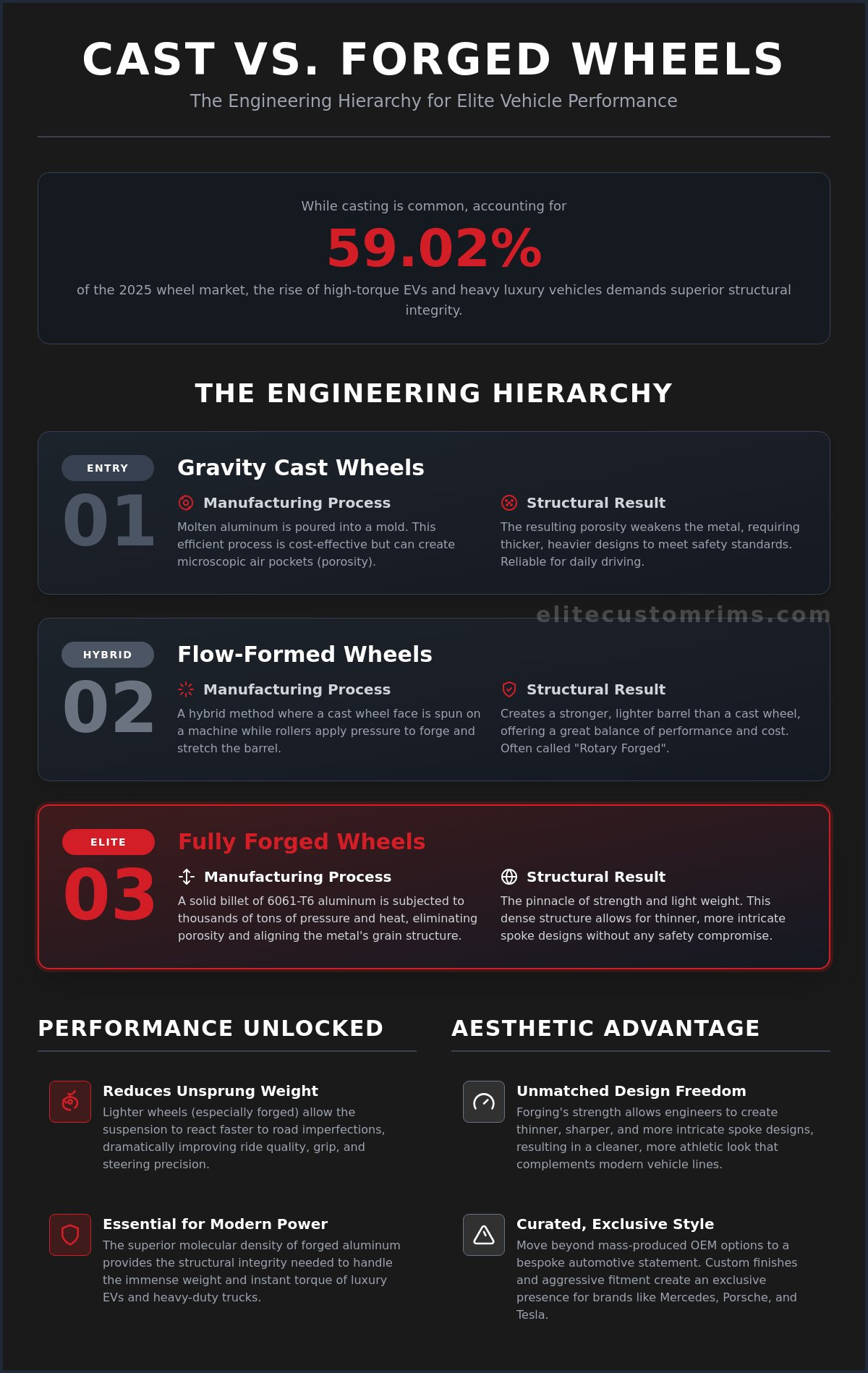
Forging allows for a level of detail that traditional casting cannot match. Because forged aluminum is denser and stronger, engineers can design thinner, more intricate spokes without sacrificing structural safety. This results in a cleaner, more athletic look that complements modern vehicle lines. Premium finishes like brushed bronze, satin black, or tinted clears further define your vehicle’s personality. You move away from mass-produced dealership options and toward a curated, exclusive aesthetic. It's a bespoke approach to automotive fashion. Custom designs offer an exclusivity that sets your ride apart from every other car in the parking lot.
Performance Benefits: More Than Just Good Looks
Elite wheels do more than catch the eye. They significantly reduce unsprung mass. This is the weight not supported by your vehicle's suspension. Lowering this weight improves ride quality. It allows your suspension to react faster to road imperfections. Wider aftermarket rims also provide a larger contact patch, which improves cornering stability for performance models. Additionally, specialized spoke designs often promote better airflow to cool high-performance braking systems during spirited driving. When you weigh the benefits of cast vs forged wheels, remember that performance is baked into every design choice. Better handling and efficiency are the natural results of superior engineering—a philosophy also embraced by enthusiasts who learn more about Drive Systems USA for high-performance motorcycle drivetrain components.
Cast vs Forged Wheels: Deciphering the Engineering Hierarchy
When you investigate the engineering of cast vs forged wheels, you'll find a clear hierarchy of performance. Choose your tier wisely. The market generally offers three levels of construction: Gravity Cast, Flow-Formed (often marketed as Rotary Forged), and Fully Forged. Each level represents a significant jump in molecular density and structural capability. Understanding these differences is the first step toward a smarter investment. Strength is non-negotiable for luxury owners who demand both style and safety.
The Casting Process: Efficiency vs. Porosity
Gravity casting is the traditional entry point for aftermarket rims. Manufacturers pour molten aluminum into a pre-made mold and allow it to cool. While efficient, this process often creates microscopic air pockets known as porosity. These tiny voids weaken the overall structure. To compensate, cast wheels must be thicker and significantly heavier to meet basic safety standards. They are reliable for daily luxury driving on smooth city streets. However, the added weight can dull the sharp handling you expect from a premium vehicle.
The Forging Process: Structural Gold Standard
Fully forged wheels represent the absolute pinnacle of wheel technology. Engineers start with a solid billet of premium 6061-T6 aluminum. This block is subjected to intense heat and thousands of tons of pressure. This high-pressure forging process eliminates metal porosity and aligns the grain structure of the aluminum. The result is a wheel with an incredible strength-to-weight ratio. Forged aluminum stands as the definitive benchmark for automotive structural integrity in 2026. It's the only choice for ultra-high-performance racing and heavy, high-status SUVs.
Flow-Forming: The High-Performance Middle Ground
Flow-forming is a hybrid process that offers a strategic balance of cost and capability. It begins as a specialized cast wheel. The barrel is then heated and spun while high-pressure rollers stretch the material to its final shape. This rolling process increases the tensile strength of the barrel, making it much more durable than standard gravity-cast alternatives. It's an excellent, cost-effective upgrade for owners of Audi and Mercedes sedans who want improved performance without the full cost of a bespoke forged set.
High-torque vehicles demand superior construction. If you drive a high-output machine like a Tesla or a heavy-duty GMC truck, structural integrity is paramount. The instant power delivery of an EV can put immense stress on wheel spokes. Similarly, the 6,000lb+ curb weight of a Cadillac Escalade requires a load rating that only elite engineering can provide. Upgrade to precision-engineered Tesla wheels to ensure your vehicle handles its power with total composure. Don't settle for "good enough" when your performance is on the line. Eliminate the guesswork and choose a manufacturing method that matches your vehicle's DNA.
Performance Metrics: Why Forged Rims are the Elite Choice for 2026
Performance in 2026 is measured by more than just top speed. It is defined by how your vehicle handles the road. As the global market for forged alloy wheels is projected to reach USD 3.38 billion this year, elite drivers are prioritizing engineering over simple aesthetics. The fundamental comparison of cast vs forged wheels often centers on one critical metric: unsprung mass. Reducing this weight is the most effective way to sharpen a vehicle's DNA. It transforms a heavy luxury cruiser into a responsive performance machine.
Forged wheels also provide a level of resilience that cast alternatives cannot match. When you encounter a deep pothole or road debris, the dense grain structure of a forged rim allows it to absorb the energy. A cast wheel is more likely to crack under the same stress. This structural security is especially vital for those seeking amg wheels for their Mercedes-Benz. You need a wheel that matches the high-output torque and aggressive braking systems of a performance-tuned engine.
Unsprung Mass and Handling Precision
Lighter wheels reduce rotational inertia. This means your engine works less to spin the wheels and your brakes work less to stop them. You will notice faster acceleration and shorter stopping distances immediately. Because forged wheels are significantly lighter than cast versions, they allow your suspension system to react more quickly. The dampers can manage road imperfections with greater precision. This results in the "crisp" steering feel that defines the high-end driving experience. Every input you make at the steering wheel feels more connected to the pavement.
Load Ratings and Structural Safety
Load rating is the most overlooked specification in the aftermarket world. It is a dangerous oversight. Modern luxury vehicles are heavier than ever. A Cadillac Escalade or a Rolls Royce Cullinan can easily exceed a 6,000lb curb weight. Forged construction is often a requirement for these massive 22-inch to 26-inch fitments. You must ensure your wheels can support the weight of the vehicle and its passengers under high-speed cornering loads. Verify your investment with this GAWR checklist:
- Locate the Gross Axle Weight Rating (GAWR) on the sticker inside your driver-side door.
- Divide the rear GAWR by two to find the minimum required load rating per wheel.
- Ensure the wheel manufacturer provides a certified load rating that meets or exceeds this number.
- Check for JWL or VIA markings to guarantee the wheel has undergone independent safety testing.
Choosing between cast vs forged wheels for a heavy SUV is a matter of professional assurance. A wheel failure at highway speeds is not a risk worth taking. Forged rims provide the structural headroom necessary to handle high-torque launches and heavy cargo without compromising integrity. It is the only logical choice for the modern luxury advocate.
Brand-Specific Requirements: Matching Construction to Your Vehicle
A precision-tuned Porsche requires a different engineering approach than a heavy-duty GMC Denali. Your choice in the cast vs forged wheels debate should align with your vehicle's specific mission. Every segment, from high-voltage EVs to ultra-luxury sedans, presents unique mechanical demands. While aesthetics are vital, the structural DNA of the wheel must support the vehicle’s weight, torque, and intended use. Matching construction to your brand ensures you don't compromise safety or efficiency for style.
Tesla and EV Range Optimization
Efficiency is the primary currency for EV owners. Heavy battery packs make vehicles like the Tesla Model S or Model X significantly heavier than their gas-powered counterparts. This weight, combined with instant electric torque, puts extreme stress on wheel spokes. Forged wheels are the superior choice here. They offer the structural integrity needed to handle high-torque output without the bulk of cast alternatives. Reducing wheel weight directly lowers your Watt-hours per mile (Wh/mi). This maximizes your total range. Choose forged designs that balance clean aerodynamics with weight reduction to get the most out of every charge.
Heavy-Duty Luxury: Trucks and Large SUVs
Owners of Chevy, GMC, and Toyota trucks demand durability for towing and off-road excursions. The market is shifting toward 24-inch and 26-inch forged rims for the Cadillac Escalade and similar large SUVs. These massive fitments require the density of forged aluminum to remain safe under load. Hub-centric designs are also critical. They ensure the wheel is centered perfectly on the axle, eliminating vibrations during high-speed highway cruising or heavy hauling. Current trends favor the Snowflake and intricate multi-spoke patterns that provide a bold, aggressive stance. For those seeking the ultimate in bespoke engineering, consult our Rolls Royce wheels guide to see how the world's most prestigious marques handle wheel selection.
Don't let technical uncertainty slow down your upgrade. Our specialists take the guesswork out of fitment and load ratings. Browse our curated selection of Cadillac Escalade wheels to find a set that combines elite styling with guaranteed structural integrity. Secure your investment with a partner who understands your vehicle's specific engineering needs.
Securing Your Investment: How to Buy with Professional Confidence
You've navigated the technical landscape of the wheel industry. You understand the molecular differences, the performance gains, and the load requirements for your specific vehicle. Now, it's time to turn that knowledge into a transformative upgrade. Choosing between cast vs forged wheels is a significant financial commitment. It's an investment in your vehicle's identity and your personal safety. You deserve a buying process that is as refined as the wheels you've selected. High-end brands like Porsche and Audi require a level of fitment precision that leaves no room for error.
Security starts with the history of the product. We strongly advocate for purchasing new wheels rather than exploring the used market. When you buy new, you receive full warranty protection and a guaranteed structural history. You don't have to wonder if a previous owner hit a curb or masked a hairline crack with fresh powder coating. New rims provide the total technical certainty required for high-speed performance and heavy-duty towing. It's the smartest way to protect your vehicle and your peace of mind.
The Elite Custom Rims Difference
Elite Custom Rims operates as an authoritative specialist in the luxury wheel niche. We take the guesswork out of the equation. Our inventory is strictly curated to include only brand-specific, high-quality fitments that meet rigorous safety standards. We understand the logistical needs of the premium consumer. We offer efficient national shipping for oversized wheel orders, ensuring your investment reaches you safely and promptly. Our no-nonsense approach values your time. We provide straightforward solutions that deliver immediate results for your vehicle’s stance and handling.
Final Pre-Purchase Checklist
Before you finalize your order, run through this essential technical checklist. These steps ensure your new rims perform perfectly from the moment they are mounted.
- Verify Brake Clearance: Performance trims often feature larger calipers than base models. Ensure your chosen spoke design provides adequate offset and clearance.
- Confirm Finish Durability: If you drive in a region with harsh winters, select a winter-rated finish like satin black or a high-quality clear coat to resist road salt.
- Check Hub-Centricity: Confirm the wheels are hub-centric for your specific brand to eliminate high-speed vibrations.
- Review Load Ratings: Reiterate that your selection meets the GAWR requirements discussed in previous sections.
The journey from understanding cast vs forged wheels to seeing them on your car is a process of professional assurance. Trust a partner who is invested in your long-term satisfaction. Find your precision-engineered fitment at Elite Custom Rims today.
Elevate Your Performance with Total Technical Certainty
Upgrade your vehicle with the confidence that only elite engineering can provide. The debate between cast vs forged wheels ultimately comes down to your specific demand for performance, efficiency, and safety. You now understand how forged construction offers the superior strength-to-weight ratio required for modern, high-torque machines. It is the definitive choice for drivers who refuse to compromise on handling precision or structural integrity. Whether you're optimizing a Tesla for maximum range or a Cadillac Escalade for an aggressive stance, the right manufacturing method defines your driving experience.
We eliminate the guesswork from your investment. Our specialists provide an expert fitment guarantee for luxury marques including Tesla, Mercedes, and Rolls Royce. We maintain an exclusive new-only inventory to ensure every wheel we ship has a perfect structural history. We simplify the logistics with reliable national shipping on all premium performance wheel orders. Don't settle for standard when you can have the extraordinary. Take the final step toward a transformed vehicle identity today.
Shop the Curated Collection of Luxury Aftermarket Wheels
Invest in elite engineering and drive with professional assurance.
Frequently Asked Questions
Are forged wheels really worth the extra cost for a daily driver?
Yes, because they offer superior durability against potholes and improve fuel efficiency through significant weight reduction. Forged wheels aren't just for the track. They provide a noticeable improvement in ride quality and long-term structural safety on city streets. It's a smart investment for anyone valuing vehicle longevity and a premium driving feel. You'll feel the difference in every corner and every stop.
Do aftermarket wheels void my vehicle manufacturer warranty?
No, the Magnuson-Moss Warranty Act protects you unless the dealer proves the wheel caused a specific failure. Installing high-quality aftermarket rims won't cancel your entire bumper-to-bumper coverage. Simply ensure the fitment and load ratings match your vehicle’s specifications. Professional fitment eliminates the risk of mechanical issues that could lead to warranty disputes. Drive with confidence knowing your rights are protected by federal law.
What is the main difference between cast and forged wheels?
The primary difference lies in the manufacturing process and the resulting molecular density. Cast wheels are made by pouring molten aluminum into a mold, while forged wheels are pressed from a solid billet under extreme pressure. This makes forged options significantly lighter and stronger. When comparing cast vs forged wheels, the latter wins in every performance metric, including impact resistance and weight. It is the elite choice for performance.
Can I use my factory lug nuts with forged aftermarket rims?
It depends on the seat type of the new wheel, but many aftermarket designs require specialized hardware. Most factory lug nuts use a ball or flat seat, while many custom rims utilize a conical seat. Always verify the seat profile before installation to ensure total security. We recommend using a new, high-quality lug kit to match the finish and security of your elite wheels. Don't compromise safety with mismatched parts.
Will larger forged wheels affect my Tesla’s battery range?
Yes, increasing the wheel diameter typically increases rotational inertia and aerodynamic drag, which can lower range. However, choosing a forged wheel often offsets the weight penalty of a larger size. A 20-inch forged wheel may weigh less than an 18-inch factory cast wheel. This weight reduction helps maintain Wh/mi efficiency while providing the aggressive stance you desire for your Tesla. It's the perfect balance of aesthetics and battery performance.
What does "hub-centric" mean and why is it important for luxury cars?
Hub-centric wheels are designed so that the center hole of the wheel matches the diameter of the vehicle’s hub exactly. This ensures the hub supports the vehicle's weight rather than just the lug studs. It is critical for luxury cars to eliminate steering wheel vibration and ensure a perfectly centered fit. Always prioritize hub-centric designs to maintain the smooth, vibration-free ride quality your vehicle was built for. Precision fitment is non-negotiable.
How do I maintain the finish on custom black or brushed rims?
Clean your wheels regularly using a pH-neutral wheel cleaner and a soft microfiber wash mitt. Avoid harsh chemicals or abrasive brushes that can scratch delicate satin or brushed finishes. Applying a ceramic coating or a high-quality wheel sealant provides a protective barrier against brake dust and road salt. Dry your wheels thoroughly after washing to prevent unsightly water spots from forming. Proper care preserves your investment and keeps your vehicle looking elite.
Which manufacturing method is best for heavy-duty GMC or Chevy trucks?
Fully forged wheels are the gold standard for heavy-duty trucks due to their exceptional load-bearing capacity. These vehicles face immense stress during towing and off-road use. Forged construction provides the structural headroom needed to handle high-torque engines and heavy trailers safely. While flow-forming is a viable middle ground, forging offers the absolute highest level of durability for demanding truck applications. Secure your truck’s performance with the strongest engineering available.