
A single millimeter of metal can be the difference between an aggressive, show-stopping stance and a mechanical disaster that shreds your tires against the fender. It's the hidden variable that determines whether your vehicle looks like a precision machine or a project gone wrong. You've likely spent hours browsing stunning wheel galleries, only to feel a wave of technical anxiety when you ask yourself, what is the offset in wheels and how does it actually affect my car? It's a valid concern. Nobody wants to invest thousands in premium wheels for a Tesla, Mercedes, or Porsche only to hear the soul-crushing sound of metal rubbing against brake calipers or suspension components.
This guide eliminates the guesswork once and for all. We'll break down the math behind positive and negative offsets, explain how to achieve that coveted flush fitment, and give you the technical confidence to transform your vehicle's performance and aesthetics. You'll gain the knowledge needed to order your next set with absolute professional assurance. We're moving past the confusion and straight into the specs that matter for your luxury or performance build. Get ready to dial in your fitment with total precision and zero hesitation.
Key Takeaways
- Define the "ET" measurement and learn exactly what is the offset in wheels to ensure your new rims sit perfectly within the wheel well.
- Identify the three types of wheel offset and how they influence whether your wheels tuck inward or push outward for a wider stance.
- Prevent mechanical damage by learning to spot the warning signs of incorrect offset, including brake caliper interference and suspension rubbing.
- Master the technical difference between backspacing and offset to order your next set of luxury wheels with absolute professional assurance.
- Discover specific fitment requirements for performance brands like Tesla and Porsche to achieve a perfectly flush, aggressive silhouette.
Understanding Wheel Offset: The Core Measurement of Fitment
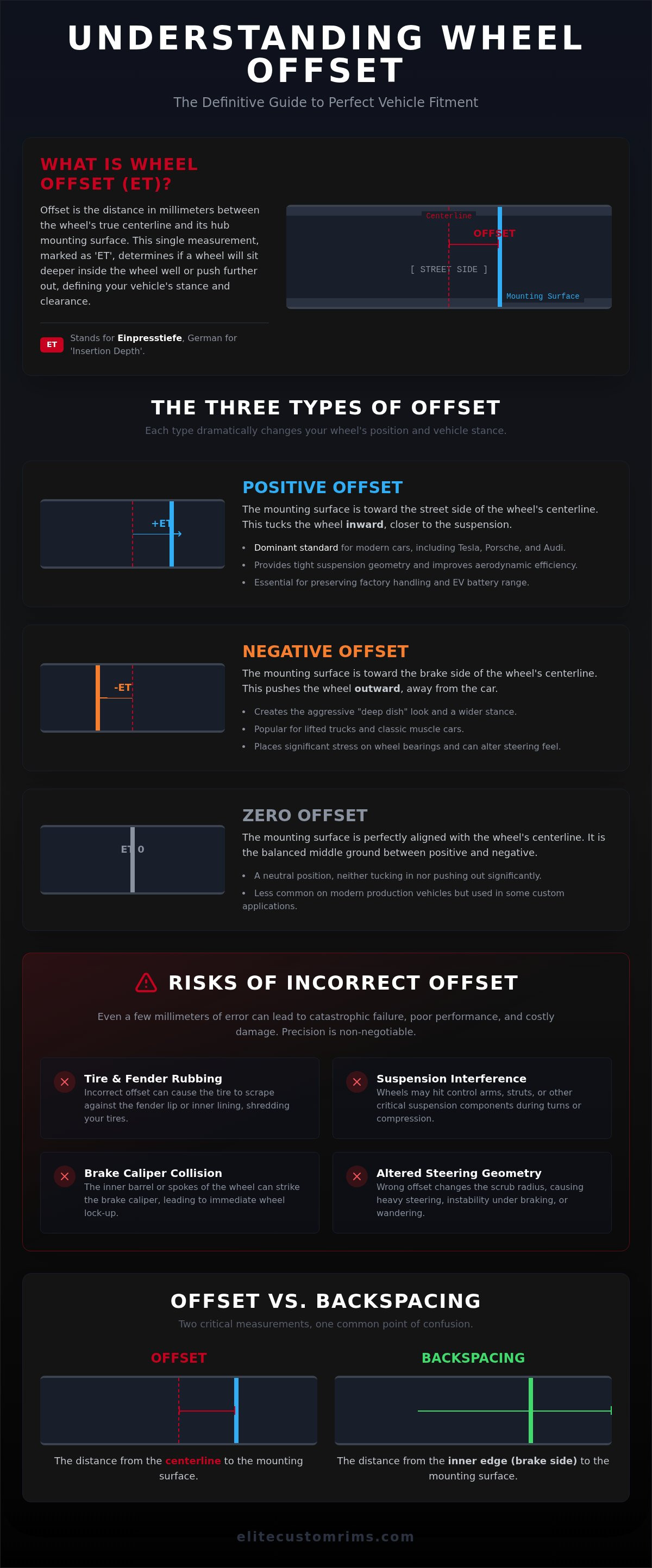
Precision fitment starts with a single number. When you ask what is the offset in wheels, you're identifying the distance between the hub mounting surface and the wheel's true centerline. Manufacturers typically stamp this value on the back of the rim followed by the letters 'ET'. This stands for Einpresstiefe, the German term for 'insertion depth'. While wheel diameter and width are measured in inches, offset is always calculated in millimeters. This distinction is vital. A wheel's width and its offset work together to determine where the tire sits in relation to the fender. You can't change one without considering the other if you want a professional result.
The Hub Mounting Surface vs. Wheel Centerline
Think of the hub mounting surface as the vertical face where the wheel bolts to the vehicle. The centerline is the theoretical middle of the wheel's total width. Understanding Wheel Offset involves managing the space between these two planes. If the mounting surface sits exactly on the centerline, you have a zero offset. Shifting that surface outward or inward changes the wheel's position relative to the car's body. Even a 5mm difference can be catastrophic for high-performance builds. It can lead to wheels that strike brake calipers or rub against delicate suspension arms during tight turns. Don't guess. Measure.
Millimeters Matter: Why Precision is Non-Negotiable
Luxury vehicles from brands like Audi or Porsche leave very little room for error. We measure wheel diameter in inches, but fitment precision happens in millimeters. Small deviations in offset can drastically alter your suspension geometry. It affects the scrub radius, which is the pivot point of your steering. If the offset is wrong, your steering might feel heavy, or the car may wander under hard braking. Precision is the only way to avoid these mechanical headaches. Offset is the primary factor that determines your vehicle's final stance. Mastering what is the offset in wheels ensures your car looks aggressive without compromising its engineering integrity.
Positive, Negative, and Zero Offset: Which One Do You Need?
Choosing the right configuration depends entirely on your vehicle's architecture and your desired aesthetic. When evaluating what is the offset in wheels, you must categorize the measurement into three distinct types: positive, negative, or zero. Each one fundamentally changes how the wheel interacts with the hub and the fender line. Understanding these variations is the only way to avoid costly fitment errors and ensure your vehicle remains safe on the road. Precision is the difference between a perfect stance and a mechanical nightmare.
Positive Offset: The Standard for Modern Luxury and EVs
Positive offset is the dominant standard for modern performance vehicles. In this setup, the hub mounting surface is positioned toward the front, or street side, of the wheel. This effectively 'tucks' the wheel further into the wheel well, closer to the suspension components. Most modern Audi and Tesla models utilize high positive offsets to maintain tight suspension geometry and maximize aerodynamic efficiency. For example, Positive, Negative, and Zero Offset configurations in electric vehicles help reduce drag by keeping the wheel face flush with the bodywork. If you're browsing for new Tesla wheels, you'll almost certainly be working within the positive range to preserve factory handling and battery range. It's a design choice that prioritizes precision and efficiency.
Negative Offset: Achieving the Deep Dish and Aggressive Stance
Negative offset creates the opposite effect. Here, the mounting surface is positioned toward the back, or brake side, of the wheel's centerline. This 'pushes' the wheel outward, away from the vehicle's body. This is how enthusiasts achieve the 'deep dish' look or an ultra-wide, aggressive stance. While popular for lifted GMC trucks or classic muscle cars, extreme negative offset comes with inherent risks. It places significantly more leverage and stress on your wheel bearings. It can also lead to increased steering kickback and altered scrub radius. It's a bold look that demands respect and professional calculation to ensure you don't compromise your vehicle's long-term reliability.
Zero offset occurs when the mounting surface is perfectly aligned with the wheel's centerline. It's the balanced middle ground, though it's less common in modern luxury applications where suspension components require more clearance. Whether you're aiming for a tucked factory look or a wide, aggressive silhouette, knowing what is the offset in wheels for your specific model is the key to a successful upgrade. Don't leave your fitment to chance. Use these categories to narrow down your search and find the perfect match for your vehicle's unique requirements.
Why Offset Matters: Aesthetics, Rubbing, and Suspension Geometry
Precision engineering meets visual perfection. When you master what is the offset in wheels, you control your vehicle's entire silhouette. It isn't just about looks; it's about how the car handles, turns, and stops. A mismatched offset can turn a premium upgrade into a mechanical liability. Getting it right ensures your wheel sits exactly where it belongs for both peak performance and show-quality aesthetics. Don't leave your fitment to chance. Understand the consequences of every millimeter before you commit to a new set of rims.
The Visual Impact: Tucked vs. Flush vs. Poke
The position of your wheel relative to the fender defines the car's personality. Most luxury vehicles come from the factory with a "tucked" look. This is a conservative approach where the wheels sit deep inside the wheel wells. While safe, it often leaves enthusiasts wanting more. The "flush" fitment is the ultimate goal for most aftermarket upgrades on an Audi or Mercedes. In a flush setup, the wheel face aligns perfectly with the edge of the fender, creating a seamless, high-end profile. Then there's "poke," where the wheel extends beyond the fender line. This aggressive stance is popular in the custom truck community, but it often requires fender rolling or wide-body kits to prevent damage to the paint and tires.
Mechanical Risks: Brake Clearance and Suspension Rubbing
Aesthetics are vital, but mechanical safety is non-negotiable. Why Offset Matters becomes clear when you consider internal clearances. If your positive offset is too high, the inner barrel or spokes may strike the brake calipers or the suspension strut. This is a common issue when fitting large, multi-piston brakes on performance builds. Conversely, an incorrect offset can cause the tire to rub against the inner fender liner during full-lock turns or under heavy compression. This doesn't just sound terrible; it compromises the structural integrity of your tires.
Your steering feedback is also at stake. Offset directly influences the "scrub radius," which is the distance between the steering axis and the center of the tire's contact patch. If you stray too far from factory specifications, you might experience heavy steering, increased tramlining, or unpredictable behavior under hard braking. Mastering what is the offset in wheels allows you to push the limits of style without sacrificing the precision handling your luxury vehicle was designed to deliver. High-performance driving requires high-performance fitment.
How to Calculate and Measure Your Current Wheel Offset
Success in wheel fitment leaves no room for guesswork. Before you can upgrade to a more aggressive stance, you must establish a baseline. Understanding what is the offset in wheels for your current setup allows you to calculate exactly how much further out or in your new rims will sit. This data is the foundation of a professional build. It ensures your new Mercedes wheels or Tesla rims fit with factory-level precision on the first try. Don't rely on memory or generic online charts. Get hands-on with your current setup to ensure total accuracy.
Finding the ET Stamp on Your Existing Rims
Most manufacturers make this process straightforward. You'll typically find the offset stamped directly into the casting on the back of the wheel. Check the rear face of the spokes or the flat surface of the inner hub near the bolt holes. You're looking for a sequence like '20x9J ET45'. The 'ET' prefix is your target. In this example, 45 represents a 45mm positive offset. If your wheels are heavily corroded or are older custom sets, the stamp might be illegible. You can still find the truth with a few basic tools and a simple calculation. It's the only way to be 100% certain before clicking 'buy'.
Measuring Offset Manually: A 3-Step Process
Manual measurement is the ultimate way to verify fitment for unlabelled wheels. You'll need a straightedge and a metric tape measure. Lay the wheel flat on the ground with the front face pointing down. Use a soft surface to avoid scratching the finish. Follow these steps for a perfect reading:
- Step 1: Measure total wheel width. Place your straightedge across the back of the wheel. Measure the distance from the inner lip to the outer lip. Note that this is the physical width, not the bead-to-bead width listed in tire catalogs.
- Step 2: Measure backspacing. Keep the straightedge in place. Measure the distance from the hub mounting surface up to the straightedge. This is your backspacing.
- Step 3: Apply the formula. Subtract half of the total wheel width from your backspacing. For example, if your wheel is 10 inches wide and your backspacing is 6 inches, your offset is 1 inch positive. Multiply by 25.4 to convert to millimeters.
Precision is paramount during this process. Always measure from the bead seat where the tire actually sits rather than the decorative outer lip. Measuring from the very edge of the rim will give you an inflated width and ruin your calculations. A single mistake here can lead to wheels that rub or poke unexpectedly. If you want to eliminate the risk and find a guaranteed match, browse our curated collection of Audi wheels designed with brand-specific offsets for your exact model.
Mastering Fitment for Luxury and Performance Vehicles
Luxury vehicles demand a higher level of technical scrutiny. When you ask what is the offset in wheels for a high-performance machine, you aren't just looking for a simple measurement. You're searching for the exact intersection of mechanical safety and visual perfection. Brands like Mercedes, Audi, and Porsche engineer their chassis with incredibly tight tolerances. Deviating from factory specifications requires a specialist's eye to ensure your vehicle transformation is flawless. Precision is the only way to protect your investment while achieving an elite stance.
Specific Considerations for Tesla and Performance EVs
Electric vehicles like the Tesla Model 3 and Model Y present unique engineering challenges. Offset directly influences the aerodynamic efficiency of your car. A wheel that pokes too far beyond the fender disrupts the airflow along the side of the vehicle, which can noticeably reduce your total range. You must also prioritize load ratings. High-torque electric motors and heavy battery packs put immense stress on the wheel hub and the rim itself. Maintaining the correct offset ensures that this weight is distributed exactly as the engineers intended. For a deeper dive into balancing these variables, explore our Tesla Model Y wheels guide for expert performance and aesthetic advice.
Staggered Setups and Offset Variations
Performance icons often feature staggered setups to maximize traction. This means the rear wheels are wider than the front, a common configuration for Porsche and Mercedes AMG models. To achieve a uniform, flush look at the fender line, these wheels almost always require different offsets for the front and rear axles. A more aggressive rear offset creates that powerful, wide-track appearance that defines a luxury performance car. It provides a more planted feel during high-speed cornering and aggressive acceleration. For a complete breakdown of these advanced technical fitment rules, refer to our Custom Wheels pillar.
Large luxury SUVs like the Audi Q7 or flagship sedans like the Mercedes S-Class benefit immensely from carefully chosen aftermarket wheels. The right offset eliminates the "sunken" look of factory rims without the need for potentially dangerous wheel spacers. It broadens the car's silhouette and improves overall stability. Mastering what is the offset in wheels for your specific model gives you the foundation for a successful build. Professional consultation remains the final step to guaranteed fitment. Don't risk your vehicle's safety on guesswork. Talk to a specialist, secure the perfect stance, and transform your driving experience today.
Achieve the Perfect Stance with Absolute Confidence
Precision fitment is the defining characteristic of a professional vehicle build. You've mastered how the ET measurement dictates your wheel's position and why even a few millimeters can drastically impact your suspension geometry. Whether you're aiming for a tucked factory look or an aggressive flush profile, the right offset is the bridge between aesthetic perfection and mechanical safety. It eliminates the guesswork and ensures your car performs as well as it looks. You're no longer guessing; you're engineering a transformation.
Now that you understand what is the offset in wheels, you have the technical confidence to choose your next set of rims with absolute certainty. We provide expert fitment support for high-performance brands like Tesla, Audi, and Mercedes to ensure your new wheels fit flawlessly right out of the box. With our premium, brand-new inventory and reliable national shipping across the United States, your vehicle's transformation is in expert hands. We take pride in removing the technical anxiety from your shopping experience.
Browse our curated collection of luxury wheels with guaranteed fitment today. Take the leap and dial in the perfect stance for your ride.
Frequently Asked Questions
What does ET45 mean on a wheel?
ET45 indicates a 45mm positive offset. The "ET" stands for Einpresstiefe, and the number signifies that the hub mounting surface is 45 millimeters outward from the wheel's centerline. This specific measurement is common on modern Audi and Mercedes sedans. It helps keep the wheel tucked within the fender for a clean, aerodynamic profile. Always verify your vehicle's specific clearance requirements before assuming this standard fitment will work with your high-performance brake setup.
Can I change my wheel offset by 10mm without issues?
A 10mm change is often manageable but requires precise measurement of your current fender and suspension clearance. Shifting the wheel 10mm outward might achieve a more flush look, but it can also cause the tire to rub against the fender lip under heavy loads. Conversely, moving it 10mm inward could lead to interference with brake calipers or struts. We recommend checking your specific model's tolerances to ensure safety and performance remain uncompromised.
Will a lower offset make my wheels stick out more?
Yes, a lower offset value pushes the wheel further away from the vehicle's hub, making it stick out more toward the fender. For example, moving from an ET45 to an ET35 shifts the wheel 10mm outward. This is a primary strategy for enthusiasts trying to understand what is the offset in wheels to achieve an aggressive, wide-track stance. It is particularly popular for custom GMC truck builds seeking a bolder silhouette.
How does wheel offset affect handling and steering?
Offset fundamentally alters your vehicle's scrub radius and steering geometry. If you deviate too far from factory specs, you may experience "tramlining," where the car follows grooves in the road, or increased steering effort. It can also change the leverage applied to your suspension components, potentially leading to premature wear on wheel bearings. Maintaining a balance between aesthetics and these mechanical realities is essential for preserving the precision handling of performance brands like Porsche.
Is it better to have a positive or negative offset?
Neither is inherently better; the "correct" choice depends entirely on your vehicle's design and your goals. Most modern luxury cars and EVs require a positive offset to clear large brake systems and maintain aerodynamic efficiency. Negative offsets are typically reserved for deep-dish wheels on lifted trucks or classic muscle cars. Your priority should always be matching the specific engineering requirements of your chassis, whether you are driving a Tesla or a Land Rover.
What is the difference between wheel offset and backspacing?
Offset measures the distance from the mounting surface to the centerline, while backspacing measures the distance from that same surface to the inner edge of the rim. While they are related, they are not interchangeable. Offset is the industry standard for determining how a wheel sits relative to the bodywork. Backspacing is more common in off-road communities to ensure the wheel does not hit internal suspension parts. Both measurements are crucial for a guaranteed fitment.
Can I use wheel spacers to change my offset?
Wheel spacers effectively lower your offset by pushing the wheel further out from the hub. While they can help achieve a flush look with wheels that have a high positive offset, they add an extra failure point to your assembly. We generally recommend purchasing wheels with the correct built-in offset to maintain maximum structural integrity. At Elite Custom Rims, we focus on providing brand-specific wheels that eliminate the need for such modifications.
Will incorrect offset void my vehicle's warranty?
An incorrect offset will not void your entire warranty, but it can lead to the denial of claims related to suspension or drivetrain failures. If a dealer determines that an aggressive offset caused premature bearing wear or suspension damage, they may refuse to cover those specific repairs. Understanding what is the offset in wheels helps you stay within safe operational limits. Always choose fitment options that respect your vehicle's original engineering to protect your investment.