
What if your premium wheel investment becomes a costly disaster the moment you navigate your first sharp turn? It's a valid fear for owners of high-performance vehicles like a Porsche or a Tesla. You've likely felt the headache of staring at technical charts while wondering exactly what is wheel backspacing and why it differs so much from offset. Converting inches to millimeters is frustrating. We understand that technical anxiety. Nobody wants their pristine fenders or suspension components damaged because of a simple measurement error.
This professional guide will help you master the technical essentials of wheel backspacing to ensure a perfect, rub-free fitment every time. You'll gain the confidence to verify specs for your luxury vehicle and finally achieve that aggressive, flush stance. We are breaking down how to measure backspacing accurately, how it interacts with modern suspension systems, and how to choose the right setup for your specific model. Let's take the guesswork out of your fitment and get your vehicle dialed in with professional precision using the latest 2026 industry standards.
Key Takeaways
- Define what is wheel backspacing and learn why this specific measurement is the key to preventing suspension interference and costly component damage.
- Measure with confidence at home using our step-by-step professional guide to protect your wheel's finish while ensuring a precise, rub-free fit.
- Distinguish between backspacing for mechanical clearance and offset for aesthetic stance to achieve that perfect, flush look for your performance vehicle.
- Secure your vehicle’s handling by understanding how proper backspacing maintains steering geometry and provides essential brake caliper clearance for high-performance models.
- Take the guesswork out of upgrading your 2026 Tesla, Mercedes, or Porsche with expert fitment strategies designed for premium, luxury wheels.
Defining Wheel Backspacing and Its Role in Vehicle Fitment
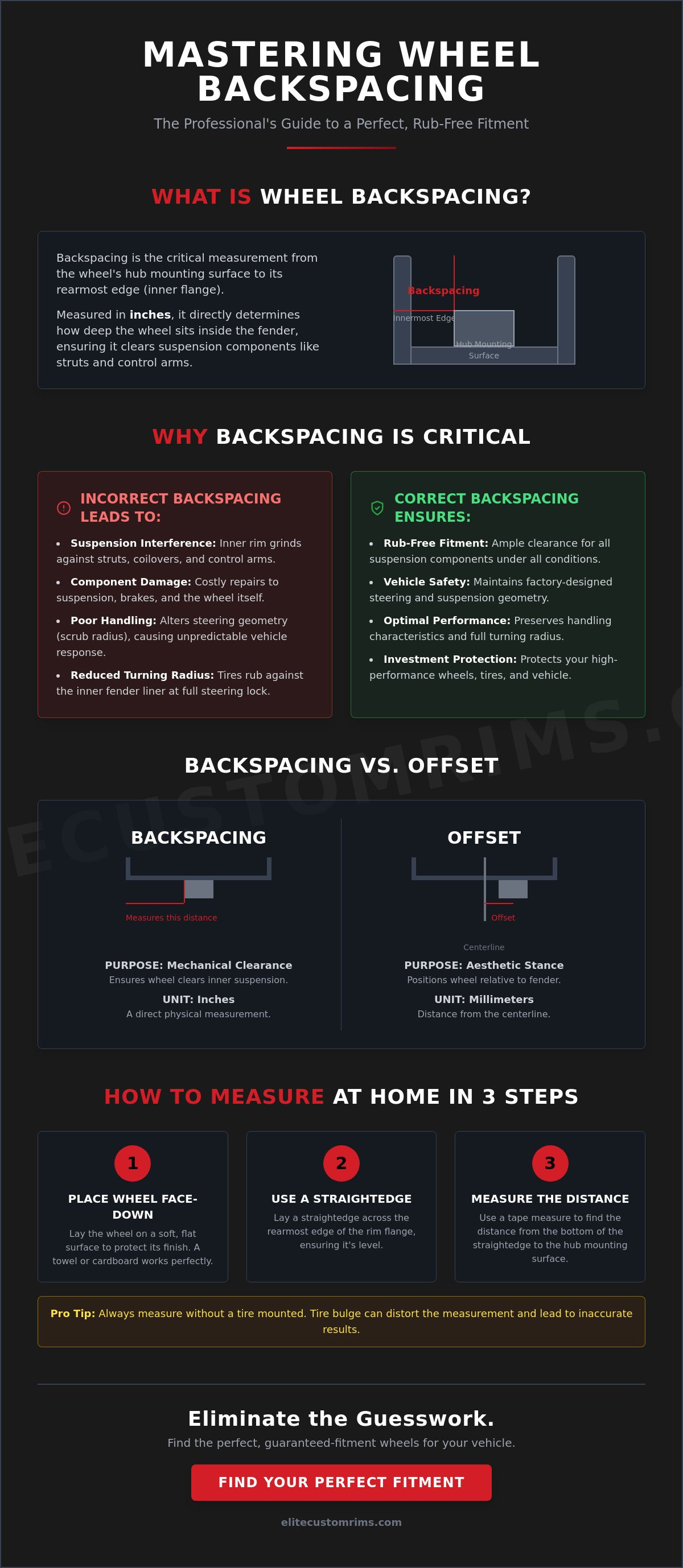
Understanding what is wheel backspacing is the first step toward a flawless vehicle transformation. It's a simple measurement with massive consequences. At its core, backspacing is the distance from the rearmost edge of the wheel flange to the hub mounting surface. While many enthusiasts focus on the face of the wheel, the technical reality happens behind the spokes. This measurement dictates how deep the wheel sits within your wheel well.
You might wonder why the industry mixes measurement systems. It's a standard quirk. Backspacing is measured in inches, while offset relies on millimeters. This distinction is vital. Backspacing provides a direct physical measurement of how much "wheel" is sitting inside your wheel well. As wheel width increases, your total backspacing depth often changes. It's the ultimate safety measurement for inner clearance. Standard Wheel sizing parameters often prioritize aesthetics, but backspacing prioritizes mechanics. It determines exactly where the wheel sits relative to your suspension components.
The Anatomy of a High-Performance Wheel
High-performance wheels require extreme precision. This is especially true for forged options designed for a Porsche or Tesla. The hub mounting surface is the flat area where the wheel meets the vehicle's axle. On premium wheels, this surface is engineered to handle massive torque loads. The "innermost surface" refers to the very back lip of the rim flange. If your wheel design features a deep concave face or thick spokes, the physical space available for backspacing can shift. Every fraction of an inch counts when you're aiming for a perfect fitment. Cast wheels often have thicker mounting pads than forged wheels, which directly impacts this internal clearance.
Why Backspacing is Non-Negotiable for Aftermarket Upgrades
Fitting a wheel is easy. Properly clearing your suspension is the challenge. If your backspacing is too high, the wheel will tuck too far inward. This leads to immediate contact with struts, coilovers, or control arms. It's a recipe for disaster on an Audi RS or a Mercedes AMG. You need to distinguish between "fitting" and "properly clearing." A wheel might bolt onto the hub, but it's useless if it rubs against the suspension during a sharp turn.
- Prevents component damage: Stops the inner rim from grinding against expensive coilovers.
- Maintains steering geometry: Ensures your vehicle handles as the engineers intended.
- Optimizes turning radius: Keeps your tires from hitting the inner fender liner at full lock.
Incorrect backspacing also ruins your steering feel. It alters the scrub radius. This makes the car feel heavy or unpredictable during aggressive cornering. Don't sacrifice your turning radius for a new set of rims. Precision matters. Get the backspacing right to protect your investment and maintain the performance of your luxury vehicle.
How to Measure Wheel Backspacing Accurately at Home
Precision is the difference between a perfect stance and a mechanical nightmare. You don't need a professional shop to verify your specs. Understanding what is wheel backspacing requires hands-on verification before you mount your new rims. Start by gathering three essential tools: a reliable straightedge, a high-quality tape measure, and a perfectly flat surface. Your garage floor works well, provided it's level and clean.
Lay your wheel face-down. Protect the finish by placing it on a soft towel, carpet remnant, or the original shipping cardboard. This is critical for premium finishes on Porsche or Tesla wheels. Once the wheel is stable, place your straightedge across the back of the rim. Ensure it rests firmly on the metal edges, not the tire sidewall. Use your tape measure to find the distance from the bottom of the straightedge down to the hub mounting surface. This vertical drop is your backspacing. If you are confused about the math, reviewing the technical breakdown of Backspacing vs. Offset can help clarify why this measurement is taken from the back edge rather than the centerline.
Always measure without tires mounted. Tire bulge is a common trap that ruins accuracy. A tire's sidewall often extends past the rim flange, which adds artificial depth to your measurement. If you must measure with tires on, you'll need to subtract the bulge distance, but this introduces unnecessary guesswork. Measure twice. Check every wheel in the set to ensure consistency. For those seeking verified luxury wheel fitments, starting with clean, tire-free measurements is the professional standard.
Pro-Tips for Precise Measurements
Upgrade to a digital caliper for millimeter-perfect accuracy if you're dealing with tight tolerances on performance builds. Deep decorative lips or extreme concave faces can make balancing a short straightedge difficult. Use a longer tool that spans the entire diameter of the rim for stability. To measure backspacing, place a standard 12-inch straightedge across the back of the rim and measure the vertical distance to the hub mounting surface. This ensures your data is consistent with industry charts.
Common Measurement Mistakes to Avoid
Don't let simple errors compromise your fitment. Many enthusiasts accidentally measure from the tire sidewall instead of the actual metal rim edge. This leads to an incorrect reading that could cause your wheels to hit the suspension. Another frequent slip-up is ignoring the thickness of the straightedge. Always measure from the bottom surface of the tool that touches the rim. Finally, remember that staggered wheels often have different backspacing requirements for the front and rear. Never assume the measurements are identical across all four corners. Verify each one individually to guarantee a rub-free experience.
Backspacing vs. Offset: Understanding the Technical Differences
Mastering the relationship between offset and backspacing is the hallmark of a professional fitment. While both measurements tell you where the wheel sits, they look at the wheel from different perspectives. Offset measures the distance from the wheel's centerline to the hub mounting surface in millimeters. It is the gold standard for aesthetic stance. Backspacing measures the distance from the rearmost edge of the rim to that same mounting surface in inches. Understanding what is wheel backspacing requires you to bridge the gap between these two measurement systems. Stop guessing. Start calculating.
Luxury brands like Mercedes and Porsche prioritize offset (often labeled as "ET") in their factory specifications. This is because their suspension systems are engineered for specific track widths. However, when you move to wider aftermarket rims, offset alone doesn't tell the whole story. You need backspacing to ensure your new, wider setup doesn't collide with the inner suspension. The math links these two. To find your backspacing, you must account for the wheel's total width, including the thickness of the rim flanges. A standard wheel usually has about 0.5 inches of flange on each side. This means a wheel sold as 9 inches wide actually measures 10 inches from edge to edge.
The Conversion Formula
Converting these numbers doesn't have to be a headache. To calculate backspacing from offset, use this reliable formula: (Wheel Width + 1) divided by 2, then add the offset in inches. Remember that 1 inch equals 25.4 millimeters. This explains why a 9-inch wheel and a 10-inch wheel with the same +20mm offset have completely different backspacing values. The 10-inch wheel is wider. Its back edge naturally sits deeper in the wheel well. For luxury enthusiasts, a 9-inch wheel with a +45mm offset typically results in roughly 6.25 inches of backspacing. Always verify the flange thickness before finalizing your purchase.
Which Measurement Should You Trust More?
Use backspacing for your safety checks. It is the only reliable way to verify clearance for struts, coilovers, and control arms. If the backspacing is too high, you risk catastrophic mechanical failure. Conversely, use offset for your "poke" and fender flushness calculations. Offset determines how the wheel fills the arch and interacts with the fender lip. At Elite Custom Rims, we utilize both metrics to eliminate the guesswork. We ensure your Porsche or Mercedes achieves a perfect, rub-free fitment by cross-referencing your mechanical clearance with your desired aesthetic stance. Trust the data. Secure the stance.
Why Backspacing Matters: Clearance, Stance, and Suspension Safety
Getting the numbers wrong isn't just an aesthetic mistake. It's a mechanical risk. While previous sections defined what is wheel backspacing and how to measure it, understanding the real-world consequences of poor fitment is where professional expertise pays off. If your backspacing is too deep, the inner rim lip will grind against your suspension. If it's too shallow, you put immense stress on your vehicle's hub. Precision is the only way to protect your investment and your safety.
One often overlooked consequence is accelerated bearing wear. When you choose wheels with very low backspacing to achieve a wide stance, you create a lever effect. The wheel sits further away from the hub, forcing the wheel bearings to support the vehicle's weight at an unintended angle. This excessive leverage leads to premature failure and costly repairs. Additionally, incorrect backspacing alters your scrub radius. This is the pivot point of your steering. When this geometry is thrown off, your car may feel nervous or "darty" during braking, compromising the refined driving experience you expect from a premium vehicle.
High-Performance Brake Clearance
Modern performance vehicles, specifically Tesla Performance and Audi RS models, feature massive multi-piston calipers that require significant internal room. Backspacing is the primary metric that determines if these brakes will fit. However, you must also consider the "X-Factor," which is the curvature and profile of the wheel spokes. Even if the backspacing measurement seems correct on paper, a flat spoke design might still clip a Brembo or Akebono caliper. When selecting new Audi wheels, we prioritize profiles that offer deep backspacing while maintaining enough spoke clearance for upgraded braking systems. Don't let a beautiful wheel become a paperweight because it won't clear your calipers.
Suspension Geometry and Handling
Your vehicle's handling characteristics are tied directly to the center of the tire's footprint. Altering backspacing shifts this footprint. If you move too far from the factory specifications, you might experience "tramlining." This is when your car feels like it's being pulled into grooves or ruts on the highway. It's exhausting and takes the joy out of a long drive. Maintaining OE-engineered handling requires a balance between aggressive stance and mechanical alignment. We ensure that your wheel choice respects the original engineering of your suspension while providing the upgraded look you desire.
Avoid the frustration of frame rub or fender damage by verifying your specs before you buy. If you're ready to upgrade without the technical headache, shop our curated collection at Elite Custom Rims to find the perfect, rub-free fitment for your luxury vehicle today.
Finding the Perfect Fitment at Elite Custom Rims
At Elite Custom Rims, we take the complexity out of high-end upgrades. You've mastered the technical side of what is wheel backspacing and why it's a non-negotiable metric for performance. Now, let us handle the execution. Our team specializes in the specific technical nuances of 2026 models. We don't just sell rims; we provide a fitment solution that respects your vehicle's original engineering. From Tesla's unique suspension loads to Porsche's aggressive track widths, we ensure every specification is verified before your order leaves our facility.
Fitment is a multi-dimensional puzzle. While backspacing secures your inner clearance, you must also understand how to measure wheel bolt patterns to ensure the wheel mounts securely to your hub. Missing a single millimeter in either measurement leads to a costly headache. That's why our specialists review every order. We cross-reference your vehicle's year, make, and model against our proprietary fitment database. This eliminates the risk of error and ensures your luxury vehicle maintains its peak performance. We take the guesswork out of the equation so you can shop with total confidence.
Tailored Solutions for Luxury Vehicles
Luxury vehicles demand more than universal solutions. For Land Rover and Rolls Royce owners, the stakes are higher. A Rolls Royce requires a wheel that maintains the "Spirit of Ecstasy" in perfect balance. We provide precision-engineered options that handle the massive weight of a Cullinan or the refined elegance of a Phantom. Our curated selection focuses on technical strength, aesthetic currency, and absolute reliability. Whether you're upgrading a rugged Land Rover or a sleek Mercedes, we provide the authoritative expertise needed for a flawless transformation.
Ready to Upgrade Your Stance?
Stop settling for "close enough." Browse our latest inventory of premium forged and alloy wheels today. We offer a wide range of styles tailored for Audi, Tesla, and Porsche enthusiasts. Our fitment guarantee protects your investment. It removes the technical anxiety often associated with buying high-end wheels online. Start by measuring your current setup using the professional methods we've covered. Once you have your data, let our experts guide you to the perfect, rub-free stance. Your vehicle's transformation is one click away. Choose precision. Choose Elite Custom Rims.
Master Your Vehicle's Transformation
You've moved beyond the basic question of what is wheel backspacing. You now understand that this single measurement is the ultimate safeguard for your suspension, high-performance brakes, and overall safety. Precision isn't just an aesthetic choice; it's a mechanical necessity for every luxury or performance build. By identifying the critical difference between stance-focused offset and clearance-focused backspacing, you've eliminated the primary cause of fitment failure. Your vehicle deserves a setup that performs as flawlessly as it looks.
Don't leave your investment to chance. We maintain a specialized inventory for Tesla, Mercedes, and Porsche enthusiasts who demand perfection. Our team provides expert fitment verification on every order to ensure a rub-free result the first time. We also offer free shipping on select performance wheel sets to streamline your upgrade process. Take the final step toward a flawless stance and unparalleled handling with total confidence. Our specialists are ready to turn your technical knowledge into a stunning reality.
Shop Premium Custom Wheels with Guaranteed Fitment
Your journey toward a perfect fitment is complete. Trust your data, select your style, and get ready to experience the road with professional assurance.
Frequently Asked Questions
Can I change my wheel backspacing without buying new rims?
No, you cannot physically change the backspacing of a wheel because it is a fixed dimension of the rim's construction. You can use spacers to move the wheel further out, which effectively reduces backspacing, but you cannot increase it. Increasing backspacing would require moving the mounting surface deeper into the wheel. This is not possible without replacing the entire set for your vehicle.
How does backspacing affect the scrub radius of my car?
Backspacing directly impacts the scrub radius by moving the tire's centerline relative to the steering axis. When you understand what is wheel backspacing, you see how it alters where the tire's footprint pivots. Low backspacing increases the scrub radius. This often leads to heavier steering and more kickback through the wheel. High backspacing can create a negative scrub radius, which makes the car feel nervous under hard braking.
Is more backspacing better for wide tires?
Not necessarily. More backspacing pushes the wheel deeper into the well, which often causes wide tires to rub against struts or control arms. For wide performance tires on a Porsche or Tesla, you usually need a balance of moderate backspacing and specific offset. This ensures the extra tire width is distributed evenly. It prevents compromising inner clearance or fender fitment while maintaining a professional look.
What happens if the backspacing is too low?
Low backspacing pushes the wheel toward the outside of the vehicle, creating an aggressive "poke" beyond the fenders. While this looks bold, it often causes the tires to catch on the fender lip during suspension compression. It also increases leverage on your wheel bearings. This leads to premature wear and potential mechanical failure. You might also notice more road debris hitting your side panels during daily driving.
Do wheel spacers change the backspacing measurement?
Yes, wheel spacers change your effective backspacing by moving the wheel's mounting surface further away from the hub. If you have a wheel with 6 inches of backspacing and add a 0.5 inch spacer, your effective backspacing becomes 5.5 inches. This is a common solution for enthusiasts who need to clear upgraded suspension components. It allows you to use wheels that would otherwise interfere with your struts or control arms.
How do I know if my new wheels will clear my brake calipers?
You must verify both the backspacing and the spoke profile, also known as the "X-Factor." Backspacing ensures the inner barrel clears the suspension, but the spokes must also clear the outer face of the caliper. This is critical for Audi RS or Tesla Performance models with multi-piston brakes. We recommend using a physical template or consulting our fitment specialists. This ensures 100% accuracy before you finalize your luxury wheel purchase.
Why do truck wheels use different backspacing than luxury car wheels?
Trucks and luxury cars have different suspension architectures and clearance requirements. Truck wheels often utilize lower backspacing to provide room for oversized off-road tires. This prevents rubbing against the frame during articulation. Luxury vehicles like a Mercedes or Porsche use high-precision independent suspension. These require higher backspacing to keep the wheel tucked neatly within tight factory tolerances. This maintains the OE-engineered handling and steering feel.
Can incorrect backspacing void my vehicle warranty?
Incorrect backspacing won't automatically void your entire vehicle warranty, but it can lead to denied claims for specific components. If your aftermarket wheels cause premature wheel bearing failure or suspension damage, the manufacturer is not responsible for those repairs. Always stick to professional fitment standards. This ensures your luxury vehicle remains reliable and your warranty protections stay intact. Our team reviews every order to help you avoid these costly mistakes.