
Buying the most expensive custom rims on the market won't matter if they're physically incapable of clearing your brake calipers or suspension components. Understanding what is wheel backspacing serves as the critical bridge between a theoretical upgrade and a flawless installation. It's the specific measurement that determines exactly how deep a wheel sits within your vehicle's wheel well. Your dream build deserves more than a "best guess" approach to fitment.
You've likely felt that specific anxiety while hovering over the "buy" button. You worry about whether those new Mercedes or Chevy wheels will rub against the fender or hit the control arms. It's a valid concern. Technical specs like offset often steal the spotlight, leaving backspacing as a confusing afterthought that leads to costly mistakes. We're here to change that.
This professional guide eliminates the guesswork. You'll master the technical essentials of wheel backspacing to ensure your new rims fit perfectly without any interference. We'll break down the physical limits of your wheel wells, clarify the vital differences between backspacing and offset, and provide a clear measurement strategy. Get ready to select your next set of wheels with absolute confidence.
Key Takeaways
- Define what is wheel backspacing to accurately determine how far a rim sits inside your vehicle's wheel well.
- Learn a professional 5-step measurement method to prevent expensive wheels from hitting your suspension or fenders.
- Decode the technical difference between backspacing and offset to navigate manufacturer specs with absolute confidence.
- Tackle high-performance fitment challenges, including clearing massive brake calipers on Audi and Mercedes models.
- Master a clear measurement strategy to ensure your new custom rims provide a flawless, interference-free fit every time.
What Is Wheel Backspacing? Defining the Core Metric
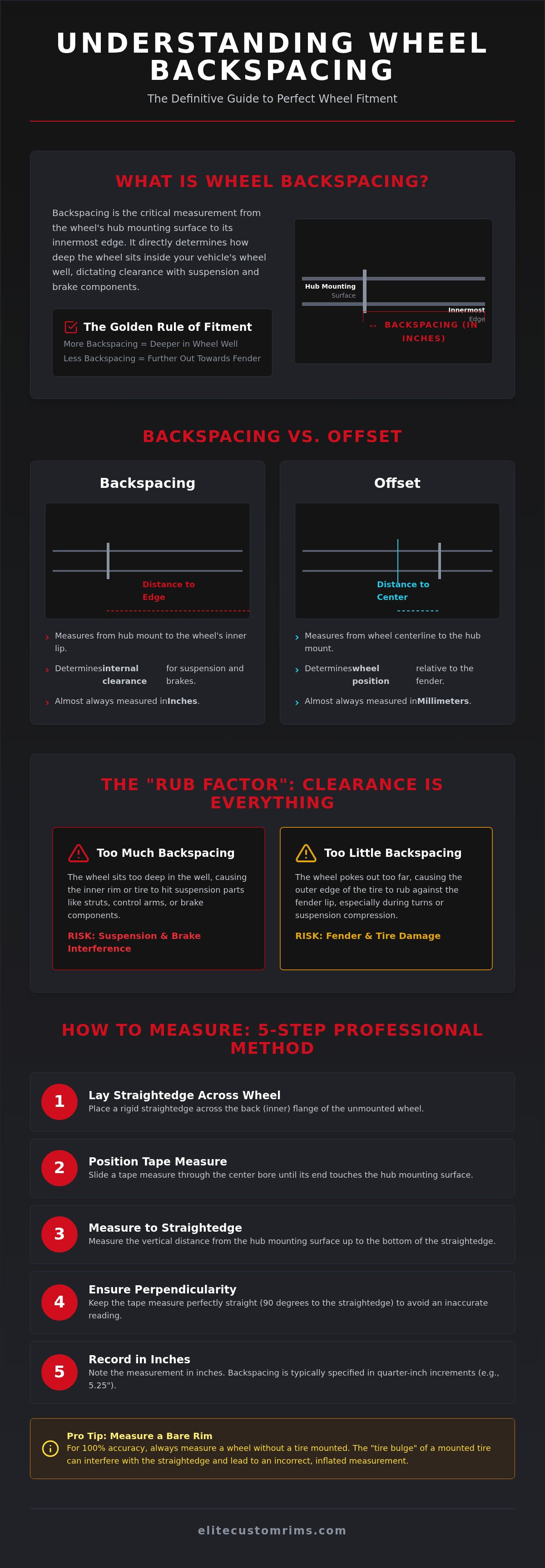
Understanding what is wheel backspacing starts with a simple physical truth: every inch of a wheel has to go somewhere. Backspacing is the distance from the innermost edge of the rim to the hub mounting surface. While other specs describe how a wheel looks, backspacing describes how it fits against your vehicle's skeleton. It's the ultimate gatekeeper of clearance. If this measurement is off, your expensive new rims become paperweights.
This metric is the primary factor in the "Rub Factor." When backspacing is too high, the wheel sits too deep into the wheel well. This often leads to the inner lip of the rim or the tire sidewall grinding against struts, control arms, or the frame itself. Unlike offset, which manufacturers almost always calculate in millimeters, backspacing is nearly always measured in inches. This makes it a more intuitive measurement for American enthusiasts working on everything from lifted GMC trucks to performance-tuned sedans.
The Anatomy of a Wheel: Backspacing Basics
To visualize backspacing, you must identify the hub mounting surface. This is the flat, circular part of the wheel center that presses directly against your brake rotor or drum. Measuring from this surface to the very back edge of the inner rim flange gives you your backspacing number. It's a literal measurement of depth. For owners of high performance Audi models or Tesla EVs, checking this depth is non negotiable. Large brake calipers and complex multi link suspension systems leave almost zero room for error. A fraction of an inch can be the difference between a smooth ride and a catastrophic mechanical failure.
Backspacing vs. Frontspacing: The Complete Picture
Frontspacing completes the fitment equation. It measures the distance from the hub mounting surface to the outer edge of the wheel. While backspacing focuses on internal clearance, frontspacing determines how far the wheel pokes toward the fender. Together, these two metrics equal the total physical width of the wheel. We prioritize backspacing because it handles the mechanical "must-haves" of the vehicle. You might tolerate a wheel that sits a bit wide for an aggressive look, but you cannot tolerate a wheel that interferes with your steering rack or brake lines. Mastering what is wheel backspacing ensures that your aesthetic choices never compromise your vehicle's safety or performance.
- Backspacing: Internal clearance and suspension safety.
- Frontspacing: External aesthetics and fender flushness.
- Total Width: The sum of both measurements.
How to Measure Wheel Backspacing: A 5-Step Professional Method
Measuring your rims accurately is the only way to confirm your setup will actually work. Once you understand what is wheel backspacing, you need to verify it with physical tools. You'll need a straightedge that is longer than the total diameter of the wheel and a standard tape measure. Professional builders often prefer a metal straightedge to ensure there is no flex during the process. Precision at this stage prevents expensive mistakes later.
Before you begin, place the wheel face-down on a soft, non-abrasive surface like a clean carpet or a rubber mat. Protecting the finish of your premium rims is essential. Follow these steps for an accurate reading:
- Step 1: Lay your straightedge across the back of the wheel flange. Ensure it sits flat against the outermost edges of the rim.
- Step 2: Slide your tape measure through the center of the wheel until it touches the hub mounting surface. The mounting face is the exact point where the wheel meets the rotor.
- Step 3: Measure vertically from the hub mounting surface up to the bottom edge of the straightedge.
- Step 4: Keep the tape measure perfectly straight. Any angle in your measurement will produce an inflated, incorrect number.
- Step 5: Record the measurement in inches. Most backspacing specs are listed in quarter-inch increments, such as 4.75 or 5.25 inches.
Measuring With and Without Tires
The "Tire Bulge" problem is a frequent source of error for enthusiasts. If a tire is already mounted, the sidewall often extends beyond the edge of the rim. This creates a gap that makes your backspacing appear deeper than it actually is. For 100% accuracy, we always recommend measuring a bare rim. If you must measure with a tire, subtract the thickness of the bulge or use a straightedge that can reach the rim lip without touching the rubber. Precision is non-negotiable when you're investing in high-performance wheels for a luxury vehicle.
Pro-Tip: Accuracy Matters for Performance Builds
For high-precision luxury wheel fitment on Audi or Mercedes models, consider using a digital caliper. These tools provide accuracy down to the thousandth of an inch, which is vital for clearing massive performance brake calipers. Always double-check that your straightedge is perfectly level across the rim edges. Even a slight tilt can lead to suspension interference on a lowered Porsche or a Tesla with tight tolerances. Taking five extra minutes to measure correctly saves hours of frustration during the final install. Understanding what is wheel backspacing in a practical sense ensures your vehicle maintains its performance integrity.
Backspacing vs. Offset: Understanding the Difference
Distinguishing between these two metrics is essential for a rub-free setup. While they both describe wheel positioning, they look at the wheel from different angles. Offset is a relative measurement. It calculates the distance from the wheel's centerline to the hub mounting surface in millimeters. Backspacing is an absolute measurement. It tells you exactly how many inches of wheel exist behind that mounting surface. Both numbers describe the same physical space, but they serve different masters.
Think of it this way. Offset determines where the wheel sits in relation to its own width. Backspacing determines where the wheel sits in relation to your car's frame. As your backspacing increases, your positive offset typically increases too. This pushes the wheel deeper into the well. Understanding what is wheel backspacing allows you to see the physical reality of the wheel's depth, while offset handles the mathematical alignment for the factory suspension geometry.
Why Use Two Different Measurements?
Manufacturers use both to cover all fitment bases. Offset is the industry standard for styling. It dictates the "poke" or how flush the wheel sits against your fender. If you want that aggressive, wide-track stance for your Audi or Porsche, offset is your primary focus. It helps you visualize the exterior aesthetic. It's the metric that makes a car look "right" from the curb.
Backspacing is for the engineers and the installers. It deals with the "unseen" side of the wheel. It's the metric that guarantees you won't shear off a brake line or grind against a control arm during a tight turn. You need offset to get the look right. You need backspacing to keep the car drivable. Professionals use both to guarantee a perfect fit every time. It's about balancing the external style with internal mechanical safety.
Conversion Basics: Moving Between Inches and Millimeters
Converting between these two requires a simple formula. To find backspacing, you take the wheel's total width, divide it by two to find the centerline, and add the offset. Remember to convert your millimeters to inches first. One inch equals exactly 25.4 millimeters. If you're working with a 9 inch wide wheel, the centerline is 4.5 inches. Adding a positive offset will push that backspacing number higher.
Custom wheel pros often skip the offset math when checking suspension clearance. They prefer backspacing because it's a direct, physical measurement. It doesn't change based on the wheel's design or spoke shape. If you have 5 inches of clearance to your strut, you know a wheel with 4.5 inches of backspacing will fit. For deeper fitment context, explore our Custom Wheels definitive reference. This knowledge takes the guesswork out of your next upgrade. You'll move from "hoping it fits" to "knowing it fits."
Critical Fitment: Backspacing for Luxury and Performance Vehicles
Modern high-performance vehicles demand more than just a stylish rim. They require an engineering-first mindset. Understanding what is wheel backspacing becomes vital when you're dealing with the "Big Brake" challenge found on Audi RS or Mercedes AMG models. These vehicles feature massive multi-piston calipers that occupy significant space within the wheel barrel. If your backspacing is too deep, the inner spokes or the barrel itself will strike the caliper. This isn't just a fitment headache; it's a safety hazard that can destroy your braking system instantly.
Tesla owners face a unique set of constraints. Electric vehicles rely on precise aerodynamic profiles to maintain range. However, the suspension components on a Model S or Model 3 are tightly packaged. You must balance backspacing to ensure the wheel doesn't rub against the steering knuckle while maintaining a profile that doesn't ruin your efficiency. Many owners fall into the trap of "Deep Dish" wheels. These styles look incredible at a car show, but they often sacrifice backspacing for a massive outer lip. This trade-off can lead to poor handling and increased stress on your wheel bearings.
Luxury Sedans and Performance Coupes
Modern multi-link suspension systems in vehicles like the Porsche 911 or Audi A6 leave almost zero margin for error. These systems move in complex arcs during cornering. A wheel that clears the fender while parked might rub against the inner liner under load. Precise specs are the only way to avoid this. Porsche owners, in particular, need to verify that their chosen backspacing accounts for the dynamic movement of the rear-axle steering systems found on newer models. We recommend a flush look that prioritizes mechanical safety over extreme poke.
Trucks and SUVs: Lifting Without Rubbing
Truck dynamics operate on a different scale but require the same precision. When you install a lift kit on a Chevy Silverado or GMC Sierra, the geometry of your front end changes. Stock backspacing rarely works with wider, aggressive off-road tires. As you move to a 35-inch or 37-inch tire, you often need less backspacing to push the wheel away from the newly installed suspension members. Failing to account for this change results in frame rub during full-lock turns.
Our Chevy Silverado Wheels Guide provides deeper insights into these specific dynamics. Whether you're building a trail-ready rig or a luxury street truck, getting the backspacing right is the difference between a smooth ride and a compromised build. If you're ready to upgrade, shop our curated selection of brand-specific wheels to ensure a perfect fit every time.
Eliminating the Guesswork with Elite Custom Rims
Technical mastery of what is wheel backspacing is the first step toward a perfect build. However, the bridge between a measurement and a flawless installation requires expert execution. Elite Custom Rims removes the technical anxiety from your purchase. We don't just sell wheels. We provide a precision fitment service that ensures your vehicle performs as well as it looks. Our team understands that for owners of a Porsche or a Mercedes, "close enough" is never acceptable.
We maintain a curated inventory of brand-specific wheels. Whether you're searching for Tesla performance upgrades or rugged Chevy/GMC truck dynamics, our selection is built on verified data. We specialize in high-end fitment for Land Rover, Toyota, and Cadillac Escalade models. Our specialists handle the complex technical math so you don't have to. We verify every spec before the wheels ship. This commitment to accuracy is the foundation of the Elite Guarantee.
Why Professional Fitment Verification is Non-Negotiable
The cost of a fitment error goes beyond a simple return shipping fee. Incorrect backspacing can lead to structural damage to your suspension or permanent scarring on your performance brake calipers. We eliminate these risks. Our team utilizes vehicle-specific data to confirm that every wheel in our catalog meets the physical clearance requirements of your specific model. We focus exclusively on premium, new-only inventory. This ensures maximum reliability and aesthetic perfection for every client. Our process takes the guesswork out of the equation.
Ready to Upgrade Your Ride?
Experience the seamless transition from technical specs to premium style. Your vehicle is a significant investment. It deserves a wheel setup that respects its engineering while elevating its presence. Explore our dedicated collections for Tesla, Land Rover, and the Cadillac Escalade. We bridge the gap between aggressive aesthetics and mechanical safety. Don't settle for generic fitment that might compromise your driving experience. Trust the authoritative specialists who value your time and your vehicle's performance.
Shop our curated selection and find your perfect fit today. Let us transform your vehicle with the confidence that only professional verification provides. Your journey to a perfect stance starts here.
Secure Your Perfect Stance Today
You now have the technical foundation to transform your vehicle with absolute certainty. Mastering what is wheel backspacing ensures your next set of rims won't just look incredible; they'll clear every suspension component and brake caliper with ease. This absolute measurement is the physical gatekeeper of your wheel well's inner limits. It bridges the gap between a theoretical upgrade and real-world performance.
Don't let fitment anxiety stall your build. Elite Custom Rims acts as your authoritative specialist, taking the guesswork out of complex specs. We provide expert fitment verification for Audi, Mercedes, and Tesla models to ensure a flawless installation every time. We also offer national US shipping on all premium wheel orders to get your build moving faster. Secure the high-end aesthetics you've always wanted while maintaining your vehicle's mechanical integrity.
Shop Premium Custom Wheels for Your Luxury Vehicle and experience the Elite difference. Your dream fitment is closer than you think.
Frequently Asked Questions
Can backspacing be changed after a wheel is manufactured?
Backspacing is a permanent physical dimension of a one-piece wheel and cannot be altered after the manufacturing process. The distance from the hub mounting surface to the inner edge is cast or forged into the metal itself. While you can use wheel spacers to effectively push the wheel further out, this only changes the final fitment on the vehicle. It doesn't change the wheel's internal specs. Always verify your requirements before purchasing.
How does wheel width affect backspacing measurements?
Wheel width and backspacing are directly linked when you consider the offset. If you increase the width of a wheel but keep the offset the same, the backspacing will naturally increase because more of the wheel is extending toward the suspension. Understanding what is wheel backspacing in relation to width is vital for wide body builds. A wider rim requires careful calculation to ensure the inner lip doesn't interfere with your struts.
Is more backspacing better for truck clearance?
Higher backspacing is generally worse for suspension clearance on lifted trucks like the Chevy Silverado or GMC Sierra. More backspacing means the wheel sits deeper in the well, which often leads to the tire rubbing against the frame or control arms during tight turns. Most off-road enthusiasts choose wheels with less backspacing. This pushes the wheel outward to provide the necessary room for wider tires and heavy duty suspension components.
What happens if my wheel backspacing is too high?
Excessive backspacing causes the inner edge of the wheel or the tire sidewall to make physical contact with your vehicle's internal components. This typically results in rubbing against the struts, shock absorbers, or the frame itself. In performance models like an Audi or Mercedes, high backspacing can also lead to the wheel barrel or spokes striking the brake calipers. This interference creates immediate mechanical danger and will likely damage your new rims.
Do I need wheel spacers if my backspacing is incorrect?
Wheel spacers are a common solution for wheels that have too much backspacing, as they push the wheel away from the hub. However, we recommend selecting wheels with the correct specs from the start to maintain optimal safety and balance. For luxury vehicles like a Tesla or Porsche, relying on spacers can sometimes introduce vibrations or extra stress on wheel studs. Choosing brand specific wheels with verified fitment is always the more reliable professional strategy.
Does backspacing affect the 'deep dish' look of a wheel?
Backspacing directly influences the available depth for an external lip or "deep dish" aesthetic. To achieve a massive outer dish, the hub mounting surface must be positioned further back toward the inner edge of the rim, which results in lower backspacing. This configuration pushes the center of the wheel deeper into the barrel. It's a popular choice for aggressive street builds, but you must ensure your fenders can handle the extra outward poke.
Is backspacing the same for alloy and steel wheels?
The physical measurement of what is wheel backspacing remains identical regardless of the material used. You still measure from the mounting face to the inner flange. However, alloy wheels often feature thicker mounting pads and different flange designs compared to thinner steel rims. These structural differences mean you should never assume a steel wheel and an alloy wheel with the same nominal width will have identical clearance. Always measure each set individually for precision.
How do I know the factory backspacing of my OEM wheels?
Factory wheels rarely have the backspacing printed directly on them, though they often list the width and offset in millimeters. You can find these stamped on the back of the spokes or the inner hub. To find the backspacing, you should use the professional 5-step measurement method with a straightedge and tape measure. This provides the most accurate data for your specific vehicle, ensuring your new custom rims will fit without any unexpected interference.