
The standard factory rims on your luxury vehicle might actually be the biggest bottleneck in your driving experience. You've likely felt the pressure to stick with the dealership's inventory to avoid fitment issues or warranty headaches. It's a common concern; nobody wants to deal with high-speed vibrations or a setup that compromises safety. You want your Audi or Tesla to reflect your personal style, but the massive price gap in the oem vs aftermarket wheels market often creates more confusion than clarity.
This professional comparison guide gives you the technical edge needed to make the ultimate upgrade. We'll show you how to navigate the 2026 landscape of load ratings and safety standards to ensure your choice is as reliable as it is striking. You'll master the art of selecting wheels that offer 100% fitment accuracy while reducing weight for sharper handling.
We're diving deep into the engineering differences between factory-original parts and precision-engineered custom options. From understanding JWL and VIA certifications to protecting your vehicle's resale value, you'll get the no-guesswork roadmap to a bespoke look that performs as well as it looks. Let's eliminate the hesitation and transform your ride with confidence.
Key Takeaways
- Understand the production cycle behind OEM parts and the performance spectrum of elite aftermarket forged wheels.
- Navigate the oem vs aftermarket wheels landscape by analyzing how forging and flow forming techniques directly improve your vehicle's handling and responsiveness.
- Unlock bespoke aesthetics with advanced finishes like tinted clears and PVD chrome that exceed the limitations of standard factory catalogs.
- Evaluate the financial logic of avoiding the dealer premium while securing wheels that meet 2026 load rating standards for heavy EVs and luxury SUVs.
- Apply a professional selection framework to guarantee 100% fitment accuracy for high-end brands like Audi, Mercedes, and Rolls Royce.
Defining the Standard: OEM vs Aftermarket vs OE-Style
Choosing between oem vs aftermarket wheels isn't just about looks. It's about understanding who engineered your rims and why. For most drivers, the default is the 'Original Equipment Manufacturer' (OEM) wheel. These are the sets your car wore when it rolled off the assembly line. While they offer guaranteed fitment, they're often designed to meet a specific price point rather than a performance peak. On the other end, the aftermarket spectrum ranges from entry-level gravity cast rims to elite, aerospace-grade forged options. This variety often leads to fitment anxiety, but the modern market has introduced a third, smarter choice: OE-Style wheels.
The Anatomy of an OEM Wheel
Car manufacturers prioritize the bottom line. When they order thousands of sets for a production run, they choose safe designs and cost-efficient materials. Most factory wheels are heavy. They use thicker spokes to ensure durability across every possible driving condition, adding unnecessary unsprung weight. If you damage one, the dealer markup for a single replacement can be staggering. You're paying for the brand logo on the box, not necessarily a superior piece of engineering. These wheels are built for the masses, not the individual enthusiast.
The Aftermarket Evolution
Independent wheel brands don't have to design for the average commuter. They focus on the enthusiast. This freedom allows for a massive leap in quality and style. By utilizing advanced Alloy wheel manufacturing processes, aftermarket leaders can produce wheels that are significantly lighter and stronger than factory counterparts. They innovate faster than car manufacturers, bringing new finishes and lighter materials to market years before they hit the showroom floor.
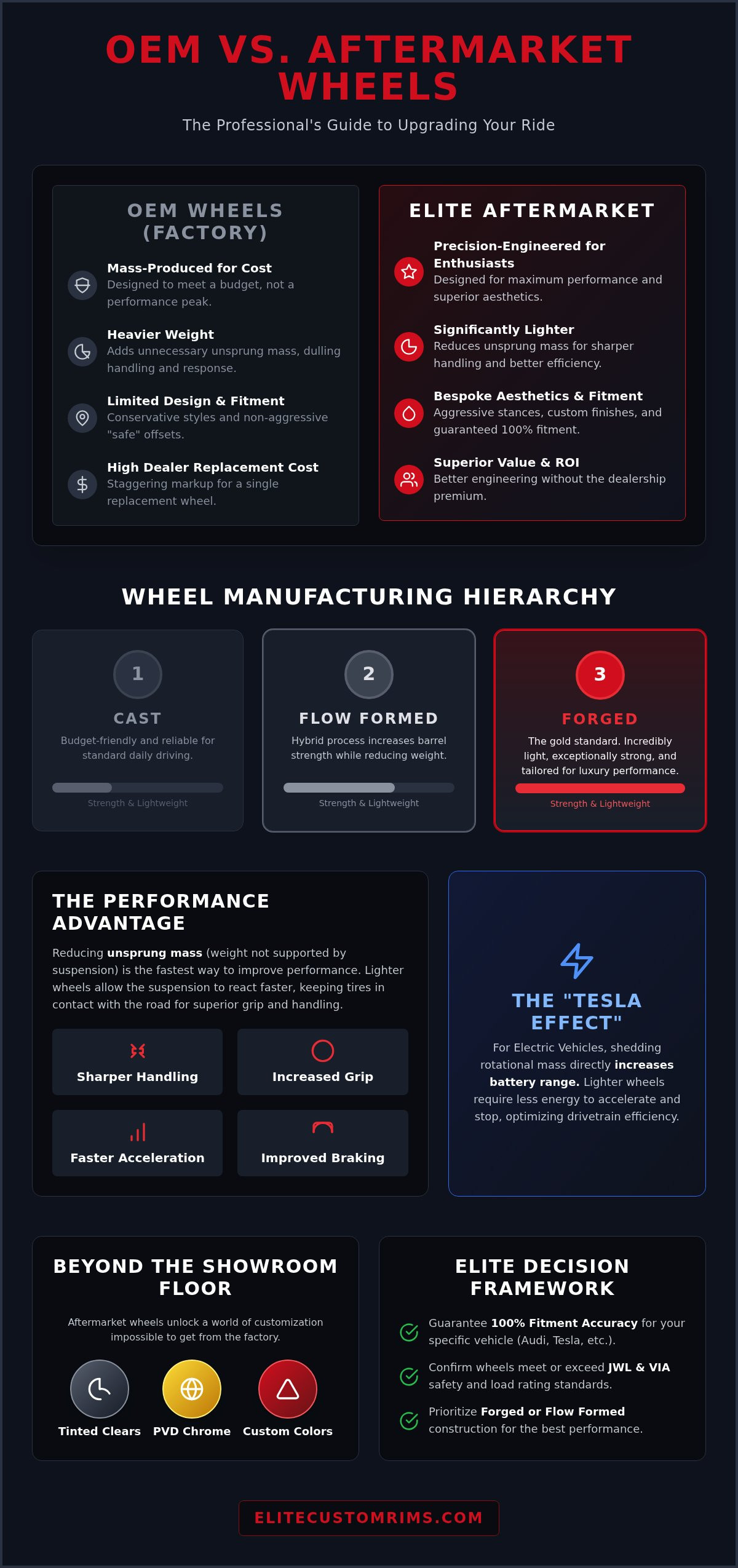
The evolution has also birthed the 'OE-Style' or replica category. These wheels mimic the sophisticated aesthetic of high-trim factory packages but offer better offsets and larger diameters. It's the factory-plus look. You get the clean lines of a Mercedes or Tesla wheel but with a more aggressive stance. We take the guesswork out of this process by focusing on brand-specific hub-centric designs. This ensures your upgrade feels like it came from the factory, even if it performs much better. The aftermarket spectrum generally breaks down into three tiers:
- Cast Wheels: Budget-friendly and reliable for standard daily driving.
- Flow Formed: A hybrid process that increases barrel strength while reducing weight.
- Forged Wheels: The gold standard of oem vs aftermarket wheels. These are incredibly light, exceptionally strong, and tailored for luxury performance.
Modern independent brands have eliminated the compatibility risks of the past. By focusing on precision engineering for specific makes like Audi or Porsche, they offer a bespoke fit without the dealership price tag.
Engineering and Performance: The Technical Truth
Performance isn't just a marketing term; it's a measurable result of engineering. When comparing oem vs aftermarket wheels, the technical differences often come down to how the wheel handles stress and weight. High-torque electric vehicles and heavy luxury SUVs demand more than just a pretty face. They require wheels that can manage extreme load ratings while maintaining structural integrity over thousands of miles. Achieving this balance requires a move away from basic gravity casting toward advanced manufacturing techniques.
Weight Matters: Unsprung Mass Explained
Unsprung mass refers to the weight of components not supported by the vehicle's suspension, including the wheels, tires, and brakes, which directly dictates how effectively your suspension can track the road surface. Reducing this weight is the fastest way to sharpen your vehicle's reflexes. Lighter wheels allow your suspension to react faster to bumps, keeping your tires in contact with the pavement longer. This results in better grip and more predictable handling.
For EV owners, this is often called the 'Tesla Effect.' Every pound of rotational mass you shed from your wheels can lead to a measurable increase in battery range. Heavier factory wheels require more energy to get spinning and more energy to stop. By switching to a lighter setup, you aren't just improving aesthetics; you're optimizing the efficiency of your drivetrain. If you're looking to maximize your Model S or Model X range, our Tesla wheels collection offers the perfect balance of weight and style.
Strength and Durability Standards
Safety is non-negotiable. While some skeptics claim non-factory rims are prone to bending, the reality depends entirely on the manufacturing process. Forged wheels are the elite choice for performance because they are machined from a solid block of pressurized aluminum, creating a grain structure that is far denser than cast alternatives. This results in a wheel that is both lighter and significantly stronger. To ensure your safety, look for JWL and VIA markings, which indicate the wheel has passed rigorous Japanese strength tests. You should also stay informed on NHTSA regulations on replacement wheels to ensure your setup meets federal safety and marking standards.
Precision fitment is the final piece of the puzzle. We focus on hub-centric designs that match your vehicle's hub diameter exactly. This eliminates the vibration issues common with generic, lug-centric aftermarket options. High-quality custom wheels bridge the gap between style and strength, giving you the confidence to push your vehicle to its limits without compromising on reliability. In the debate of oem vs aftermarket wheels, engineering always wins over brand names.
Aesthetics and Customization: Beyond the Showroom Floor
Factory wheel catalogs are designed to be safe. Car manufacturers build rims that appeal to the broadest possible demographic, which often leaves the enthusiast with a generic, uninspired look. When you evaluate oem vs aftermarket wheels, the most immediate advantage of going custom is the sheer depth of visual options. You aren't restricted to the silver or two-tone finishes found on the showroom floor. Modern customization allows you to coordinate your wheel design with your vehicle's specific body lines and trim packages.
Finishing technology has seen a massive leap in 2026. PVD Chrome offers the brilliant shine of traditional dipping but with the durability of a powder coat, making it ideal for daily drivers. Tinted clears are also surging in popularity, allowing the intricate grain of a brushed forged wheel to show through a layer of charcoal or bronze transparency. Many Major aftermarket wheel brands are now focusing on these high-end finishes to meet the growing 'Black Out' trend in luxury segments. This isn't just about changing colors; it's about adding a layer of sophisticated texture that OEM wheels simply don't provide.
Bespoke Fitment for Luxury Brands
Achieving a flush, aggressive stance requires more than just a larger diameter. It requires precise offset management. For instance, tailoring Audi wheels often involves pushing the wheel face outward to align perfectly with the fender flare. This eliminates the "sunken" look common with factory setups. For the ultra-luxury segment, maintaining the prestige of Rolls Royce wheels means choosing designs that respect the vehicle's heritage while introducing modern concave depth. Concave faces create a 3D effect that flat factory rims can't replicate, giving the car a more dynamic presence even when parked.
Truck and SUV Presence
In the world of full-size trucks, size is a statement of capability and style. We've seen a significant shift where Chevy Silverado wheels now frequently move to 22-inch diameters to fill out the massive wheel wells. It's a delicate balance between 'Street' style and the 'Utility' requirements of a working truck. For those driving a Cadillac Escalade, the visual power of 26-inch rims is unmatched. These larger diameters provide a commanding road presence that standard 20-inch or 22-inch factory options lack. Choosing the right oem vs aftermarket wheels setup for an SUV ensures the vehicle looks as premium as its price tag suggests.
Financial Logic: Cost, Value, and ROI
The financial side of the oem vs aftermarket wheels debate is often where drivers feel the most pressure. Dealerships capitalize on this by charging a significant 'Dealer Premium' for factory replacements. For a standard luxury vehicle, a single new OEM wheel from a dealer typically ranges from $400 to $1,200. When you consider that a full set of high-quality aftermarket rims can often be acquired for a similar investment, the math starts to shift in favor of customization. However, you must avoid the 'Cheap Wheel' trap. Entry-level sets priced between $300 and $500 for all four wheels are often gravity-cast and prone to bending, which leads to vibration issues and costly rebalancing later.
The Replacement Dilemma
If you've damaged a single factory rim, you're faced with a tough choice. You can pay the inflated dealer price for one wheel or invest in a completely new look. Many insurance policies cover factory replacements but may require a rider for custom upgrades. This is where OE-Style wheels provide the best financial middle ground. They offer the sophisticated look of high-trim factory packages without the thousand-dollar-per-wheel price tag. It's a savvy way to maintain your vehicle's aesthetic while keeping your budget intact.
Resale value is another critical factor. Data shows that a car with its original OEM wheels can sell for $500 to $1,500 more than the same car with generic aftermarket rims. To maximize your ROI, we recommend keeping your factory set in storage. When it's time to sell, you can swap the OEM wheels back on and sell your premium aftermarket set separately to an enthusiast, effectively getting paid twice for your upgrade.
Investment in Performance
Quality wheels are a functional investment, not just a visual one. Lightweight alloys reduce the strain on your drivetrain, leading to measurable fuel and energy savings over the life of the vehicle. This is especially true for heavy luxury SUVs and EVs where every pound of rotational mass matters. By choosing a set with 100% fitment accuracy, you also protect your vehicle's expensive suspension components from the premature wear caused by poorly balanced, generic alternatives. Upgrading to forged aluminum wheels delivers a long-term return on investment by significantly reducing rotational mass, which lowers fuel consumption and prevents premature wear on expensive suspension components.
Ready to make a smart investment in your vehicle's future? Browse our curated selection of luxury wheels to find the perfect balance of performance and value.
Selecting Your Set: The Elite Decision Framework
Mastering the oem vs aftermarket wheels choice requires more than just picking a design that looks good on a screen. It demands a methodical approach to ensure your luxury vehicle maintains its integrity while gaining a bespoke edge. Follow this five-step framework to eliminate the variables and secure a perfect result. We take the guesswork out of the process by prioritizing precision over generic fitment.
- Step 1: Identify Requirements. Verify your vehicle’s specific load and speed ratings. This is critical for 2026 heavy EV standards where weight capacity is non-negotiable.
- Step 2: Determine Aesthetic. Decide between the factory-plus look of OE-Style rims or the bold, distinctive presence of a full custom design.
- Step 3: Technical Verification. Confirm the offset and backspacing. This ensures a zero-rub fitment even at full steering lock or under heavy suspension compression.
- Step 4: Coordinate Finish. Select a finish like PVD chrome or matte black that complements your vehicle’s specific paint and trim package.
- Step 5: Specialist Partnership. Work with an authoritative specialist to guarantee precision shipping and expert support throughout the transition.
Brand-Specific Considerations
Different luxury platforms have unique engineering needs. When optimizing Tesla Model Y wheels, you must prioritize aerodynamic efficiency to protect your battery range. A wheel with too much "open" area can increase drag. Conversely, choosing Mercedes S-Class wheels requires a focus on brake clearance. High-performance calipers need room to breathe to avoid heat soak. For GMC and Toyota trucks, the focus shifts to bolt patterns and hub diameters. Using brand-specific hub-centric designs is the only way to ensure a vibration-free ride on these heavy-duty platforms.
The Final Inspection
Quality control is the final barrier between a good upgrade and a great one. New wheels beat refurbished OEM options every time. Refurbished rims often hide structural stress or microscopic cracks under a fresh layer of paint. We only provide brand-new inventory to ensure your safety isn't compromised. Before the final torque, always verify that you have the correct hub-centric rings and that the lug seating matches your new hardware. This attention to detail is what separates a professional installation from a DIY gamble. Finalize your vehicle's transformation by exploring our curated selection of high-performance rims today.
Elevate Your Driving Experience Today
You now have the professional framework to move beyond the limitations of factory catalogs. Upgrading your rims is more than a cosmetic choice; it's a strategic performance enhancement that sharpens handling and optimizes efficiency. Whether you're weighing oem vs aftermarket wheels for a Tesla Model Y or a Cadillac Escalade, the technical truth remains that precision engineering beats mass-market compromise every time. You've seen how forged alloys reduce unsprung mass and how bespoke finishes create a presence that standard silver rims simply can't match.
As a premium brand specialist, we take the guesswork out of your next upgrade. Every order comes with expert fitment guaranteed and free shipping on all new sets to ensure a seamless experience from checkout to the first drive. We're dedicated to helping you achieve a bespoke look without the technical anxiety. It's time to stop settling for the dealer's safe choices and start defining your own road presence. Shop the Elite Collection of Luxury & Performance Wheels today and transform your vehicle into the masterpiece it was meant to be. Your journey toward a sharper, more personalized ride starts now.
Frequently Asked Questions
Will aftermarket wheels void my vehicle's factory warranty?
Under the Magnuson-Moss Warranty Act, installing aftermarket wheels won't void your entire vehicle warranty. The manufacturer can only deny a specific claim if they prove the non-factory part directly caused the failure. For example, if a wheel with the wrong offset damages a wheel bearing, that specific repair might not be covered. Your powertrain and electronics remain protected regardless of your wheel choice. Always choose rims with precise fitment to avoid these conflicts.
Are aftermarket wheels as strong as OEM wheels for daily driving?
High-quality aftermarket rims are often stronger than factory options when comparing oem vs aftermarket wheels manufacturing methods. While entry-level cast wheels are suitable for standard roads, forged or flow-formed wheels offer superior structural density. These premium options handle the heavy load ratings required for luxury SUVs and EVs without bending. We only provide brand-new inventory to ensure you receive the highest level of durability for your daily commute or high-speed highway driving.
What is the difference between hub-centric and lug-centric wheels?
Hub-centric wheels are designed so the center bore matches your vehicle's hub exactly, transferring the car's weight directly to the hub. This setup ensures a perfectly centered fit and eliminates high-speed vibrations. Lug-centric wheels rely on the wheel studs to center the rim, which often leads to balance issues. We specialize in brand-specific hub-centric designs for makes like Audi and Mercedes to guarantee a smooth, factory-like ride quality every time you drive.
Why are OEM wheels so much more expensive than aftermarket options?
The high cost of OEM rims stems from dealer markups and corporate overhead rather than just material quality. You're paying for the manufacturer's logo and the logistical costs of stocking parts at thousands of dealerships. In the oem vs aftermarket wheels market, independent brands can innovate faster and use superior materials like forged aluminum at a more competitive price point. This allows you to secure a performance upgrade without the inflated dealership premium.
Can I use my original TPMS sensors with aftermarket rims?
You can typically transfer your original TPMS sensors to your new rims, provided the valve stem design is compatible with the new wheel's barrel. Most modern luxury wheels are designed to accommodate factory sensors without modification. If you're building a dedicated winter set, you might prefer purchasing a second set of sensors to avoid the labor of swapping them. Always verify sensor clearance during the initial test fit to ensure 100% functionality.
How do I know if an aftermarket wheel will fit my car perfectly?
Achieving a perfect fit requires verifying four critical measurements: bolt pattern, hub bore, offset, and backspacing. A perfect setup should offer zero-rub clearance even when the suspension is fully compressed or the steering is at full lock. We take the guesswork out of this process by providing curated selections tailored to specific luxury platforms. This ensures your new set aligns flush with the fenders while providing ample room for high-performance brake calipers.
Do aftermarket wheels affect the resale value of my luxury car?
While original factory wheels can help maintain a car's trade-in value at a dealership, premium aftermarket sets often hold significant value in the enthusiast market. To maximize your return, we suggest keeping your original rims in storage. You can reinstall the factory set when selling the vehicle and sell your custom wheels separately. This strategy often results in a higher total payout than trading the car in with the upgrades attached.
What are the benefits of choosing OE-Style wheels over pure custom designs?
OE-Style wheels offer the sophisticated aesthetic of high-trim factory packages with the flexibility of custom sizing. They provide a "factory-plus" look that doesn't scream for attention but still distinguishes your vehicle from the base models. These options are perfect for drivers who appreciate the clean lines of brands like Tesla or Porsche but want a more aggressive stance. You get the benefit of lower costs compared to dealership replacements without the fitment anxiety of universal designs.