
What if the most aggressive set of custom audi wheels you've ever seen actually made your RS5 slower or your Q7 ride like a brick? It's a common fear. You want that head-turning aesthetic, but you don't want to sacrifice the precision engineering that makes an Audi special. You're likely tired of guessing if a wheel will rub or if you'll need messy spacers just to make a set fit. Technical jargon like ET, PCD, and center bore shouldn't stand between you and a better-looking ride.
We understand the need for both style and stability. This guide eliminates the guesswork. You'll discover how to select the perfect balance of performance and aesthetics for your Audi while ensuring flawless technical fitment. We'll look at the 2026 shift toward lightweight forged and flow-formed construction; we'll also compare the reliability of factory OE wheels against the bold designs of the aftermarket. From understanding new safety labeling requirements to mastering the latest finish trends, you're about to get the ultimate blueprint for a guaranteed, trial-and-error-free upgrade.
Key Takeaways
- Learn how to elevate your vehicle’s stance and handling by choosing the ideal construction for your custom audi wheels.
- Master the technical "Audi Standard," including 5x112 bolt patterns and 66.5mm center bores, to ensure a vibration-free, factory-perfect fit.
- Identify the best manufacturing method for your needs, from elite forged monoblocks for RS models to versatile flow-formed options.
- Navigate model-specific sizing to balance comfort and aesthetics, whether you drive a sleek A3 sedan or a high-performance SUV.
- Eliminate fitment anxiety by learning how to verify VIN-specific data for guaranteed brake clearance and offset precision.
The Impact of Custom Audi Wheels on Performance and Style
Changing your wheels isn't just a modification. It's a complete transformation. Most visual upgrades feel like additions; wheels feel like a core change. For an Audi, the right set of custom audi wheels bridges the gap between a standard commuter and a bespoke performance machine. It is the single most significant visual upgrade you can make. It alters the vehicle's silhouette, changes how light hits the bodywork, and defines the car's personality on the road.
The "OEM+" trend is currently dominating the enthusiast community. This approach focuses on achieving a factory-upgraded look with custom finishes and slightly more aggressive fitments. It's about refinement. You aren't trying to make the car look like something it isn't. You're making it the best version of itself. By adjusting wheel diameter and width, you transform the vehicle's stance. A wider wheel pushes the tire closer to the fender edge, creating a planted, muscular road presence that factory setups often lack.
Aesthetics vs. Engineering: The Audi Philosophy
Respect Audi's clean lines. The brand is famous for its Bauhaus-inspired, "less is more" design language. Your choice in custom audi wheels should complement these sophisticated curves, not clutter them. Finishes play a massive role here. Matte black offers a stealthy, modern vibe. Machined faces provide high-contrast detail. Classic silver remains the gold standard for a timeless look. High-quality Alloy wheels provide the structural integrity required for Audi’s high-torque Quattro systems while allowing for these intricate, weight-saving designs. View your wheels as the first step in a professional vehicle build. They set the tone for every other modification to follow.
How New Rims Affect Driving Dynamics
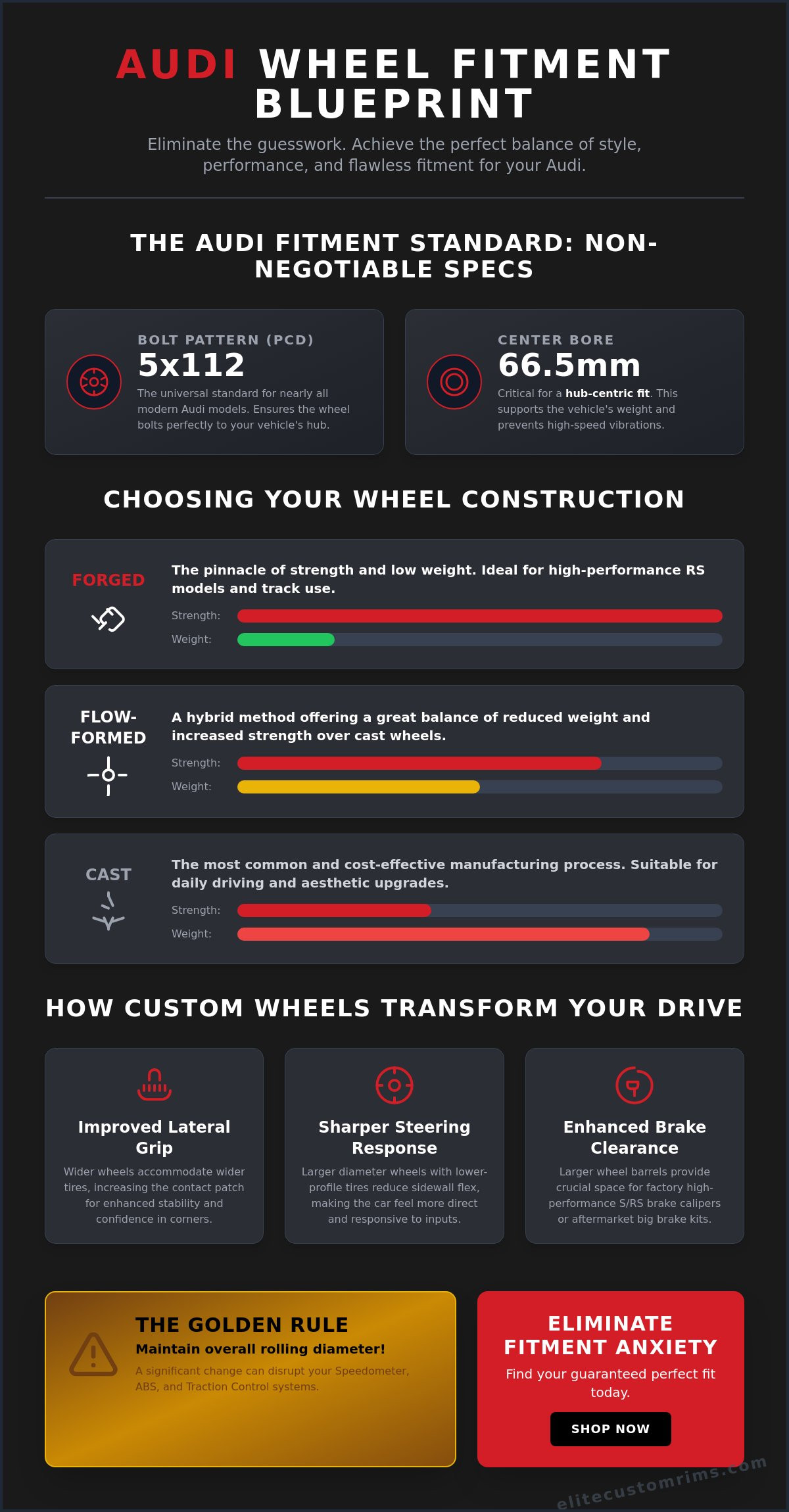
Performance is about more than just straight-line speed. It is about how the car communicates with you through the steering wheel. Increasing your wheel diameter typically requires a lower-profile tire, which reduces sidewall flex. This sharpens steering response and makes the car feel more "on its toes" during quick transitions. Consider these technical impacts:
- Improved Lateral Grip: Wider wheels allow for a larger tire contact patch, increasing stability in corners.
- Brake Clearance: Larger wheel barrels provide more room for high-performance S or RS brake calipers.
- Rolling Diameter: Maintaining the correct overall diameter is critical. If the new setup is too tall or too short, it will throw off your speedometer and potentially interfere with the ABS and traction control systems.
Select your set with precision. Balance the aggressive look you want with the mechanical requirements your Audi demands. Don't just pick a style; pick a performance upgrade that works with your suspension, not against it.
Audi Fitment 101: OE Wheels vs. Aftermarket Specifications
Audi engineering is a masterclass in precision. When you shop for custom audi wheels, you aren't just buying a visual upgrade; you are investing in a specific set of mechanical measurements. "OE wheels" refer to Original Equipment designs. These match factory specifications exactly. They ensure your car drives exactly as the German engineers intended. Aftermarket wheels offer more variety and aggressive styling, but they require a deeper understanding of the "Audi Standard" to avoid costly mechanical mistakes.
Incorrect fitment is a genuine nightmare for luxury car owners. A wheel that sits too far into the wheel well looks weak and tucked. A wheel that sits too far out will rub against the fender liner every time you hit a bump. Beyond the noise, poor fitment can cause premature suspension wear or compromise emergency handling. Understanding the impact of lightweight wheels on performance starts with ensuring they actually seat against the hub correctly.
Technical Specs Every Audi Owner Must Know
Modern Audis almost exclusively use a 5x112 bolt pattern. This is the Pitch Circle Diameter (PCD). If you accidentally purchase a 5x120 wheel, it simply won't bolt onto your hub. The center bore is equally vital. Most modern Audi chassis use a 66.5mm bore. Hub-centric wheels are essential for a smooth ride. They ensure the weight of the vehicle is supported by the hub itself, not just the lug bolts. This prevents the high-speed vibrations that often plague cheap, universal-fit wheels. Offset is the distance from the hub mounting surface to the wheel's centerline.
- 5x112 PCD: The standard bolt pattern for nearly all modern Audi models.
- 66.5mm Center Bore: The specific hub diameter required for a vibration-free fit.
- ET (Offset): The measurement that determines how far the wheel sticks out or stays tucked.
Choosing Between OE-Style and Bespoke Custom Rims
OE-style wheels are the ideal choice for the "OEM+" look. They maintain a factory aesthetic which is excellent for preserving resale value. They are "plug and play" solutions that require no extra hardware. Bespoke custom audi wheels allow you to push the limits of design. You can choose aggressive offsets to achieve a perfect "flush" look without the need for wheel spacers. While spacers can help a high-offset wheel fit better, a wheel engineered with the correct offset from the start is always the safer, more professional choice. If you're ready to see what is possible for your specific model, browse our curated selection of Audi wheels to find your perfect technical match.
Forged, Flow-Formed, or Cast: Selecting the Right Construction
The method used to build your custom audi wheels dictates everything from the car's curb appeal to its lap times. In the world of high-end wheel manufacturing, there is a clear hierarchy of quality. Cast wheels serve as the entry point. They are created by pouring molten aluminum into a mold. While cost-effective, they are typically heavier and less dense. For the discerning Audi owner, the real choice lies between flow-formed and fully forged constructions. These methods provide the structural integrity required to handle the aggressive driving dynamics of a Quattro-equipped machine.
Flow-forming represents the "middle ground" for performance-minded daily drivers. This process starts with a cast center, but the barrel is then heated and spun under immense pressure. This stretches the aluminum, creating a thinner, stronger, and lighter barrel than a standard cast wheel. It offers a significant performance jump without the premium price of a full forging. However, for those pushing the limits of an S or RS model, nothing compares to the elite standard of a forged monoblock.
Why Forged Aluminum is the Elite Standard
Forged wheels are the ultimate choice for high-performance Audis. Instead of using liquid metal, forging starts with a solid block of 6061-T6 aluminum. This block is subjected to extreme pressure that aligns the metal's grain structure. The result is a wheel with incredible tensile strength and a much higher load rating. This molecular density allows engineers to carve out thinner spokes and deeper concavity without compromising safety. These wheels easily handle the high-torque demands of tuned Audi engines. For a deeper look at why this process matters, read our technical breakdown on Why Forged Wheels Are the Elite Choice.
Quattro and Wheel Weight: A Performance Synergy
Reducing wheel weight is the most effective way to improve your car's "unsprung weight." This is the mass not supported by your suspension. When you install lightweight custom audi wheels, you make it easier for your suspension to react to road imperfections. This keeps your tires in contact with the pavement more consistently. The benefits are immediate:
- Faster Acceleration: Less rotational mass means your engine spends less energy spinning the wheels and more energy moving the car.
- Shorter Braking Distances: Lighter wheels are easier for your brake system to stop, reducing heat and fade.
- Quattro Efficiency: The AWD system can distribute power between the axles more rapidly when it isn't fighting the inertia of heavy, cheap cast wheels.
Heavy wheels dull the "Audi feel." They make the steering feel sluggish and the ride feel crashy over bumps. By selecting a flow-formed or forged option, you ensure your upgrade enhances the driving experience rather than just the visual one. Invest in the construction that matches the engineering of your vehicle.
Audi Model-Specific Wheel Guide: From Sedans to SUVs
Audi models have distinct personalities. A sleek A3 requires a different approach than a muscular RS6 or a heavy-duty Q8. Your choice of custom audi wheels must respect these differences. For A-Series sedans like the A3, A4, and A6, 19-inch or 20-inch upgrades offer the perfect middle ground. They fill the wheel arches without ruining the refined ride quality Audi is known for. These models often benefit from "flush" fitments that bring the wheel face in line with the fender for a cleaner silhouette.
Move up to the S and RS models, and the rules change. These cars demand aggressive 21-inch setups. Deep concave designs emphasize the wider bodywork and high-performance brakes of the RS line. If you drive an RS6 or RS7, 22-inch custom audi wheels are becoming the new standard for 2026. These larger diameters provide the visual scale needed for such powerful silhouettes. Electric models like the E-Tron present a different challenge. Efficiency is everything. Aerodynamic wheel designs help maintain range by reducing drag. Look for "aero-blade" styles that combine futuristic aesthetics with functional wind resistance.
The Audi Q7 and Q8: Heavy Duty Style
Load rating is the absolute priority for Audi’s largest SUVs. These vehicles are heavy. They require wheels engineered to support significant weight, especially under cornering loads. Choosing a 22-inch or 23-inch wheel isn't just about style; it's about structural safety. Ensure your chosen rims are rated for the Gross Vehicle Weight Rating (GVWR) of your specific SUV. Match the massive presence of the Q-series with bold finishes like satin black or tinted clear coats. For a deeper dive into SUV-specific fitment, check out our Audi Q7 Wheels: The 2026 Guide.
Staggered vs. Square Setups for Audi
Most Audis utilize a "square" setup. This means the wheel and tire sizes are identical on all four corners. It is the safest way to protect the Quattro AWD system. If the rolling diameters differ by even a small percentage, it puts unnecessary stress on the center differential. Staggered setups, where the rear wheels are wider than the fronts, are typically reserved for the R8 or specific RS models like the RS3. Even then, maintaining identical tire rolling diameters on all four corners is mandatory. This ensures the AWD system reads the same wheel speed at every corner.
Ready to transform your vehicle's stance? Shop our full collection of Audi wheels and find the exact fitment for your model today.
Ordering Your Custom Audi Wheels with Professional Assurance
Buying custom audi wheels should be an exciting milestone for any enthusiast. It shouldn't be a source of technical anxiety. We've engineered our ordering process to eliminate the "will it fit" gamble that plagues many online shoppers. By focusing on precision data and expert consultation, we ensure your upgrade arrives exactly as expected. We don't just sell parts; we deliver a guaranteed transformation for your vehicle.
Precision starts with your VIN. Audi's brake systems, particularly on S and RS models, vary significantly across different production years. We use your vehicle's unique identification to verify exact brake caliper clearance and suspension geometry. This removes the trial and error often found with generic retailers. You get a perfect, vibration-free fitment on the first try. Once your order is confirmed, expect professional-grade packaging. We utilize heavy-duty materials to protect the finish during national shipping. Your wheels arrive at your door in pristine condition, ready for your chosen local installer.
Choose new over used every time. While refurbished or used wheels might seem like a bargain, they often hide structural defects. Refurbished wheels can have hidden cracks masked by fresh powder coating. Used wheels might be slightly bent or out of round. Investing in brand-new custom audi wheels ensures you receive the full structural integrity and flawless factory finish your Audi deserves. It's a smarter investment for the long-term safety and resale value of your car.
The Elite Custom Rims Guarantee
Our commitment to accuracy is backed by human expertise. You have direct access to wheel specialists who live and breathe Audi fitment. We don't deal in "universal" solutions. We provide only brand-new, premium performance wheels that meet our strict quality standards. This ensures your custom setup is ready for a seamless professional installation without the need for unexpected modifications or spacers.
Final Checklist Before You Buy
Before you finalize your selection, run through these essential technical checks. Ensuring these details are correct will make your installation day go smoothly.
- TPMS Compatibility: Verify that your new wheels support your Audi’s Tire Pressure Monitoring System sensors.
- Lug Bolt Seat Type: Most factory Audi wheels use a "ball seat" bolt. Many aftermarket wheels require a "conical seat" bolt. We'll help you identify which one your new setup requires.
- Finish Durability: Consider your local climate. If you drive in winter conditions, look for finishes rated for salt and road grime resistance.
Eliminate the guesswork and upgrade with confidence. Browse our curated collection of Custom Audi Wheels and secure your perfect fitment today.
Command the Road with Precision Fitment
Choosing the right custom audi wheels is the ultimate way to synchronize your vehicle's aesthetic with its performance potential. You've seen how the right construction, whether forged or flow-formed, reduces unsprung weight to sharpen handling and acceleration. You also know that mastering the "Audi Standard" of bolt patterns and offsets is the only way to achieve a flush, rubbing-free look that respects German engineering. Your Audi deserves an upgrade that is as technically sound as it is visually striking.
Don't leave your fitment to chance. We provide expert Audi fitment verification using your VIN to ensure total accuracy before your order leaves our warehouse. With our premium selection of brand-new forged and flow-formed wheels and reliable national shipping across the United States, your vehicle's transformation is just a few clicks away. Stop settling for factory generic and start driving a car that truly reflects your style.
Upgrade Your Audi with Elite Custom Wheels Now and experience the difference that professional assurance makes. We are ready to help you find the perfect balance of performance and aesthetics. Your perfect stance is waiting.
Frequently Asked Questions
What is the standard bolt pattern for most Audi wheels?
Modern Audi models almost exclusively use a 5x112 bolt pattern. This Pitch Circle Diameter (PCD) ensures the wheel is centered and secured properly to the hub. While older models from several decades ago might vary, you can trust the 5x112 standard for your current Audi sedan, wagon, or SUV.
Can I put 20-inch wheels on an Audi A4 without modifications?
You can fit 20-inch wheels on an Audi A4, but you must select a low-profile tire to maintain the correct rolling diameter. This setup fills the wheel arches for a premium look without requiring fender rolling or suspension changes. Always check your specific offset to ensure there is no inner suspension rubbing during full-lock turns.
Do custom wheels void my Audi factory warranty?
Installing custom audi wheels does not automatically void your factory warranty. Under the Magnuson-Moss Warranty Act, a dealer must prove that the aftermarket part caused a specific failure to deny a warranty claim. However, if an incorrect offset causes premature wheel bearing wear, that specific repair may not be covered under your Audi warranty.
What is the difference between hub-centric and lug-centric wheels for Audi?
Hub-centric wheels use a center bore that fits perfectly over the vehicle's hub, while lug-centric wheels rely on the bolts to center the wheel. Audis are engineered to be hub-centric to prevent high-speed vibrations and ensure proper load distribution. Always choose hub-centric designs or use high-quality hub-centric rings to match your Audi's specific bore diameter.
How does changing wheel size affect my Audi's Quattro system?
Changing wheel size won't damage the Quattro system as long as the overall rolling diameter remains identical on all four corners. If you choose a square setup, your AWD system will function perfectly. Staggered setups require precise tire calculations to ensure the front and rear axles rotate at the same speed, preventing mechanical stress on the center differential.
Why should I choose OE wheels over cheap aftermarket options?
OE wheels provide a guaranteed factory fit and meet rigorous safety standards that unbranded, budget options often ignore. Lower-end wheels are typically heavy cast aluminum, which can dull your car's performance and crack under impact. High-quality custom audi wheels from reputable brands offer better materials, lighter weights, and superior finishes that withstand road salt and debris.
Does Elite Custom Rims provide tire mounting and balancing?
Elite Custom Rims specializes in the sale and national shipping of premium wheels, but we don't provide tire installation, mounting, or balancing services. We focus on delivering brand-new, high-performance rims directly to your door. This allows you to work with your preferred local specialist for professional tire mounting and precise balancing once your wheels arrive.
What is the correct center bore for a 2026 Audi model?
The standard center bore for 2026 Audi models is 66.5mm. This measurement has been the brand's go-to specification for several years across its most popular platforms. Ensuring your new wheels have this exact bore size, or using precise adapter rings, is the only way to guarantee a smooth, vibration-free driving experience at highway speeds.