
What if the most expensive upgrade you make to your Mercedes or Tesla is actually the one that puts your suspension at the greatest risk? Choosing between forged vs cast wheels isn't just about picking a design that looks sharp in the driveway. It's a high-stakes decision that affects how your vehicle handles every corner and survives every unexpected pothole. You want a transformative look without the technical anxiety of choosing the wrong fitment for a luxury investment.
We know that technical jargon like "unsprung mass" and "billet" can feel like unnecessary gatekeeping. You deserve to know if the premium price of a forged rim actually delivers a better driving experience for your Audi or Porsche. This guide clears the confusion by comparing structural integrity, weight savings, and the 10,000 tons of pressure used in elite manufacturing. Maximum strength. Reduced weight. Precise fitment. We'll show you how to balance high-end aesthetics with practical reliability. You'll gain the confidence to make an informed purchase that protects your car's performance and your financial investment. Let's explore the engineering that separates a standard upgrade from a true performance investment.
Key Takeaways
- Learn the fundamental engineering differences between forged vs cast wheels, contrasting the efficiency of molten molds with the structural integrity of pressurized aluminum.
- Understand the critical impact of unsprung mass on your vehicle's handling and how lighter wheel options improve acceleration by reducing rotational inertia.
- Compare real-world durability to see why forged wheels provide superior safety by bending under high-impact forces instead of cracking.
- Evaluate the investment value of premium manufacturing, including the ability to achieve more aggressive concave designs and precise offsets for luxury vehicles.
- Gain the confidence to select the perfect fitment for your Audi, Tesla, or Porsche with our specialist-curated selection of high-end wheel options.
The Engineering Difference: How Forged and Cast Wheels Are Made
The debate over forged vs cast wheels starts at the molecular level. It's about how raw aluminum transforms into a structural component for your high-end Tesla or Mercedes. At its core, the difference lies in how aluminum is manipulated to handle the stresses of the road. Casting relies on liquid states and pre-made molds, while forging uses brute force and solid billets. Understanding these Alloy Wheel Manufacturing techniques is essential for any owner looking to optimize their vehicle's handling and safety.
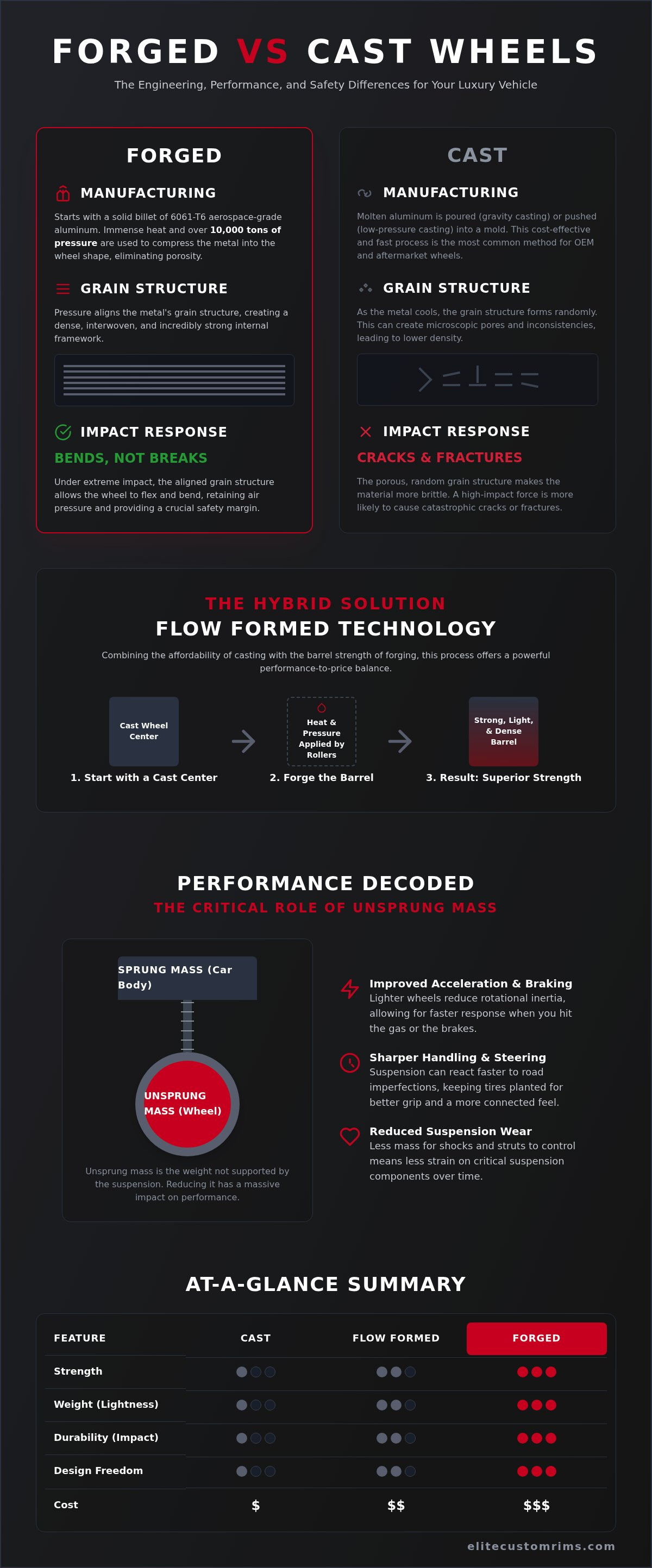
Metal grain structure dictates how a wheel reacts to impact. In a cast wheel, the grain is random and porous, which can lead to structural weaknesses. In a forged wheel, the grain is compressed and aligned. This alignment creates a much stronger internal "skeleton" for the wheel. Between these two extremes lies flow-forming. This hybrid process starts with a cast center but uses high-pressure rollers to stretch and compress the barrel. It offers a significant strength-to-weight advantage over traditional casting at a much lower cost than fully forged options. This creates a grain structure similar to forging in the most critical areas of the rim.
The Gravity and Low-Pressure Casting Process
Gravity casting is the most straightforward method. Manufacturers simply pour molten aluminum into a mold and let it settle. It's cost-effective and fast. However, it often leads to air pockets or "porosity" within the metal. To combat this, low-pressure casting uses positive pressure to push the molten metal into the mold more quickly. This results in a denser part than gravity casting. Even with these improvements, cast wheels require more material to meet safety standards. This extra mass is why cast wheels are typically heavier and thicker. They lack the structural density to be thin and light without sacrificing safety.
The Precision of Forged Aluminum Billet
Forging is an entirely different beast. It starts with a solid block of 6061-T6 aerospace-grade aluminum, known as a billet. Instead of melting the metal, engineers use immense heat and over 10,000 tons of pressure to crush the aluminum into shape. This process eliminates porosity and aligns the metal's grain structure with the shape of the wheel. This precision is why the choice between forged vs cast wheels is so critical for performance enthusiasts.
Because the material is inherently stronger, manufacturers can use less of it. This allows for the intricate, thin-spoke designs seen on high-performance Porsche or Audi models. You get a wheel that is significantly lighter but far more resistant to the cracking seen in cheaper alternatives. Forged wheels offer several distinct advantages:
- Higher tensile strength for extreme performance
- Significant weight reduction compared to cast rims
- Superior resistance to high-impact forces
- More intricate and aggressive aesthetic options
Forged wheels don't just look better; they are engineered to be the ultimate structural upgrade for your luxury vehicle. They provide a level of reliability that simple casting cannot match.
Performance and Weight: Why Every Ounce Matters
When comparing forged vs cast wheels, the most impactful metric isn't the price tag; it's the weight. Every pound shaved off a wheel has a disproportionate effect on performance compared to weight removed from the cabin. This is because wheels represent "unsprung mass." This mass is situated outside the vehicle's suspension system, making it harder for shocks and struts to control. Reducing this weight isn't just for racing; it's for anyone who values a smooth, responsive ride in their daily driver. It's the difference between a car that feels planted and one that feels sluggish over imperfections.
Lighter wheels also improve braking efficiency and acceleration. There is less rotational inertia to overcome when you step on the gas or the brake pedal. This means your vehicle reacts faster to your inputs, providing a more connected driving experience. It's a holistic performance upgrade that protects your suspension components from unnecessary wear and tear while delivering a sharper feel behind the wheel.
Unsprung Mass and Suspension Dynamics
Lighter wheels allow your suspension to track the road with surgical accuracy. When a heavy cast wheel hits a bump, its momentum forces the suspension to work harder to settle the car. A lighter forged wheel reacts instantly, keeping the tire in contact with the asphalt. This results in a massive improvement in steering feel and "turn-in" precision. High-performance brands like Porsche and Audi S-Line prioritize lightweight alloys for this exact reason. Understanding the Technical Differences in Wheels is key to realizing why forged options are the gold standard for luxury dynamics.
EV Efficiency and Battery Range Optimization
For electric vehicle owners, especially those driving a Tesla Model Y or Model X, wheel weight directly dictates battery range. Heavy 22-inch cast wheels can act like anchors, increasing your watt-hour per mile (Wh/mi) consumption and shortening your trip distance. Forged wheels provide a solution by offering the strength needed for heavy EVs while offsetting the mass of larger diameters. A 25% reduction in wheel weight can significantly impact rotational energy requirements. This reduction in rotational inertia means your car accelerates faster and stops more efficiently, preserving battery life in the process.
The transition to a lighter wheel setup transforms the driving experience from muted to sharp. It's a practical investment in your vehicle's longevity and efficiency. If you want to see how the right fitment changes your car's profile and performance, browse our specialized wheel inventory for Tesla and Mercedes models. You'll find options that balance aggressive aesthetics with the technical requirements of modern luxury vehicles.
Durability and Safety: Street vs. Track Realities
Durability isn't just a buzzword for track enthusiasts; it's a daily requirement for surviving the modern road. When evaluating forged vs cast wheels, you must consider how each reacts to sudden, extreme stress. Cast wheels are manufactured by cooling liquid metal, which can leave microscopic voids and air pockets. Forged wheels are compressed into a dense, solid form under immense pressure. This difference in density directly translates to how the wheel handles a high-impact event like hitting a curb or a deep pothole. Safety isn't just about looks. It's about structural integrity when things go wrong.
Material density also plays a massive role in long-term aesthetics and maintenance. Forged alloys are significantly less porous than their cast counterparts. This density prevents the "pitting" and subsurface corrosion that often plague cheaper alternatives in harsh climates. When you invest in a premium finish for your Rolls Royce or Land Rover, you want that finish to last. A denser metal provides a more stable foundation for paints and clear coats. This ensures your wheels stay vibrant and resistant to road salts and chemicals over time.
Load Ratings for Luxury SUVs and Trucks
Choosing wheels for a heavy SUV or truck requires looking past the spoke design. You must understand the Gross Axle Weight Rating (GAWR). This is the maximum weight a single axle can safely carry. Heavy hitters like the Cadillac Escalade or a loaded GMC Sierra put immense pressure on their wheels. High-capacity wheels are a necessity. If a wheel isn't rated for your GAWR, you risk catastrophic failure during towing or heavy-load situations. We specialize in matching the right load-rated wheels to your specific vehicle specs, taking the guesswork out of the process.
Impact Resistance and Pothole Protection
The science of ductility is what separates a minor inconvenience from a dangerous blowout. Forged wheels are more ductile, meaning they tend to bend rather than shatter under extreme force. If you hit a massive pothole, a forged rim might deform, but it usually holds air, allowing you to pull over safely. Cast wheels are more brittle. They often develop micro-fractures over time on poorly maintained roads. These fractures can lead to sudden cracking without warning. For a deeper dive into fitment and safety, see our guide on Custom Wheels: The Definitive Reference for Luxury & Performance Fitment (2026). This reliability is why we recommend forged options for high-performance Tesla and Porsche models that demand the highest safety margins on the street.
Making the Investment: When to Choose Forged Over Cast
Deciding between forged vs cast wheels often comes down to a simple calculation of value versus cost. There is no denying the sticker shock. High-end forged wheels typically cost three to four times more than their cast counterparts. This price gap reflects the intensive labor, specialized machinery, and aerospace-grade materials required for the forging process. You aren't just paying for a brand name. You're paying for a wheel that is lighter, stronger, and engineered to a higher standard of precision than any mass-produced alternative.
For many owners, a high-quality cast wheel is a perfectly smart choice for a daily driver that stays on well-maintained city streets. If your priority is a quick aesthetic refresh without a five-figure investment, modern low-pressure cast options offer great style at a fraction of the price. However, if you demand peak performance from your Porsche or want to maximize the range of your Tesla, the investment in forging becomes a necessity rather than a luxury.
Visual Customization and Bespoke Fitment
Forged wheels offer a level of aesthetic freedom that casting simply cannot match. Because the metal is so much stronger, engineers can carve out deep concave profiles and razor-thin spokes that would be structurally impossible in a cast mold. Cast wheels are often limited by the "draft angles" required to pull the wheel out of its mold. Forged monoblocks are CNC-machined from a solid block, allowing for aggressive offsets and bespoke fitments tailored to your specific vehicle. If you're looking for the perfect stance, check out The Definitive 2026 Guide to Mercedes S-Class Wheels: Style Meets Precision to see how custom offsets transform a luxury sedan.
Long-term ROI and Vehicle Value
Investing in premium forged brands can actually protect your vehicle's overall market value. In the high-end aftermarket, forged wheels from reputable manufacturers hold their resale value remarkably well. While a used set of cast wheels might be difficult to sell, a set of forged alloys for a Land Rover or Audi often commands a high price even years later. While the initial cost is higher, the durability often makes forged wheels a one-time purchase for the life of the car. They resist the metal fatigue that eventually degrades cast alloys, making them a more sustainable financial choice for long-term owners.
Ready to upgrade your vehicle's performance and presence? Shop our curated collection of luxury wheels and find the perfect set for your Tesla, Mercedes, or Audi today.
Premium Wheel Selection at Elite Custom Rims
Elite Custom Rims isn't a generic warehouse. We are a specialized retail partner for owners who demand the best for their Audi, Tesla, or Mercedes. Our curated inventory focuses on the high-stakes choice between forged vs cast wheels, ensuring every option meets our rigorous standards for quality and currency. We understand that a luxury vehicle requires more than just a universal fitment. It requires a precise engineering match that respects the original design while enhancing its presence on the road.
Our team stays updated on the latest 2026 trends, from minimalist monoblock designs to the rise of performance-oriented flow-formed hybrids. We help you navigate the technical nuances of weight and strength so you can invest with total confidence. Whether you're looking for the extreme weight savings of a forged setup or the cost-effective style of a premium cast wheel, we provide the authoritative guidance needed to transform your vehicle’s aesthetics and handling. We take the guesswork out of the equation, positioning ourselves as the ultimate source of truth for your next upgrade.
Specialized Fitment for Performance Brands
Fitment is where most high-dollar purchases go wrong. We eliminate that risk by focusing on specialized offsets for Porsche and dedicated Tesla Model Y Wheels: The 2026 Performance and Aesthetics Guide. We don't just look at the bolt pattern. We ensure your new wheels provide the necessary clearance for the massive brake calipers found on high-performance Audi and Mercedes-AMG systems. This methodical approach ensures a frictionless experience from the moment you browse our collection to the moment your wheels arrive at your door.
Authoritative Support for Your Upgrade
Shopping with a specialist means you get access to human expertise that generic warehouses can't match. We are invested in your long-term satisfaction. Our streamlined national shipping and professional technical support take the anxiety out of the logistics. We treat your vehicle like it's our own, providing straightforward solutions that value your time and your financial savvy. You don't have to guess about compatibility or structural integrity. We've already done the work for you. It's about more than just a transaction; it's about a partnership in your vehicle's transformation.
Upgrade your vehicle with our premium wheel collection today and experience the difference that expert curation makes for your luxury car or SUV.
Transform Your Driving Experience Today
Choosing between forged vs cast wheels is the ultimate decision for your vehicle's performance and presence. You now understand how forged engineering reduces unsprung mass for sharper handling and how premium casting offers a smart, stylish refresh. It's about matching the right manufacturing process to your specific road realities. Whether you're optimizing a Tesla for range or giving a Porsche the aggressive stance it deserves, the right fitment is a high-stakes investment. Elite Custom Rims is here to ensure that investment pays off and eliminates technical anxiety.
As an authorized retailer of the latest 2026 wheel designs, we provide specialized fitment for Tesla, Porsche, and Mercedes-Benz. We take the guesswork out of the process with national shipping and guaranteed fitment accuracy. Our commitment to professional assurance means you can shop with confidence, knowing your vehicle is in expert hands. We are dedicated to your long-term satisfaction and the transformative effect of a premium wheel upgrade. Browse our curated collection of forged and luxury cast wheels to find the perfect match for your vehicle. Your car is ready for its transformation.
Frequently Asked Questions
Are forged wheels actually stronger than cast wheels?
Yes, forged wheels are significantly stronger due to their dense, aligned grain structure. Unlike cast wheels, which are made by cooling liquid metal that can leave microscopic air pockets, forged aluminum is compressed under 10,000 tons of pressure. This eliminates porosity and creates a structural skeleton that resists high-impact forces. This superior tensile strength allows for thinner, more intricate designs without compromising the safety of your luxury vehicle.
Can you repair a cracked cast wheel?
Repairing a cracked cast wheel is usually not recommended because the structural integrity is permanently compromised. Cast aluminum is brittle by nature. If it cracks, the metal has already reached its fatigue limit. While some shops offer welding services, the heat from the torch can further weaken the surrounding alloy. For safety on performance vehicles like a Tesla or Mercedes, replacing the damaged wheel with a new one is the only reliable solution.
Do forged wheels improve gas mileage or EV range?
Yes, the choice between forged vs cast wheels directly impacts efficiency because of the difference in unsprung mass. Lighter forged wheels reduce rotational inertia, meaning your motor or engine works less to get the car moving. For Tesla Model Y or Model X owners, switching to a lighter forged setup can lower your watt-hour per mile consumption. This weight saving often offsets the range penalty of upgrading to larger 22-inch diameters.
Why are forged wheels so much more expensive than cast ones?
The price reflects the intensive manufacturing process and premium 6061-T6 aerospace-grade aluminum. Forging requires massive hydraulic presses and precision CNC machining to carve the final design from a solid billet. Casting is a mass-production method where molten metal is simply poured into a mold. You're paying for a labor-intensive product that offers superior durability and performance compared to the faster, cheaper cooling process used for standard cast rims.
Are flow-formed wheels the same as forged wheels?
No, flow-formed wheels are a hybrid between casting and forging. The process starts with a cast center, but high-pressure rollers stretch and compress the barrel while it spins. This creates a grain structure in the barrel similar to a forged wheel, making it lighter and stronger than a standard cast rim. While they are a great middle ground for performance, they don't offer the total structural density of a fully forged monoblock.
What happens if a forged wheel hits a deep pothole?
When a forged wheel hits a severe pothole, its high ductility often causes it to bend rather than shatter. This is a critical safety feature. A bent wheel usually maintains its seal, allowing the tire to hold air so you can pull over safely. In the same scenario, a more brittle cast wheel might develop a catastrophic crack or lose a chunk of the lip, leading to an immediate and dangerous blowout.
Which wheel type is better for heavy SUVs like the Cadillac Escalade?
Forged options are the superior choice for heavy vehicles like the Cadillac Escalade because they offer higher load ratings at a lower weight. These SUVs put immense pressure on their axles, and the structural integrity of forged vs cast wheels becomes a factor during towing or high-speed highway driving. A forged wheel handles these heavy loads without the metal fatigue that can affect cast alloys over thousands of miles of street use.
How do I know if my current wheels are forged or cast?
You can often identify the type by looking at the back of the wheel spokes. Cast wheels usually have raised lettering or cast-in markings from the mold. Forged wheels typically have engraved or CNC-machined text because they are carved from a solid block. Additionally, forged wheels are noticeably lighter than cast versions of the same size. If the spokes are exceptionally thin and sharp, it's likely a high-end forged or flow-formed product.