
What if the aftermarket rims that look perfect on your vehicle are the wrong upgrade for the way you drive? A striking design can catch your eye, but fitment comes first. The wrong specifications may create clearance problems or affect everyday drivability.
It’s easy to get stuck comparing diameter, width, offset, bolt pattern, and load rating. You also want wheels that suit your priorities, whether that means a distinctive look, durable construction, or a comfortable daily drive. This guide explains what aftermarket rims can change, how to compare options, and what to verify before you buy.
We’ll break down key fitment specifications, compare cast, flow-formed, and forged construction, and show how to weigh style against practical use. You’ll also learn what to check for your exact vehicle before choosing a set. Start with fitment and driving needs, then choose a look that brings it all together.
Key Takeaways
- Aftermarket rims can change your vehicle’s appearance, fitment, weight, and everyday practicality, so consider more than looks alone.
- Compare diameter and width alongside bolt pattern, offset, and center bore. Wheel size by itself doesn’t confirm compatibility.
- Use the specific product details to compare construction, style, care needs, and suitability for your driving priorities.
- Check fitment in order: identify your exact year, make, model, and trim or configuration, then compare specifications and confirm the listing.
- Browse new wheels by vehicle brand and model at Elite Custom Rims, and verify fitment for your exact vehicle before choosing a design.
What Are Aftermarket Rims, and What Can They Change?
Aftermarket rims are replacement wheels selected outside a vehicle’s original equipment specification, with designs or specifications that may differ from its factory wheels. They offer a way to change a vehicle’s look, but a different wheel can also affect fitment, weight, and everyday practicality. “Aftermarket” describes where the replacement choice comes from, not a promise of better performance.
In everyday conversation, “rim” and “wheel” often mean the same thing. More precisely, the rim is the outer part of the wheel that holds the tire, while the wheel is the metal structure that mounts to the vehicle. A complete wheel-and-tire assembly includes both the wheel and a tire mounted on it. For a basic overview of wheel construction and materials, see Wikipedia’s reference on the subject.
How aftermarket rims differ from factory wheels
Replacement wheels can differ from factory options in design, dimensions, construction, and intended use. One may have a more dramatic spoke pattern; another may be designed around a particular vehicle application. Materials and construction vary, as do the measurements that determine whether a wheel fits. Compare those details in the specific product listing rather than assuming that a similar-looking wheel will suit your vehicle.
Aftermarket doesn’t automatically mean lighter, stronger, or more durable. Those qualities depend on the wheel’s specifications and construction. Treat appearance as a style choice, and look for product-specific details before drawing conclusions about performance.
What a wheel upgrade can and cannot do
A different finish, spoke design, or overall profile can give a vehicle a distinctly different appearance. That visual change alone doesn’t improve handling, braking, or acceleration. Any effect on driving depends on the wheel’s specifications and the full vehicle setup, so check the relevant product details and compatibility before deciding whether an option makes sense.
Start with how you use the vehicle. A good choice should fit correctly and meet your practical needs, not just look appealing. Tires and installation are separate considerations: Elite Custom Rims sells new wheels, not standalone tires or tire or wheel installation services. Keep the complete setup in mind as you compare aftermarket rims.
Aftermarket Rim Specifications: Understand Size, Offset, and Bolt Pattern
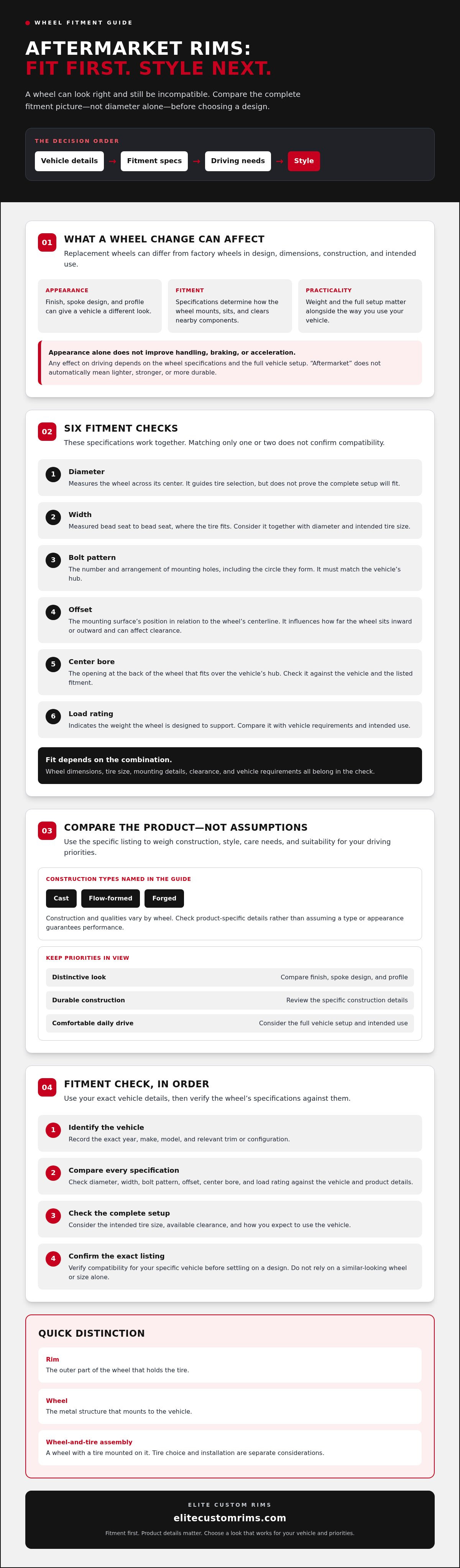
A wheel can look right and still be incompatible. Its listed diameter is only one part of fitment. Before ordering aftermarket rims, check the measurements that determine how the wheel mounts, where it sits, and whether its load rating suits your vehicle and intended use.
Verify diameter, width, bolt pattern, offset, center bore, and load rating against your exact vehicle and the wheel’s product specifications. These details work together, so matching just one or two isn’t enough to confirm fit. The Tire and Rim Association develops standards related to tire and rim interchangeability, which is why checking precise specifications matters.
How wheel diameter and width affect your options
Diameter measures the wheel across its center, while width measures it from bead seat to bead seat, where the tire fits. Together, these dimensions guide tire selection. They also affect available clearance around vehicle components and within the wheel well. A larger diameter may create the appearance you want, but that preference doesn’t prove that a wheel-and-tire combination will fit or work for your setup.
Don’t assume there’s one ideal size for every vehicle or trim. Check your vehicle’s specifications and compare them with the exact wheel listing. Consider the tire size intended for that wheel, too, since fitment depends on the complete setup, not diameter alone.
Why offset, bolt pattern, and center bore matter
Offset describes where the wheel’s mounting surface sits in relation to its centerline. That position influences how far the wheel sits inward or outward, so an unsuitable offset can affect clearance. Bolt pattern describes the number and arrangement of mounting holes, including the circle they form. The pattern must match the vehicle’s hub; a similar-looking wheel isn’t enough.
Center bore is the opening at the back of the wheel that fits over the vehicle’s hub. Check that it’s appropriate for the vehicle and the wheel’s listed fitment. Also verify the load rating, which indicates the weight a wheel is designed to support. Compare it with your vehicle’s requirements and how you expect to use the vehicle. Don’t guess based on appearance or brand alone.
Use the listing as your final check
Record your exact year, make, model, and relevant trim or configuration. Then compare each measurement with the product details and confirm compatibility before ordering. If a specification is missing or unclear, pause and verify it rather than assuming it matches.
Once you have those details, you can browse vehicle-focused wheel options and compare listings with your requirements in hand. Check fitment first, then choose a style.
Compare Aftermarket Rims by Material, Style, and Driving Priorities
The best-looking option isn’t automatically the best match for your routine. Compare design, construction details, care needs, and vehicle fitment together. A multi-spoke pattern may create a detailed, sporty look, while a simpler design can feel more understated. Either way, confirm the specific wheel’s specifications before treating its appearance or construction as evidence of performance.
Check material and construction claims against each wheel’s own product specifications rather than assuming them from its appearance or category. If a listing identifies a material or manufacturing method, use that information to compare options. Don’t assume a particular wheel is lighter, stronger, or easier to maintain unless its product details support that conclusion.
Match wheel design to your vehicle and personal style
Start by choosing a visual direction: understated, sporty, or bold. Then consider how the design complements your vehicle. A refined spoke pattern may suit the look you want for a Mercedes or Audi, while a more substantial design might appeal to someone styling a Chevy or GMC truck. These are style examples, not fitment recommendations. Check the exact vehicle and wheel listing. For more inspiration and selection considerations, explore this custom wheels reference guide.
Design also affects upkeep. Intricate spoke shapes and tight spaces may take more effort to clean than simpler layouts. Think about how much time you want to spend maintaining the finish, and follow the care guidance provided for the specific wheel.
Balance everyday use with performance and utility needs
Consider your usual roads, how you use the vehicle, and what you’re willing to maintain. A vehicle driven daily may call for a different balance of appearance and practicality than one used primarily for specific recreational or utility needs. Larger or heavier wheel-and-tire combinations can also influence how a vehicle drives. The Car and Driver test examines how upsizing can affect factors such as acceleration and fuel economy, underscoring why size and weight deserve attention beyond appearance.
Keep the comparison grounded in the product listing. Look for the stated construction, material, wheel weight, finish, and any care instructions. If a listing doesn’t confirm a detail, don’t infer it from the style or a broad material label.
| What to compare | Appearance | Weight considerations | Care and typical use |
|---|---|---|---|
| Understated design | Clean, restrained look | Check the listed wheel weight | Review finish care; consider everyday preferences |
| Sporty design | More pronounced spoke styling | Use product specifications, not appearance, to assess weight | Consider cleaning access and intended driving needs |
| Bold design | Distinctive visual presence | Confirm the actual weight and construction details | Assess maintenance preferences and vehicle use |
For a vehicle-specific example of how style and fitment questions come together, see this guide to Chevy Silverado wheel styles and fitment. Use it as a reference, then confirm details for your own vehicle and selected wheel.
How to Check Aftermarket Rim Fitment Before You Buy
Use a consistent sequence to reduce guesswork: identify the exact vehicle, gather its wheel and fitment information, compare that data with the product listing, then confirm any unclear details before ordering. A wheel that matches one measurement may still be unsuitable if other specifications or clearances don’t line up.
Gather the correct vehicle and original wheel information
Start with the precise year, make, model, trim, and relevant factory configuration. Variations within a model range can affect fitment, so don’t rely on the model name alone. Check the owner’s manual and markings on your existing wheels for original specifications. If information is missing or difficult to interpret, ask a qualified vehicle specialist. For help identifying the bolt pattern, use this guide to measuring a wheel bolt pattern.
Record the details before browsing. Keep your vehicle information and original wheel measurements together so you can compare the same criteria across listings instead of relying on photos or broad compatibility labels.
Confirm clearance and complete fitment details
Compare the listing with your vehicle requirements, checking diameter, width, bolt pattern, offset, center bore, and load rating. A matching bolt pattern only tells you that the mounting holes may align. It doesn’t confirm the wheel’s position, hub fit, load suitability, or clearance.
Clearance depends on the complete setup, including the wheel and tire dimensions, not diameter alone. Use vehicle-specific information to check space around the brakes, suspension, and body, as well as tire clearance. Don’t assume a wheel will fit simply because its diameter matches the factory size or another listing describes it as compatible.
Before placing an order, compare every listed measurement with the details you gathered. If a specification is missing, conflicting, or unclear, pause and ask the retailer to confirm it for your exact year, model, trim, and configuration. Clarify the relevant fitment information before completing the purchase.
- Identify: Record the exact vehicle and configuration.
- Collect: Find original wheel measurements and vehicle requirements.
- Compare: Check every listed specification and relevant clearance.
- Confirm: Resolve any uncertainty before ordering aftermarket rims.
Ready to compare vehicle-focused options? Browse wheels by vehicle brand and model, then verify the specific listing against your fitment details.
Choose Aftermarket Rims with Confidence at Elite Custom Rims
A confident choice follows a clear order: vehicle compatibility first, driving needs second, design preference third. That sequence keeps an appealing finish or spoke pattern from distracting you from the specifications that determine whether a wheel suits your vehicle. Once fitment is verified, compare options based on how you use your vehicle and the look you want.
Elite Custom Rims sells new, vehicle-focused wheels for brands including Audi, Mercedes, Porsche, Tesla, Chevy and GMC, Toyota, and Land Rover. Its selection also includes Cadillac Escalade and Rolls-Royce wheels. Browse by brand and model, then check the specific product listing carefully. A brand match alone doesn’t confirm that a particular wheel fits every model or configuration.
Browse new wheels by vehicle brand
Begin with your vehicle’s make and model to narrow your options, then verify fitment for its exact year, trim, and configuration. Model-specific details matter. For example, if you’re researching a Mercedes S-Class, explore these Mercedes S-Class wheel options as a starting point, and confirm the specifications of any wheel you’re considering against your vehicle.
Keep the product category clear: Elite Custom Rims sells wheels, not standalone tires, tire or wheel installation, tire fitting, or powder-coating services. If your purchase requires other parts or work, check those needs separately.
Take the next step with a fitment-first shortlist
Before choosing a design, create a shortlist and compare each option against the same checklist:
- Vehicle: Record the exact year, make, model, trim, and relevant configuration.
- Specifications: Compare diameter, width, bolt pattern, offset, center bore, and load rating with the product listing and vehicle requirements.
- Use: Consider your usual driving, road conditions, and practical priorities.
- Design: Choose a finish and wheel style after compatibility and intended use are clear.
- Confirmation: Resolve missing or uncertain fitment details against the exact listing before ordering.
This process makes it easier to compare aftermarket rims without letting style alone drive the decision. If a specification is unclear, pause and seek confirmation rather than assuming compatibility. Ready to explore your options? Browse aftermarket wheels at Elite Custom Rims, and verify fitment for your exact vehicle before ordering.
Make Your Next Wheel Upgrade a Confident One
The smartest choice of aftermarket rims starts with verified compatibility, accounts for your driving needs, and finishes with a design you’ll enjoy seeing on your vehicle. Check the full set of specifications, not just the diameter or bolt pattern, and compare material or weight claims with the details for the specific wheel. These steps help keep style aligned with a practical fit.
Elite Custom Rims offers new wheels across luxury, performance, and utility vehicle categories, with options organized around vehicle-specific fitment. Before ordering, compare your exact vehicle details with the relevant product listing and confirm anything that’s unclear.
Ready to explore options for your vehicle? Browse new aftermarket wheels and confirm the right fitment. Take your time with the checks, choose a look that suits your priorities, and move forward with confidence.
Frequently Asked Questions
What are aftermarket rims?
Aftermarket rims are replacement wheels chosen outside a vehicle’s original equipment specification. They can differ from factory wheels in design, dimensions, construction, or intended use. “Rim” is often used to mean the whole wheel, though technically it refers to the outer part that holds the tire. A complete wheel-and-tire assembly includes both the wheel and a tire mounted on it. Check each wheel’s details rather than assuming all aftermarket options are alike.
Are aftermarket rims safe for everyday driving?
Aftermarket rims can be suitable for everyday driving when the wheel is appropriate for the vehicle and its intended use. Check the product’s specifications, including fitment and load rating, against your vehicle’s requirements. The wheel should also have appropriate clearance as part of the complete wheel-and-tire setup. Don’t rely on appearance or a general compatibility label alone. Verify the exact listing and have any uncertain details checked before purchase.
How do I know if aftermarket rims will fit my car?
Compare the wheel listing with your car’s exact year, make, model, trim, and relevant configuration. Verify diameter, width, bolt pattern, offset, center bore, and load rating, then consider clearance for brakes, suspension, bodywork, and tires. A matching bolt pattern or diameter alone doesn’t confirm fitment. Use your owner’s manual, existing wheel markings, or a qualified vehicle specialist to check your vehicle information, and confirm unclear specifications before ordering.
What do wheel offset and bolt pattern mean?
Wheel offset describes the position of the mounting surface in relation to the wheel’s centerline, affecting how far the wheel sits inward or outward. The bolt pattern identifies the number and arrangement of mounting holes and the circle they form. The pattern must match the vehicle’s hub, while offset must suit the vehicle’s fitment and clearance needs. Check both against the exact wheel listing and vehicle specifications.
Do aftermarket rims affect ride quality or handling?
They can, depending on the wheel’s dimensions and weight and the tire combination used. Changes to wheel diameter may also change tire sidewall height, which can influence how the vehicle feels over bumps. A different appearance doesn’t automatically mean improved handling. Compare product-specific specifications with your priorities, and consider the complete setup rather than judging the wheel alone. Confirm fitment and intended use before selecting an option.
Can I use my existing tires with new aftermarket rims?
Possibly, if the tires are compatible with the new wheels’ diameter and width and are in suitable condition. Check the tire size and the wheel’s product specifications before assuming they can be paired. Changing wheel dimensions may require a different tire size to maintain an appropriate setup. If you’re unsure, ask a qualified tire or vehicle specialist to assess compatibility. Elite Custom Rims sells wheels, not standalone tires or tire-fitting services.
Do aftermarket rims come with tires or installation?
Elite Custom Rims sells new wheels; tires and installation aren’t included services. Check the specific product listing to see what’s included with the wheel, and arrange any tires, mounting, or installation separately if needed. Confirm that the tire size is compatible with the selected wheel and your vehicle before assembling the complete setup. Don’t assume a wheel listing includes tires or installation unless the listing explicitly says so.