
Could a rim that looks like a perfect match still fail to fit safely? It can. Knowing how to check bolt pattern on rims helps you look beyond appearance and confirm the wheel’s lug count and bolt-circle measurement before narrowing your options. A notation such as 5x114.3 means five lug holes arranged on a 114.3 mm circle, but measuring a five-lug pattern correctly takes a different approach than measuring an even-lug pattern.
You’re right to be cautious: patterns such as 5x114.3 and 5x115 are close in measurement but are not interchangeable. Guessing can lead to a costly fitment mistake. This guide shows you how to count the lugs, measure the bolt circle using the right reference points, and compare the result with your vehicle’s specifications. It also explains why bolt pattern alone doesn’t confirm compatibility. Center bore, offset, wheel dimensions, and brake clearance matter too. Check the rim first, then verify the complete fitment before choosing wheels.
Key Takeaways
- Learn how to check bolt pattern on rims by counting the lug holes and measuring the bolt circle using the correct method for an even or odd lug count.
- Use the rim’s markings as a starting point, then measure rather than relying on appearance alone.
- Compare your result with specifications for your vehicle’s exact year, make, model, and trim.
- Record the measurement and its units so inches and millimeters don’t lead you to the wrong match.
- Write down the measurement and the source of your vehicle specifications, then resolve any mismatch before choosing wheels.
What a Rim Bolt Pattern Means, and Where to Find It
A rim’s bolt pattern describes two things: the number of lug holes and the diameter of the imaginary circle that passes through their centers. You may also see it called the lug pattern or pitch circle diameter (PCD). The circle measurement is often called the bolt-circle diameter, describing the circular layout of evenly spaced holes.
How to read bolt-pattern notation
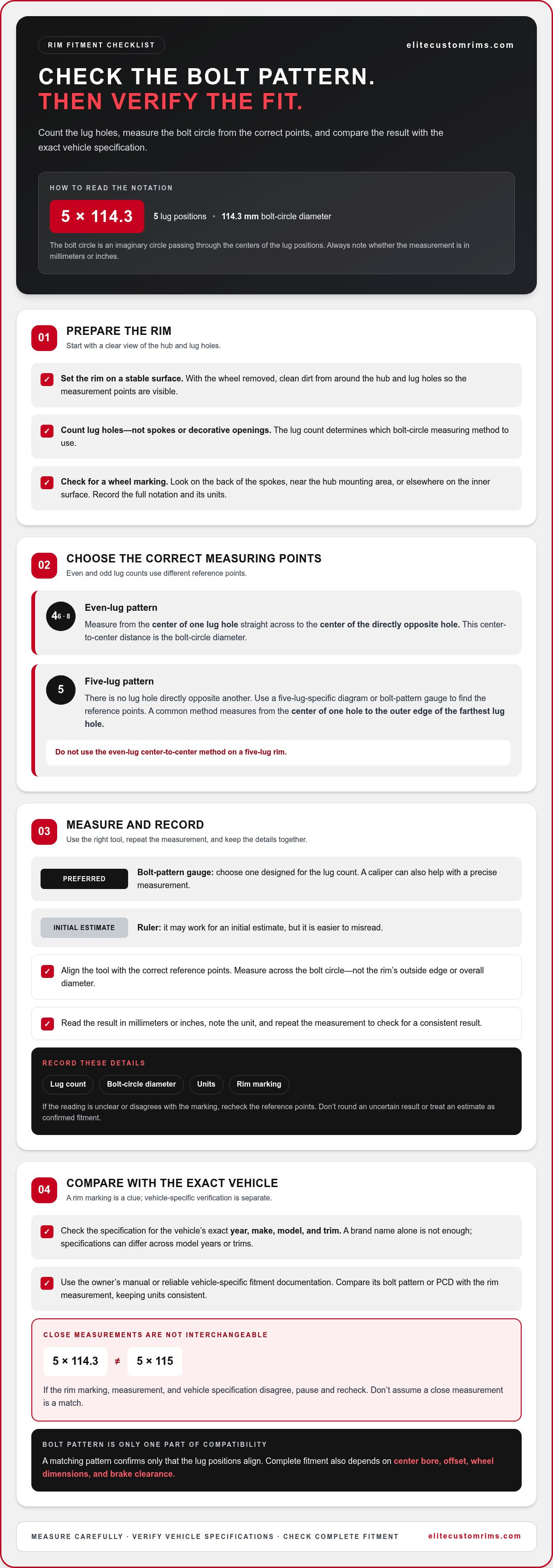
In a notation such as 5x114.3, the first number indicates five lug holes or studs. The second gives the diameter of the bolt circle, usually in millimeters. For a technical explanation of the bolt circle diameter, picture a circle centered on the wheel hub and passing through the center of each lug position.
Illustrative example: A rim marked 5x114.3 has five lug positions arranged on a 114.3 mm bolt circle. This describes the pattern only; it doesn’t identify a compatible vehicle. Notation may use different units, so check whether the measurement is stated in millimeters or inches before comparing values.
Where to look before measuring the rim
Start with the wheel itself. If the marking is present and legible, look for stamped or cast information on the back of the spokes, near the hub mounting area, or elsewhere on the inner surface. Wheel documentation or original specifications may also list the pattern. Record the full notation, including units, rather than relying on a partial or hard-to-read marking.
Treat that information as a useful clue, not a final fitment decision. A marking may identify the wheel’s bolt pattern, but it doesn’t prove that the rim matches your vehicle. Verify the vehicle’s exact year, make, model, and trim specifications separately. If the wheel marking and vehicle information disagree, don’t assume one is close enough. Recheck the details and measure the rim in the next step.
This distinction matters because bolt pattern is only one part of wheel compatibility. A matching pattern is necessary for the lug positions to align, but it doesn’t confirm complete fitment. Keep the rim’s marking and the vehicle’s specifications as separate pieces of information. That gives you a reliable starting point for how to check bolt pattern on rims and narrow down options without choosing by appearance alone.
How to Check the Bolt Pattern on a Rim Step by Step
With the wheel removed, clean away dirt around the hub and lug holes so you can see the measurement points clearly. Set the rim on a stable surface. Count the lug holes around the center, not the spokes or decorative openings. The hole count determines how to measure the bolt circle, so get this step right first.
Count the lug holes and choose the right measurement method
Check whether the lug count is even or odd. On an even-lug wheel, such as one with four, six, or eight holes, measure from the center of one lug hole straight across to the center of the directly opposite hole. That center-to-center distance is the bolt-circle diameter.
Five-lug patterns need a different reference because there’s no hole directly opposite another. Use a five-lug-specific diagram or bolt-pattern gauge to identify the correct points. A common method is to measure from the center of one hole to the outer edge of the farthest lug hole. Tire Rack’s guide to how to measure a bolt pattern includes diagrams for common patterns, including five-lug wheels. Don’t apply the even-lug center-to-center method to a five-lug rim.
Measure carefully and record the result
Use a bolt-pattern gauge designed for your lug count where possible. A caliper can help you take a precise measurement. A ruler may work for an initial estimate, but it’s easier to misread. Align the tool with the specified hole references and measure across the bolt circle, not the rim’s outside edge or overall diameter.
Follow these steps:
- Position the tool on the correct reference points for the lug count.
- Read the measurement in millimeters or inches, and note the unit.
- Repeat the measurement to see whether you get a consistent result.
Write down the lug count, measured bolt-circle diameter, units, and any stamped or cast marking on the rim. If the measurement is difficult to read or doesn’t match the marking, pause and recheck your reference points. Close measurements can be easy to confuse, so don’t round an uncertain result or treat an estimate as confirmed fitment. This careful process is the practical core of how to check bolt pattern on rims.
Once you’ve recorded a clear result, use it as a starting point for selecting wheels made for your vehicle. Explore vehicle-focused wheel options with your measurement in hand.
How to Verify the Rim’s Bolt Pattern Against Your Vehicle
A rim measurement is useful once you compare it with specifications for the vehicle it’s meant to fit. Check the exact year, make, model, and trim. A manufacturer can use different wheel specifications across model years or trims, so a brand name alone isn’t enough to identify the correct pattern.
Find the vehicle’s stated bolt-pattern specification
Start with the owner’s manual or reliable vehicle-specific fitment documentation. Look for the bolt pattern or PCD, then compare that specification with your measured rim pattern. Keep the units consistent. If the vehicle information and wheel marking disagree, pause before choosing a wheel. Recheck the measurement and find a specification that clearly applies to the vehicle’s exact configuration.
Use a simple comparison to keep the details straight:
| Rim measurement | Vehicle specification | Match status |
|---|---|---|
| 5x114.3 mm, illustrative | 5x114.3 mm, illustrative | Bolt pattern matches in this example |
This is only an example of how to compare the numbers, not a specification for a particular vehicle. A matching bolt pattern confirms that the lug layout aligns on paper. It doesn’t prove the wheel is a complete fit.
Separate bolt pattern from other fitment measurements
Each fitment measurement answers a different question. Bolt pattern describes the arrangement of the lug holes. Center bore is the diameter of the wheel’s center opening, which must suit the vehicle’s hub. Offset describes the wheel’s mounting position relative to its centerline. Wheel width and diameter describe its size. Check each specification against the vehicle and wheel documentation. Don’t treat a bolt-pattern match as a substitute for reviewing full fitment.
For a broader overview of how these dimensions work together, read this custom wheel fitment reference. If you’re checking a trailer wheel rather than a passenger-vehicle rim, use a trailer-specific guide, such as this resource on how to measure your trailer wheel bolt pattern, rather than assuming the same vehicle documentation applies.
That cross-check is the final step in how to check bolt pattern on rims with confidence. Once the rim measurement agrees with the correct vehicle-specific source, assess the remaining fitment details before selecting wheels.
Bolt-Pattern Checking Mistakes That Can Lead to a Bad Fit
A small measuring or notation error can turn a promising wheel into the wrong choice. Avoid shortcuts: bolt patterns can look similar, and a correct lug count alone doesn’t tell you whether the holes form the right-size circle.
Measurement errors to catch before choosing a wheel
Don’t estimate the pattern by eye or measure across the rim’s outside edge. The bolt pattern is based on the circle through the lug-hole centers, so measuring the wheel’s full diameter gives you the wrong information. Align your ruler, caliper, or gauge with the specified reference points for that lug count. Take the measurement again. Inconsistent results are a reason to reset the tool and recheck.
Keep units clear, too. Bolt-circle measurements are commonly written in millimeters, while some references use inches. For example, 114.3 mm is equivalent to 4.5 inches. A notation may use either value, but comparing numbers without accounting for units can make a matching pattern look different. Don’t round a close measurement into a different specification: 5x114.3 and 5x115 are distinct notations, despite their small numerical difference. Record the reading as measured, with its unit.
If a stamped marking, your measurement, and vehicle documentation disagree, stop before selecting a wheel. Confirm that you used the correct hole references, repeat the measurement with an appropriate tool, and check that the vehicle information matches its exact year, make, model, and trim. Resolve the discrepancy rather than choosing whichever number seems most plausible.
Why bolt pattern alone does not prove a wheel fits
A matching bolt pattern is one fitment requirement, not a complete compatibility check. The center bore must suit the hub, offset affects where the wheel sits, and wheel width and diameter also need to work for the vehicle. Brake clearance matters as well: a wheel can have the correct lug layout yet lack the space needed around the brakes.
That’s why wheels that share a bolt pattern aren’t automatically interchangeable. Review the full set of vehicle-specific fitment details before making a decision. For a model-focused example, see this Chevy Silverado wheel fitment guide. It offers a useful next step for readers researching wheels for that vehicle, without treating bolt pattern as the only consideration.
Once your measurements and vehicle details line up, explore Chevy/GMC wheel options with fitment in mind.
What to Do After You Check the Bolt Pattern on Your Rims
Once you’ve measured the pattern, turn the result into a clear fitment note. That record makes it easier to compare wheel options without relying on memory or interpreting a faint marking more than once. If your measurement, the rim’s marking, and the vehicle specifications don’t agree, pause. Recheck the measurement and vehicle details before selecting a wheel.
Use a final pre-selection checklist
Before moving on, record the details you’ll need to compare rim and vehicle specifications:
- Lug count: Note the number of lug holes or studs.
- Bolt-circle measurement: Write the measurement and its unit, such as millimeters or inches.
- Vehicle reference: Record the source and the exact year, make, model, and trim it applies to.
- Other fitment details: Check the required center bore, offset, wheel width and diameter, and brake clearance.
- Wheel markings: Keep a note or photograph of legible stamps or cast information to compare later.
Use the list as a set of checks, not a shortcut. If a measurement is uncertain or sources conflict, resolve the difference first. A clean record is especially helpful when comparing several wheels that look similar but have different specifications. The goal of how to check bolt pattern on rims is to establish a reliable starting point, then verify the rest of the fitment for your vehicle.
Explore wheels by vehicle after confirming fitment
With the key specifications in hand, model-focused wheel options can make the next comparison more relevant. Start with choices associated with your vehicle, then check each wheel’s details against your fitment note. Educational guidance can help you identify and compare specifications, but this process is not an installation procedure. Keep the measurement, vehicle reference, and full fitment requirements together as you narrow your options.
After verifying the details, explore Elite Custom Rims and browse wheel options by vehicle. Compare each option with your fitment notes. A confident choice starts with accurate measurements and a complete fitment check, not appearance alone.
Make Your Next Wheel Choice with Confidence
Knowing how to check bolt pattern on rims starts with counting the lug holes and measuring the bolt circle using the right reference points. Record the result with its units, then compare it with specifications for your vehicle’s exact year, make, model, and trim. A matching bolt pattern is essential, but it’s only one part of fitment. Check center bore, offset, wheel dimensions, and brake clearance before deciding.
With those details verified, focus on wheels that suit both your vehicle and your style. Elite Custom Rims offers new wheel options for luxury, performance, and utility vehicles, including Audi, Mercedes, Porsche, Tesla, Chevy, and GMC. Explore wheels for your vehicle and use your fitment notes to guide your search.
Measure carefully, verify the full fit, and move forward with confidence. Choose your next wheels based on accurate measurements and a complete compatibility check, not guesswork.
Frequently Asked Questions
How do I check the bolt pattern on a rim?
Count the lug holes, then measure the bolt-circle diameter using the correct reference points for that lug count. For even-numbered patterns, measure from the center of one hole to the center of the directly opposite hole. Five-lug patterns need a five-lug-specific gauge or diagram because there’s no directly opposite hole. Record the measurement and units, then compare it with specifications for your vehicle’s exact year, make, model, and trim.
How do you measure a 5-lug bolt pattern?
Use a five-lug bolt-pattern gauge or a diagram that shows the correct measurement points. A common method is to measure from the center of one lug hole to the outer edge of the farthest hole. Don’t measure it like an even-lug pattern, since no hole sits directly across from another. Repeat the reading and record the result with its units. If you’re unsure of the reference points, verify the method before relying on the number.
What does 5x114.3 mean on a wheel?
In 5x114.3, “5” indicates five lug holes or studs, and “114.3” indicates the bolt-circle diameter in millimeters. The measurement describes a circle passing through the lug positions. It doesn’t identify a specific vehicle or confirm complete fitment. Compare the pattern with specifications for your vehicle’s exact year, make, model, and trim, then check other requirements such as center bore, offset, and wheel dimensions before choosing a rim.
Can I tell a rim’s bolt pattern by counting the lug holes?
Counting the lug holes tells you the first part of the bolt pattern, not the complete pattern. For example, five holes indicate a five-lug layout, but you still need to measure the bolt-circle diameter to distinguish among different five-lug patterns. Count actual lug holes, not spokes or decorative openings. Use a suitable gauge or the correct measurement method, and confirm the result against vehicle-specific specifications before selecting a wheel.
Can a wheel fit if the bolt pattern matches?
Not necessarily. A matching bolt pattern means the lug positions align, but other fitment details matter too. Check the wheel’s center bore, offset, width, diameter, and brake clearance against your vehicle’s requirements. A mismatch in one of these areas can prevent proper fitment even when the bolt pattern matches. Treat the pattern as an essential first check, then verify the complete wheel specifications for your vehicle before making a selection.
Where can I find my vehicle’s bolt-pattern information?
Start with your owner’s manual or reliable vehicle-specific fitment documentation. Make sure the information applies to your vehicle’s exact year, make, model, and trim, since specifications can vary across configurations. You can also review the rim’s stamped or cast markings and its original documentation, but use those as clues about the wheel, not proof that it fits your vehicle. If sources conflict, pause and verify the correct specification before choosing a rim.
Are bolt patterns measured in inches or millimeters?
Bolt-circle diameter may be listed in millimeters or inches, so always note the unit and convert values before comparing them. For example, 114.3 mm equals 4.5 inches. The lug-hole count stays the same, but mixing measurement units can make a matching pattern appear different. Check that both the rim measurement and the vehicle specification use the same units, and avoid rounding a close reading into a different bolt-pattern value.